The BMW iX occupies a specific niche in the luxury electric SUV segment: it prioritizes interior volume, ride comfort, and highway cruising efficiency over sport-sedan dynamics. For buyers researching the BMW iX cargo space and whether this midsize electric crossover can serve as a practical daily driver and road-trip vehicle, the numbers tell a nuanced story. The iX delivers class-competitive storage, excellent DC fast-charging speeds, and a refined cabin — but its pricing and tax-credit eligibility require careful attention.
This review covers the 2026 BMW iX lineup (xDrive50 and M60) with exact EPA figures, real-world range data, charging curves, cargo dimensions, and current federal incentive eligibility.
BMW iX Quick Specs at a Glance
| Specification | xDrive50 | M60 |
|---|---|---|
| EPA Range | 324 mi (20" wheels) | 288 mi (21" wheels) |
| Battery (usable) | 105.2 kWh, NMC | 105.2 kWh, NMC |
| Horsepower | 516 hp | 610 hp |
| 0–60 mph | 4.4 sec | 3.6 sec |
| Drivetrain | Dual-motor AWD | Dual-motor AWD |
| Max DC Charge Rate | 195 kW | 195 kW |
| 10–80% DC Time | ~35 min | ~35 min |
| Level 2 Rate | 11 kW (44 mi/hr) | 11 kW (44 mi/hr) |
| MPGe (combined) | 86 MPGe | 78 MPGe |
| Efficiency | 39 kWh/100mi | 43 kWh/100mi |
| Cargo (rear seats up) | 35.5 cu ft | 35.5 cu ft |
| Cargo (rear seats folded) | 77.9 cu ft | 77.9 cu ft |
| Base MSRP | $87,250 | $111,500 |
| Battery Warranty | 8 yr / 100,000 mi | 8 yr / 100,000 mi |
Range and Efficiency: EPA Sticker vs. Real-World Driving
Real-World Expectation: Plan for 260–290 miles on highway road trips at 70–80 mph. In cold weather (below 32°F), expect a 15–25% reduction, bringing usable range to roughly 210–250 miles before needing a charge stop.
The xDrive50's 324-mile EPA rating is strong for a luxury SUV in this weight class (over 5,600 lbs). BMW's fifth-generation eDrive powertrain and the 105.2 kWh usable battery (NMC chemistry, supplied in a prismatic cell format) deliver consistent efficiency in mixed suburban and city driving. According to fueleconomy.gov, the xDrive50 achieves 86 MPGe combined, which translates to 39 kWh per 100 miles — competitive with the Audi Q8 e-tron and slightly behind the Tesla Model X.
Highway efficiency is where the iX shows its mass. At sustained 75–80 mph speeds, expect consumption to climb to 42–46 kWh/100mi, which reduces effective range to roughly 260–280 miles on a full charge. This is physics, not a flaw — a 5,600-lb SUV with a large frontal area will consume more energy at speed. Cold weather compounds this: battery resistance increases and cabin heating draws additional power. The iX includes a heat pump (standard on 2025+ models), which mitigates but does not eliminate winter range loss. Owners in northern climates should budget 20–25% range reduction in sub-freezing conditions.
The M60 sacrifices range for performance. Its 288-mile EPA rating drops to roughly 230–250 miles in real-world highway driving. For most M60 buyers, this trade-off is acceptable — the 610 hp and 3.6-second 0–60 time are the priority.
Charging Speed: DC Fast Charging and Home Level 2
| Charging Level | Power | Speed (approx.) | Typical Use Case |
|---|---|---|---|
| Level 1 (120V) | 1.4 kW | ~5 miles/hour | Emergency / overnight trickle |
| Level 2 (240V, 48A) | 11 kW | ~44 miles/hour | Home daily charging (full charge in ~10 hrs) |
| DC Fast Charge | Peak 195 kW | 10–80% in ~35 min | Road trips, public fast-charging stations |
The iX supports a peak DC fast-charge rate of 195 kW via its CCS1 connector (NACS adapter available from BMW for Tesla Supercharger access). At a 200+ kW capable station — such as Electrify America's 350 kW stalls or Tesla Superchargers with the adapter — the iX sustains roughly 150–170 kW through the 20–60% state-of-charge window before tapering. The 10–80% charge takes approximately 35 minutes in ideal conditions (battery preconditioned, moderate ambient temperature).
Charge-curve reality matters here: the "195 kW peak" is just that — a peak. Sustained rates average closer to 130–140 kW across the full 10–80% session. This is typical for NMC batteries in this capacity class and comparable to the Audi Q8 e-tron (170 kW peak) and Mercedes EQE SUV (170 kW peak). The iX's charging speed is a genuine strength in its segment.
For home charging, the onboard 11 kW AC charger is among the fastest in the luxury EV segment. On a 48-amp Level 2 circuit (hardwired, 60-amp breaker), you'll add roughly 44 miles of range per hour. A full 10–100% charge takes approximately 10 hours — meaning an overnight session easily replenishes a full day's driving. Most iX owners will rarely need public charging outside of road trips.
Note: Home Level 2 installation costs vary widely. Expect $800–$2,500 for a standard install (charger + electrician + permit) if your panel has capacity. A 200-amp panel upgrade can add $1,500–$3,500. Consult a licensed electrician for your specific situation.
BMW iX Cargo Space and Interior Dimensions
This is where the iX justifies its midsize luxury SUV positioning. The cargo area is one of the primary reasons buyers cross-shop the iX against the Tesla Model X, Audi Q8 e-tron, and Mercedes EQE SUV.
| Dimension | BMW iX | Tesla Model X | Audi Q8 e-tron |
|---|---|---|---|
| Cargo (rear seats up) | 35.5 cu ft | 37.1 cu ft | 28.5 cu ft |
| Cargo (rear seats folded) | 77.9 cu ft | 72.3 cu ft | 56.7 cu ft |
| Front Legroom | 40.2 in | 41.2 in | 40.7 in |
| Rear Legroom | 38.9 in | 37.0 in | 37.2 in |
| Frunk (front trunk) | None | 7.1 cu ft | None |
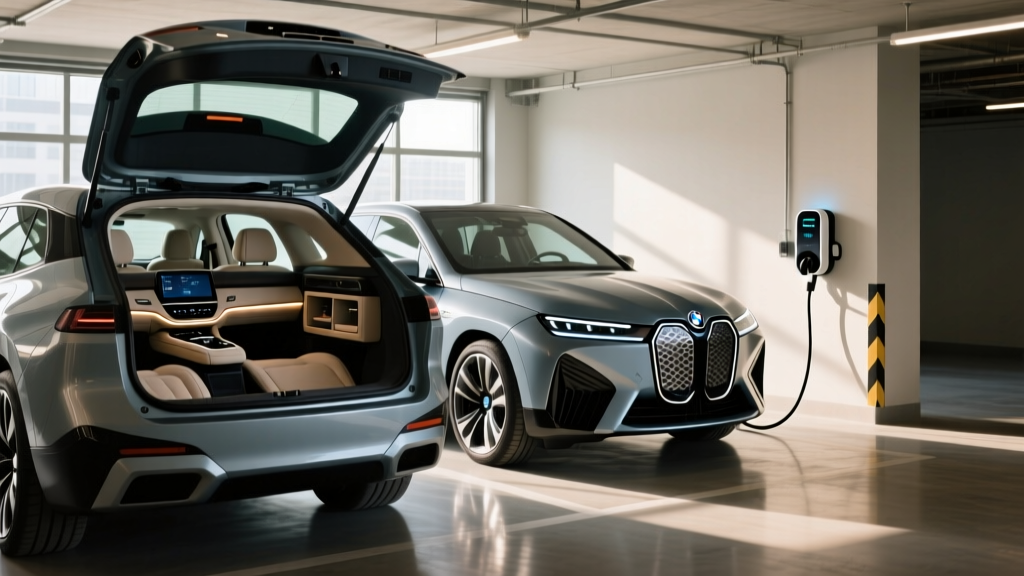
The 35.5 cubic feet behind the second row is generous and easily accommodates four large suitcases, a double stroller, or a full Costco run. With the 40/20/40 split rear seats folded, the 77.9 cu ft maximum exceeds the Tesla Model X and significantly outpaces the Audi Q8 e-tron. This makes the iX a strong choice for families who need flexible cargo configurations.
The notable omission is a frunk. BMW uses the space under the hood for power electronics and the HVAC system, so there is no front trunk. For owners accustomed to Tesla's frunk storage, this is a trade-off. The under-floor cargo compartment in the rear partially compensates, offering a hidden storage well for smaller items.
Interior materials and build quality are where the iX separates from rivals. The cabin features BMW's Curved Display (14.9" touchscreen merged with a 12.3" instrument cluster), sustainable microfiber and wood trim options, and available massaging front seats. Rear-seat passengers get excellent headroom (the flat EV floor helps) and available heated rear seats. The panoramic glass roof with electrochromic shading is a standout feature — it dims electronically at the touch of a button.
Pricing, Trims, and Federal Tax Credit Eligibility
| Trim | Base MSRP | Est. As-Tested | §30D Credit Eligible? |
|---|---|---|---|
| xDrive50 | $87,250 | $92,000–$102,000 | No (MSRP cap exceeded) |
| M60 | $111,500 | $118,000–$130,000 | No (MSRP cap exceeded) |
Under current IRS §30D rules, the federal EV tax credit has an MSRP cap of $80,000 for SUVs, vans, and pickup trucks. The BMW iX xDrive50 starts at $87,250 — above the cap — meaning it does not qualify for the up-to-$7,500 federal tax credit regardless of buyer income or battery sourcing. The M60 is further above the threshold.
This is a significant consideration for cross-shoppers. The Tesla Model X (starting ~$79,990) and certain trims of the Cadillac Lyriq and Rivian R1S may still qualify for partial or full credits depending on configuration and current battery-sourcing requirements. Buyers should verify eligibility on the IRS clean vehicle credit page and consult a tax professional, as rules around critical-mineral sourcing and battery-component origin change periodically.
The point-of-sale transfer option (available since 2024) allows eligible buyers to apply the credit as an immediate price reduction at the dealership. However, since the iX exceeds the MSRP cap, this mechanism does not apply.
For buyers who do not need the federal credit — or who can benefit from state-level incentives (which vary by jurisdiction and are not covered here) — the iX's pricing reflects its premium positioning. Expect as-tested prices of $95,000–$105,000 for a well-equipped xDrive50 with the Premium Package, Driving Assistance Professional, and 21" wheels.
Driving Dynamics, Tech, and Driver Assistance
The iX xDrive50's 516 hp dual-motor AWD system delivers confident acceleration (4.4 seconds to 60 mph) without the aggressive throttle mapping of the M60. The ride quality is the iX's defining characteristic: standard adaptive air suspension absorbs road imperfections with a composure that outclasses the stiffer Model X and the firmer Audi Q8 e-tron. This is a luxury cruiser, not a track car, and it excels at that mission.
The M60 adds rear-axle steering (improving low-speed maneuverability), a sport-tuned air suspension, and an electronic limited-slip rear differential. The 3.6-second 0–60 time is rapid, but the M60's 288-mile range and higher price make it a niche choice.
On the technology front, BMW's iDrive 8.5 system powers the Curved Display with quick response times, wireless Apple CarPlay/Android Auto, and an improved voice assistant. The available Driving Assistance Professional Package includes Highway Assistant — BMW's hands-off, eyes-on Level 2 system that operates up to 85 mph on divided highways. This is an SAE Level 2 system, meaning the driver must remain attentive and is legally responsible for the vehicle at all times. It is not self-driving.
Notable tech drawbacks: the iX lacks a traditional key fob option in some markets (relying on the Digital Key Plus via smartphone), and the gesture-control feature remains gimmicky. The absence of a frunk has already been noted. Charging-port placement on the driver's rear quarter can be awkward at some pull-through charging stations.
Pros and Cons
Pros
- Class-leading cargo volume (77.9 cu ft max) and rear legroom
- Excellent DC fast-charge speed (195 kW peak, ~35 min 10–80%)
- Supremely comfortable air-suspension ride quality
- 11 kW onboard charger — faster home charging than most rivals
- Strong 324-mile EPA range (xDrive50, 20" wheels)
- High-quality interior materials and quiet cabin
- Heat pump standard for improved cold-weather efficiency
Cons
- Does NOT qualify for §30D federal tax credit (above $80K MSRP cap)
- No front trunk (frunk)
- Heavy at 5,600+ lbs — highway efficiency suffers at speed
- M60 range drops to 288 mi EPA (real-world ~230–250 mi highway)
- Premium pricing: as-tested xDrive50 often exceeds $100K
- Charging port on driver-rear quarter can be inconvenient
- Gesture control is unreliable; iDrive learning curve for new users
Who Should Buy the BMW iX?
The BMW iX is best suited for:
- Families needing maximum cargo flexibility — the 35.5 / 77.9 cu ft cargo split and generous rear legroom make it a genuine minivan alternative for two-row SUV shoppers.
- Home-charging-committed owners — with 11 kW Level 2 capability and 324-mile range, daily driving is effortless if you charge at home.
- Luxury-focused buyers who prioritize ride comfort over sporty handling — the air suspension and cabin isolation are best-in-class.
- Road-trippers willing to plan charge stops — 195 kW DC charging means ~35-minute stops, comparable to a meal break.
The iX is not ideal for:
- Budget-conscious buyers who need the $7,500 federal tax credit — look at the Cadillac Lyriq, Tesla Model X (base), or Rivian R1S (certain trims).
- Drivers in extreme cold climates without garage parking — the 20–25% winter range loss is meaningful on a 324-mile battery.
- Performance-first buyers — the M60 is quick but heavy; the Porsche Cayenne EV or Tesla Model X Plaid better serve that use case.
Frequently Asked Questions
What is the real-world range of the BMW iX?
The xDrive50's EPA rating is 324 miles, but real-world highway driving at 70–80 mph typically yields 260–290 miles. In cold weather (below freezing), expect 210–250 miles. The M60 delivers roughly 230–250 miles on the highway in normal conditions.
How fast does the BMW iX charge?
On a DC fast charger, the iX peaks at 195 kW and charges from 10–80% in approximately 35 minutes. At home on a 48-amp Level 2 charger (11 kW), it adds about 44 miles of range per hour, with a full charge taking roughly 10 hours.
Does the BMW iX qualify for the federal EV tax credit?
No. Under current IRS §30D rules, the MSRP cap for SUVs is $80,000. The iX xDrive50 starts at $87,250 and the M60 at $111,500, so neither qualifies regardless of buyer income or battery sourcing. Always verify current rules at irs.gov.
Is the BMW iX worth buying vs. the Tesla Model X or Audi Q8 e-tron?
Choose the iX if you prioritize ride comfort, cargo volume (77.9 cu ft max), and build quality. Choose the Model X if you need a frunk, Supercharger-native access, or want to stay near the $80K tax-credit threshold. Choose the Q8 e-tron if you prefer a more traditional luxury aesthetic and slightly lower starting price, though its cargo space (28.5 cu ft) is significantly smaller.
What is the BMW iX battery warranty?
BMW covers the iX high-voltage battery for 8 years or 100,000 miles (whichever comes first), warranting against defects and capacity loss below 70% of original capacity. This is standard for the luxury EV segment and matches most competitors.
Does the BMW iX have a frunk?
No. The BMW iX does not have a front trunk. The space under the hood houses power electronics and thermal management components. All cargo must go in the rear cargo area.