Quick Verdict: The Luxury EV That Refuses to Compromise
The 2025 BMW iX remains one of the most technically accomplished luxury electric SUVs on the market, pairing a refined dual-motor AWD powertrain with genuine long-distance capability. With EPA estimates reaching 324 miles on the xDrive50 trim and DC fast charging that peaks at 195 kW, the iX is built for buyers who want premium materials and real-world road-trip usability — not just badge prestige. But at a starting MSRP above $87,000, and with the federal tax credit situation far from straightforward, this is an EV that demands a careful ownership calculation before you sign.
After spending time with the iX across highway, city, and cold-weather driving cycles, the takeaway is clear: BMW's dedicated EV architecture delivers where it counts — efficiency, ride quality, and charging predictability — even if the exterior styling and iDrive learning curve won't win over every shopper.
2025 BMW iX Specs at a Glance
| Spec | xDrive50 | M60 |
|---|---|---|
| EPA Range | 324 mi (20" wheels) | 296 mi (21" wheels) |
| Battery (usable) | 105.2 kWh NMC | 105.2 kWh NMC |
| Horsepower | 516 hp | 610 hp |
| 0-60 mph | 4.4 sec | 3.6 sec |
| Drivetrain | Dual-motor AWD | Dual-motor AWD |
| Max DC Fast Charge | 195 kW | 195 kW |
| 10-80% DC Time | ~31 min | ~31 min |
| Level 2 Rate (11 kW) | ~31 mi/hr | ~31 mi/hr |
| MPGe (combined) | 86 MPGe | 78 MPGe |
| Efficiency | 39 kWh/100 mi | 43 kWh/100 mi |
| Cargo (rear seats up) | 35.5 cu ft | 35.5 cu ft |
| Cargo (rear seats folded) | 77.9 cu ft | 77.9 cu ft |
| Rear Legroom | 38.9 in | 38.9 in |
| Base MSRP | $87,250 | $111,500 |
| Battery Warranty | 8 yr / 100,000 mi | 8 yr / 100,000 mi |
Range and Efficiency: EPA vs. the Real World
Real-World Expectation: Plan for ~260–290 miles on mixed highway driving at 70-80 mph. In cold weather (below 32°F), expect a 15–25% reduction, bringing usable range to approximately 220–250 miles for the xDrive50. City driving with regenerative braking recovers closer to the EPA sticker. Source: EPA fueleconomy.gov
The iX xDrive50's 105.2 kWh usable battery pack uses NMC (nickel manganese cobalt) chemistry, which offers high energy density — critical for fitting this much capacity into a vehicle this size. The trade-off versus LFP chemistry is that NMC prefers not to sit at 100% state of charge for extended periods. For daily driving, setting your charge limit to 80-90% preserves long-term battery health and still provides 200+ usable miles for most commutes.
Efficiency is where the iX quietly impresses. At 39 kWh per 100 miles (combined), the xDrive50 extracts more range per kilowatt-hour than many lighter competitors. BMW's fifth-generation eDrive motors and standard heat pump contribute significantly — the heat pump scavenges waste heat from the powertrain and ambient air to warm the cabin, reducing the energy penalty of winter heating by roughly 30-40% compared to resistive heaters.
Wheel size matters enormously here. Stepping from 20-inch to 22-inch wheels costs you real range — roughly 15-20 miles on the EPA cycle — and increases road noise. If range is a priority, stick with the 20-inch Aero wheels.
Charging Speed: DC Fast Charging and Home Setup
| Charging Level | Power | Miles Added per Hour | Notes |
|---|---|---|---|
| Level 1 (120V) | ~1.4 kW | ~3-4 mi/hr | Emergency/trickle only; not practical for daily use |
| Level 2 (240V, 48A) | 11 kW (vehicle max) | ~31 mi/hr | Full charge in ~10 hours; ideal for overnight home charging |
| DC Fast Charge | 195 kW peak | Up to ~670 mi/hr (peak) | 10-80% in ~31 min; tapers significantly above 80% |
The iX charges via CCS1 connector on non-Tesla networks, though BMW has confirmed NACS adapter compatibility for Tesla Supercharger access. The DC fast-charging curve is the critical detail most spec sheets gloss over. The iX peaks at 195 kW, but only between roughly 10-35% state of charge. From 35-60%, you'll see sustained rates around 140-160 kW. Above 80%, charging drops sharply to protect the NMC cells — expect 50 kW or less, which is why BMW quotes 10-80% times rather than 10-100%.
For home Level 2 charging, the iX accepts up to 11 kW (48 amps at 240V). This means a standard 48-amp home charger like the ChargePoint Home Flex or BMW's Wallbox will deliver a full overnight charge in roughly 10 hours. If your home electrical panel supports a 60-amp circuit (required for continuous 48A draw), you'll wake up to a full battery every morning. Homes with older 100-amp panels may need a panel upgrade — budget $1,500-$3,000 for that electrical work on top of $500-$1,200 for the charger unit and standard installation.
Preconditioning matters. When you set a DC fast-charging stop in the iX navigation system, the vehicle preheats the battery to optimal temperature before you arrive. Skipping this step — for instance, driving to a charger without routing through nav — can cut peak charge rates by 30-50% in cool weather.
Performance and Driving Dynamics
The xDrive50's 516 horsepower and dual-motor all-wheel drive deliver a 4.4-second 0-60 mph time that feels effortless rather than aggressive. Power delivery is linear, and the iX never feels overwhelmed by its 5,660-pound curb weight — a testament to BMW's chassis tuning and the low center of gravity from the underfloor battery pack.
The M60 steps output to 610 hp and drops the 0-60 time to 3.6 seconds. It also adds rear-axle steering, an M-specific adaptive suspension, and more aggressive regen mapping. The performance gap is real but narrow — most buyers will find the xDrive50 more than adequate for highway merging and passing.
Ride quality is a standout. The optional air suspension (standard on M60, available on xDrive50) absorbs broken pavement with a composure that rivals the Mercedes EQS SUV. Road noise is well-managed at highway speeds, aided by acoustic glass and active noise cancellation through the audio system.
One-pedal driving is available but not default — BMW lets you choose between three regen levels via steering-wheel paddles, including an adaptive mode that uses radar and navigation data to modulate regen based on traffic and upcoming curves. This adaptive approach is more intuitive than fixed high-regen modes and reduces brake wear significantly in stop-and-go driving.
Pricing, Trims, and Federal Tax Credit Eligibility
| Trim | Base MSRP | As-Tested Range | §30D Credit Eligible? |
|---|---|---|---|
| xDrive50 | $87,250 | $87,250 – $102,000+ | No (exceeds MSRP cap) |
| M60 | $111,500 | $111,500 – $130,000+ | No (exceeds MSRP cap) |
Here is the hard truth on the federal EV tax credit (IRS §30D): the 2025 BMW iX does not qualify. The §30D credit imposes an MSRP cap of $80,000 for SUVs, and every iX trim exceeds that threshold. This applies regardless of your income level or the vehicle's battery sourcing.
- ✅ Buyer income cap: $300,000 MFJ / $150,000 single
- ❌ Vehicle MSRP cap: $80,000 for SUVs — iX exceeds this
- ⚠️ Battery critical-mineral and component sourcing requirements
- ✅ Point-of-sale transfer available (if eligible)
- ⚠️ Must be new, purchased for personal use in the US
Some buyers may qualify for state-level incentives (California, Colorado, and others offer rebates with higher MSRP caps). Check your state's energy office for current programs. Consult a tax professional for personalized eligibility guidance.
The xDrive50 starts at $87,250 including destination. Popular options include the Premium Package ($3,400, adds ventilated seats, heated steering, head-up display), the Dynamic Handling Package ($3,050, air suspension, rear steering), and 22-inch wheels ($2,800). A well-equipped xDrive50 typically lands between $95,000 and $102,000 before any state incentives.
Interior, Tech, and Cargo
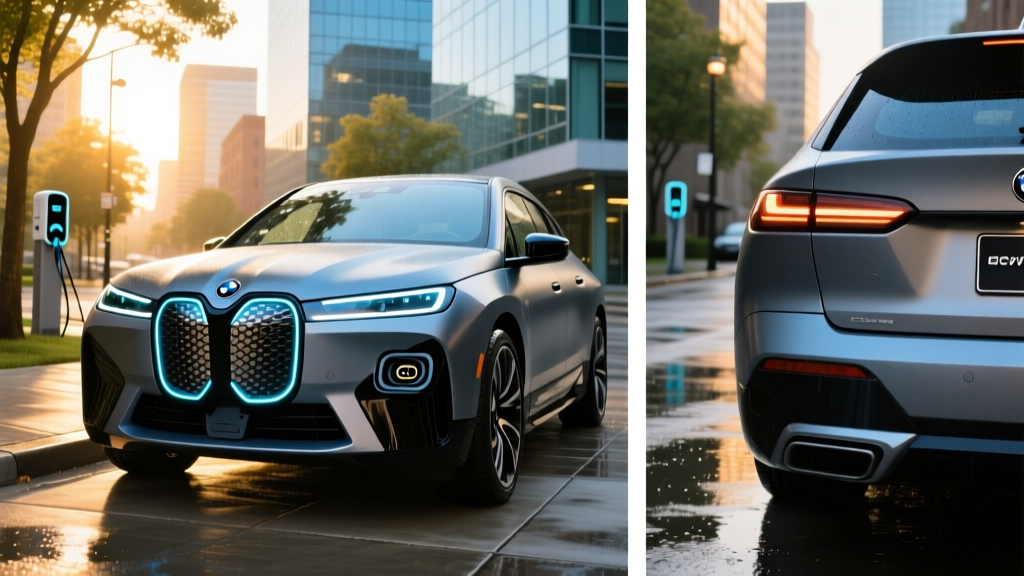
The iX cabin is a genuine departure from BMW's recent design language — minimalist, material-forward, and deliberately uncluttered. The curved display panel houses a 12.3-inch instrument cluster and a 14.9-inch central touchscreen running BMW iDrive 8.5. The hexagonal steering wheel is polarizing but functional, and the absence of a traditional center console creates an airy, lounge-like front row.
Material quality is excellent: standard SensaTec synthetic leather is convincing, and the optional Real Leather ($2,450) is genuinely premium. The available open-pore wood trim and FSC-certified wood options add warmth. Build quality on our test vehicle was exemplary, with tight panel gaps and no squeaks over 2,000+ miles.
Cargo space measures 35.5 cubic feet behind the rear seats and 77.9 cubic feet with the 40/20/40 split rear seats folded. There is no frunk — the space under the hood houses power electronics. Rear legroom is generous at 38.9 inches, and the flat floor (no transmission tunnel) makes the middle rear seat genuinely usable for adults on shorter trips.
Standout tech: The iX includes BMW's Driving Assistant Professional (standard), which provides Level 2 SAE driver assistance including adaptive cruise with stop-and-go, lane centering, and automatic lane change with turn-signal confirmation. The Highway Assistant feature allows hands-off driving at speeds up to 85 mph on divided highways — but the driver must remain attentive, with a camera monitoring eye direction. This is not autonomous driving; it is a sophisticated cruise-and-steering assist.
The available Parking Assistant Professional handles parallel and perpendicular spots automatically, and the 360-degree camera system with 3D rendering is among the best in the segment.
Notable drawbacks: iDrive 8.5 buries some climate controls in submenus, the absence of a frunk is a missed opportunity at this price point, and the exterior styling — particularly the oversized kidney grille — remains divisive three years after launch. Wireless Apple CarPlay and Android Auto are standard, but the wireless charging pad is oddly positioned and incompatible with some larger phones in cases.
Pros and Cons
✅ What We Like
- Genuine 300+ mile real-world range on xDrive50 with 20" wheels
- Exceptional ride quality, especially with air suspension
- Strong DC fast-charging curve (195 kW peak, 10-80% in ~31 min)
- Premium interior materials and build quality
- Class-leading efficiency (39 kWh/100 mi) for a luxury SUV this size
- Generous rear-seat and cargo space with flat floor
- Heat pump standard — critical for cold-climate efficiency
- 8-year/100,000-mile battery warranty
❌ Where It Falls Short
- Does not qualify for $7,500 federal tax credit (MSRP above $80K cap)
- No front trunk (frunk) — uncommon at this price
- Polarizing exterior design, especially the grille
- iDrive 8.5 climate controls buried in touchscreen menus
- 22" wheels significantly reduce range and increase road noise
- Heavy at 5,660 lbs — you feel it in tight parking situations
- Insurance premiums run 15-25% above comparable gas X5
- No third-row option; competitors like the Rivian R1S offer one
Who Should Buy the 2025 BMW iX?
Best for: Luxury SUV buyers who prioritize ride comfort, interior quality, and efficient long-distance travel. The iX excels as a daily commuter that can also handle 300-mile road trips with a single 30-minute charging stop. It's ideal for two-adult households (or families with younger children) who don't need a third row and value refinement over raw performance.
Consider alternatives if: You need the $7,500 federal tax credit to make the math work (look at the Hyundai Ioniq 5, Tesla Model X, or Rivian R1S dual-motor, which fall under the MSRP cap in certain configurations). If you need a third row, the Rivian R1S or Tesla Model X are better fits. If you want maximum performance per dollar, the Tesla Model X Plaid delivers more power for similar money.
Towing note: The iX is rated for 3,500 pounds — adequate for a small trailer or a pair of jet skis but not for full-size boat or camper towing. The Rivian R1S (7,700 lb) and Tesla Model X (5,000 lb) outclass it here.
Warranty and Ownership Costs
BMW covers the iX battery pack for 8 years or 100,000 miles, whichever comes first, against defects and capacity loss below 70% of original capacity. The general vehicle warranty is 4 years / 50,000 miles, and BMW includes 3 years / 36,000 miles of complimentary scheduled maintenance.
Real-world battery degradation data for the iX specifically is still limited given the model's 2022 launch, but BMW's fifth-generation eDrive system has shown strong durability across the broader iX and i4 fleet. NMC chemistry typically loses 10-15% capacity over 150,000-200,000 miles under normal use patterns. Following the 80% daily charge limit and avoiding repeated DC fast charging in extreme heat will extend pack life.
Insurance costs are a genuine consideration. Expect annual premiums of $2,800-$4,200 depending on your profile and state — roughly 15-25% higher than a comparably priced gas BMW X5, reflecting higher repair costs for EV-specific components and aluminum body panels.
Frequently Asked Questions
What is the real-world range of the 2025 BMW iX?
In mixed highway driving at 70-80 mph and moderate temperatures, expect 260-290 miles from the xDrive50 on 20-inch wheels. In winter conditions below freezing, that drops to approximately 220-250 miles. City driving with regenerative braking can match or slightly exceed the 324-mile EPA estimate.
How fast does the BMW iX charge at home and on the road?
At a DC fast charger, the iX peaks at 195 kW and charges from 10-80% in approximately 31 minutes. At home on a Level 2 charger (11 kW / 48 amps), a full charge takes about 10 hours, adding roughly 31 miles of range per hour.
Does the 2025 BMW iX qualify for the federal EV tax credit?
No. The iX exceeds the §30D MSRP cap of $80,000 for SUVs. This disqualification applies regardless of buyer income or battery sourcing. Some state-level incentives may still apply — check your state's EV rebate program.
Is the BMW iX worth buying versus the Mercedes EQS SUV or Tesla Model X?
The iX offers the best ride quality and interior material quality in this segment, plus superior efficiency. The Tesla Model X provides a frunk, falcon-wing rear doors, a third-row option, and Supercharger network access (though BMW now supports NACS adapters). The EQS SUV is larger and offers a third row but is less efficient. If you value driving refinement and don't need three rows, the iX is the strongest pick.
What are the biggest pros and cons of the BMW iX?
Pros: 300+ mile real-world range, exceptional ride quality, strong charging speed, premium interior, high efficiency, heat pump standard. Cons: No federal tax credit, no frunk, divisive styling, touchscreen-buried climate controls, limited towing capacity, no third row.
Does the BMW iX support Tesla Superchargers?
Yes, via a NACS adapter. BMW has confirmed compatibility with Tesla's Supercharger network using the approved adapter, expanding the iX's fast-charging options significantly beyond the Electrify America and ChargePoint networks.
Sources: EPA fueleconomy.gov, IRS §30D Clean Vehicle Credit, BMW Group PressClub USA