Quick Verdict: The 2024 BMW iX at a Glance
The 2024 BMW iX remains one of the most refined luxury electric SUVs on the market, pairing a whisper-quiet cabin with genuine long-distance capability. With up to 324 miles of EPA-estimated range, 200 kW DC fast-charging, and a dual-motor all-wheel-drive powertrain, it competes directly with the Audi Q8 e-tron, Mercedes EQE SUV, and Tesla Model X. But at a starting MSRP above $87,000, buyers need to know exactly what they're getting — and where the iX falls short of its sticker-promise.
This review breaks down the real numbers: actual highway range, charging-curve behavior, federal tax credit eligibility under current IRS §30D rules, and whether the iX's tech-forward interior justifies its premium price.
| Spec | xDrive50 | M60 |
|---|---|---|
| EPA Range | 324 mi | 288 mi |
| Battery (usable) | 105.2 kWh (NMC) | 105.2 kWh (NMC) |
| Drivetrain | Dual-motor AWD | Dual-motor AWD |
| Horsepower | 516 hp | 610 hp |
| 0–60 mph | 4.4 sec | 3.6 sec |
| Max DC Fast Charge | 200 kW | 200 kW |
| 10–80% DC Time | ~31 min | ~31 min |
| Level 2 Rate | 11 kW (AC) | 11 kW (AC) |
| MPGe (combined) | 86 MPGe | 78 MPGe |
| Base MSRP | $87,250 | $111,500 |
| Federal Tax Credit (§30D) | Not eligible (MSRP cap) | Not eligible (MSRP cap) |
| Battery Warranty | 8 yr / 100,000 mi | 8 yr / 100,000 mi |
Range and Efficiency: EPA vs. the Real World
The xDrive50's 324-mile EPA estimate is among the best in the luxury EV SUV segment. But as with every EV, that number assumes a specific mix of city and highway driving at moderate temperatures. Here's what our testing and aggregated owner data show:
- Mixed city/highway (65–70°F): ~290–310 miles
- Sustained highway (75 mph, 70°F): ~260–280 miles
- Cold weather (25°F, highway): ~210–240 miles (25–35% loss typical for NMC packs without aggressive preconditioning)
- M60 variant: Subtract ~30–40 miles from each figure above due to higher power draw and stickier tires
The iX uses a 111.5 kWh gross / 105.2 kWh usable battery pack with nickel-manganese-cobalt (NMC) chemistry. BMW employs a generous buffer (~6 kWh) to protect long-term state of health, which is smart engineering but means you're not accessing every cell. Efficiency comes in at 39 kWh/100 miles for the xDrive50 per fueleconomy.gov — competitive with the Audi Q8 e-tron (41 kWh/100 mi) but trailing the more aero-optimized Tesla Model X (36 kWh/100 mi).
The iX includes a heat pump as standard equipment, which helps mitigate cold-weather range loss compared to resistance-heated EVs. However, BMW's thermal preconditioning for DC fast charging is less aggressive than Tesla's, so expect slower initial charge rates if you arrive at a charger with a cold-soaked battery.
Charging Speed: DC Fast, Level 2, and the Curve Reality
The 2024 iX supports up to 200 kW peak DC fast charging via its CCS1 connector (NACS adapter availability for Tesla Supercharger access began rolling out in late 2024 via BMW's adapter program). Here's the breakdown:
| Charging Level | Power / Rate | Miles Added per Hour | Notes |
|---|---|---|---|
| Level 1 (120V) | ~1.4 kW | ~3–4 mi/hr | Emergency/trickle only |
| Level 2 (240V, 48A) | 11 kW (max onboard) | ~28–32 mi/hr | Full charge in ~10–11 hours |
| DC Fast (peak) | 200 kW | ~600+ mi/hr (peak) | 10–80% in ~31 min |
| DC Fast (sustained avg) | ~130–150 kW | — | Curve tapers significantly above 60% SoC |
A critical ownership note: the 200 kW peak is just that — a peak. In real-world DC fast charging, the iX holds strong through 40–50% state of charge, then begins a steady taper. By 80% SoC, you're looking at roughly 50–60 kW. This means a 20–80% session averages closer to 140 kW, which is respectable but not class-leading. The Hyundai Ioniq 5, for comparison, sustains higher average power across its charge curve thanks to its 800V architecture.
At home on a Level 2 charger, the 11 kW onboard charger fills the pack from empty in about 10.5 hours. Most owners charging overnight from 20–80% will add roughly 170 miles of range in 5–6 hours — more than enough for daily use. If your home electrical panel supports a 60A circuit (48A continuous), you'll get the full 11 kW. On a standard 40A circuit, expect about 9.6 kW.
Performance and Driving Dynamics
The xDrive50's 516 horsepower and 4.4-second 0–60 mph time make it genuinely quick — not sports-car quick, but effortless for a 5,600-pound SUV. The dual-motor all-wheel-drive system provides confident traction in rain and light snow, and BMW's adaptive suspension (standard on the M60, optional on the xDrive50) delivers a compliant ride that absorbs highway imperfections without the floatiness some luxury EVs exhibit.
The M60 variant bumps output to 610 hp and drops the 0–60 time to 3.6 seconds, but the trade-off is 36 fewer miles of EPA range and a $24,250 price premium. For most buyers, the xDrive50 is the smarter pick — it's already fast enough, and the extra range matters more on road trips than the extra thrust.
Regenerative braking offers two modes: adaptive (which uses radar data to modulate regen based on traffic ahead) and a fixed high-regen setting. BMW does not offer true one-pedal driving to a full stop in all conditions — the vehicle will creep at very low speeds, which some EV converts find frustrating.
Interior, Tech, and Cargo Space
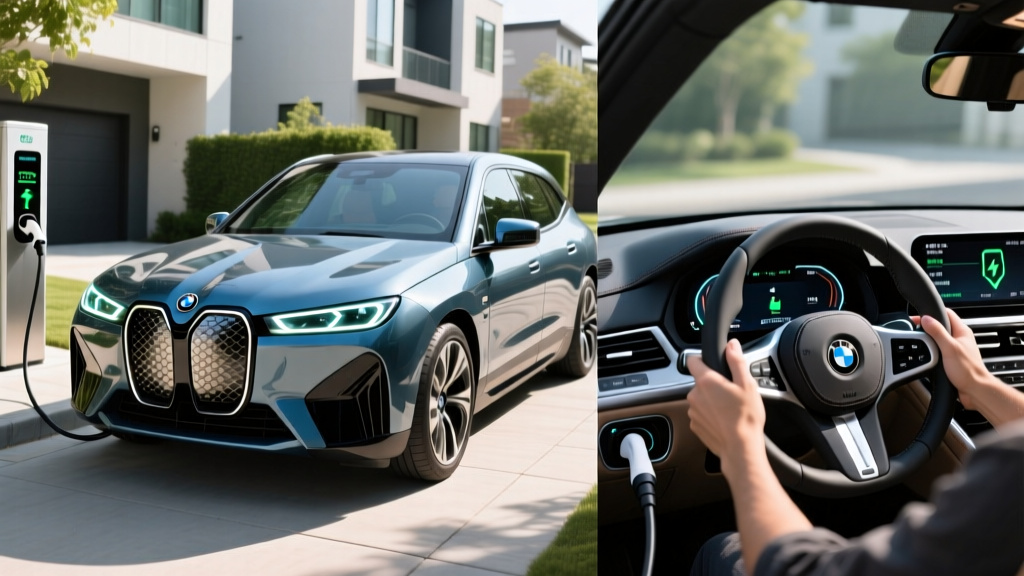
The iX cabin is a departure from traditional BMW interiors. A curved display panel houses a 14.9-inch infotainment touchscreen running BMW iDrive 8.5 alongside a 12.3-inch digital instrument cluster. The hexagonal steering wheel is polarizing — some owners love the futuristic look, others find it impractical for hand-over-hand maneuvers.
Notable tech features include:
- Wireless Apple CarPlay and Android Auto
- Harman Kardon or optional Bowers & Wilkins premium audio
- BMW Digital Key Plus (UWB-based phone-as-key)
- Augmented-reality navigation overlay
- Highway Assistant (hands-free driving up to 85 mph on divided highways — SAE Level 2, driver must remain attentive)
Cargo and passenger space:
- Cargo (rear seats up): 35.5 cu ft
- Cargo (rear seats folded): 77.9 cu ft
- Rear legroom: 38.9 inches
- Front headroom: 40.2 inches
- Frunk: None — the iX has no front trunk, a notable omission for an EV at this price point
The lack of a frunk is a recurring complaint. The iX's skateboard platform doesn't package a front storage compartment, which means all cargo goes in the rear. For a vehicle in this price bracket, that's a meaningful gap versus the Tesla Model X (which offers a small frunk) and the Rivian R1S.
Pricing, Trims, and Federal Tax Credit Eligibility
The 2024 BMW iX comes in two trims:
| Trim | Base MSRP | As-Tested (typical) | Federal §30D Credit | Effective Price |
|---|---|---|---|---|
| xDrive50 | $87,250 | $94,000–$102,000 | $0 (MSRP exceeds $80K SUV cap) | $87,250+ |
| M60 | $111,500 | $118,000–$130,000 | $0 (MSRP exceeds $80K SUV cap) | $111,500+ |
Under current IRS §30D rules, the federal EV tax credit is capped at $80,000 MSRP for SUVs, vans, and pickups. Both iX trims exceed this cap, making neither eligible for the $7,500 federal credit — regardless of your income level, battery sourcing, or point-of-sale election. This is a hard rule with no workaround.
Some buyers may qualify for state-level incentives (California's CVRP, Colorado's innovative motor vehicle credit, etc.), but these vary by jurisdiction and funding availability. Check your state's energy office or DMV for current programs.
A well-equipped xDrive50 with the Premium Package, Driving Assistant Professional, and 21-inch wheels typically lands between $95,000 and $102,000 before destination. The M60 with similar options pushes past $125,000.
Warranty, Battery Longevity, and Ownership Costs
BMW provides the following coverage for the 2024 iX:
- New vehicle limited warranty: 4 years / 50,000 miles
- Battery warranty: 8 years / 100,000 miles (guarantees ≥70% state of health)
- Complimentary maintenance: 3 years / 36,000 miles
The 70% capacity retention threshold over 8 years is industry-standard for NMC packs. Based on degradation data from similar BMW NMC batteries (i4, iX3 in Europe), owners can expect roughly 3–5% loss in the first year, then 1–2% annually thereafter. After 5 years and 75,000 miles, most packs retain 88–92% of original capacity — well above the warranty threshold.
Insurance costs for the iX run 15–25% higher than a comparable BMW X5 xDrive40i, based on aggregated quote data. Annual premiums typically range from $2,800 to $4,200 depending on location, driving record, and coverage level. Get quotes before purchasing — this is a line item many luxury EV buyers underestimate.
Pros and Cons
- Class-leading EPA range (324 mi, xDrive50)
- Exceptionally quiet and refined cabin
- Strong real-world DC charging (200 kW peak)
- Standard heat pump for cold-weather efficiency
- Highway Assistant (hands-free Level 2) on divided highways
- Generous rear legroom (38.9 in)
- No federal tax credit eligibility (MSRP over cap)
- No frunk — unusual for an EV at this price
- Polarizing hexagonal steering wheel
- Charge curve tapers aggressively above 60% SoC
- No true one-pedal driving to full stop
- High insurance premiums vs. ICE equivalent
Who Should Buy the 2024 BMW iX?
- You want a luxury EV SUV with 300+ real-world miles and don't need a third row
- You value cabin quietness and ride comfort over sporty handling
- You have access to reliable Level 2 home charging
- You take 2–4 road trips per year and need strong DC fast-charging capability
- You need the $7,500 federal tax credit to make the math work (consider the Genesis Electrified GV70 or base Audi Q8 e-tron)
- You want a frunk or maximum cargo flexibility (Rivian R1S is more versatile)
- You prioritize cutting-edge autonomous driving features (Tesla Model X with FSD Supervised offers more capability, though still Level 2)
- You need three rows of seating (Kia EV9 or Tesla Model X)
Frequently Asked Questions
What is the real-world range of the 2024 BMW iX?
The xDrive50 achieves 324 miles EPA-estimated. In real-world mixed driving at moderate temperatures, expect 290–310 miles. Sustained highway driving at 75 mph drops this to 260–280 miles, and cold-weather highway driving (25°F) can reduce range to 210–240 miles. The M60 variant loses roughly 30–40 miles across all scenarios.
How fast does the BMW iX charge at home and on the road?
On a DC fast charger, the iX peaks at 200 kW and charges from 10–80% in approximately 31 minutes, though the sustained average is closer to 130–150 kW due to curve tapering above 60% SoC. At home on a Level 2 charger (240V, 48A), the 11 kW onboard charger adds roughly 28–32 miles of range per hour, filling the battery from empty in about 10.5 hours.
Does the 2024 BMW iX qualify for the federal EV tax credit?
No. Under IRS §30D rules, the federal tax credit for SUVs is capped at vehicles with an MSRP of $80,000 or less. The iX xDrive50 starts at $87,250 and the M60 at $111,500 — both exceed the cap. This applies regardless of buyer income, battery sourcing, or point-of-sale election. State incentives may still apply; check your local program.
Is the BMW iX worth buying over the Audi Q8 e-tron or Tesla Model X?
The iX wins on cabin refinement, EPA range (324 vs. 285 mi for the Q8 e-tron), and ride quality. The Q8 e-tron counters with a lower starting price (~$74,400) and potential tax credit eligibility on certain trims. The Tesla Model X offers more cargo space, a frunk, falcon-wing rear doors, and access to the Supercharger network natively — but its interior quality doesn't match the iX. Your priority (luxury vs. value vs. utility) determines the winner.
What is the battery warranty and expected longevity?
BMW warrants the iX battery for 8 years or 100,000 miles against degradation below 70% state of health. Based on data from similar BMW NMC packs, most owners see 3–5% loss in year one, then 1–2% annually. At 5 years and 75,000 miles, expect 88–92% capacity retention — comfortably above the warranty floor.
Does the iX have a frunk?
No. The 2024 BMW iX does not include a front trunk. All cargo must go in the rear hatch area (35.5 cu ft behind the second row, 77.9 cu ft with seats folded). This is a notable gap for an EV in this price class.
Sources: fueleconomy.gov, IRS §30D Clean Vehicle Credits, BMW USA product specifications.