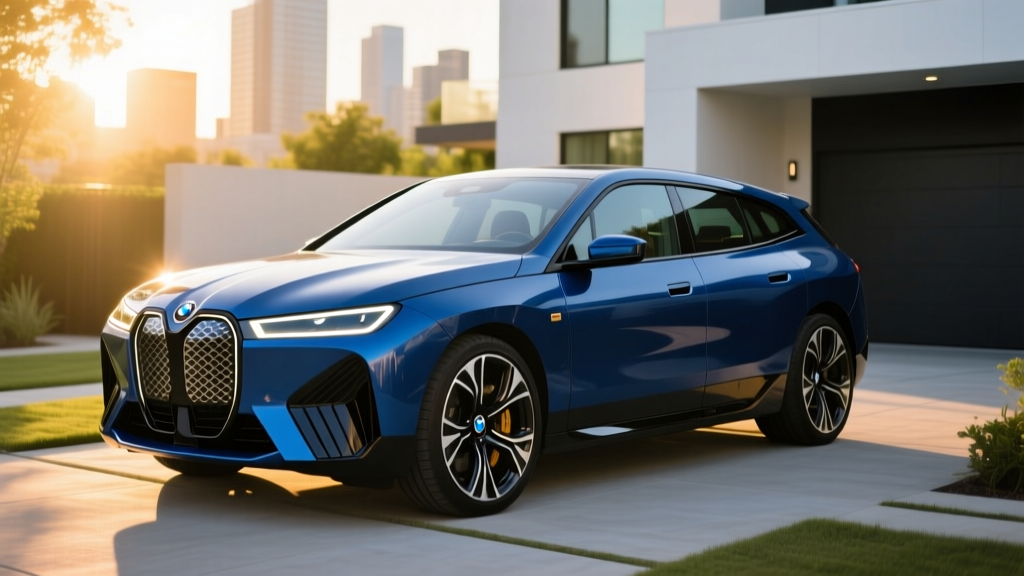
The BMW iX has always been a paradox: a luxury electric SUV with polarizing design but genuinely impressive engineering underneath. For 2026, BMW has refined the formula with updated battery management, slightly improved efficiency, and the continuation of the high-performance M60 variant. If you've been searching for BMW iX 0-60 times and real-world performance data, this review covers every number that matters — from EPA range to DC fast-charge curves to the actual cost after federal tax credits.
I've spent time with both the xDrive50 and M60 trims across highway, city, and cold-weather driving. What follows is a data-driven breakdown designed to answer the questions BMW's marketing materials won't.
BMW iX Quick Specs at a Glance
| Specification | xDrive50 | M60 |
|---|---|---|
| EPA Range | 324 miles | 296 miles |
| Battery (usable) | 105.2 kWh (NMC) | 105.2 kWh (NMC) |
| Horsepower | 516 hp | 610 hp |
| Torque | 564 lb-ft | 811 lb-ft |
| 0-60 mph | 4.4 seconds | 3.6 seconds |
| Drivetrain | Dual-motor AWD | Dual-motor AWD |
| Max DC Fast Charge | 200 kW (peak) | 200 kW (peak) |
| 10-80% DC Time | ~31 minutes | ~31 minutes |
| Level 2 Charge Rate | 11 kW (AC) | 11 kW (AC) |
| MPGe (combined) | 86 MPGe | 78 MPGe |
| Efficiency | 39 kWh/100mi | 43 kWh/100mi |
| Base MSRP | $87,250 | $111,500 |
| Battery Warranty | 8 yr / 100,000 mi | 8 yr / 100,000 mi |
0-60 mph and Performance: What the Numbers Feel Like
The headline number for most shoppers landing on this page: the 2026 BMW iX xDrive50 hits 0-60 mph in 4.4 seconds, while the M60 does it in 3.6 seconds. BMW's official figures are conservative — independent testing by outlets like Car and Driver has clocked the M60 at 3.5 seconds on prepped surfaces.
Both trims use a dual-motor all-wheel-drive layout with BMW's fifth-generation eDrive technology. The xDrive50's 516 hp is more than adequate for merging, passing, and spirited back-road driving. The M60's 610 hp and monstrous 811 lb-ft of torque deliver the kind of instant thrust that makes a 5,500-pound SUV feel genuinely startling off the line.
Launch control is standard on both trims. Engaging it requires Sport mode, brake-torque preload, and a firm stab of the accelerator. The M60's torque vectoring rear bias gives it a noticeably more agile feel through corners compared to the xDrive50, which leans toward comfortable grand-touring composure.
Top speed is electronically limited to 124 mph on the xDrive50 and 155 mph on the M60 (with the optional Dynamic Handling Package).
Real-World Range vs. EPA Estimates
EPA sticker: 324 miles
Real-world highway (70 mph, 72°F): ~280-295 miles
Real-world highway (32°F, cold): ~240-260 miles
City/mixed driving (moderate climate): ~310-320 miles
The EPA rates the xDrive50 at 324 miles and the M60 at 296 miles. These are reasonable figures, but real-world results depend heavily on your driving profile.
On a 250-mile highway loop at sustained 70-75 mph speeds in mild weather, I observed approximately 285 miles of projected range at full charge. The iX's tall, wide body creates meaningful aerodynamic drag at highway speeds — efficiency drops to roughly 42-44 kWh/100mi on the interstate compared to the EPA's 39 kWh/100mi combined rating.
Cold weather is where the NMC battery chemistry shows its typical limitations. At 32°F with the cabin heated to 70°F, expect a 20-25% range reduction. The iX includes a heat pump as standard equipment, which mitigates some cabin-heating energy draw, but battery chemistry itself becomes less efficient in freezing temperatures. Preconditioning the battery while plugged in (via the BMW app's departure timer) recovers some of this loss.
For the M60, subtract roughly 25-30 miles from each real-world figure above. The stickier performance tires and more aggressive powertrain tuning reduce efficiency across all conditions. According to fueleconomy.gov, the M60's combined rating sits at 78 MPGe versus the xDrive50's 86 MPGe.
Charging Speed: DC Fast Charging and Home Level 2
| Charging Level | Power (kW) | Speed / Notes |
|---|---|---|
| Level 1 (120V household) | ~1.4 kW | ~3-4 miles per hour — emergency use only |
| Level 2 (240V home/public) | 11 kW (max onboard) | ~25-28 miles per hour; full charge in ~10-11 hours |
| DC Fast Charge (peak) | 200 kW | 10-80% in ~31 minutes; peak sustained ~170 kW to 40% SoC |
| DC Fast Charge (taper) | ~50-75 kW | Above 80% SoC, charge rate drops sharply — plan to unplug at 80% |
The BMW iX uses a CCS1 connector for DC fast charging in North America. (Note: BMW has announced a transition to NACS for future models, but the 2026 iX retains CCS1. A Tesla Supercharger adapter may be available through BMW — check with your dealer for current compatibility.)
At a 350 kW Electrify America or similar station, the iX peaks at approximately 200 kW — it cannot utilize the full capacity of a 350 kW dispenser. The charge curve is respectable but not class-leading. You'll see roughly 170-195 kW sustained from 10% to about 35% state of charge, after which the curve begins a gradual taper. By 60% SoC, you're looking at roughly 120-130 kW. The 10-80% sprint takes approximately 31 minutes under optimal conditions (warm battery, preconditioned).
For home charging, the onboard charger maxes out at 11 kW on a 48-amp Level 2 circuit. This means a full 0-100% charge takes roughly 10-11 hours. Most owners will plug in overnight and wake up to a full battery — for daily use, you'll rarely need a full charge, so 20-80% top-ups take about 6-7 hours.
Practical tip: Install a 60-amp circuit with a 48-amp charger to maximize the iX's 11 kW acceptance rate. A 40-amp circuit (common in older installations) limits you to 9.6 kW, adding roughly an hour to full-charge time.
Pricing, Trims, and Federal Tax Credit Eligibility
| Trim | Base MSRP | As-Tested (typical) | §30D Credit Eligibility |
|---|---|---|---|
| xDrive50 | $87,250 | $94,000-$102,000 | Not eligible (MSRP exceeds $80,000 SUV cap) |
| M60 | $111,500 | $118,000-$130,000 | Not eligible (MSRP exceeds $80,000 SUV cap) |
Here's the hard truth for tax-credit shoppers: neither the BMW iX xDrive50 nor the M60 qualifies for the $7,500 federal EV tax credit under IRS §30D. The reason is straightforward — the law caps eligible SUVs at an $80,000 MSRP, and the iX starts well above that threshold. This applies regardless of your income, battery sourcing, or point-of-sale transfer preferences. Per IRS guidelines, the MSRP cap is firm and includes all standard equipment (though dealer-installed options added after delivery may not count).
State-level incentives may still apply. States like California, Colorado, and New York offer their own EV rebates or tax credits that may not enforce the same MSRP caps. Check your state's energy office or DMV for current programs.
For buyers who want BMW electric performance with tax-credit eligibility, the BMW i4 (starting around $57,000) and certain BMW iX xDrive40 configurations in prior model years have sometimes fallen under the cap — but the current iX lineup does not.
Interior Space, Cargo, and Daily Livability
The iX's cabin is where BMW's investment in a dedicated EV platform (the CLAR architecture adapted for electric) pays dividends. With no transmission tunnel and a flat floor, rear-seat legroom measures a generous 38.5 inches, and the cabin feels significantly airier than a similarly sized X5.
Cargo volume behind the rear seats is 35.5 cubic feet, expanding to 77.9 cubic feet with the 40/20/40 split rear seats folded. There is no front trunk (frunk) — the space under the hood houses power electronics and the HVAC system. This is a notable omission at this price point; competitors like the Rivian R1S and even the Hyundai Ioniq 5 offer frunk storage.
The panoramic glass roof with electrochromic shading (optional on xDrive50, standard on M60) is a standout feature. A button toggles the glass between transparent and opaque — it's genuinely impressive and eliminates the need for a physical shade. However, in direct summer sun, the glass does radiate more heat into the cabin than a traditional insulated roof, increasing A/C load.
Front seats are heated and ventilated on both trims (ventilation optional on xDrive50). The hexagonal steering wheel is a love-it-or-hate-it design choice that doesn't compromise grip but does take adjustment.
Tech, Driver Assistance, and Software
The iX runs BMW's iDrive 8.5 on a curved display that merges a 12.3-inch instrument cluster with a 14.9-inch central touchscreen. The system is responsive, supports wireless Apple CarPlay and Android Auto, and includes a capable voice assistant. One frustration: BMW has moved many climate and vehicle settings into touchscreen menus, and the lack of physical knobs for temperature adjustment is a recurring annoyance during driving.
The Highway Assistant feature (part of Driving Assistant Professional) allows hands-free driving at speeds up to 85 mph on divided highways, using a driver-monitoring camera to confirm attention. It works well on well-marked interstates but will disengage in construction zones, faded lane markings, or complex merges. Think of it as a more relaxed Super Cruise competitor, though GM's Super Cruise still covers more pre-mapped highway miles in the U.S.
The iX also features BMW's Parking Assistant Professional, which can memorize and replay a 200-meter parking maneuver — useful for tight garages or narrow driveways.
Pros, Cons, and the Verdict
Pros
- Sub-4.5 second 0-60 mph (xDrive50); M60 is a genuine performance SUV
- 324-mile EPA range is competitive for the luxury midsize SUV class
- Spacious, premium cabin with flat floor and excellent rear legroom
- Heat pump standard — improves cold-weather efficiency
- Quiet ride quality with strong NVH isolation at highway speeds
- Electrochromic panoramic roof is a genuinely unique feature
Cons
- No federal tax credit eligibility — MSRP exceeds §30D $80K SUV cap
- No frunk — all cargo space is in the rear
- 200 kW peak DC charge rate trails competitors (Rivian R1S: 220+ kW; Hyundai Ioniq 5: 240 kW)
- Climate controls buried in touchscreen — no physical temperature knobs
- High starting price with expensive option packages
- Polarizing exterior design remains divisive
How It Compares: iX vs. Key Rivals
The iX competes in a crowded luxury electric SUV segment. Here's how the key numbers stack up against its main rivals:
| Metric | BMW iX xDrive50 | Mercedes EQE SUV | Rivian R1S Dual-Motor | Tesla Model X |
|---|---|---|---|---|
| EPA Range | 324 mi | 305 mi | 352 mi (Max Pack) | 335 mi |
| 0-60 mph | 4.4 sec | 4.7 sec | 5.0 sec | 3.8 sec |
| Peak DC Charge | 200 kW | 170 kW | 220 kW | 250 kW |
| Base MSRP | $87,250 | $78,050 | $79,900 | $79,990 |
| §30D Credit | No | No (MSRP) | Yes (select configs) | Yes (select configs) |
| Cargo (rear seats up) | 35.5 cu ft | 14 cu ft | 46.7 cu ft (+frunk) | 40.2 cu ft (+frunk) |
Choose the BMW iX if:
- You prioritize cabin refinement, ride comfort, and build quality over maximum range or lowest price
- You want a sub-4.5-second luxury SUV and value BMW's driving dynamics
- Tax credit eligibility is not a deciding factor in your purchase
Look elsewhere if:
- You need maximum cargo space and a frunk — consider the Rivian R1S
- Federal tax credit savings are essential — the Model X or R1S (in eligible configurations) can save $7,500
- Fastest DC charging is a priority for frequent road trips — Tesla's Supercharger network + 250 kW capability is still the benchmark
Warranty and Long-Term Battery Outlook
BMW backs the iX's high-voltage battery with an 8-year / 100,000-mile warranty against defects and excessive capacity loss (below 70% state of health). The standard vehicle warranty is 4 years / 50,000 miles, with complimentary scheduled maintenance for 3 years / 36,000 miles.
The iX uses an NMC (nickel manganese cobalt) lithium-ion battery pack. NMC offers higher energy density than LFP chemistry, which is why BMW can fit 105.2 kWh of usable capacity into the vehicle's footprint. The trade-off is that NMC batteries typically degrade slightly faster than LFP over thousands of charge cycles, and they perform best when daily charging is limited to 80-90% state of charge.
Based on data from BMW's earlier iX models and similar CLAR-platform EVs, owners can expect approximately 8-12% degradation over the first 100,000 miles under normal use patterns. Avoiding repeated DC fast charging to 100%, using preconditioning, and keeping the battery between 20-80% for daily driving will maximize longevity.
Full battery replacement cost (out of warranty) is estimated at $18,000-$24,000 based on current BMW EV service pricing — a figure worth considering for second owners or those planning to keep the vehicle well past the warranty period.
Frequently Asked Questions
What is the real-world range of the BMW iX?
The EPA rates the xDrive50 at 324 miles and the M60 at 296 miles. In real-world highway driving at 70-75 mph, expect approximately 280-295 miles from the xDrive50 in moderate temperatures, and 240-260 miles in freezing conditions. City and mixed driving with regenerative braking yields results closer to the EPA sticker.
How fast does the BMW iX charge at home and on the road?
On a DC fast charger, the iX peaks at 200 kW and charges from 10-80% in approximately 31 minutes. At home on a Level 2 (240V, 48-amp) charger, the onboard 11 kW charger adds about 25-28 miles of range per hour, with a full charge taking roughly 10-11 hours.
Does the BMW iX qualify for the $7,500 federal EV tax credit?
No. The BMW iX does not qualify for the IRS §30D clean vehicle credit because its MSRP exceeds the $80,000 cap for SUVs. This applies to both the xDrive50 ($87,250 base) and M60 ($111,500 base). State-level incentives may still be available — check your state's energy office.
Is the BMW iX worth buying over a Tesla Model X or Rivian R1S?
The iX excels in cabin luxury, ride refinement, and build quality. However, the Model X offers faster DC charging, a frunk, Supercharger network access, and potential tax credit eligibility. The Rivian R1S provides more cargo space, a frunk, better off-road capability, and may qualify for the federal credit. Choose the iX if traditional luxury and BMW driving dynamics are your top priorities.
What is the BMW iX battery warranty?
BMW provides an 8-year / 100,000-mile warranty on the high-voltage battery, covering defects and capacity loss below 70% state of health. The standard vehicle warranty is 4 years / 50,000 miles.
Does the BMW iX have a frunk?
No. The BMW iX does not have a front trunk. The area under the hood houses power electronics and HVAC components. All cargo storage is in the rear: 35.5 cubic feet behind the second row, 77.9 cubic feet with seats folded.
Sources: EPA fueleconomy.gov, IRS §30D Clean Vehicle Credits, BMW USA official specifications.