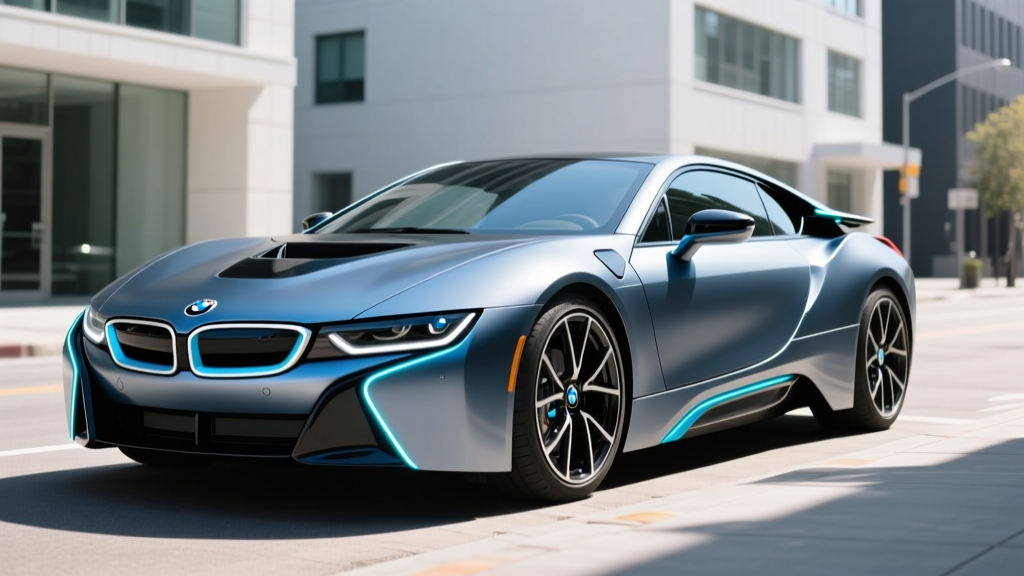
If you're searching for the BMW i8 electric car, here's the essential fact: the BMW i8 is not a fully electric vehicle (BEV). It is a plug-in hybrid (PHEV) that BMW discontinued after the 2020 model year. The i8 pairs a 1.5-liter turbocharged three-cylinder gasoline engine with an electric motor and an 11.6 kWh battery pack, delivering approximately 18 miles of electric-only range and 369 combined horsepower. There is no 2026 BMW i8 in production, and BMW has not announced a direct successor under the i8 nameplate.
Quick Answer: The BMW i8 in 2026
The BMW i8 was a PHEV sports car produced from 2014–2020. It is no longer manufactured. If you want a fully electric BMW in 2026, the closest performance-oriented options are the BMW i4 M50 (EPA range up to 270 miles, starting ~$67,000) or the BMW iX M60 (EPA range up to 296 miles, starting ~$111,500). Used i8s trade between $45,000 and $90,000 depending on year, mileage, and condition.
What the BMW i8 Actually Is (and Isn't)
The BMW i8 occupied a unique niche: a futuristic-looking sports car with plug-in hybrid capability. Under its carbon-fiber-reinforced plastic body sat a mid-mounted 1.5L turbo three-cylinder engine driving the rear wheels (228 hp) and an electric motor driving the front wheels (141 hp), for a combined system output of 369 hp and 420 lb-ft of torque.
The 11.6 kWh lithium-ion battery (approximately 9.4 kWh usable) provided an EPA-rated 18 miles of electric-only range in the final model years. Combined fuel economy with the engine running was rated at 27 mpg, or 69 MPGe when operating in electric mode. A full charge on a Level 1 (120V) outlet took roughly 4.5 hours; Level 2 (240V) charging took about 3 hours. The i8 did not support DC fast charging.
| Specification | Value |
|---|---|
| Powertrain | PHEV (1.5L turbo I3 + electric motor) |
| Combined Horsepower | 369 hp |
| Combined Torque | 420 lb-ft |
| Battery Capacity | 11.6 kWh total / ~9.4 kWh usable |
| EPA Electric-Only Range | 18 miles |
| EPA Combined MPG (gas) | 27 mpg |
| EPA MPGe (electric mode) | 69 MPGe |
| 0–60 mph | 4.2 seconds |
| Level 2 Charge Time (0–100%) | ~3 hours |
| DC Fast Charging | Not supported |
| Production Years | 2014–2020 |
The critical misconception is that the i8 was an "electric car." It was a plug-in hybrid with modest electric-only range — more comparable to a Toyota Prius Prime's philosophy than a Tesla Model 3. Buyers drawn to the i8's styling who want a true BEV from BMW need to look elsewhere in the current lineup.
Used BMW i8: 2026 Ownership Costs and Realities
If you're considering a used i8 in 2026, understand the cost landscape. Used examples typically trade between $45,000 (higher-mileage 2014–2016 models) and $90,000+ (low-mileage 2019–2020 models, especially Roadster variants). These prices place the i8 in competition with used Porsche 911s, Chevrolet Corvette C8s, and new performance EVs.
| Cost Category | Used BMW i8 (PHEV) | New BMW i4 M50 (BEV) |
|---|---|---|
| Purchase Price | $55,000–$80,000 | ~$67,000 MSRP (base) |
| Annual Fuel/Energy | ~$1,200–$1,800 (gas + electricity, 12k mi/yr) | ~$540–$720 (electricity, 12k mi/yr) |
| Annual Insurance | ~$2,400–$3,600 | ~$2,000–$2,800 |
| Annual Maintenance | ~$800–$1,500 (gas engine + hybrid system) | ~$300–$600 (BEV, no engine maintenance) |
| Federal Tax Credit (§30D) | $0 (used PHEV, over MSRP cap for used credit) | Up to $7,500 (if eligible per IRS §30D rules) |
| Battery Warranty | Expired or expiring (original 8yr/80k mi) | 8 years / 100,000 miles |
The i8's hybrid complexity means you're maintaining both a gasoline engine (oil changes, spark plugs, turbo cooling system, exhaust components) and a high-voltage electrical system. The original BMW high-voltage battery warranty was 8 years/80,000 miles. For a 2014–2016 i8, that warranty has expired. A replacement battery pack for the i8 can cost $10,000–$16,000 based on dealer parts pricing — a significant liability on a used vehicle.
By contrast, a new BMW i4 M50 qualifies for BMW's full new-vehicle warranty, 8-year/100,000-mile battery coverage, and potentially the federal tax credit (subject to income caps of $150,000 single / $300,000 joint and the vehicle meeting critical-mineral and battery-component sourcing requirements per current IRS guidance).
EV vs. Gas vs. PHEV: Where Does the i8 Fit?
The i8 was designed as a bridge technology — exotic styling and partial electrification without full range-anxiety elimination. In 2026, the landscape has shifted decisively toward full electrification for most buyers, but the right choice depends on your driving patterns and infrastructure access.
| Factor | Used BMW i8 (PHEV) | BMW i4 M50 (BEV) | Porsche 911 Carrera (Gas) |
|---|---|---|---|
| 0–60 mph | 4.2 sec | 3.7 sec | 3.8 sec |
| EPA Range / Tank Range | 18 mi electric + ~320 mi gas | 270 mi (EPA) | ~380 mi (17.9-gal tank) |
| Energy Cost per Mile | $0.10–$0.15 (blended) | $0.04–$0.06 (home charging) | $0.18–$0.25 (premium gas) |
| Home "Refueling" | Yes (Level 2, ~3 hr for full charge) | Yes (Level 2, ~8 hr for full charge) | No (gas station required) |
| Road-Trip Convenience | Excellent (gas stations everywhere) | Good (requires DC fast-charging planning) | Excellent |
| Cold-Weather Range Loss | Minimal (gas engine provides heat) | ~20–30% reduction in extreme cold | Minimal |
| Maintenance Complexity | Highest (dual powertrains) | Lowest (no engine, transmission simpler) | Moderate-High |
The data shows a clear trade-off. The i8 offers the safety net of gasoline for long trips but carries the maintenance burden of two complete powertrains. The i4 M50 delivers quicker acceleration and dramatically lower per-mile energy costs but requires charging infrastructure planning for trips exceeding 200+ miles. The conventional 911 offers the longest range and simplest refueling at the highest per-mile cost.
Real-World Ownership: What First-Time EV (or PHEV) Buyers Should Know
Whether you're eyeing a used i8 or a new BEV, these ownership realities determine satisfaction more than spec sheets:
Home charging access is the single biggest factor. If you can install a Level 2 (240V) home charger — typically a 32-amp or 48-amp unit on a dedicated circuit — daily EV or PHEV ownership is effortless. You wake up with a full charge or topped-off battery every morning. Level 2 installation costs range from $500 to $2,500 depending on your electrical panel's capacity and the run distance from panel to garage. Homes with 100-amp panels may require a $1,500–$3,000 panel upgrade to support a 48-amp charger.
Public charging reliability varies by network. As of 2026, Tesla's Supercharger network (now open to non-Tesla EVs via NACS adapter or built-in NACS port) leads in uptime and availability. Electrify America and EVgo provide broad CCS coverage but station-level reliability remains inconsistent in some regions. For a used i8 with no DC fast-charging capability, public charging means Level 2 destination chargers only — adding hours, not minutes.
Cold weather reduces battery range. All lithium-ion batteries lose efficiency in cold temperatures. BEVs typically see 20–30% range reduction below 20°F due to increased battery resistance and cabin heating demands. The i8's gasoline engine mitigates this for long winter drives but its 18-mile electric range may shrink to 12–14 miles in deep cold.
Insurance costs are higher for both PHEVs and BEVs compared to comparable gas vehicles, typically 15–30% more, due to higher repair costs for battery and power-electronics damage. Get quotes before purchasing.
BMW's 2026 Electric Alternatives to the i8
If the i8's mission was "futuristic BMW performance with electrification," BMW's 2026 lineup fulfills that brief with fully electric options:
BMW i4 M50: 536 hp, 0–60 in 3.7 seconds, EPA range up to 270 miles, 84.3 kWh battery (NMC chemistry), DC fast charging at up to 205 kW (10–80% in approximately 31 minutes). Starting MSRP around $67,000. This is the closest spiritual successor to the i8's performance mission in a practical package.
BMW iX M60: 610 hp, 0–60 in 3.6 seconds, EPA range up to 296 miles, 111.5 kWh battery, DC fast charging at up to 200 kW (10–80% in approximately 34 minutes). Starting MSRP around $111,500. For buyers who wanted the i8's exotic presence in a larger, all-electric SUV form factor.
BMW i7 xDrive50: 536 hp, EPA range up to 318 miles, starting around $120,000. The luxury flagship that the i8's premium aspirations pointed toward.
All current BMW EVs use the NACS charging standard (as of the 2025 model year transition), granting access to Tesla Supercharger stations alongside BMW's own charging partnerships. All carry the standard 8-year/100,000-mile high-voltage battery warranty with a capacity-retention threshold of 70%.
Decision Framework: Should You Buy a Used i8 or Go Fully Electric?
If-Then Decision Guide
Buy a used BMW i8 if:
- You want exotic styling and a conversation-piece vehicle under $80,000
- Your daily commute is under 18 miles round-trip and you can charge at home
- You take frequent road trips to areas with sparse charging infrastructure
- You accept higher maintenance costs as the trade-off for dual-powertrain versatility
- You understand the high-voltage battery warranty has likely expired
Buy a new BMW i4 M50 (or other BEV) if:
- You want a warranty-backed vehicle with modern range (250+ miles)
- You can install Level 2 home charging
- You want the lowest per-mile energy cost (~$0.04–$0.06/mile with home charging)
- You want to potentially qualify for the federal §30D tax credit (up to $7,500 at point of sale, subject to IRS income and sourcing requirements)
- You prefer minimal maintenance (no oil changes, no spark plugs, no exhaust system)
Consider a modern PHEV (BMW X5 xDrive50e, etc.) if:
- You want 30–40 miles of electric-only range for daily commuting
- You frequently drive 400+ miles in a day and don't want to plan charging stops
- You live in an area with limited public charging infrastructure
Common i8 and EV Misconceptions — Fact-Checked
| Myth | Fact |
|---|---|
| "The BMW i8 is a fully electric car." | The i8 is a plug-in hybrid (PHEV) with 18 miles of electric range plus a gasoline engine. It is not a BEV. |
| "There's a new 2026 BMW i8." | BMW discontinued the i8 after the 2020 model year. No direct successor under the i8 nameplate has been announced or released as of 2026. |
| "The i8 qualifies for the $7,500 federal EV tax credit." | Even when new, the i8's MSRP exceeded the §30D cap for sedants ($55,000). As a used vehicle, it would need to meet the $25,000 used-vehicle cap and buyer income limits, which most examples do not. |
| "PHEVs are always the best of both worlds." | PHEVs carry the maintenance burden of two powertrains. If you rarely plug in, you're hauling dead battery weight. If you always plug in, you're maintaining an engine you rarely use. |
| "EVs need battery replacement every few years." | Modern EV batteries (NMC and LFP) are designed for 200,000+ miles with gradual degradation. Most retain 85–90% capacity after 100,000 miles based on fleet data. Warranties cover 8 years/100,000 miles minimum at 70% capacity retention. |
| "Home charging is too expensive to install." | A basic Level 2 (32-amp) installation on an existing 200-amp panel typically costs $500–$1,200. Many utilities offer rebates of $200–$500 for charger installation. |
Frequently Asked Questions
Is BMW making a new i8 electric car?
As of 2026, BMW has not announced a new i8. The original i8 ended production in 2020. BMW's electrified performance focus has shifted to the i4 M50, iX M60, and upcoming Neue Klasse platform vehicles. Rumors of an i8 successor surface periodically but nothing is confirmed or available for purchase.
How much does a used BMW i8 cost in 2026?
Used BMW i8 prices range from approximately $45,000 for higher-mileage 2014–2016 coupes to $90,000+ for low-mileage 2019–2020 Roadster models. Average transaction prices cluster around $55,000–$70,000. Values have stabilized after initial steep depreciation from the original $147,500+ MSRP.
Can I drive a BMW i8 on electric power only?
Yes, but only for about 18 miles (EPA-rated) at speeds up to 75 mph. After the 9.4 kWh usable battery is depleted, the gasoline engine engages automatically. In real-world mixed driving with climate control active, expect 14–16 miles of electric-only range before the engine starts.
What is the BMW i8's fuel economy compared to a fully electric car?
The i8 is rated at 27 mpg combined when the gas engine is active and 69 MPGe in electric mode. A comparable BEV like the BMW i4 eDrive40 achieves 109 MPGe combined (per EPA data on fueleconomy.gov). In pure energy cost terms, the BEV costs roughly $0.04–$0.06 per mile on home electricity versus the i8's blended $0.10–$0.15 per mile.
Is the BMW i8 battery expensive to replace?
Yes. A replacement high-voltage battery pack for the BMW i8 costs approximately $10,000–$16,000 through BMW dealerships. The original 8-year/80,000-mile battery warranty has expired on 2014–2017 models. Third-party hybrid battery repair shops may offer cell-level repairs for $3,000–$6,000, but availability varies. This is a significant financial risk when buying a used i8.
Should I buy a used i8 or a new electric BMW?
It depends on your priorities. The used i8 offers exotic design and collectibility at a fraction of its original price, but with expired warranties, dual-powertrain maintenance costs, and only 18 miles of electric range. A new BMW i4 M50 offers superior performance (3.7s vs 4.2s 0–60), 270 miles of range, full warranty coverage, potential tax-credit eligibility, and dramatically lower operating costs. For most buyers seeking electrified BMW performance, the new BEV is the more rational choice.