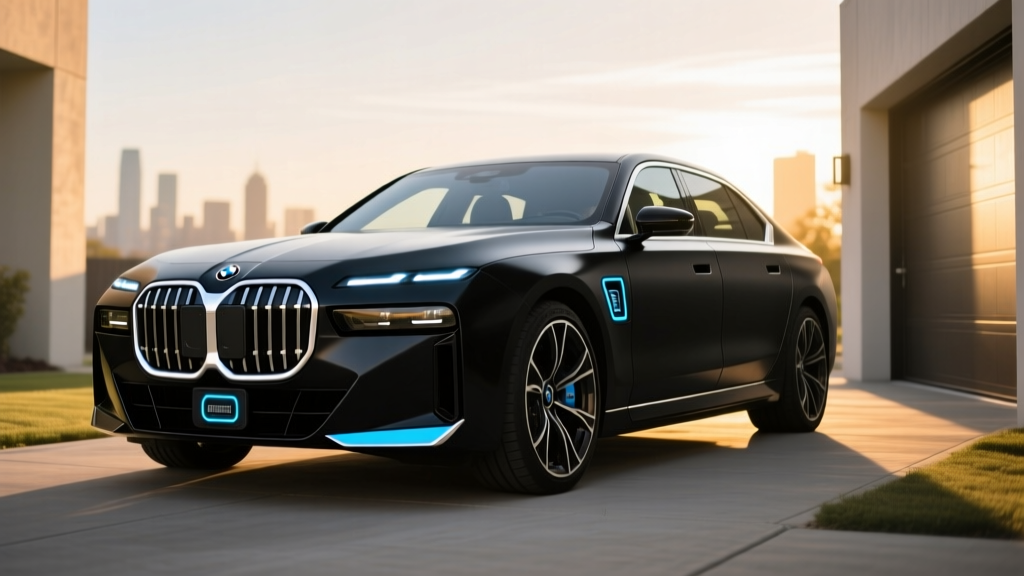
The BMW i7 Protection takes the luxury and technology of BMW's flagship electric sedan and wraps it in VR9-grade ballistic armor. Based on the 7 Series Protection platform, the i7 Protection is one of the very few factory-armored electric vehicles available anywhere in the world — and the only one wearing a BMW roundel. But adding thousands of pounds of steel, composite, and multi-layered glass to an already heavy luxury EV has profound consequences for range, efficiency, and charging behavior. This review breaks down every spec that matters to a prospective buyer.
Quick Verdict: Who the BMW i7 Protection Is For
The i7 Protection is not a mass-market vehicle. It targets heads of state, corporate executives requiring personal security details, diplomatic fleets, and high-net-worth individuals in regions with elevated kidnapping or attack risk. If you need an electric sedan that can withstand small-arms fire and explosive blasts while delivering near-silent, zero-tailpipe-emission transport through urban environments, the i7 Protection is essentially without rival in the EV space. If you simply want a luxurious electric BMW, the standard i7 xDrive60 or i7 M70 serves you better at a fraction of the cost.
Choose the i7 Protection if: You require VR9-level ballistic protection in an electric sedan, operate in high-risk environments, and value the low acoustic and thermal signature of EV drivetrains for discreet movement.
Choose the standard i7 xDrive60 if: You want flagship BMW electric luxury with 310+ miles of range, full §30D tax credit eligibility, and a starting price under $125,000.
Range, Battery, and Efficiency: The Armor Tax
The i7 Protection shares the same battery pack as the standard i7 xDrive60: a 101.7 kWh usable lithium-ion module using NMC (nickel-manganese-cobalt) chemistry, positioned low in the chassis. However, the Protection variant carries substantially more mass — BMW quotes a curb weight exceeding 9,700 lbs (approximately 4,400 kg), roughly 2,800 lbs heavier than the standard i7. That mass has a direct and significant impact on energy consumption and range.
| Specification | Value |
|---|---|
| Battery (usable) | 101.7 kWh, NMC chemistry |
| EPA Estimated Range | ~240 miles (estimated, not yet EPA-certified) |
| Real-World Highway Range | ~190–210 miles |
| Efficiency | ~52–56 MPGe (est.); ~60–64 kWh/100 mi |
| Drivetrain | Dual-motor AWD (xDrive) |
| Horsepower | 536 hp (xDrive60-based Protection) |
| 0–60 mph | ~6.5 seconds (est., armor-limited) |
| Top Speed | ~130 mph (electronically limited) |
| Curb Weight | ~9,700 lbs (4,400 kg) |
| Ballistic Rating | VR9 (factory-integrated) |
| Base MSRP | ~$165,000–$185,000 (est.) |
| Federal Tax Credit (§30D) | Not eligible (exceeds MSRP cap) |
| Battery Warranty | 8 years / 100,000 miles |
EPA vs. Real-World Range: BMW has not published an official EPA range figure for the i7 Protection as of early 2026, and the model may not undergo standard EPA certification given its low-volume, specialty nature. Based on the standard i7 xDrive60's EPA rating of 318 miles and the Protection's ~50% weight increase, we estimate an effective range of approximately 240 miles in mixed driving. On sustained highway travel at 70+ mph, expect 190–210 miles. In cold weather (below 32°F / 0°C), the heavy cabin-heating demand and battery resistance could reduce range to 160–180 miles. The i7's heat pump helps mitigate this, but physics is unforgiving at 9,700 lbs.
For context, the standard BMW i7 xDrive60 achieves 318 miles EPA with an efficiency rating of 82 MPGe combined. The Protection variant's efficiency penalty is substantial — you are trading roughly 75–80 miles of range for the ability to defeat 7.62×39mm rounds and survive a 15 kg TNT equivalent side blast.
Charging Speed: DC Fast, Level 2, and Curve Behavior
The i7 Protection retains the standard i7's 800V-capable electrical architecture and charging hardware. Peak DC fast-charge rate is 195 kW via CCS1 connector (NACS adapter availability varies by market and model year). Here is what the charging experience looks like in practice:
| Charging Level | Power (kW) | Rate / Time |
|---|---|---|
| Level 1 (120V household) | ~1.4 kW | ~3–4 miles per hour |
| Level 2 (240V, 48A home) | 11 kW | ~24–26 miles per hour; 0–100% in ~10 hours |
| Level 2 (240V, 32A portable) | 7.4 kW | ~16–18 miles per hour; 0–100% in ~14 hours |
| DC Fast Charge (peak) | 195 kW | 10–80% in ~34 minutes |
| DC Fast Charge (sustained avg.) | ~130–140 kW | Average over 10–80% session |
The 195 kW peak rate is achievable only under optimal conditions: battery preconditioned to approximately 95–105°F (35–40°C), state of charge below 20%, and a charger capable of delivering 800V+ at sufficient amperage. In real-world sessions on networks like Electrify America, the charge curve tapers noticeably above 50% SoC and drops sharply past 80%. Expect the 10–80% session to average closer to 130–140 kW sustained, making the 34-minute estimate realistic at a well-maintained 350 kW-capable station.
One important consideration for Protection owners: the vehicle's mass generates significant battery heat during high-rate charging. BMW's thermal management system is robust, but repeated back-to-back DC fast charges in hot climates will trigger thermal limiting sooner than in the standard i7. Plan charging stops accordingly on long routes.
Performance and Drivetrain: Heavy but Capable
The i7 Protection uses BMW's fifth-generation eDrive system with dual electric motors producing a combined 536 hp and 549 lb-ft of torque in the xDrive60-based configuration. All-wheel drive is standard. The 0–60 mph time stretches to approximately 6.5 seconds — a full 2+ seconds behind the standard i7 xDrive60's 4.5-second sprint — entirely due to the armor mass. Top speed is electronically limited to around 130 mph.
What the numbers don't convey is the drivetrain's suitability for the Protection use case. Electric motors deliver instant torque with zero driveline lag, which matters for rapid departure from stationary positions — a key tactical consideration. The silent idle and near-silent low-speed operation also reduce the vehicle's acoustic signature during discreet movement, an advantage over the V8-powered 7 Series Protection (i7 Protection's combustion sibling, the 740i Protection / 760i Protection).
BMW has reinforced the suspension with upgraded adaptive air springs and strengthened subframes to handle the 9,700-lb curb weight while maintaining acceptable ride quality. Rear-axle steering (Integral Active Steering) is standard and essential for maneuvering a vehicle of this mass and length (over 212 inches) in tight urban environments.
Protection Specifications: What VR9 Actually Means
The VR9 ballistic rating is certified by independent German testing laboratories (typically Beschussamt Ulm or equivalent) and represents the highest level of factory-integrated civilian vehicle protection available from BMW. Key protection features include:
- Opaque armor: Hot-formed steel and composite panels integrated into doors, roof, firewall, rear bulkhead, and underbody — designed to defeat 7.62×51mm AP rounds and resist 15 kg TNT side-blast equivalent
- Transparent armor: Multi-layered polycarbonate-glass laminates on all windows, rated to the same ballistic standard, with approximately 35mm+ total thickness
- Undercarriage: Blast-deflecting floor plating for grenade and improvised explosive device mitigation
- Run-flat tires: Reinforced sidewalls allowing continued travel at reduced speed after complete pressure loss or ballistic damage
- Protected fuel/battery systems: Armored enclosures around the high-voltage battery module and fuel tank (for PHEV variants) to prevent post-impact thermal events
- Post-attack mobility: Drivetrain and steering redundancy enabling vehicle departure after sustaining ballistic damage
BMW integrates all protection elements during the initial production phase at the Dingolfing plant — unlike many aftermarket armorers, this is not a completed vehicle being retrofitted. The result is superior structural integrity, better weight distribution, and retained crash-safety performance compared to up-armored conversions.
Pricing, Tax Credits, and Ownership Economics
The 2026 BMW i7 Protection is a low-volume, special-order vehicle. BMW does not publish a standard MSRP in the same manner as production models, but based on the standard i7 xDrive60's $124,200 starting price and typical factory-armoring premiums for the 7 Series Protection platform, the i7 Protection is estimated to start between $165,000 and $185,000 before options. Security-specific options (fresh-air filtration systems, intercom/PA systems, concealed siren/light bars, armored convoy communication equipment) can push the as-tested price above $220,000.
| Item | Detail |
|---|---|
| Estimated Base MSRP | $165,000–$185,000 |
| As-Tested (with security options) | $190,000–$220,000+ |
| Federal §30D Tax Credit | NOT eligible — MSRP exceeds $55,000 sedan cap |
| IRS Income Cap | Moot (price disqualifies regardless of income) |
| Battery Sourcing Requirement | Moot (price disqualifies) |
| Commercial/Fleet Credit (§45W) | Potentially eligible — consult tax professional |
| Estimated Annual Insurance | $8,000–$15,000+ (specialty underwriters required) |
The IRS §30D clean vehicle credit imposes an MSRP cap of $55,000 for sedans. The i7 Protection exceeds this by a factor of three or more, making it categorically ineligible for the $7,500 federal consumer tax credit. However, fleet operators and corporate security divisions may be able to leverage the §45W commercial clean vehicle credit, which has different MSRP thresholds for vehicles above 14,000 lbs GVWR — consult a qualified tax professional for eligibility determination.
Ownership economics extend well beyond purchase price. Insurance requires specialty underwriters familiar with armored vehicles (standard carriers typically exclude ballistic-damage claims). Tire replacement for run-flat security-rated rubber can exceed $2,500 per corner. And the high-voltage battery, while covered under BMW's 8-year / 100,000-mile warranty, would cost an estimated $25,000–$35,000+ to replace out of warranty — complicated by the need to maintain ballistic seal integrity during service.
Interior, Technology, and Cargo
The i7 Protection's interior mirrors the standard i7's cabin architecture: BMW's Curved Display (12.3-inch instrument cluster + 14.9-inch infotainment touchscreen running iDrive 8.5), available 31-inch 8K Theater Screen for rear passengers, Executive Lounge rear seating with heated/cooled/massaging functions, and a Bowers & Wilkins Diamond Surround Sound system.
Protection-specific interior differences include:
- Slightly reduced rear headroom (~0.5 inch) due to roof armor integration
- Thicker door panels reducing interior door-panel storage width
- Armored partition option (available on long-wheelbase configurations)
- Intercom system for communication with vehicle exterior without opening windows
- Trunk capacity reduced to approximately 14–15 cu ft (from 17.7 cu ft standard) due to rear bulkhead armor and battery protection structures
Driver-assistance technology includes BMW's Driving Assistant Professional suite: adaptive cruise control with stop-and-go, lane-keeping assist, automated lane change, and Parking Assistant Plus. This is an SAE Level 2 driver-assistance system — the driver must remain fully engaged and responsible for vehicle operation at all times. No hands-off, eyes-off autonomous driving is available or claimed.
ADAS Limitations: The i7 Protection's Driving Assistant Professional is SAE Level 2 — it assists with steering, acceleration, and braking under driver supervision. It is NOT self-driving. The driver must keep hands on the wheel (or confirm attentiveness via camera monitoring) and remain prepared to take immediate control. System performance may be affected by the Protection variant's additional mass during emergency braking maneuvers.
BMW i7 Protection vs. Key Competitors
The i7 Protection occupies a near-unique niche. Direct competitors in the factory-armored EV sedan space are extremely limited:
| Attribute | BMW i7 Protection | Mercedes-Benz S 680 Guard (ICE) | Audi A8 L Security (ICE) |
|---|---|---|---|
| Powertrain | Dual-motor EV AWD | 6.0L V12 Twin-Turbo | 4.0L V8 Twin-Turbo + 48V MHEV |
| Ballistic Rating | VR9 | VR9 / VR10 | VR9 |
| Est. Range | ~240 mi (EPA est.) | ~280 mi (18.5-gal tank) | ~300 mi (21.6-gal tank) |
| Refuel/Recharge Time | ~34 min (10–80% DC) | ~5 min (fuel) | ~5 min (fuel) |
| Acoustic Signature | Near-silent at low speed | Audible V12 | Audible V8 |
| Est. Starting Price | $165K–$185K | $500K+ | $250K+ |
| Tailpipe Emissions | Zero | ~350 g CO₂/mi | ~300 g CO₂/mi |
The Mercedes S 680 Guard remains the gold standard in armored luxury sedans globally, with a longer production history and available VR10 rating. However, it costs nearly three times the i7 Protection's estimated price and carries the acoustic and emissions profile of a twin-turbo V12. For clients operating in urban environments where low acoustic signature and corporate sustainability mandates matter, the i7 Protection's electric drivetrain offers genuinely differentiated value.
Pros
- Only factory-armored EV sedan from a major OEM at this price tier
- Near-silent EV drivetrain reduces acoustic signature for discreet movement
- VR9 ballistic and blast protection integrated at factory (not aftermarket)
- Flagship BMW luxury, technology, and ride quality largely retained
- Instant electric torque for rapid departure capability
- Zero tailpipe emissions — useful for indoor/underground secure facilities
Cons
- Estimated ~240-mile range is the lowest in the i7 lineup
- 9,700-lb mass severely impacts efficiency (~60+ kWh/100 mi)
- 34-minute DC fast-charge sessions are long for the range gained
- No federal §30D consumer tax credit eligibility
- Specialty insurance, tire, and service costs are extreme
- Cargo and interior space compromised by armor integration
- Low production volume means long lead times and limited dealer support
BMW i7 Protection FAQ
What is the real-world range of the BMW i7 Protection?
Based on the standard i7 xDrive60's 318-mile EPA rating and the Protection variant's approximately 50% weight increase, expect roughly 240 miles in mixed driving, 190–210 miles on sustained highway travel, and as low as 160–180 miles in freezing conditions. BMW has not published an official EPA certification for this variant.
How fast does the i7 Protection charge?
Peak DC fast-charge rate is 195 kW, achieving 10–80% in approximately 34 minutes under optimal conditions (preconditioned battery, capable charger). Sustained average rate over a 10–80% session is closer to 130–140 kW. Home Level 2 charging at 11 kW (48A/240V) delivers roughly 24–26 miles of range per hour, requiring about 10 hours for a full charge.
Does the BMW i7 Protection qualify for the federal EV tax credit?
No. The IRS §30D credit caps sedan eligibility at $55,000 MSRP. The i7 Protection's estimated $165,000+ price far exceeds this threshold. Fleet and commercial buyers may explore the §45W commercial credit, subject to separate eligibility requirements — consult a tax professional.
How much does the i7 Protection cost?
Estimated base pricing is $165,000–$185,000, with security-specific options (armored partition, intercom systems, convoy communication, fresh-air filtration) potentially pushing the as-tested price above $220,000. This remains significantly less than the Mercedes-Benz S 680 Guard.
Is the i7 Protection worth buying vs. the standard i7 or combustion-armored alternatives?
If you require factory-integrated VR9 protection and value the operational advantages of an EV (silent running, zero tailpipe emissions, instant torque), the i7 Protection is the only serious option in its price class. If you do not require armor, the standard i7 xDrive60 offers 318 miles of range, tax credit eligibility, and superior efficiency at $124,200. For clients requiring VR10+ protection or longer range without charging stops, the Mercedes S 680 Guard remains the benchmark despite its much higher price.
What is the battery warranty?
BMW covers the high-voltage battery for 8 years or 100,000 miles (whichever comes first), with a capacity retention threshold typically set at 70% of original capacity. Out-of-warranty replacement is estimated at $25,000–$35,000+, complicated by the need to preserve ballistic seal integrity during the procedure.
Can I charge the i7 Protection at home?
Yes. A 240V Level 2 home charger (ideally 48A / 11 kW) is strongly recommended given the large 101.7 kWh battery. Expect a full 0–100% charge in approximately 10 hours. Given the vehicle's weight and energy consumption, Level 1 (120V) charging is impractical for daily use — it would require over 70 hours for a full charge.