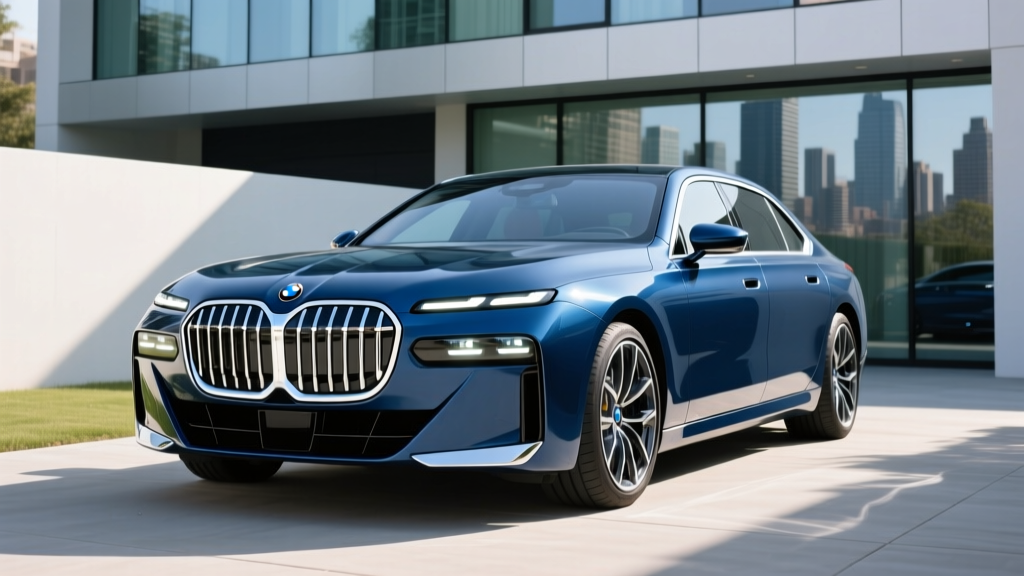
If you've been searching for BMW i7 lease deals, you're likely weighing whether BMW's flagship electric sedan justifies its six-figure sticker — or whether a well-structured lease can make it surprisingly attainable. The 2026 BMW i7 is a full-size luxury EV that competes directly with the Mercedes-Benz EQS, Lucid Air, and Tesla Model S, offering a plush cabin, advanced driver assists, and genuine long-distance capability. This review breaks down every number you need — from real-world range to charging curves to lease economics — so you can negotiate with confidence.
2026 BMW i7 Quick Spec Overview
| Specification | xDrive50 | M70 xDrive |
|---|---|---|
| EPA Range | 318 miles | 295 miles |
| Battery (usable) | 101.6 kWh (NMC) | 101.6 kWh (NMC) |
| Drivetrain | Dual-motor AWD | Dual-motor AWD |
| Horsepower | 536 hp | 650 hp |
| 0–60 mph | 4.5 seconds | 3.5 seconds |
| Peak DC Fast Charge | 195 kW | 195 kW |
| 10–80% DC Charge Time | ~34 minutes | ~34 minutes |
| Level 2 Home Charge Rate | 11 kW (~30 mi/hr) | 11 kW (~30 mi/hr) |
| MPGe (Combined) | 82 MPGe | 75 MPGe |
| kWh/100 mi | 41 kWh | 45 kWh |
| Base MSRP (2026) | $120,675 | $169,375 |
| Battery Warranty | 8 yr / 100,000 mi | 8 yr / 100,000 mi |
EPA Range vs. Real-World Expectations
EPA Estimated Range: 318 miles (xDrive50) / 295 miles (M70)
Real-World Expectation: In mixed highway-and-city driving at 70–75 mph, expect roughly 270–290 miles from the xDrive50 and 250–270 miles from the M70. In cold weather (below 30°F), range can drop 20–30%, putting the xDrive50 closer to 220–255 miles on a full charge. The i7's heat pump helps mitigate winter losses compared to EVs without one, but a 5,400-pound sedan pushing through cold, dense air will always consume more energy.
The 101.6 kWh usable battery pack (105.7 kWh gross) uses NMC (nickel manganese cobalt) chemistry, which offers high energy density suited to a large luxury sedan. This is not an LFP pack — BMW prioritized range and performance over the lower cost and longer cycle life that LFP provides. For a flagship vehicle driven 10,000–15,000 miles per year, NMC's energy density advantage outweighs LFP's longevity edge.
Efficiency varies meaningfully between trims. The xDrive50 achieves 82 MPGe combined (41 kWh/100 mi) according to the EPA, while the M70's more aggressive tuning and stickier tires drop it to 75 MPGe (45 kWh/100 mi). On a road trip, that 4 kWh/100 mi difference adds up — roughly 12 extra kWh consumed every 300 miles in the M70.
Charging Speed: DC Fast, Level 2, and the Curve
| Charging Level | Power (kW) | Speed (miles/hr) | Notes |
|---|---|---|---|
| Level 1 (120V) | ~1.4 kW | ~3–4 mi/hr | Emergency/trickle only |
| Level 2 (240V, 48A) | 11 kW | ~30 mi/hr | Full charge in ~10 hours |
| DC Fast Charge (peak) | 195 kW | ~550 mi/hr (peak) | 10–80% in ~34 min |
The i7's 195 kW peak DC fast-charging rate is respectable but not class-leading. The Hyundai Ioniq 5 peaks at 240 kW, and the Lucid Air can accept over 300 kW under ideal conditions. However, peak kW tells only part of the story. BMW's thermal management system maintains a relatively flat charge curve from 10% to about 60% SoC, meaning the i7 sustains close to its peak rate longer than some competitors that spike and taper aggressively.
In practice, a 10–80% session on a 350 kW Electrify America or Tesla Supercharger (with NACS adapter) takes approximately 34 minutes. Above 80%, charging slows significantly — expect another 25–30 minutes to reach 100%. For road trips, plan your stops around 10–80% sessions and skip the top-off unless you're parking overnight.
For home charging, the i7 accepts up to 11 kW on Level 2 (48 amps at 240V). An overnight session from 20% to 100% takes roughly 10 hours — easily achievable if you plug in when you get home. You'll need a 60-amp dedicated circuit and a hardwired Level 2 station (such as a ChargePoint Home Flex or BMW's own Wallbox). Budget $800–$2,000 for professional installation depending on your electrical panel's proximity to the parking spot and whether a panel upgrade is required.
Performance, Ride, and Daily Livability
The xDrive50's dual-motor all-wheel-drive powertrain produces 536 horsepower and launches the i7 to 60 mph in 4.5 seconds — brisk for a sedan that weighs over 5,800 pounds. The M70 cranks that up to 650 hp and 3.5 seconds, which borders on supercar territory for a vehicle with executive rear seating.
Ride quality is where the i7 earns its flagship badge. Standard adaptive air suspension with automatic self-leveling absorbs highway imperfections with genuine authority. The optional Executive Lounge Seating package ($3,700) adds reclining, massaging rear seats with calf rests — a legitimate alternative to first-class air travel for shorter routes.
Cargo and passenger dimensions:
- Trunk volume: 17.7 cu ft (no frunk)
- Rear legroom: 42.8 inches
- Front legroom: 41.2 inches
- Overall length: 212.2 inches
The absence of a frunk is a notable omission for an EV — BMW uses that space for HVAC and power electronics. The 17.7 cu ft trunk is adequate for luggage but trails the Mercedes EQS's 22 cu ft and the Lucid Air's 32 cu ft combined cargo volume.
Pricing, Lease Deals, and Federal Tax Credit Eligibility
The 2026 BMW i7 lineup starts at $120,675 for the xDrive50 and climbs to $169,375 for the M70 — before options. Commonly added packages (Driving Assistance Professional, Executive Lounge, Bowers & Wilkins audio) push a well-equipped xDrive50 to $135,000–$145,000.
| Trim | Base MSRP | As-Tested (Typical) | Federal Credit Eligibility |
|---|---|---|---|
| xDrive50 | $120,675 | $135,000–$145,000 | See §30D rules below |
| M70 xDrive | $169,375 | $180,000+ | See §30D rules below |
Federal EV Tax Credit (§30D) — Key Rules for 2026:
- MSRP Cap: Sedans must be under $55,000 MSRP to qualify. The i7, as a sedan priced above $120,000, does not qualify for the $7,500 new-vehicle credit under current IRS rules.
- Income Cap: AGI limits apply ($150K single / $300K joint) — moot here given the MSRP cap exclusion.
- Battery Sourcing: Critical mineral and battery component requirements phase in annually through 2029.
- Lease Loophole (§45W): Commercial clean vehicle credit may apply to the leasing entity (BMW Financial Services), who may pass savings to the lessee as a capitalized-cost reduction — typically $2,000–$7,500 depending on the deal. Ask your dealer explicitly whether the lease includes a pass-through credit.
- Point-of-Sale Transfer: If eligible, the credit can be applied at purchase to reduce out-of-pocket cost — but again, the i7 exceeds the sedan MSRP cap.
For the latest eligibility rules, consult IRS Publication on New Clean Vehicle Credits or speak with a tax professional.
Why leasing may be the smartest move: Even without the direct §30D credit, leasing an i7 offers advantages. You avoid the steepest depreciation hit (luxury EVs can lose 40–50% of value in three years), you're covered under BMW's full warranty for the lease term, and BMW Financial Services occasionally subsidizes money factors on slow-selling trims. Target a 36-month lease at 10,000 miles/year and negotiate the capitalized cost down from MSRP — current market data shows xDrive50 leases in the $1,400–$1,800/month range depending on down payment and regional incentives.
Technology, Driver Assists, and Standout Features
The i7 runs BMW's iDrive 8.5 on a curved display panel (12.3-inch instrument cluster + 14.9-inch central touchscreen). The system is responsive and logically structured, though some climate and seat-heating controls buried in submenus require more taps than physical buttons would.
The 31-inch BMW Theater Screen (standard on M70, optional on xDrive50) drops from the ceiling for rear passengers, offering 8K streaming via built-in Amazon Fire TV — a genuine differentiator for chauffeured executives or families on long drives.
Driver assistance (SAE Level 2): The available Driving Assistance Professional package includes Highway Assistant — BMW's hands-free driving system valid at speeds up to 85 mph on divided highways. This is a Level 2 system, meaning you must remain attentive and keep your eyes on the road (monitored via an infrared camera). It is not autonomous driving. The system handles lane centering, adaptive cruise, and lane changes competently, but construction zones and faded lane markings still require manual takeover.
ADAS Limitation Notice: Highway Assistant is an SAE Level 2 driver-assist feature. The driver must remain fully engaged, monitor the roadway, and be prepared to take over immediately. This is not self-driving. Automated lane changes require driver confirmation via turn signal stalk.
How the BMW i7 Compares to Key Rivals
| Attribute | BMW i7 xDrive50 | Mercedes EQS 580 | Lucid Air Pure |
|---|---|---|---|
| EPA Range | 318 mi | 371 mi | 419 mi |
| Battery (usable) | 101.6 kWh | 108.4 kWh | 88 kWh |
| Peak DC Charge | 195 kW | 200 kW | 250 kW |
| 0–60 mph | 4.5 sec | 4.1 sec | 5.0 sec |
| Rear Legroom | 42.8 in | 42.0 in | 38.3 in |
| Base MSRP | $120,675 | $105,550 | $69,900 |
| Theater Screen | Yes (31 in) | No (MBUX Hyperscreen) | No |
The EQS wins on range and price; the Lucid Air wins on range and efficiency by a wide margin. The i7's edge is rear-seat luxury and cabin execution — BMW's materials, sound insulation, and available Executive Lounge package are genuinely a cut above. If you're the one in the back seat, the i7 is the strongest choice. If you're the driver who prioritizes range-per-dollar, the Lucid Air Pure is hard to beat.
Pros
- Exceptional ride quality with standard air suspension
- Best-in-class rear-seat luxury (Theater Screen, Executive Lounge)
- Strong straight-line performance (536–650 hp)
- Quiet, well-insulated cabin at highway speeds
- Competent Level 2 Highway Assistant up to 85 mph
Cons
- Exceeds $55K sedan MSRP cap — no §30D tax credit
- No front trunk (frunk) for extra cargo
- DC charging peaks at 195 kW — slower than Lucid Air or Ioniq 5
- Heavy: 5,800+ lbs affects tire wear and efficiency
- Steep depreciation curve hurts resale value
Who Should Lease the BMW i7?
Choose the BMW i7 if:
- You want a chauffeur-grade luxury sedan and regularly carry rear-seat passengers
- You can charge at home and your daily commute is under 200 miles
- You prefer leasing to avoid luxury EV depreciation risk
- You value cabin materials, silence, and ride quality above maximum range
Look elsewhere if:
- Range-per-dollar is your top priority (consider Lucid Air Pure)
- You need maximum cargo space (consider EQS SUV or Tesla Model X)
- You want to buy and hold for 8+ years (depreciation risk is steep)
- You lack reliable home or workplace charging access
BMW i7 Warranty and Long-Term Ownership
BMW covers the i7's high-voltage battery for 8 years or 100,000 miles (whichever comes first), guaranteeing at least 70% capacity retention during that period. The limited vehicle warranty is 4 years/50,000 miles, and complimentary scheduled maintenance is included for 3 years/36,000 miles.
NMC battery degradation in the i7 is expected to be moderate — roughly 8–12% loss over the first 100,000 miles based on data from BMW's iX (which shares the same battery architecture). Regular DC fast charging, extreme heat exposure, and consistently charging to 100% accelerate degradation. For daily driving, BMW recommends setting a charge limit of 80–90% and only charging to full before long trips.
If you plan to own beyond the lease term or warranty period, note that a full high-voltage battery replacement for the i7 is estimated at $25,000–$35,000 at current pricing — a significant out-of-warranty risk that further supports the leasing case.
Frequently Asked Questions
What is the real-world range of the 2026 BMW i7?
The xDrive50 achieves an EPA-estimated 318 miles, but expect 270–290 miles in real-world highway driving and 220–255 miles in cold weather below 30°F. The M70 drops to roughly 250–270 miles in mixed conditions.
How fast does the BMW i7 charge at home and on the road?
On a Level 2 home charger (11 kW), the i7 gains about 30 miles of range per hour, with a full charge taking ~10 hours. On a DC fast charger, it peaks at 195 kW and charges from 10–80% in approximately 34 minutes.
Does the BMW i7 qualify for the $7,500 federal EV tax credit?
No. Under current IRS §30D rules, the new-vehicle credit is capped at $55,000 MSRP for sedans. The i7 starts at $120,675 and is ineligible. However, the commercial vehicle credit (§45W) may allow leasing companies to pass partial savings to lessees — confirm with your dealer.
Is the BMW i7 worth leasing over buying?
For most buyers, yes. Luxury EVs depreciate heavily (40–50% over 3 years), and the i7's out-of-warranty battery replacement cost ($25K–$35K) is a significant long-term risk. A 36-month lease keeps you under full warranty and lets you upgrade to the next generation.
How does the i7 compare to the Mercedes EQS and Lucid Air?
The EQS offers more range (371 mi) at a lower starting price ($105,550). The Lucid Air Pure delivers class-leading range (419 mi) from $69,900. The i7's advantage is rear-seat luxury — the Theater Screen, Executive Lounge seating, and cabin isolation are best-in-class. If rear-seat comfort matters most, the i7 wins; for range-per-dollar, the Lucid Air leads.
What charger do I need at home for the BMW i7?
A hardwired Level 2 station capable of 48 amps (11 kW) on a dedicated 60-amp circuit. BMW's Wallbox or the ChargePoint Home Flex are popular choices. Installation typically costs $800–$2,000 depending on electrical panel proximity and whether an upgrade is needed.
Sources: EPA Fuel Economy, IRS Clean Vehicle Credits, BMW USA official specifications.