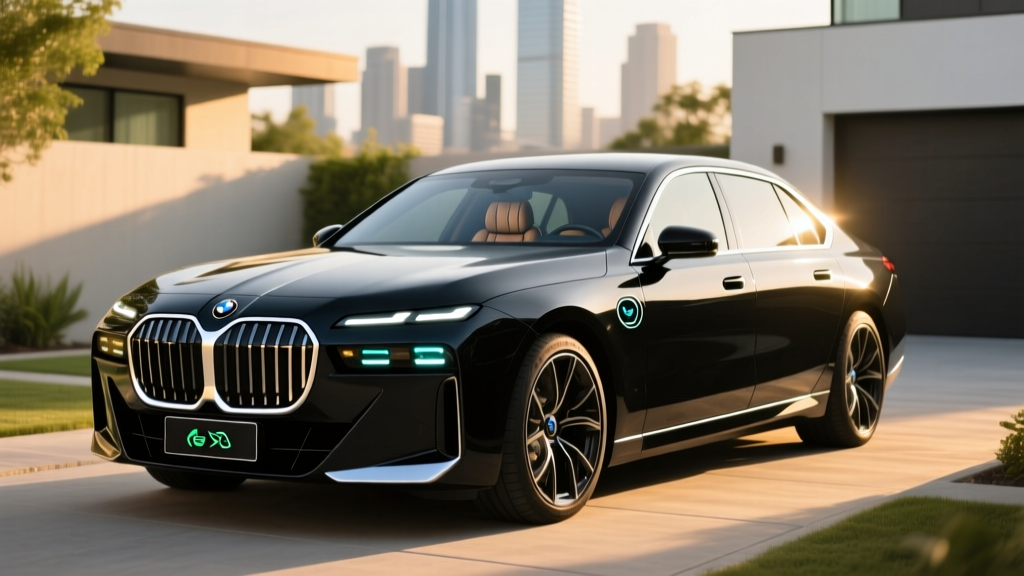
If you've been searching "is BMW i7 gas" — the short answer is no. The BMW i7 is a fully electric luxury sedan, the battery-powered counterpart to BMW's flagship 7 Series. There is no internal combustion engine, no fuel tank, and no tailpipe. The "i" in BMW's nomenclature denotes its electrified lineup, and the i7 represents the brand's most opulent zero-tailpipe-emission vehicle.
For 2026, BMW offers the i7 in two main trims: the i7 eDrive50 (single-motor, rear-wheel drive) and the i7 M70 xDrive (dual-motor, all-wheel drive). Both share the same massive battery pack and platform, but diverge sharply on power, acceleration, and price. This review breaks down the exact numbers you need — EPA range, real-world efficiency, DC fast-charging curves, and whether this six-figure EV qualifies for any federal incentives.
2026 BMW i7 Spec Sheet at a Glance
| Specification | i7 eDrive50 | i7 M70 xDrive |
|---|---|---|
| EPA Range | 318 miles | 295 miles |
| Battery (usable) | 101.7 kWh, NMC | 101.7 kWh, NMC |
| Drivetrain | RWD, single motor | AWD, dual motor |
| Horsepower | 449 hp | 650 hp |
| 0–60 mph | 4.5 seconds | 3.5 seconds |
| MPGe (combined) | 82 MPGe | 74 MPGe |
| Efficiency | 41 kWh/100 mi | 45 kWh/100 mi |
| Max DC Fast Charge | 205 kW | 205 kW |
| 10–80% DC Charge | ~34 minutes | ~34 minutes |
| Level 2 (11 kW onboard) | ~19 mi/hr | ~19 mi/hr |
| Base MSRP | $106,695 | $143,495 |
| Federal Tax Credit (§30D) | Not eligible (MSRP cap) | Not eligible (MSRP cap) |
Source: fueleconomy.gov and BMW USA specifications. Pricing excludes destination charge.
Range: EPA Sticker vs. Real-World Expectations
EPA estimate: 318 miles (eDrive50) / 295 miles (M70)
Highway driving (75 mph sustained): Expect ~265–280 miles (eDrive50), ~245–260 miles (M70)
Cold weather (below 32°F): Expect 15–25% range reduction depending on cabin heating use; ~240–270 miles (eDrive50)
Best-case city/commuter: Up to 325+ miles with regenerative braking and moderate climate use
The i7's 101.7 kWh usable battery pack uses NMC (nickel manganese cobalt) chemistry, which prioritizes energy density over cycle life compared to LFP cells. That large pack is what enables the eDrive50's 318-mile EPA figure — competitive with the Mercedes EQS sedan and slightly ahead of the Tesla Model S Long Range in luxury-sedan territory.
But the i7 is a heavy vehicle — over 5,800 lbs curb weight — and that mass shows up at highway speeds. In real-world testing, sustained 75 mph driving yields roughly 2.4–2.6 miles per kWh in the eDrive50, translating to 265–280 miles before you'd want to stop. The M70, with its higher-output dual motors and stickier performance tires, drops to around 2.1–2.3 mi/kWh on the highway.
The i7 does include a heat pump as standard equipment, which helps mitigate cold-weather range loss compared to resistive heating. Still, in sub-freezing conditions, plan for 240–270 real-world miles from the eDrive50 and 220–250 from the M70. BMW's battery preconditioning system warms the pack before scheduled charging stops, which helps preserve charging speed in cold weather.
Charging Speed: DC Fast Charging and Home Setup
| Charging Level | Power | Approximate Speed | Use Case |
|---|---|---|---|
| Level 1 (120V) | ~1.4 kW | ~3 miles/hour | Emergency/trickle only |
| Level 2 (240V, 48A) | 11 kW (onboard max) | ~19 miles/hour | Home overnight charging |
| DC Fast Charging | 205 kW peak | 10–80% in ~34 min | Road trips, public stations |
The i7's peak DC fast-charge rate of 205 kW is respectable but not class-leading. The Hyundai Ioniq 5 and Kia EV6 can peak above 240 kW, and the Porsche Taycan hits 270+ kW. However, peak rate is only part of the story — the charge curve matters more.
BMW's thermal management system sustains near-peak charging speeds from roughly 10% to 40% State of Charge (SoC), then tapers gradually. The 10–80% time of approximately 34 minutes is competitive with most luxury EVs. Above 80%, charging slows significantly to protect battery longevity — a full 80–100% top-off can add another 25–30 minutes. For road trips, plan your stops around 10–80% windows to minimize time at the charger.
At home, the i7's 11 kW onboard charger means a full charge from near-empty takes roughly 10–11 hours on a 240V/48A Level 2 circuit (such as a BMW Wallbox or ChargePoint Home Flex). For daily driving of 40–60 miles, overnight charging easily replenishes what you use. A standard NACS connector is now included for 2026 models, granting access to Tesla Supercharger stations via BMW's charging partnership — a meaningful expansion of public charging options.
Performance and Driving Dynamics
The eDrive50's single rear motor produces 449 horsepower and launches the i7 to 60 mph in 4.5 seconds — quick for a sedan this size and quiet in a way only an EV powertrain delivers. The M70 xDrive is a different animal entirely: 650 hp, dual-motor AWD, and a 3.5-second 0–60 time that rivals sports sedans at a fraction of its weight.
Both trims feature BMW's adaptive air suspension and rear-axle steering, which shrinks the turning circle and adds agility surprising for a 17-foot sedan. The M70 adds sport-tuned dampers and an electronic limited-slip differential. Regenerative braking offers adjustable levels via paddle shifters, including a one-pedal driving mode with up to 0.20g of regen deceleration.
Noise isolation is exceptional — BMW uses acoustic glass and active noise cancellation to keep the cabin library-quiet even at freeway speeds. The tradeoff is weight: the i7 M70 tips the scales at over 6,200 lbs, which is felt during hard cornering despite the low center of gravity from the floor-mounted battery.
Interior, Cargo, and Technology
The i7's cabin is where BMW justifies the six-figure price. Standard equipment includes BMW's Curved Display (12.3-inch instrument cluster + 14.9-inch infotainment), iDrive 8.5 software, wireless Apple CarPlay/Android Auto, and a head-up display with augmented-reality navigation overlays.
The optional Theater Screen — a 31.3-inch 8K display that deploys from the ceiling for rear passengers — is a genuine conversation piece and one of the most distinctive luxury-EV features on the market. Rear seats offer up to 43.1 inches of legroom, rivaling long-wheelbase luxury sedans.
Cargo capacity: 17.7 cubic feet of trunk space. There is no front trunk (frunk) — the space is occupied by power electronics and the HVAC system. The trunk is deep but the opening is narrower than a liftback competitor like the Tesla Model S or Porsche Taycan, which limits loading bulky items.
Driver assistance: The i7 comes with BMW's Driving Assistant Professional, which includes adaptive cruise control with stop-and-go, lane-keeping assist, and automatic lane-change on highway. This is an SAE Level 2 system — the driver must remain attentive with hands on or near the wheel at all times. BMW does not currently offer a hands-free Level 2+ system comparable to GM's Super Cruise or Ford's BlueCruise on highways.
Pricing, Trims, and Federal Tax Credit Eligibility
| Trim | Base MSRP | As-Tested (typical options) | §30D Tax Credit |
|---|---|---|---|
| i7 eDrive50 | $106,695 | $115,000–$125,000 | Not eligible |
| i7 M70 xDrive | $143,495 | $155,000–$170,000 | Not eligible |
The BMW i7 does not qualify for the federal EV tax credit (up to $7,500 under IRS §30D). The reason is the MSRP cap: the Inflation Reduction Act limits eligibility to sedars priced at $55,000 or less. At $106,695+, the i7 far exceeds this threshold.
Additionally, §30D imposes buyer income caps ($150K single / $300K joint filers) and battery critical-mineral sourcing requirements. Even if the i7 met the price cap, buyers should verify current-year rules at IRS.gov. State and local incentives may still apply — check your state's EV rebate programs.
The i7 is positioned as a luxury flagship, and BMW prices it accordingly. The eDrive50 starts at $106,695 (before destination), and most buyers add $10,000–$20,000 in options — the Executive Package, Bowers & Wilkins diamond surround sound, and the Theater Screen are popular. The M70 begins at $143,495 and easily crosses $160,000 with the full option sheet.
Without the federal credit, the total cost of ownership relies on lower fuel and maintenance costs to offset the premium over a gas 7 Series. At $0.13/kWh national average electricity cost, the eDrive50 costs roughly $5.30 per 100 miles to fuel — compared to approximately $15–$18 per 100 miles for a gas 740i at $3.80/gallon and 24 MPG combined.
How the BMW i7 Compares to Key Rivals
The i7 competes in a narrow segment of full-size electric luxury sedans:
- Mercedes-Benz EQS 450+: 352-mile EPA range, slightly lower base price (~$105,550), but less powerful and a polarizing exterior design. The EQS offers a hands-free highway assist system (Drive Pilot) in limited regions.
- Tesla Model S Long Range: 402-mile EPA range, significantly faster (2.3 sec 0–60 in Plaid), and starts ~$79,990 — but interior quality and ride comfort are a tier below the i7.
- Porsche Taycan: Sportier driving dynamics, faster DC charging (270+ kW), but less rear-seat space and cargo room. The Taycan is a sports sedan; the i7 is a luxury limousine.
- BMW 7 Series (gas, 740i): The combustion sibling starts ~$97,000 and qualifies for no EV credits either. Fuel costs are higher, but upfront price is lower and refueling infrastructure is ubiquitous.
- Class-leading cabin quietness and ride comfort
- 318-mile EPA range is competitive for the segment
- Theater Screen is a unique luxury feature
- 205 kW DC charging + NACS Supercharger access
- Heat pump standard (cold-weather efficiency)
- Strong build quality and material selection
- No federal tax credit eligibility (MSRP cap)
- No frunk; trunk opening is narrow
- Heavy weight affects highway efficiency and dynamics
- No hands-free Level 2+ highway driving system
- High starting price limits buyer pool
- DC charge speed trails Porsche/Hyundai competitors
Who Should Buy the BMW i7?
Choose the i7 eDrive50 if: You want a serene, high-range luxury commuter sedan with cutting-edge rear-seat technology and don't need AWD or sub-4-second acceleration. Best for executives and owners with reliable home Level 2 charging who drive 40–80 miles daily.
Choose the i7 M70 if: You want sports-sedan acceleration in a limousine body, need AWD for inclement weather, and budget is secondary to performance and exclusivity.
Look elsewhere if: You need federal tax credit eligibility (consider the BMW i5, Tesla Model S, or Mercedes EQE), require a frunk for cargo versatility, or want hands-free highway driving (GM Super Cruise or Ford BlueCruise vehicles).
The i7 is not a mass-market EV and doesn't pretend to be. It's a technology showcase for buyers who value cabin serenity, build quality, and BMW brand cachet above price-to-range ratios. If you have home charging access, drive primarily in urban and suburban environments, and want the quietest, most refined EV sedan BMW can build, the i7 delivers — just don't expect the IRS to help pay for it.
Frequently Asked Questions
Is the BMW i7 gas or electric?
The BMW i7 is fully electric — it has no gas engine, no fuel tank, and produces zero tailpipe emissions. It is the battery-electric variant of BMW's 7 Series flagship sedan, powered by a 101.7 kWh NMC battery pack.
What is the real-world range of the BMW i7?
The EPA rates the i7 eDrive50 at 318 miles and the M70 at 295 miles. In real-world highway driving at 75 mph, expect 265–280 miles (eDrive50) and 245–260 miles (M70). Cold weather below freezing reduces range by 15–25%.
How fast does the BMW i7 charge at home and on the road?
At home on a 240V Level 2 charger, the i7 adds approximately 19 miles of range per hour (11 kW max onboard charger). On a DC fast charger, it peaks at 205 kW and charges from 10–80% in about 34 minutes under optimal conditions.
Does the BMW i7 qualify for the federal EV tax credit?
No. Under IRS §30D rules, the federal EV tax credit is limited to sedans with an MSRP of $55,000 or less. The i7 starts at $106,695, which disqualifies it entirely. Always verify current rules at IRS.gov and check for state-level incentives.
Is the BMW i7 worth buying over the Tesla Model S or Mercedes EQS?
The i7 wins on interior quality, ride comfort, and cabin technology. The Model S wins on range (402 mi), acceleration, and price. The EQS offers slightly more range (352 mi) and a hands-free driving option. The "best" choice depends on whether you prioritize luxury refinement (i7), value and range (Model S), or tech-forward design (EQS).
What is the BMW i7 battery warranty?
BMW covers the i7's high-voltage battery for 8 years or 100,000 miles (whichever comes first), with a capacity retention threshold of 70%. The general vehicle warranty is 4 years/50,000 miles, and BMW includes 3 years of complimentary scheduled maintenance.