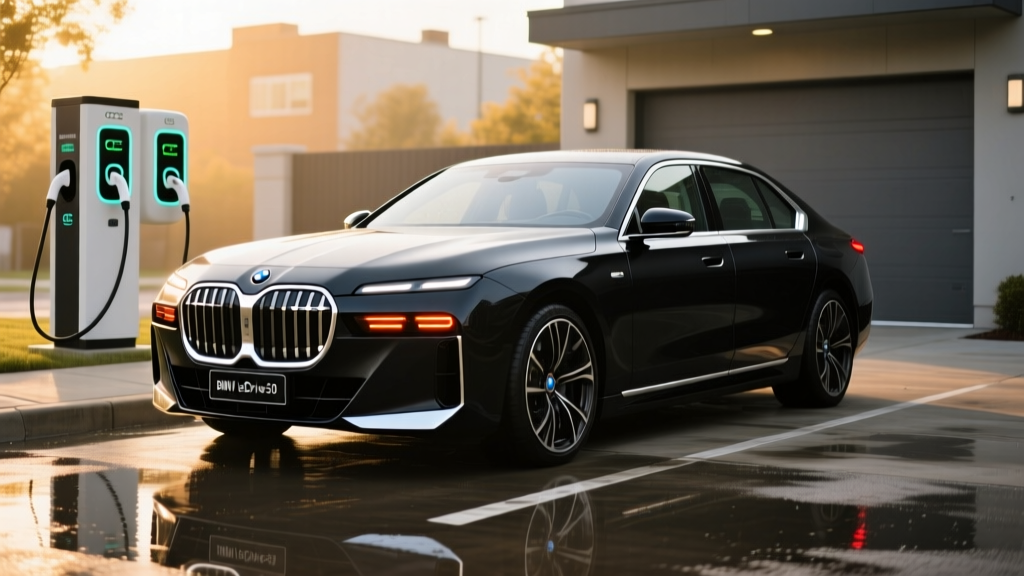
The BMW 7 Series has long been the benchmark for executive luxury sedans, and the all-electric i7 carries that mandate into the battery era. But while the dual-motor xDrive60 grabs headlines with its 600-horsepower shove, the BMW i7 eDrive50 occupies a more pragmatic—and arguably more compelling—position in the lineup. It's the rear-wheel-drive, single-motor variant that prioritizes range and value over brute acceleration, and for most luxury EV sedan buyers, that trade-off makes a lot of sense.
After spending time with the i7 eDrive50's specs, efficiency data, and real-world driving characteristics, here's everything you need to know before writing a six-figure check.
Quick Verdict: Who the BMW i7 eDrive50 Is For
The i7 eDrive50 is built for the executive commuter and long-distance cruiser who wants flagship BMW luxury without paying the xDrive60 premium or sacrificing range. If you routinely drive 200+ miles between charges, value a whisper-quiet cabin over sub-4-second sprints, and want a vehicle that charges meaningfully fast on road trips, the eDrive50 hits the mark. If you need all-wheel-drive traction for mountain winters or want M-car performance, look at the xDrive60 or i7 M70 instead.
- You prioritize maximum EPA range in the 7 Series lineup
- Rear-wheel drive is sufficient for your climate and roads
- You want to stay closer to (though still well above) the $100K mark
- Highway cruising and comfort matter more than 0-60 bragging rights
- You need AWD for snow/ice traction (get the xDrive60)
- You want sub-4.5-second 0-60 performance (get the xDrive60 or M70)
- You need a sub-$80K EV sedan (consider the i5 or Mercedes EQE)
Range, Battery, and Efficiency
The i7 eDrive50 draws from a 101.7 kWh usable battery pack (105.7 kWh gross) using NMC (nickel manganese cobalt) lithium-ion cells. BMW's fifth-generation eDrive platform places the battery low in the chassis, contributing to the sedan's planted handling and 50/50-ish weight distribution.
| Spec | Value |
|---|---|
| EPA Range | 318 miles |
| Battery (usable / gross) | 101.7 kWh / 105.7 kWh (NMC) |
| Efficiency | 84 MPGe combined / 32 kWh per 100 mi |
| Motor | Single rear motor (RWD), 449 hp, 479 lb-ft |
| 0-60 mph | 5.5 seconds |
| Max DC Charge Rate | 195 kW (CCS1, NACS via adapter) |
| 10-80% DC Time | ~34 minutes |
| Level 2 Onboard Charger | 11 kW (22 kW optional) |
| Base MSRP | $105,700 (+ $995 destination) |
| Federal Tax Credit (§30D) | Not eligible (MSRP exceeds $55,000 sedan cap) |
| Battery Warranty | 8 years / 100,000 miles |
The EPA-estimated 318 miles is a legitimate figure for mixed city/suburban driving in moderate temperatures. However, real-world conditions shift that number meaningfully:
- Highway cruising at 75 mph: Expect approximately 260-280 miles due to the i7's large frontal area and aerodynamic drag at sustained speed.
- Cold weather (below 32°F): Range drops to roughly 230-260 miles as battery heating consumes energy and cabin HVAC demand spikes. The i7 includes a heat pump (standard), which mitigates some loss versus resistive heating systems.
- Optimal conditions (55-65°F, city/suburban mix): You can approach or even slightly exceed the 318-mile EPA sticker thanks to regenerative braking recovery.
Plan road trips around 230-250 miles between stops to maintain a comfortable buffer. Source: fueleconomy.gov
The 84 MPGe combined rating and 32 kWh per 100 miles efficiency figure are respectable for a 5,800-pound luxury barge, though the Mercedes EQS 450+ (97 MPGe combined) edges ahead on the efficiency leaderboard thanks to its more aerodynamic teardrop shape. The i7 prioritizes traditional sedan proportions and interior volume over slippery aero optimization.
Charging Speed: DC Fast Charging and Home Level 2
Charging is where luxury EV buyers often face unpleasant surprises. The i7 eDrive50 performs competently but not class-leading. Here's the full breakdown:
| Charge Level | Power | Speed / Time |
|---|---|---|
| Level 1 (120V household) | ~1.4 kW | ~4 miles per hour |
| Level 2 (240V, standard onboard) | 11 kW | ~33 miles per hour / full charge in ~11 hours |
| Level 2 (240V, optional onboard) | 22 kW | ~66 miles per hour / full charge in ~5.5 hours |
| DC Fast Charge (peak) | 195 kW | 10-80% in ~34 minutes |
DC fast charging reality check: The 195 kW peak rate is available only under optimal conditions—battery preconditioned (the i7 does this automatically when you navigate to a charger), SoC below 20%, and a charger capable of delivering at least 200 kW. The charge curve tapers significantly above 80%, so that last 20% can take nearly as long as the first 70%. On a typical road trip, plan for 34-minute stops at 10-80%, then move on rather than waiting for a full top-off.
The i7 ships with a CCS1 connector natively. BMW provides access to the Tesla Supercharger network via a NACS adapter, which substantially expands fast-charging options on road trips—a meaningful advantage in charging-desert regions. Electrify America, EVgo, and ChargePoint networks remain native CCS options.
Home charging: With the standard 11 kW onboard charger and a 48-amp Level 2 wallbox (requiring a 60-amp circuit), you'll add about 33 miles of range per hour. An overnight 10-hour session recovers roughly 330 miles—more than enough for a full recharge. The optional 22 kW onboard charger halves that time but requires a 100-amp circuit and compatible charger, which most residential panels can't support without a costly upgrade. For most owners, the standard 11 kW setup is the practical choice.
Performance and Driving Dynamics
The single rear-mounted electric motor produces 449 horsepower and 479 lb-ft of torque, propelling the i7 eDrive50 from 0-60 mph in 5.5 seconds. That's quick by any sedan standard, and the instant torque delivery makes it feel even brisker in around-town driving. However, it's notably relaxed compared to the xDrive60's 4.5-second dual-motor sprint or the M70's sub-4-second ferocity.
The rear-wheel-drive layout gives the eDrive50 a slightly more traditional BMW driving character—there's a hint of tail-happy adjustability under hard cornering that the AWD models neutralize. The adaptive air suspension (standard across the i7 lineup) soaks up road imperfections with genuine authority, and the cabin remains remarkably isolated at highway speeds. Wind noise, tire noise, and road harshness are filtered to a level that justifies the price of admission.
Regenerative braking is adjustable via steering-wheel paddles (three levels) or can be set to adaptive mode, which uses radar and navigation data to modulate regen based on traffic and upcoming curves. One-pedal driving is achievable on the highest regen setting but isn't as aggressive as Tesla or Hyundai's implementations—you'll still reach for the brake pedal in stop-and-go traffic.
Interior, Tech, and Cargo Space
Step inside the i7 and the flagship positioning becomes obvious. The cabin is wrapped in standard Veganza synthetic leather (genuine leather is optional), and the dashboard is dominated by BMW's Curved Display—a 12.3-inch instrument cluster seamlessly joined to a 14.9-inch infotainment touchscreen running iDrive 8.5. The system is responsive, logically structured, and supports wireless Apple CarPlay and Android Auto.
Standout tech features:
- Theater Screen (optional): A 31.3-inch 8K rear-seat display that deploys from the headliner, complete with integrated Amazon Fire TV—genuine first-class entertainment for passengers.
- Highway Assistant (Level 2): BMW's hands-free driving assist (eyes-on, SAE Level 2) operates up to 85 mph on divided highways. It's smooth, confident, and competitive with GM's Super Cruise, though you must keep your eyes on the road per the infrared driver-monitoring camera.
- Parking Assistant Professional: Handles parallel, perpendicular, and garage parking maneuvers autonomously, including a remote-parking feature via the BMW app.
- Interaction Bar: A crystalline ambient-light strip spanning the dashboard that doubles as a touch-sensitive control surface for climate and lighting.
BMW's Highway Assistant and Driving Assistant Professional are SAE Level 2 systems. They provide hands-free steering and acceleration/braking on qualified highways, but the driver must remain fully engaged and eyes on the road at all times. These are not self-driving systems. Only Level 4 services like Waymo operate without a human driver. Never treat Level 2 assist as an excuse to disengage from driving.
Passenger and cargo dimensions:
- Front legroom: 41.2 inches
- Rear legroom: 42.8 inches (executive lounge seating with power recline optional)
- Trunk volume: 17.7 cubic feet (competitive with the gas 7 Series; no frunk)
- Rear-seat folding: 40/20/40 split for longer cargo
The trunk is generous for a luxury sedan but notably, there is no front trunk (frunk). BMW uses that space for power electronics and HVAC components. If you're comparing to the Mercedes EQS (which offers a small frunk), this is a minor but real omission.
Pricing, Trims, and Federal Tax Credit Eligibility
The BMW i7 eDrive50 starts at $105,700 (plus $995 destination), making it one of the more accessible entries in the ultra-luxury EV sedan segment—though "accessible" is relative at this price point. A well-optioned example with the Executive Package, Bowers & Wilkins surround sound, the Theater Screen, and 22-inch wheels can climb to $125,000-$130,000.
| Item | Amount |
|---|---|
| Base MSRP (eDrive50) | $105,700 |
| Destination charge | $995 |
| Typical as-tested (well-optioned) | $120,000 - $130,000 |
| Federal §30D Tax Credit | Not eligible (MSRP exceeds $55K sedan cap) |
Federal tax credit reality: The i7 eDrive50 does not qualify for the IRS §30D clean vehicle credit. Under current law, sedans must have an MSRP at or below $55,000 to be eligible, and the i7 sits far above that threshold. Buyers should not factor any federal credit into their purchase calculations. Some state and local incentives may still apply (check AFDC's incentive database for your jurisdiction), but these vary widely and are subject to change.
For context, BMW's own i5 eDrive40 (starting around $70,000) also exceeds the sedan MSRP cap, so no current BMW sedan qualifies for the federal credit. The credit is effectively limited to more affordable models like the Tesla Model 3, Chevrolet Equinox EV, and select trims of the Ford Mustang Mach-E.
Ownership Costs and Warranty
BMW provides a 4-year/50,000-mile limited warranty and a 8-year/100,000-mile high-voltage battery warranty that covers the pack if capacity falls below 70% of its original state of health. This battery warranty is industry-standard and aligns with Mercedes, Audi, and Tesla's coverage.
Maintenance costs are lower than a gas 7 Series—no oil changes, no transmission fluid, no spark plugs. Expect to budget for cabin air filters, brake fluid flushes, tire rotations, and wiper blades. However, the i7's 2,630 kg (5,800 lb) curb weight is hard on tires; budget for replacement rubber every 25,000-35,000 miles, especially with the standard 20-inch performance tires.
Insurance: Luxury EVs carry elevated premiums. Expect $2,800-$4,200 annually depending on your profile, location, and coverage level—roughly 15-25% higher than a comparable gas 7 Series due to repair cost complexity and battery replacement exposure.
Charging cost vs. gas: At the national average electricity rate of ~$0.17/kWh, fully charging the 101.7 kWh battery costs roughly $17.30 at home. A gas 740i averaging 22 MPG combined at $3.50/gallon would cost $47.70 for an equivalent 300-mile tank. Over 15,000 annual miles, home charging saves approximately $1,500-$1,800 per year versus premium gasoline. Public DC fast charging at $0.35-$0.48/kWh narrows that gap considerably.
BMW i7 eDrive50 vs. the Competition
The i7 eDrive50 competes in a thin but formidable segment. Here's how it stacks up against the three rivals luxury EV sedan buyers actually cross-shop:
| Metric | BMW i7 eDrive50 | Mercedes EQS 450+ | Tesla Model S LR | Lucid Air Pure |
|---|---|---|---|---|
| EPA Range | 318 mi | 390 mi | 402 mi | 419 mi |
| 0-60 mph | 5.5 sec | 5.9 sec | 3.1 sec | 5.0 sec |
| Peak DC Charge | 195 kW | 200 kW | 250 kW | 200+ kW |
| Starting MSRP | $105,700 | $104,400 | $74,990 | $69,900 |
| Federal Tax Credit | No | No | No | No |
The i7 trades range leadership to the Lucid Air Pure and Tesla Model S, both of which crack 400 miles. The EQS 450+ sits in between at 390 miles and offers the most aerodynamically efficient shape in the segment. Where the i7 wins is cabin build quality, traditional luxury material execution, and rear-seat comfort. The Tesla Model S is faster and cheaper but feels a generation behind in interior refinement. The Lucid Air offers spectacular range and space but has a smaller service network.
Pros and Cons
- Class-leading rear-seat comfort and optional Theater Screen
- Whisper-quiet cabin isolation at highway speeds
- Adaptive air suspension delivers superb ride quality
- Competent 195 kW DC fast charging with NACS adapter access
- Strong build quality and material execution
- Highway Assistant (Level 2) is smooth and confidence-inspiring
- 318-mile range trails Lucid Air, Tesla Model S, and EQS 450+ significantly
- No front trunk (frunk) — lost cargo utility
- No federal tax credit eligibility due to MSRP cap
- RWD only — no AWD option on the eDrive50
- Heavy weight accelerates tire wear
- High starting price vs. rivals with more range
Frequently Asked Questions
What is the real-world range of the BMW i7 eDrive50?
The EPA rates the i7 eDrive50 at 318 miles, but expect 260-280 miles on the highway at 75 mph and 230-260 miles in freezing temperatures. City driving in mild weather can match or slightly exceed the EPA figure.
How fast does the BMW i7 eDrive50 charge?
On a DC fast charger, it peaks at 195 kW and charges from 10-80% in approximately 34 minutes under optimal conditions. At home on a Level 2 wallbox (11 kW onboard charger), it adds about 33 miles of range per hour, achieving a full charge overnight in roughly 11 hours.
Does the BMW i7 eDrive50 qualify for the federal EV tax credit?
No. Under IRS §30D rules, sedans must have an MSRP at or below $55,000 to qualify. The i7 eDrive50 starts at $105,700, far exceeding the cap. State and local incentives may still apply depending on your jurisdiction.
Is the BMW i7 eDrive50 worth buying vs. the Mercedes EQS or Lucid Air?
If rear-seat luxury, cabin quietness, and traditional BMW build quality are your top priorities, the i7 eDrive50 is a strong choice. If maximum range is paramount, the Lucid Air Pure (419 mi, ~$69,900) or Tesla Model S Long Range (402 mi, ~$74,990) offer significantly more miles per charge at lower prices. The EQS 450+ (390 mi) splits the difference with excellent aerodynamics and a comparable luxury experience.
Does the i7 eDrive50 have all-wheel drive?
No. The eDrive50 is rear-wheel drive only, powered by a single rear motor. If you need AWD for snow or traction, step up to the i7 xDrive60 (dual-motor, 536 hp, ~$124,200 MSRP).
What is the battery warranty on the BMW i7 eDrive50?
BMW covers the high-voltage battery for 8 years or 100,000 miles, whichever comes first. The warranty applies if the battery's state of health degrades below 70% of its original capacity during the coverage period.
Sources: EPA fueleconomy.gov, BMW Group PressClub, IRS §30D Clean Vehicle Credits