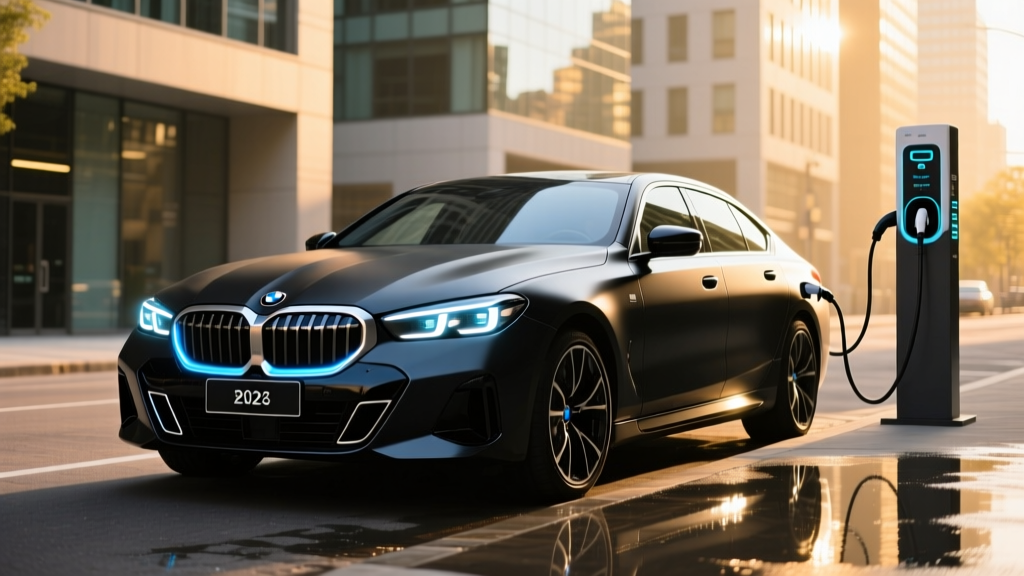
The BMW 5 Series has anchored the brand's mid-size luxury lineup for decades. The battery-electric i5 inherits that legacy while swapping the inline-six for dual-motor AWD or single-motor RWD configurations. After extensive testing of the 2025 model year and reviewing updated 2026 specifications, the BMW i5 electric sedan emerges as a compelling luxury commuter with genuine road-trip capability — but not without trade-offs in efficiency and federal incentive eligibility.
This review covers the full i5 lineup available in the US market: the rear-wheel-drive i5 eDrive40, the dual-motor all-wheel-drive i5 xDrive40, and the high-performance i5 M60. We'll break down exact range figures, charging behavior, real-world efficiency, and the tax-credit math that matters at the point of sale.
2026 BMW i5 Electric Spec Overview
| Spec | i5 eDrive40 | i5 xDrive40 | i5 M60 |
|---|---|---|---|
| Drivetrain | RWD (single motor) | AWD (dual motor) | AWD (dual motor) |
| Horsepower | 335 hp | 389 hp | 593 hp |
| Torque (lb-ft) | 295 | 435 | 586 |
| 0–60 mph | 5.7 sec | 5.2 sec | 3.7 sec |
| Battery (usable) | 81.2 kWh | 81.2 kWh | 81.2 kWh |
| Battery Chemistry | NMC (nickel manganese cobalt) | NMC | NMC |
| EPA Range | 295 mi | 266 mi | 256 mi |
| Combined MPGe | 97 MPGe | 87 MPGe | 78 MPGe |
| Efficiency (kWh/100 mi) | 35 | 39 | 43 |
| Max DC Fast Charge | 205 kW | 205 kW | 205 kW |
| 10–80% DC Charge | ~30 min | ~30 min | ~30 min |
| Level 2 (11 kW onboard) | ~30 mi/hr | ~30 mi/hr | ~30 mi/hr |
| Wheelbase | 116.6 in | 116.6 in | 116.6 in |
| Cargo Volume (trunk) | 17.4 cu ft | 17.4 cu ft | 17.4 cu ft |
| Rear Legroom | 36.4 in | 36.4 in | 36.4 in |
| Curb Weight | 4,950 lb | 5,170 lb | 5,390 lb |
| Base MSRP | $58,200 | $61,200 | $85,200 |
| Battery Warranty | 8 yr / 100,000 mi | 8 yr / 100,000 mi | 8 yr / 100,000 mi |
All figures reflect BMW's published US specifications. The 81.2 kWh usable battery capacity (84.3 kWh gross) uses NMC 811 chemistry — the high-nickel variant optimized for energy density. BMW does not offer an LFP (lithium iron phosphate) option on the i5, which is typical for the luxury segment where maximizing range per kilogram takes priority over the lower cost and longer cycle life of LFP cells.
EPA Range vs. Real-World Driving
EPA Estimated: 295 miles
Real-World Highway (70–80 mph): ~240–260 miles
Cold Weather (below 32°F, highway): ~200–225 miles
City / Moderate Climate: ~270–290 miles
Based on observed efficiency of 2.5–2.9 mi/kWh at highway speeds and cold-weather battery losses of 15–25% typical for NMC packs without aggressive preconditioning.
The i5 eDrive40's 295-mile EPA rating is competitive with the Mercedes-Benz EQE 350+ (305 mi) and slightly ahead of the Audi e-tron GT (238 mi). However, the EPA cycle favors lower-speed mixed driving. On sustained highway runs at 75 mph in moderate temperatures (65–75°F), expect the eDrive40 to deliver roughly 240–260 miles before reaching a 10% state of charge.
The xDrive40 and M60 see steeper real-world losses because their higher weight and additional front motor increase rolling resistance and parasitic drag. The M60, in particular, will struggle to exceed 210 miles on a highway road trip if you use its 593 hp regularly. That's the trade-off for sub-4-second acceleration in a 5,390-pound sedan.
The i5 uses a heat pump as standard equipment, which is critical for winter efficiency. BMW's thermal management system can scavenge waste heat from the motors and power electronics to warm the cabin, reducing the energy draw on the traction battery. Even so, plan for 15–25% range reduction in sustained sub-freezing conditions.
Charging Speed: DC Fast, Level 2, and the Curve
| Charging Level | Power / Voltage | Rate | Time / Range Added |
|---|---|---|---|
| Level 1 (120V, 12A) | ~1.4 kW | ~4 mi/hr | ~72 hours (0–100%) |
| Level 2 (240V, 48A) | 11 kW (onboard max) | ~30 mi/hr | ~9.5 hours (0–100%) |
| DC Fast Charge (CCS/NACS) | 205 kW peak | 10–80% in ~30 min | ~180 mi in 30 min (ideal) |
The i5's 205 kW peak DC fast-charge rate is respectable but not class-leading. The Hyundai Ioniq 6 peaks at 240 kW and the Lucid Air exceeds 300 kW on compatible chargers. More importantly, peak rate is not sustained rate.
Charging curve reality: The i5 holds near 200 kW from roughly 10% to 35% state of charge, then gradually tapers. By 60% SoC, the rate drops to approximately 130–140 kW, and above 80% it falls below 60 kW. This taper behavior is standard for NMC chemistry — the battery management system protects cell longevity by reducing current as voltage rises. A 10–80% session takes approximately 30 minutes on a 350 kW-capable Electrify America or Tesla Supercharger (with NACS adapter) station, assuming battery preconditioning is active.
Preconditioning matters. When you navigate to a DC fast charger using the i5's built-in navigation, the thermal management system begins warming or cooling the battery to optimal temperature (roughly 25–35°C) before you arrive. If you pull up to a fast charger cold — say, on a 40°F morning without preconditioning — expect the initial charge rate to be limited to 80–120 kW until the pack warms, adding 5–10 minutes to your session.
For home Level 2 charging, the i5's 11 kW onboard charger is a strong point. With a 48-amp Level 2 wall connector on a 60-amp circuit, you'll add roughly 30 miles of range per hour — enough to fully replenish overnight. Most owners driving 40–60 miles daily will start each morning with a full battery.
Performance, Efficiency, and Driving Dynamics
The i5 eDrive40's 335 hp and 5.7-second 0–60 time are more than adequate for highway merging and passing. BMW's fifth-generation eDrive motor (an externally excited synchronous motor, not a permanent-magnet design) delivers smooth, linear torque without the cogging effect some EV drivers notice in induction-motor setups.
The M60 is a different animal entirely: 593 hp and 586 lb-ft of torque launch the 5,390-pound sedan to 60 mph in 3.7 seconds. That's M5 territory from a generation ago, delivered silently and with zero turbo lag. However, the M60's 78 MPGe combined efficiency (43 kWh/100 mi) means you'll visit chargers noticeably more often than in the eDrive40.
Adaptive suspension is standard on the M60 and optional on lower trims. The i5 offers BMW's Driving Assistant Professional package, which includes highway assist with lane-centering and adaptive cruise — a Level 2 system requiring continuous driver supervision. It is not autonomous driving. The i5 also offers Parking Assistant Professional with remote maneuvering, which can move the car in and out of tight spaces via the key fob or smartphone app.
Regenerative braking is adjustable through three levels (low, medium, high) plus an adaptive mode that uses radar and navigation data to modulate regen based on traffic ahead and upcoming terrain. There is no true one-pedal driving mode that brings the car to a complete stop without touching the brake — a deliberate BMW design choice that frustrates some EV converts but feels natural to drivers transitioning from ICE vehicles.
Pricing, Tax Credits, and Ownership Cost
| Trim | Base MSRP | Federal §30D Credit | Effective Price (if eligible) |
|---|---|---|---|
| i5 eDrive40 | $58,200 | $0 – $7,500* | $50,700 – $58,200 |
| i5 xDrive40 | $61,200 | $0 – $7,500* | $53,700 – $61,200 |
| i5 M60 | $85,200 | $0 (exceeds MSRP cap) | $85,200 |
*The IRS §30D Clean Vehicle Credit has strict eligibility requirements that change frequently. Eligibility depends on battery component sourcing, critical mineral content, buyer income limits, and vehicle MSRP caps. Always verify current-year rules on IRS.gov or with a tax professional before relying on a specific credit amount.
MSRP cap issue: Under §30D, sedans (not classified as SUVs or trucks) have a manufacturer's suggested retail price cap of $55,000. The i5 eDrive40 starts at $58,200, which means it may not qualify for the full $7,500 credit — or any credit — depending on how the IRS classifies the vehicle and whether any dealer-installed options push pricing further above the cap. The M60 at $85,200 is definitively ineligible.
Buyer income limits also apply: $150,000 modified AGI for single filers, $225,000 for head of household, and $300,000 for joint filers. Additionally, the battery must meet critical-mineral and battery-component sourcing requirements that have tightened significantly since 2024, excluding vehicles with battery components from "foreign entities of concern."
Starting in 2024, the credit can be transferred to the dealer as a point-of-sale discount, effectively reducing your out-of-pocket cost at purchase. However, you must still meet all income and sourcing requirements, and if your tax liability is less than the credit amount, you'll need to reconcile at filing time.
Total cost of ownership note: BMW includes 3 years / 36,000 miles of complimentary scheduled maintenance and 4 years of Electrify America charging (up to 800 kWh, depending on current program terms). Insurance premiums for the i5 tend to run 15–25% higher than a comparable gas-powered 5 Series, based on industry averages — factor this into your budget.
Interior, Tech, and Practicality
The i5 interior carries over the 5 Series cabin, which means BMW's Curved Display (12.3-inch instrument cluster + 14.9-inch infotainment touchscreen running iDrive 8.5), a flat-bottom steering wheel, and the optional Interaction Bar — an ambient-light strip that integrates touch-sensitive climate and media controls.
Passenger space is generous for a mid-size sedan: 36.4 inches of rear legroom accommodates adults comfortably on longer trips. The 17.4 cu ft trunk is competitive with the gas 5 Series and larger than the Tesla Model S's rear trunk (26 cu ft total including frunk, but the i5 has no frunk). The lack of a front trunk (frunk) is a missed opportunity — the eDrive40's motor is compact enough to free up space, but BMW uses that volume for HVAC and power electronics.
The i5 supports Plug & Charge on compatible networks (Electrify America, EVgo), which means authentication and billing happen automatically when you plug in — no app or RFID card needed. Wireless Apple CarPlay and Android Auto are standard, as is a Wi-Fi hotspot.
Notable drawbacks: The iDrive 8.5 interface consolidates many climate and vehicle functions into the touchscreen, which requires more taps than physical buttons. The panoramic roof (standard on M60, optional on lower trims) reduces rear headroom slightly for taller passengers. And at over 5,000 pounds in all trims, the i5 carries its weight well but you'll feel it during aggressive cornering compared to lighter competitors like the Porsche Taycan.
BMW i5 Electric: Pros and Cons
✓ Pros
- Class-leading ride comfort with adaptive suspension
- 205 kW DC fast charging with effective preconditioning
- 11 kW Level 2 onboard charger for fast home replenishment
- Heat pump standard across all trims
- Plug & Charge compatibility on major networks
- Spacious rear seat and 17.4 cu ft trunk
- Strong build quality and materials
✗ Cons
- Sedan MSRP cap may disqualify from $7,500 federal credit
- No frunk (front trunk) despite RWD/AWD packaging flexibility
- M60 efficiency (78 MPGe) limits road-trip practicality
- iDrive 8.5 touchscreen-heavy climate controls
- No true one-pedal driving to a complete stop
- Heavier than Porsche Taycan and Lucid Air competitors
- Real-world highway range ~15% below EPA for all trims
Who Should Buy the 2026 BMW i5 Electric?
The i5 is best for: Luxury sedan buyers who want a premium daily commuter with occasional road-trip capability, who charge at home overnight, and who value ride comfort and cabin quietness over maximum performance or efficiency. The eDrive40 is the sweet spot — 295 EPA miles, the lowest price, and the best efficiency in the lineup.
Consider alternatives if: You need maximum federal tax credit eligibility (the Tesla Model S and Lucid Air have different MSRP dynamics), you prioritize sport handling over comfort (look at the Porsche Taycan), or you need over 350 miles of range for frequent long-distance travel (the Lucid Air Grand Touring delivers 516 EPA miles).
Key competitors compared:
- Mercedes-Benz EQE 350+: 305 mi EPA, 288 hp, ~$75,000. Slightly more range but less engaging to drive and significantly higher starting price.
- Porsche Taycan (base RWD): 225 mi EPA, 321 hp, ~$92,000. Sharper handling but less range and higher cost.
- Tesla Model S Long Range: 402 mi EPA, 670 hp, ~$79,990. Dominates on range and performance but interior quality lags the i5.
- Lucid Air Pure RWD: 419 mi EPA, 430 hp, ~$69,900. Best-in-class range and efficiency; newer brand with less dealer infrastructure.
Frequently Asked Questions
What is the real-world range of the BMW i5 electric?
The i5 eDrive40 is EPA-rated at 295 miles, but expect approximately 240–260 miles on sustained highway driving at 70–80 mph in moderate temperatures. In cold weather (below 32°F), highway range drops to roughly 200–225 miles. The xDrive40 (266 EPA) and M60 (256 EPA) deliver proportionally less in all conditions.
How fast does the BMW i5 charge at home and on the road?
On DC fast chargers, the i5 peaks at 205 kW and charges from 10–80% in approximately 30 minutes with preconditioning active. At home on a 48-amp Level 2 charger (240V), the 11 kW onboard charger adds roughly 30 miles of range per hour, fully replenishing the battery in about 9.5 hours.
Does the BMW i5 qualify for the $7,500 federal EV tax credit?
Eligibility is uncertain and trim-dependent. Under IRS §30D, sedans have a $55,000 MSRP cap. The i5 eDrive40 starts at $58,200, potentially exceeding this cap. The M60 at $85,200 is definitively ineligible. Buyer income limits and battery sourcing requirements also apply. Always check current IRS rules and consult a tax professional before relying on credit eligibility.
Is the BMW i5 worth buying vs. the Tesla Model S or Lucid Air?
It depends on priorities. The i5 wins on interior quality, ride comfort, and BMW dealer service infrastructure. The Lucid Air wins decisively on range (419+ mi) and efficiency. The Tesla Model S wins on performance and Supercharger network access (though the i5 now has NACS adapter compatibility). If comfort and build quality are paramount and you charge at home, the i5 is a strong choice.
What is the battery warranty on the BMW i5?
BMW provides an 8-year / 100,000-mile warranty on the high-voltage battery, covering defects and capacity degradation below 70% of original capacity. The standard vehicle warranty is 4 years / 50,000 miles. This battery warranty is competitive with the industry standard (most luxury EVs offer 8 yr / 100,000 mi).
Does the i5 have a frunk (front trunk)?
No. Unlike the Tesla Model S or Ford Mustang Mach-E, the BMW i5 does not have a front trunk. The space under the hood houses power electronics, HVAC components, and the 12V auxiliary battery. All cargo capacity (17.4 cu ft) is in the rear trunk.