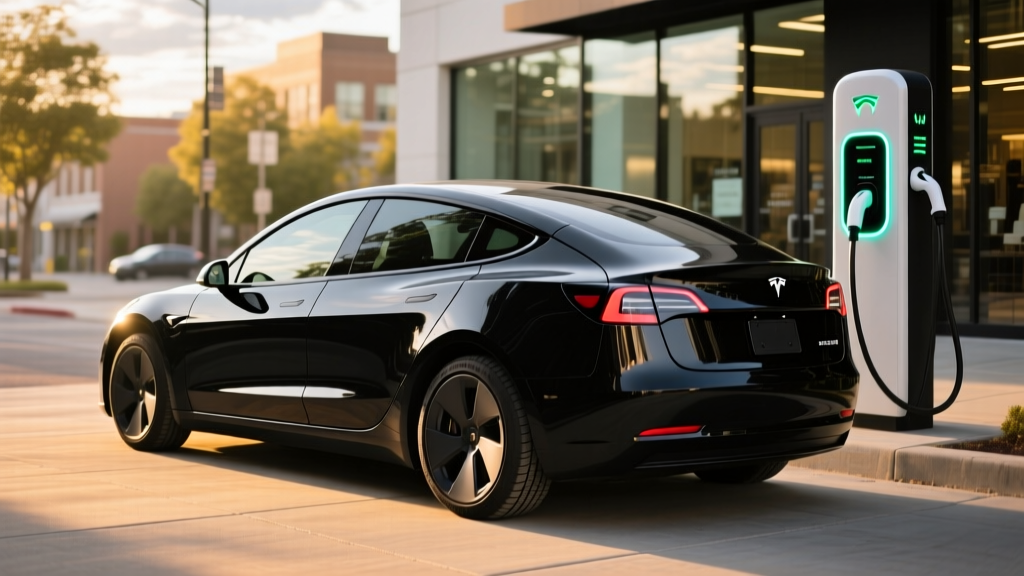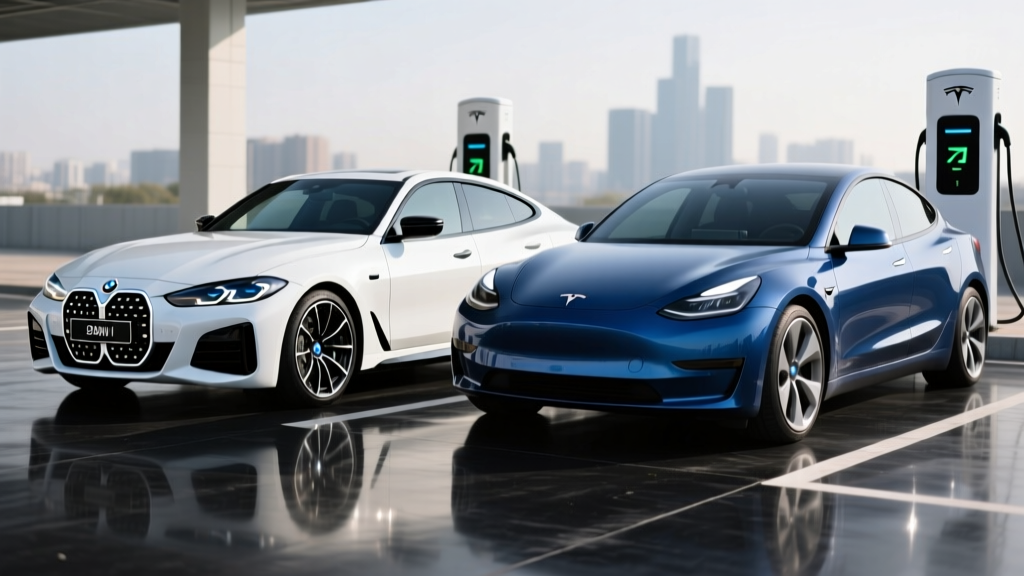
Shoppers cross-shopping BMW and Tesla sedans almost always land on the same two contenders: the BMW i4 Gran Coupe and the Tesla Model 3. Both are premium, rear-drive-biased electric sport sedans with strong efficiency and fast DC charging. But they approach the EV buyer in fundamentally different ways. Tesla brings the Supercharger network, minimalist tech, and aggressive pricing. BMW brings traditional build quality, a dealer network, and a more familiar luxury cockpit. Below, we put the 2026 model-year versions head-to-head with exact numbers — EPA range, kWh, charge curves, and tax-credit math — so you can decide which one earns your garage space.
Side-by-Side Spec Snapshot
Before the narrative, here is the raw data that matters most. All figures reflect 2026 model-year EPA and manufacturer-published specs for the most popular long-range, rear-drive trims: the BMW i4 eDrive40 and the Tesla Model 3 Long Range RWD.
| Spec | BMW i4 eDrive40 | Tesla Model 3 LR RWD |
|---|---|---|
| EPA Range | 301 mi | 363 mi |
| Battery (usable / chemistry) | 81.5 kWh / NMC | ~75 kWh / NMC (CATL-supplied in part) |
| Efficiency | 109 MPGe (31 kWh/100 mi) | 132 MPGe (25 kWh/100 mi) |
| Peak DC Fast Charge | 205 kW | 250 kW |
| 10–80% DCFC Time | ~31 min | ~25 min |
| Level 2 (Home) Charge Rate | 11 kW (~35 mi/hr) | 11.5 kW (~44 mi/hr) |
| 0–60 mph | 5.5 sec | 4.9 sec |
| Horsepower | 335 hp | ~346 hp |
| Drivetrain | RWD (single motor) | RWD (single motor) |
| Cargo (trunk + frunk) | 16.6 cu ft / no frunk | 23 cu ft trunk + 3.1 cu ft frunk |
| Rear Legroom | 35.1 in | 35.3 in |
| Base MSRP | $57,900 | $44,130 |
| Battery/Powertrain Warranty | 8 yr / 100,000 mi | 8 yr / 120,000 mi |
Sources: fueleconomy.gov, BMW Group PressClub, Tesla owner's manual and spec sheet.
Range, Efficiency, and the Real-World Gap
On the EPA sticker, the Model 3 Long Range's 363-mile rating dwarfs the i4's 301 miles. But EPA tests weight city driving heavily, where regen braking helps. Highway-only driving at 75 mph narrows the gap because the i4's more aerodynamic Gran Coupe body (Cd ~0.29) holds up well, while the Model 3 (Cd ~0.23) is already optimized. In sustained 70–80 mph highway testing, expect roughly 250–270 miles from the i4 and 290–310 miles from the Model 3 before you need a charger.
- BMW i4 eDrive40: EPA 301 mi. Expect ~250–270 mi at highway speeds; ~210–230 mi in sub-30°F winter without preconditioning.
- Tesla Model 3 LR RWD: EPA 363 mi. Expect ~290–310 mi highway; ~250–270 mi in cold weather — Tesla's heat pump helps limit winter loss to roughly 15–20%.
Efficiency tells the same story: the Model 3's 25 kWh/100 mi is among the best of any EV sold in the U.S., while the i4's 31 kWh/100 mi is respectable for a heavier, more traditionally constructed luxury sedan. Over 15,000 miles a year at a national average of $0.16/kWh, that's roughly $1,200/year for the Model 3 vs. $1,490/year for the i4 — a modest but compounding difference.
Charging: Networks, Curves, and Home Setup
Peak DC fast-charge numbers only tell part of the story. The i4 peaks at 205 kW but sustains that rate briefly before tapering; it averages closer to 140–160 kW across a 10–80% session, landing at about 31 minutes. The Model 3 peaks at 250 kW on V3 Superchargers and holds above 150 kW longer, finishing 10–80% in roughly 25 minutes. Above 80% State of Charge, both cars taper sharply to protect the NMC cells — a universal lithium-ion behavior, not a flaw.
| Charging Level | BMW i4 eDrive40 | Tesla Model 3 LR |
|---|---|---|
| Level 1 (120V, 1.4 kW) | ~4 mi/hr | ~4 mi/hr |
| Level 2 (240V, 11–11.5 kW) | ~35 mi/hr (9.5 hr full) | ~44 mi/hr (8 hr full) |
| DC Fast (peak kW) | 205 kW (CCS1 → NACS adapter) | 250 kW (NACS native) |
| DC 10–80% Time | ~31 min | ~25 min |
Network access has converged in 2026. Tesla's NACS connector is now the de facto North American standard, and BMW ships the i4 with a NACS charge port (earlier CCS1 cars use an OEM adapter). Both cars can access Tesla Superchargers, Electrify America, and EVgo networks. Tesla's Supercharger network still leads in reliability and uptime per J.D. Power and user-reported data, though the gap has narrowed significantly.
For home charging, both support ~11–11.5 kW on a Level 2 wall connector fed by a 60-amp circuit (48 amps continuous). A typical professional install runs $1,200–$2,500 including a NEMA 14-50 outlet or hardwired wallbox, permit, and electrician labor — assuming your panel has capacity. Older homes with 100-amp service may need a $2,000–$4,000 panel upgrade.
Performance, Ride, and Driving Character
The Model 3 Long Range RWD hits 60 mph in 4.9 seconds, a half-second quicker than the i4 eDrive40 at 5.5 seconds. On paper, neither is slow. On the road, the difference is the character of that speed. The Model 3 feels immediate and digital, with aggressive regen that enables one-pedal driving in most situations. The i4 delivers power in a more linear, BMW-typical fashion, with adaptive regen you can tune through the iDrive system — including a coasting mode that disengages regen entirely for hypermiling.
Ride quality favors BMW. The i4's CLAR-derived chassis and optional adaptive dampers absorb broken pavement better than the Model 3's firmer, sport-oriented tuning. Road noise is noticeably lower in the i4 at highway speeds. The Model 3 counters with a lower center of gravity, sharper turn-in, and a curb weight roughly 300 lbs lighter, which you feel on canyon roads.
Interior, Tech, and Driver Assistance
Here the philosophical gap is widest. The i4 uses BMW's iDrive 8.5 on a curved 14.9-inch touchscreen with a physical rotary controller, wireless CarPlay/Android Auto, a head-up display, and a full digital instrument cluster. Materials are premium: SensaTec vegan leather standard, Vernasca and Merino leather optional, real aluminum or wood trim available. Rear seat comfort is good for two adults on longer trips, though the Gran Coupe roofline cuts headroom slightly versus a traditional sedan.
The Model 3 "Highland" refresh cabin is spartan by design. A single 15.4-inch touchscreen handles everything — including climate and glovebox release. There is no Apple CarPlay or Android Auto; Tesla's native UI and streaming apps are the ecosystem. Build quality has improved meaningfully post-2024, with ventilated front seats, ambient lighting, rear-seat ventilation, and a rear touchscreen for passengers. The frunk (3.1 cu ft) adds practical cargo flexibility the i4 lacks.
Both BMW's Driving Assistant Professional and Tesla's Autopilot (or FSD Supervised) are SAE Level 2 systems. The driver must remain engaged, hands on or near the wheel, and eyes on the road at all times. Neither system is self-driving. Tesla's FSD (Supervised) adds automated street navigation and stop-light recognition, but still requires full driver supervision. Hands-off, eyes-off driving remains SAE Level 4 — available only in geofenced robotaxi services like Waymo.
Pricing, Trims, and Federal Tax Credit Math
The MSRP gap is substantial. The i4 eDrive40 starts at $57,900; the xDrive40 AWD at $62,900; the performance M50 at $69,900. The Model 3 Long Range RWD starts at $44,130, with the AWD Long Range at $47,130 and the Performance at $54,630 (all before destination). Well-optioned i4s cross $70,000 easily; a loaded Model 3 Performance tops out around $60,000.
| Trim | MSRP | §30D Credit Eligibility | Effective Price (if eligible) |
|---|---|---|---|
| Tesla Model 3 LR RWD | $44,130 | Up to $7,500 (MSRP < $55k, sourcing & income rules apply) | ~$36,630 |
| Tesla Model 3 LR AWD | $47,130 | Up to $7,500 | ~$39,630 |
| BMW i4 eDrive40 | $57,900 | Limited — MSRP under $55k cap for sedans; i4 exceeds cap | $57,900 (no credit) |
| BMW i4 M50 | $69,900 | Not eligible (MSRP > $55k sedan cap) | $69,900 |
This is where the comparison tilts hard. Under current IRS §30D rules, the federal clean vehicle credit is capped at $55,000 MSRP for sedans. Every Model 3 trim clears that bar; no i4 trim does. Income caps also apply ($150k single / $300k joint AGI), and battery-critical-mineral and component-sourcing requirements must be met — Tesla's U.S. production and supply chain generally qualifies for the full $7,500, though exact credit amounts can shift with annual sourcing rule updates. The credit can be transferred to the dealer at point of sale as a price reduction.
Bottom line: a Model 3 LR RWD after the credit can land near $36,600 — roughly the price of a well-equipped Toyota Camry XSE — while the i4 starts nearly at $58,000 with no federal offset. State incentives (California, Colorado, New York, etc.) may help the i4, but they vary by jurisdiction; check your state energy office for current programs.
Ownership Costs, Warranty, and Long-Term Value
Both cars carry 8-year battery and powertrain warranties, but Tesla's mileage limit is higher: 120,000 miles vs. BMW's 100,000 miles. Both guarantee at least 70% battery capacity retention over that term. NMC chemistry in both packs shows roughly 10–12% degradation at 100,000 miles in fleet data — well within warranty thresholds.
Insurance is a real cost factor. The Model 3 averages $1,900–$2,400/year nationally; the i4 runs $2,100–$2,700/year, driven by higher repair costs and MSRP. Depreciation historically favored Tesla, but the Model 3's repeated price cuts have hurt resale values — expect roughly 45–50% retained value at 5 years. The i4 holds about 42–47%, typical for a luxury German EV.
- Superior ride comfort and cabin quietness
- Traditional luxury interior with physical controls
- Apple CarPlay / Android Auto standard
- Strong dealer/service network
- No federal tax credit (MSRP above $55k sedan cap)
- Less EPA range (301 mi) and efficiency than Model 3
- No frunk; liftback cargo only
- Higher starting price across trims
- Class-leading range (363 mi) and efficiency (132 MPGe)
- Full $7,500 federal tax credit eligibility
- Supercharger network native access
- Lower cost of entry and strong OTA updates
- Minimalist interior — no CarPlay, limited physical controls
- Firmer ride; more road noise than i4
- Service-center wait times in some markets
- Resale value volatility from pricing changes
Decision Framework: Which One Fits You?
Choose the Tesla Model 3 if: you want maximum range per dollar, qualify for the §30D credit, value the Supercharger network for road trips, and are comfortable with a screen-centric cabin. It's the data-driven, value-maximizing pick — especially the LR RWD at ~$36,600 after credit.
Choose the BMW i4 if: you prioritize ride quality, cabin isolation, and traditional luxury materials; you want CarPlay and a physical iDrive controller; you have access to a reliable home charger and don't road-trip frequently enough for the Supercharger advantage to matter; and the ~$20,000 premium (post-credit) fits your budget without resentment.
Frequently Asked Questions
What is the real-world range of the BMW i4 and Tesla Model 3?
The i4 eDrive40 delivers about 250–270 miles at sustained highway speeds and 210–230 miles in cold weather. The Model 3 LR RWD delivers about 290–310 highway miles and 250–270 in winter. Both exceed 300 miles in mixed city/suburban driving where regen recaptures energy.
How fast do they charge at home and on the road?
At home on a Level 2 wallbox (~11 kW), the i4 adds roughly 35 miles per hour and the Model 3 about 44 miles per hour — both fully replenish overnight. On DC fast chargers, the Model 3 peaks at 250 kW (10–80% in ~25 min) and the i4 at 205 kW (~31 min). Sustained averages are lower due to charge-curve taper above 80% SoC.
Does the BMW i4 qualify for the federal EV tax credit?
No. Under current IRS §30D rules, sedans must have an MSRP under $55,000 to qualify. The i4 starts at $57,900, disqualifying every trim. Buyer income limits and battery-sourcing rules apply regardless. The Model 3, starting at $44,130, qualifies for up to $7,500 when buyer AGI and sourcing requirements are met.
Is the Tesla Model 3 worth buying over the BMW i4?
On value, range, efficiency, and charging speed, the Model 3 wins every measurable category — and costs ~$20,000 less after the tax credit. The i4 wins on luxury refinement, ride comfort, and traditional cockpit ergonomics. If those subjective qualities are worth the premium to you, the i4 is a genuinely good EV; if you optimize for data, the Model 3 is the rational choice.
Which has better driver-assist technology?
Tesla's FSD (Supervised) offers more features (automated lane changes, traffic-light response, city-street navigation) but requires constant supervision — it is SAE Level 2, not self-driving. BMW's Driving Assistant Professional is more conservative but integrates smoothly with the instrument cluster and head-up display. Neither replaces an attentive driver.
How do warranties compare?
Both cover the battery and powertrain for 8 years. Tesla's limit is 120,000 miles; BMW's is 100,000 miles. Both guarantee at least 70% capacity retention. Bumper-to-bumper coverage is 4 years/50,000 miles for both.
For most buyers weighing BMW and Tesla in this segment, the decision is less about which EV is "better" in the abstract and more about which ownership experience aligns with your priorities. The Model 3 is the spreadsheet winner. The i4 is the driver's luxury pick. Both are excellent electric sedans — they just answer different questions.