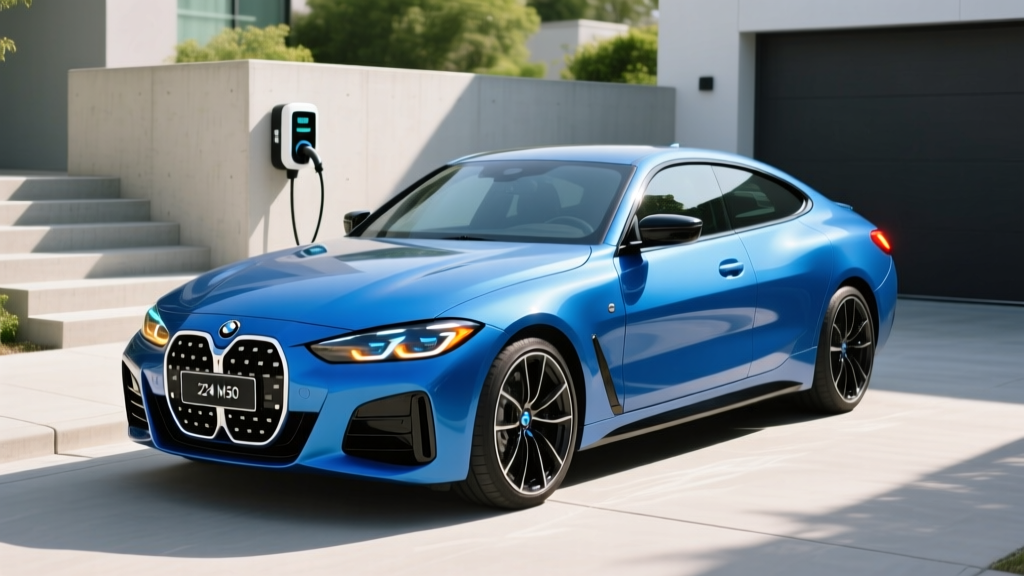
The BMW i4 debuted for the 2022 model year (first deliveries in late 2021) as the brand's first all-electric Gran Coupe. Built on the same CLAR platform as the 4 Series, it trades a dedicated EV skateboard for BMW's proven driving dynamics wrapped in a premium, tech-heavy package. Now several model years in, the i4 lineup has matured — but the core question remains: does a luxury electric sport sedan built on a shared platform hold up against purpose-built EV rivals like the Tesla Model 3 and Hyundai Ioniq 6?
This review covers every model year from the original 2021 launch through the current 2026 lineup, with exact specs, real-world range data, charging benchmarks, and ownership economics so you can decide whether the i4 earns a spot in your garage.
BMW i4 Spec Sheet at a Glance
| Spec | eDrive35 | eDrive40 | M50 | xDrive40 (2025+) |
|---|---|---|---|---|
| Drivetrain | RWD (single motor) | RWD (single motor) | AWD (dual motor) | AWD (dual motor) |
| Horsepower | 281 hp | 335 hp | 536 hp | 396 hp |
| 0–60 mph | 5.8 sec | 5.5 sec | 3.7 sec | 4.9 sec |
| Battery (usable) | 66.5 kWh (NMC) | 81.5 kWh (NMC) | 81.5 kWh (NMC) | 81.5 kWh (NMC) |
| EPA Range | 243–256 mi | 282–307 mi | 227–270 mi | 277–307 mi |
| MPGe (combined) | 99–104 | 97–109 | 85–97 | 97–105 |
| Max DC Charge Rate | 180 kW | 200 kW | 200 kW | 200 kW |
| 10–80% DCFC Time | ~31 min | ~31 min | ~31 min | ~31 min |
| Level 2 Charge Rate | 11 kW (~32 mi/hr) | 11 kW (~32 mi/hr) | 11 kW (~32 mi/hr) | 11 kW (~32 mi/hr) |
| Base MSRP (2026) | ~$53,100 | ~$58,100 | ~$68,100 | ~$60,100 |
Sources: fueleconomy.gov, BMW USA press materials. EPA range varies by wheel size and model year.
Real-World Range: What the EPA Sticker Doesn't Tell You
eDrive40 (19" wheels): EPA 307 mi → Expect ~260–280 mi mixed highway/city, ~230–250 mi sustained 75+ mph highway driving, ~190–220 mi in freezing weather with cabin heat.
eDrive35: EPA 256 mi → Expect ~215–235 mi mixed, ~170–195 mi cold-weather highway.
M50 (20" wheels): EPA 227 mi → Expect ~185–205 mi mixed; aggressive driving drops this further.
The i4 eDrive40 with 18-inch wheels achieves an EPA-estimated 307 miles — impressive for a luxury sport sedan. However, the CLAR platform's less aerodynamic underbody (compared to dedicated EV architectures like Hyundai's E-GMP) means highway efficiency suffers at speed. In real-world 70–80 mph highway testing, the eDrive40 typically delivers 260–280 miles before hitting a 10% state of charge.
Cold weather is the equalizer. Without a standard heat pump on earlier model years (added as standard on 2024+ models), cabin heating draws significantly from the 81.5 kWh NMC battery. Expect 25–35% range loss in sub-freezing conditions. The eDrive35's smaller 66.5 kWh pack makes cold-weather range particularly tight — plan charging stops carefully on winter road trips.
The NMC (nickel manganese cobalt) chemistry provides high energy density but requires more careful state-of-charge management than LFP batteries. BMW recommends daily charging to 80–90% and occasional 100% charges before long trips for optimal longevity.
Charging Speed: DC Fast Charging and Home Level 2
| Charging Level | Power / Rate | Miles Added per Hour | Time to Charge |
|---|---|---|---|
| Level 1 (120V household) | ~1.4 kW | ~4–5 mi/hr | ~60+ hours (0–100%) |
| Level 2 (240V home) | 11 kW (48A) | ~32 mi/hr | ~8.5 hours (0–100%, eDrive40) |
| DC Fast Charge (CCS) | Peak 200 kW | — | 10–80% in ~31 min |
The i4's 200 kW peak DC fast-charge rate (180 kW on eDrive35) is respectable but not class-leading. For comparison, the Hyundai Ioniq 6 peaks at 350 kW on an 800V architecture, achieving 10–80% in roughly 18 minutes. The i4 uses a conventional 400V system, which caps its charge speed.
More importantly, the i4's charging curve tapers noticeably above 50% state of charge. While it may hit 200 kW briefly at low SoC, sustained rates above 60% drop to 80–100 kW. This means the 10–80% time of ~31 minutes is accurate, but an 80–100% top-off can add another 25–30 minutes. On road trips, plan to charge to 80% and move on.
For home charging, the i4's onboard charger accepts up to 11 kW on Level 2 (48 amps on a 60-amp circuit). A full charge of the 81.5 kWh battery takes roughly 8.5 hours — easily achievable overnight. Home Level 2 installation typically costs $800–$2,000 depending on panel capacity and run length; budget more if your home needs a 200-amp service upgrade.
The i4 ships with a CCS1 connector. Starting with the 2025 model year, BMW began offering a NACS (Tesla) charge port as an option, and adapters are available for older CCS-equipped models to access Tesla Superchargers.
Performance and Driving Dynamics
The i4 M50 is the performance flagship: 536 horsepower, dual-motor AWD, and a 3.7-second 0–60 time that embarrasses most combustion M cars off the line. BMW's adaptive M suspension and rear-biased torque distribution give it genuine sport-sedan credibility. The eDrive40's 335 hp and 5.5-second sprint are more than adequate for daily driving and highway merging.
Where the i4 shines is ride refinement. The CLAR platform's multi-link suspension, sound insulation, and low center of gravity (thanks to the floor-mounted battery) create a cabin that is significantly quieter than the Tesla Model 3 at highway speeds. Steering is precise, and the available M Sport package adds firmer damping without harshness.
One limitation: at ~4,700 lbs (eDrive40) to ~5,000 lbs (M50), the i4 is heavy. You feel that mass during hard cornering and braking. The regenerative braking system offers adjustable levels including a one-pedal driving mode, though it doesn't quite bring the car to a complete stop in all conditions — you'll still use the friction brakes at low speeds.
Interior, Cargo, and Technology
The i4's cabin is unmistakably BMW: the curved display running iDrive 8 (updated to iDrive 8.5 on 2024+ models) pairs a 12.3-inch instrument cluster with a 14.9-inch touchscreen. Wireless Apple CarPlay and Android Auto are standard, as is a Wi-Fi hotspot. The system is responsive, though some functions buried in submenus require more taps than the previous iDrive's rotary controller allowed.
Cargo space: The i4's liftback (Gran Coupe) design gives it a practical advantage over traditional sedans. You get 16.6 cubic feet behind the rear seats and 45.6 cubic feet with the 40/20/40 rear seats folded. That's competitive with the Tesla Model 3's trunk-plus-frunk total, though the i4 lacks a front trunk entirely — the CLAR platform's front end houses HVAC and power electronics where a dedicated EV platform would free up frunk space.
Passenger space: Front legroom is generous at 42.0 inches, but the rear seat is the i4's weakest interior point. At 34.5 inches of rear legroom, tall adults will find it tight on longer trips. The transmission tunnel hump (a CLAR-platform leftover) further compromises the middle seat. If rear-seat comfort is a priority, the Hyundai Ioniq 6 or Tesla Model 3 offer more room.
Driver assistance: The i4 includes BMW's Driving Assistant Professional, a Level 2 SAE system with adaptive cruise, lane centering, and automatic lane changes on highways. It's competent but requires hands-on-wheel engagement at all times. This is not a self-driving system — the driver remains fully responsible. The available Parking Assistant Plus with Reversing Assistant is genuinely useful for tight urban garages.
Pricing, Trims, and Federal Tax Credit Eligibility
| Trim | Base MSRP | Federal §30D Credit | Effective Price (if eligible) |
|---|---|---|---|
| eDrive35 | ~$53,100 | Up to $7,500* | ~$45,600 |
| eDrive40 | ~$58,100 | Up to $7,500* | ~$50,600 |
| xDrive40 | ~$60,100 | Up to $7,500* | ~$52,600 |
| M50 | ~$68,100 | Up to $7,500* | ~$60,600 |
*Federal EV tax credit eligibility under IRS §30D is not guaranteed. Eligibility depends on:
- MSRP cap: Sedans must be priced at or below $55,000. The eDrive35 qualifies on MSRP alone; the eDrive40, xDrive40, and M50 exceed the cap at base and do not qualify unless BMW restructures pricing or the vehicle is classified differently.
- Buyer income limits: AGI must not exceed $150,000 (single), $225,000 (head of household), or $300,000 (joint filing).
- Battery sourcing: Critical minerals and battery components must meet escalating domestic-content thresholds. BMW sources cells from CATL and Samsung SDI — verify current-year compliance on the IRS qualified vehicles list before purchasing.
- Point-of-sale transfer: As of 2024, eligible buyers can transfer the credit to the dealer for an immediate price reduction at purchase rather than waiting to claim it on their tax return.
The MSRP cap is the i4's biggest credit hurdle. Most trims price above $55,000, which disqualifies them from the federal credit unless options are stripped to the bare minimum. Always confirm eligibility with your tax professional and check the fueleconomy.gov tax credit lookup for the specific VIN before committing.
Warranty and Long-Term Ownership
BMW covers the i4's high-voltage battery for 8 years or 100,000 miles, whichever comes first, against defects and capacity loss below 70% of original capacity. The standard vehicle warranty is 4 years/50,000 miles, with complimentary scheduled maintenance for 3 years/36,000 miles.
NMC batteries in the i4 have shown moderate degradation in early owner reports — typically 5–8% capacity loss over the first 60,000 miles. This is within the normal range for liquid-cooled NMC packs but falls short of LFP chemistry longevity. To maximize battery life, avoid frequent DC fast charging above 80%, minimize time spent at 100% SoC, and precondition the battery before fast charging (the i4 does this automatically when a DC charger is set as your navigation destination).
If out-of-warranty replacement becomes necessary, BMW's high-voltage battery replacement currently costs approximately $16,000–$22,000 depending on the trim and labor — a significant expense that buyers planning 10+ year ownership should factor in.
Pros and Cons
Pros
- Premium build quality and cabin quietness rivaling ICE BMW sedans
- Up to 307 mi EPA range (eDrive40, 18" wheels)
- Liftback cargo versatility (16.6 cu ft, 45.6 cu ft folded)
- M50 delivers genuine M-car performance (3.7s 0–60)
- iDrive 8.5 is responsive with wireless CarPlay/Android Auto
- Strong regenerative braking with one-pedal mode
Cons
- Most trims exceed $55K MSRP cap — federal credit unlikely
- No front trunk (frunk) — CLAR platform limitation
- Tight rear legroom (34.5") for a vehicle this size
- 200 kW peak DC charge rate trails 800V competitors
- Heavy (~4,700–5,000 lbs) — felt in corners and braking
- Charge curve tapers significantly above 50% SoC
Who Should Buy the BMW i4?
- You want a luxury sport sedan with BMW driving dynamics and don't need maximum rear-seat space
- Your daily commute is under 200 miles round-trip and you have reliable home Level 2 charging
- You value cabin materials, sound insulation, and brand prestige over pure range-per-dollar efficiency
- The M50's performance appeals to you and you accept the range trade-off
- Federal tax credit eligibility is essential to your budget — consider the Tesla Model 3 or Hyundai Ioniq 6
- You regularly carry rear-seat passengers — the Ioniq 6 and Model 3 offer more legroom
- You take frequent long road trips and want the fastest possible DC charging — Hyundai/Kia's 800V architecture is faster
- You need a frunk or maximum cargo versatility — a dedicated EV platform serves you better
Frequently Asked Questions
What is the real-world range of the BMW i4?
The eDrive40 with 18-inch wheels delivers an EPA-estimated 307 miles, but real-world mixed driving typically yields 260–280 miles. Sustained highway driving at 75+ mph reduces this to around 230–250 miles, and freezing temperatures can drop range to 190–220 miles. The eDrive35 (256 mi EPA) and M50 (227 mi EPA) have proportionally tighter real-world envelopes.
How fast does the BMW i4 charge at home and on DC fast chargers?
On a home Level 2 charger (240V, 48A), the i4 accepts up to 11 kW, adding roughly 32 miles of range per hour and fully charging the 81.5 kWh battery in about 8.5 hours. On DC fast chargers, it peaks at 200 kW and charges from 10–80% in approximately 31 minutes, though the charge curve tapers above 50% SoC.
Does the BMW i4 qualify for the federal EV tax credit?
Likely not for most trims. Under IRS §30D rules, sedans must have an MSRP at or below $55,000 to qualify. Only the base eDrive35 comes close to this threshold, and even then, options can push it over. Additionally, battery sourcing requirements and buyer income limits apply. Always verify with the IRS qualified vehicle list and a tax professional before purchasing.
Is the BMW i4 worth buying versus the Tesla Model 3 or Hyundai Ioniq 6?
The i4 wins on build quality, cabin quietness, and driving refinement. The Model 3 offers better range-per-dollar, faster Supercharger access, and likely qualifies for the federal credit. The Ioniq 6 delivers faster 800V charging, more rear-seat room, and a lower price. If luxury and driving dynamics are your top priorities, the i4 is compelling; if efficiency and value lead your list, the competitors are stronger choices.
What is the BMW i4's battery warranty?
BMW warranties the high-voltage battery for 8 years or 100,000 miles against defects and capacity loss below 70% of original capacity. Out-of-warranty replacement costs approximately $16,000–$22,000.