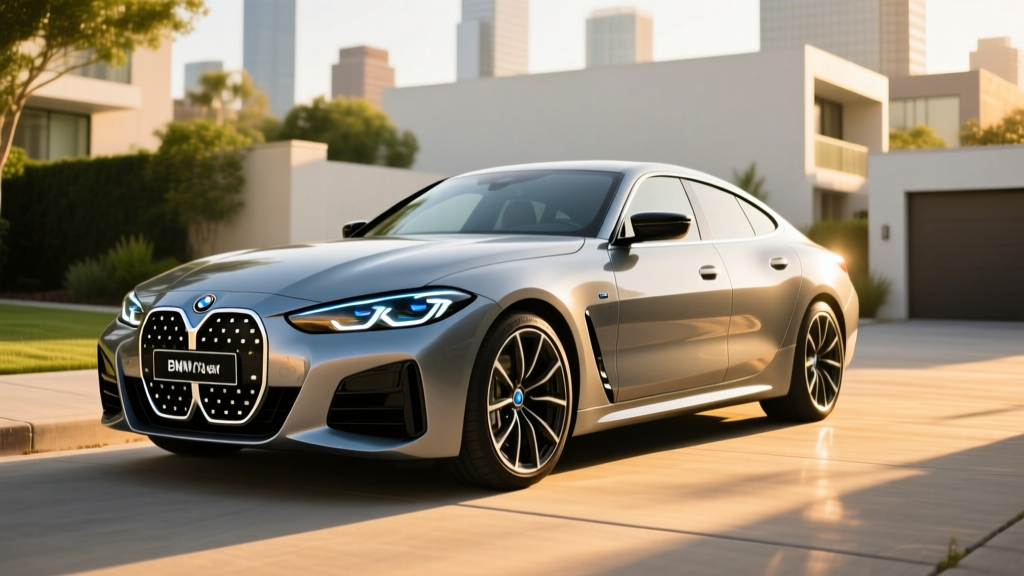
The BMW i4 Is Leaving — Here's What Buyers Need to Know
BMW confirmed that the i4 Gran Coupe will end production in late 2026 as the automaker shifts its electric sedan strategy to the upcoming Neue Klasse platform. For buyers who've had the i4 on their shortlist, this creates a narrow decision window: grab one of the final model-year examples while inventory lasts, or pivot to a competitor. This review breaks down everything you need to decide — from real-world range to federal tax credit eligibility under current IRS §30D rules.
The 2026 BMW i4 carries over with minor updates from the 2025 refresh, including the updated iDrive 8.5 infotainment system and revised front-end styling. It remains one of the best-driving electric sedans in its class, but its CLAR-platform roots (shared with the ICE 4 Series Gran Coupe) impose packaging compromises that newer dedicated-EV architectures have largely solved.
Range, Battery, and Real-World Efficiency
The 2026 i4 lineup uses a single 83.9 kWh usable battery pack (90.1 kWh gross) with NMC (nickel manganese cobalt) chemistry. BMW does not offer an LFP variant for the i4. The eDrive40 remains the range king of the lineup, while the M50 sacrifices roughly 40 miles for dual-motor performance.
| Trim | Drivetrain | EPA Range | MPGe (Combined) | kWh/100 mi |
|---|---|---|---|---|
| eDrive40 | RWD | 307 mi | 109 MPGe | 31 |
| xDrive40 | AWD | 282 mi | 100 MPGe | 34 |
| M50 | AWD (Dual-Motor) | 269 mi | 93 MPGe | 36 |
Efficiency-wise, the eDrive40's 31 kWh/100 mi is competitive with the Tesla Model 3 Long Range (25 kWh/100 mi on a lighter chassis) but falls behind the Hyundai Ioniq 6 (27 kWh/100 mi). The i4's heavier CLAR-derived platform — roughly 4,700 lbs for the eDrive40 — is the primary efficiency penalty.
Charging Speed: DC Fast and Home Level 2
The i4 supports up to 205 kW peak DC fast charging on CCS1-equipped public stations. BMW quotes a 10–80% charge time of approximately 31 minutes. However, the charging curve tells a more nuanced story: the i4 sustains its peak rate only between roughly 10–35% state of charge before tapering progressively. From 50–80%, you'll see rates closer to 80–110 kW. This taper is noticeable on road trips when you're trying to minimize stop times.
| Charging Level | Power / Rate | Time / Miles Added |
|---|---|---|
| Level 1 (120V, 12A) | ~1.4 kW | ~3–4 miles per hour |
| Level 2 (240V, 48A) | 11 kW | ~33 miles per hour; 0–100% in ~8.25 hrs |
| DC Fast Charge (CCS1) | Up to 205 kW peak | 10–80% in ~31 min; 10–100% in ~50 min |
For home charging, the i4's 11 kW onboard charger is among the best in its class. On a properly installed 48-amp Level 2 circuit (NEMA 14-50 or hardwired), you'll add roughly 33 miles of range per hour — enough to fully replenish even the eDrive40 overnight in about 8 hours. Home installation typically runs $800–$2,200 depending on panel capacity and run length; budget for a potential $1,500–$3,000 panel upgrade if your home has a 100-amp service.
One notable drawback: the i4 uses CCS1, not NACS. While BMW has committed to NACS adoption on future models (Neue Klasse), the 2026 i4 requires a CCS-to-NACS adapter for Tesla Supercharger access. BMW provides this adapter with new vehicles, but it's an extra piece of hardware to manage compared to native NACS vehicles.
Performance, Driving Dynamics, and Platform
This is where the i4 earns its BMW badge — and where it separates from competitors that prioritize efficiency over engagement.
| Trim | Motor Config | Horsepower | Torque (lb-ft) | 0–60 mph | Top Speed |
|---|---|---|---|---|---|
| eDrive40 | Single Motor (Rear) | 335 hp | 317 | 5.5 sec | 118 mph |
| xDrive40 | Dual Motor (AWD) | 396 hp | 443 | 4.9 sec | 118 mph |
| M50 | Dual Motor (AWD) | 536 hp | 586 | 3.7 sec | 130 mph |
The eDrive40's rear-wheel-drive layout delivers the classic BMW driving feel — balanced, communicative steering, and a chassis that rewards spirited driving. The adaptive M suspension (standard on M50, optional on xDrive40) manages ride quality impressively, absorbing highway imperfections while maintaining composure through corners. The M50's 3.7-second 0–60 time puts it in genuine sports-sedan territory, though it can't match the raw thrust of a Tesla Model 3 Performance (3.1 seconds).
Regenerative braking offers three levels (low, medium, high) plus an adaptive mode that uses radar and navigation data to modulate regen automatically. The i4 does not offer true one-pedal driving in the way a Nissan Leaf or Chevrolet Bolt does — even in its highest regen setting, the car will creep forward at stops. Drivers who prefer full one-pedal operation will need to adjust.
Interior, Cargo Space, and Technology
The i4's interior is a study in BMW's current design language: a curved display panel houses a 12.3-inch digital instrument cluster and a 14.9-inch infotainment touchscreen running iDrive 8.5. The system is responsive and feature-rich, with wireless Apple CarPlay and Android Auto, a built-in navigation system with EV-aware route planning (factoring in charging stops and battery preconditioning), and a well-implemented voice assistant.
Cargo and passenger space reflect the i4's Gran Coupe body style — it's a hatchback, which helps practicality, but the CLAR platform's transmission tunnel (a vestige of its ICE origins) creates a pronounced floor hump in the rear seat.
| Measurement | Specification |
|---|---|
| Cargo Volume (rear seats up) | 16.6 cu ft |
| Cargo Volume (rear seats folded) | 45.6 cu ft |
| Front Headroom | 39.3 in |
| Rear Headroom | 36.6 in |
| Front Legroom | 41.5 in |
| Rear Legroom | 34.5 in |
Compared to the Tesla Model 3 (23 cu ft rear trunk + frunk), the i4's hatchback design is more versatile for bulky items, but total volume is similar. There is no front trunk (frunk) — the space is occupied by power electronics and HVAC components. Rear-seat passengers taller than 6 feet will find headroom snug due to the sloping roofline, and the center seat is essentially unusable for adults given the floor tunnel.
Driver-assistance tech includes BMW's Driving Assistant Professional, which bundles adaptive cruise control with stop-and-go, lane-keeping assist, and automated lane changes on highways. This is an SAE Level 2 system — the driver must remain fully engaged with hands on the wheel and eyes on the road. It is not autonomous driving. BMW also offers a Highway Assistant feature on equipped models that allows hands-free driving at speeds up to 85 mph on divided highways, but it requires continuous eye monitoring via an infrared camera.
Pricing, Trims, and Federal Tax Credit Eligibility
The 2026 BMW i4 starts at $52,200 for the eDrive40, rising to $69,700 for the M50 before options and destination charges ($995). Well-optioned examples — particularly xDrive40s with the Premium and Executive packages — can push past $70,000.
| Trim | Base MSRP | Typical As-Tested | Under §30D MSRP Cap? | Est. Credit (if eligible) |
|---|---|---|---|---|
| eDrive40 | $52,200 | $56,000–$60,000 | Yes (sedan cap: $55,000)* | Up to $7,500 |
| xDrive40 | $58,200 | $63,000–$68,000 | No — exceeds $55,000 cap | $0 |
| M50 | $69,700 | $74,000–$78,000 | No — exceeds $55,000 cap | $0 |
*Note: The BMW i4 is classified as a sedan for §30D purposes, which carries a $55,000 MSRP cap. The base eDrive40 at $52,200 qualifies, but adding packages that push MSRP above $55,000 will disqualify it. SUV-classified vehicles have a higher $80,000 cap. Verify classification and eligibility with your dealer and a tax professional.
Federal tax credit eligibility under IRS §30D depends on several factors beyond MSRP:
- Buyer income caps: Modified adjusted gross income must not exceed $300,000 (joint filers), $225,000 (head of household), or $150,000 (single filers).
- Battery sourcing requirements: The credit is split into two halves — $3,750 for critical minerals sourcing and $3,750 for battery component manufacturing. As of 2026, strict sourcing rules mean many vehicles qualify for only $3,750 or $0 depending on supply-chain compliance. Check the latest fueleconomy.gov listings for the i4's current status.
- Point-of-sale transfer: Buyers can transfer the credit to the dealer at purchase, reducing the vehicle's price directly rather than waiting for a tax refund. This requires the dealer to be registered with the IRS Energy Credits Online portal.
Warranty, Ownership Costs, and Long-Term Battery Outlook
BMW covers the i4 with a 4-year/50,000-mile limited warranty and an 8-year/100,000-mile high-voltage battery warranty. The battery warranty guarantees that the pack will retain at least 70% of its original capacity during the coverage period — if degradation exceeds 30%, BMW will repair or replace the battery at no cost.
NMC chemistry in the i4 has shown moderate degradation in real-world fleet data. Owners report approximately 5–8% capacity loss over the first 50,000 miles, with the curve flattening significantly thereafter. This is consistent with industry averages for liquid-cooled NMC packs. The i4's thermal management system is robust, using a dedicated cooling circuit for the battery that maintains optimal temperatures during fast charging and extreme-weather operation.
Insurance costs are a notable ownership factor. The i4 typically carries premiums 15–25% higher than a comparable gas-powered 4 Series, reflecting higher repair costs for EV-specific components and BMW's parts pricing. Expect annual premiums in the $1,800–$2,800 range depending on your profile and location.
Maintenance costs are lower than ICE equivalents — no oil changes, no spark plugs, no transmission fluid. BMW includes 3 years/36,000 miles of complimentary scheduled maintenance. Brake wear is minimal thanks to regenerative braking; many owners report original brake pads beyond 80,000 miles.
Pros, Cons, and the Competition
✓ Pros
- Class-leading driving dynamics and steering feel
- Premium interior with excellent build quality
- Competitive 307-mile EPA range (eDrive40)
- Strong 11 kW Level 2 onboard charging
- Hatchback cargo versatility (45.6 cu ft max)
- Highway Assistant hands-free driving (with eye monitoring)
✗ Cons
- No frunk; rear floor tunnel compromises middle seat
- CCS1 connector requires adapter for Tesla Superchargers
- DC fast charging tapers significantly above 50% SoC
- Only base eDrive40 qualifies for federal tax credit
- Heavier than dedicated-EV competitors (hurts efficiency)
- Production ending — long-term parts/service uncertainty
Key competitors to cross-shop:
- Tesla Model 3 Long Range ($47,740): More efficient, native NACS, better Supercharger access, but less refined ride and interior.
- Hyundai Ioniq 6 SE Long Range ($42,715): Ultra-efficient, 361-mile EPA range, 800V architecture for faster charging, but polarizing design.
- Polestar 2 Long Range ($51,300): Similar premium positioning, competitive range, Google-based infotainment, but slower DC charging.
- Mercedes-Benz EQB/EQE: The EQE sedan is larger and more expensive; the EQB is an SUV alternative.
Should You Buy the i4 Before Production Ends?
- You prioritize driving dynamics and premium build over maximum efficiency
- You want a hatchback sedan with BMW badge cachet
- You can charge at home and your commute is under 200 miles daily
- You value BMW's dealer network and service infrastructure
- You need the lowest cost per mile — the Ioniq 6 or Model 3 wins
- You road-trip frequently and want seamless Tesla Supercharger access
- You regularly carry rear-seat passengers (the floor tunnel is a dealbreaker for three-across seating)
- You want a vehicle with a long production future for parts and resale confidence
The production-ending context matters. On one hand, final-year models sometimes come with attractive dealer incentives and lease deals as BMW clears inventory for its Neue Klasse successor. On the other hand, a discontinued model may face steeper depreciation and potential long-term parts scarcity — though BMW's commitment to supporting legacy models for at least 10–15 years provides some reassurance.
For the right buyer — someone who values the i4's unique blend of Bavarian driving dynamics, premium interior, and practical hatchback design — this final production year represents a last chance. Just go in with eyes open about the tax-credit limitations, charging-curve taper, and the reality that you're buying into a platform with a defined end date.
Frequently Asked Questions
What is the real-world range of the 2026 BMW i4?
The eDrive40 achieves an EPA-estimated 307 miles, but real-world highway driving at 75 mph yields approximately 255–275 miles. In cold weather below freezing, expect 220–245 miles. The xDrive40 and M50 deliver proportionally less due to their higher weight and dual-motor powertrains.
How fast does the BMW i4 charge at home and on DC fast chargers?
On a 48-amp Level 2 home charger, the i4 charges at 11 kW, adding about 33 miles per hour and completing a full charge in roughly 8.25 hours. On DC fast chargers, it peaks at 205 kW but sustains that rate only briefly — a 10–80% session takes about 31 minutes, with significant tapering above 50% state of charge.
Does the BMW i4 qualify for the $7,500 federal EV tax credit?
Only the base eDrive40 (MSRP $52,200) falls under the $55,000 sedan MSRP cap for §30D eligibility. Even then, battery-sourcing requirements may limit the credit to $3,750. The xDrive40 ($58,200) and M50 ($69,700) exceed the cap and are ineligible. Buyer income limits also apply. Confirm current status at fueleconomy.gov and with a tax professional.
Is the BMW i4 worth buying now that production is ending?
It depends on your priorities. The i4 offers driving dynamics and interior quality that few EV sedans match, and final-year pricing incentives may make it attractive. However, a discontinued model typically depreciates faster, and competitors like the Tesla Model 3 and Hyundai Ioniq 6 offer better efficiency, charging access, and long-term production certainty.
What connector does the BMW i4 use, and can I charge at Tesla Superchargers?
The 2026 i4 uses the CCS1 connector. You can access Tesla Superchargers using a CCS-to-NACS adapter (provided by BMW with new vehicles), but native NACS vehicles have a more seamless experience. BMW's Neue Klasse successors are expected to adopt NACS natively.
How long will the BMW i4 battery last?
BMW warranties the high-voltage battery for 8 years/100,000 miles with a 70% capacity retention guarantee. Real-world data suggests NMC packs in the i4 lose approximately 5–8% capacity in the first 50,000 miles, with degradation slowing significantly after that. Many owners can expect 15–20 years of usable service before the pack falls below 70% capacity under normal use patterns.