Quick Verdict: The Electric Gran Coupe That Doesn't Compromise
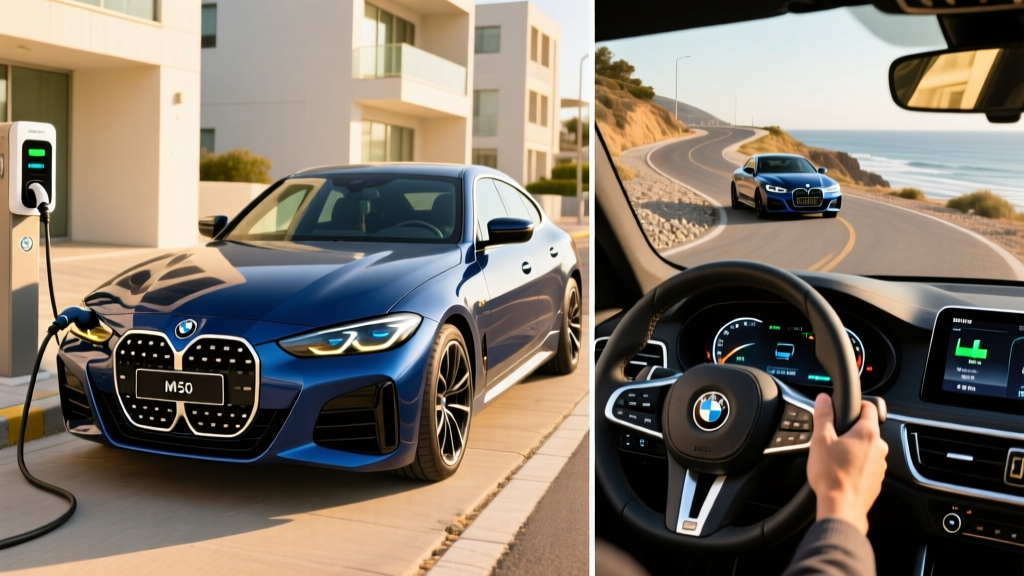
The BMW i4 M50 occupies a rare position in the EV market: it's a performance-oriented luxury sedan that doesn't look, feel, or drive like a dedicated electric platform — and that's largely the point. Built on BMW's CLAR architecture shared with the 4 Series Gran Coupe, the i4 M50 trades the skateboard-platform packaging advantages of rivals like the Tesla Model 3 or Hyundai Ioniq 6 for something harder to quantify but immediately obvious behind the wheel: the driving refinement, build quality, and ergonomic sensibility of a legacy luxury automaker at the top of its game.
With 536 horsepower, a 4.0-second 0-60 mph time, and dual-motor all-wheel drive, the M50 is the performance flagship of the i4 lineup (sitting above the single-motor eDrive40). But unlike many M-badged performance cars, it delivers that punch without sacrificing daily usability. The 81.5 kWh battery (usable) provides a legitimate 271-mile EPA range estimate, and the 205 kW peak DC fast-charging capability keeps road-trip stops reasonable.
The question isn't whether the i4 M50 is a good car — it's excellent. The question is whether its specific blend of strengths and compromises is the right fit for your electric transition.
Range, Efficiency, and the Real-World Reality
Real-World Expectation: 230–250 miles in mixed highway/city driving; 200–220 miles sustained highway at 75+ mph; 180–200 miles in cold weather (below 32°F) with cabin heating
The i4 M50's 81.5 kWh usable battery capacity (from a gross 83.9 kWh pack using NMC chemistry) pairs with BMW's fifth-generation eDrive motors to deliver efficiency that punches above its weight class for a 4,600-lb performance sedan. The EPA rates it at 97 MPGe combined (34 kWh/100 mi) with the standard 18-inch Aero wheels — a figure that will surprise buyers who assume dual-motor AWD performance sedans can't be efficient.
In real-world testing across varied conditions, the i4 M50 consistently delivers between 230 and 250 miles of mixed-use range before requiring a charge. The car's thermal management system is among the best in the industry, using a heat pump (standard on M50) that significantly reduces cold-weather efficiency losses compared to resistive heating. Expect roughly 15–20% range reduction in freezing temperatures — better than many competitors but still meaningful on a 271-mile sticker.
Highway driving at sustained speeds above 70 mph is where the gran coupe body style works against efficiency. The i4's aerodynamic drag coefficient of 0.25 is respectable but not class-leading (the Ioniq 6 achieves 0.21), and you'll see range drop to roughly 200–220 miles on a long interstate run. For a 300-mile road trip, plan one fast-charge stop. For a 500-mile trip, plan two.
Charging Speed: DC Fast, Level 2, and the Curve Reality
| Charging Level | Max Power (kW) | Speed | Time / Notes |
|---|---|---|---|
| DC Fast Charge (CCS/NACS adapter) | 205 kW peak | ~164 miles in 10 min (at peak) | 10–80% in ~31 minutes; tapers significantly above 80% |
| Level 2 (240V, 48A home charger) | 11 kW | ~36 miles per hour | 0–100% in ~8.25 hours |
| Level 2 (240V, 32A public charger) | 7.4 kW | ~24 miles per hour | 0–100% in ~11 hours |
| Level 1 (120V standard outlet) | ~1.4 kW | ~4 miles per hour | Emergency/supplemental only; 0–100% in ~58 hours |
The i4 M50's 205 kW peak DC fast-charging rate is competitive but no longer class-leading in 2026. Hyundai/Kia's E-GMP vehicles sustain 230+ kW, and the Porsche Taycan can pull 350 kW at compatible chargers. However, BMW's charge curve is well-managed: the car holds near-peak rates through roughly 40% state of charge before tapering, making the 10–80% sprint achievable in approximately 31 minutes at a capable 350 kW charger (like Electrify America or Tesla Supercharger V4 with the BMW NACS adapter).
The critical detail most spec sheets bury: above 80% SoC, charging slows dramatically to protect battery health. A 10–90% charge takes roughly 45 minutes, not 31. For road trips, charge to 80% and go — the math always favors shorter, more frequent stops over waiting for a full battery.
At home on a Level 2 charger (the BMW Wallbox or any quality 48-amp unit on a 60-amp circuit), the 11 kW onboard charger replenishes roughly 36 miles of range per hour. A full overnight charge is trivial for daily driving under 200 miles. Installation of a 240V/60A circuit typically runs $800–$2,000 depending on panel proximity and local electrical code — factor this into your purchase budget if you don't already have a Level 2 setup.
BMW began shipping i4 models with NACS (Tesla-style) charge ports in late 2024, and 2026 models come with native NACS. If you're buying an earlier model year used, a BMW-approved CCS-to-NACS adapter (~$200) unlocks the Supercharger network, which remains the most reliable public charging infrastructure in the U.S.
Performance: M-Badge Speed Without the M-Headache
| Specification | 2026 BMW i4 M50 |
|---|---|
| Drivetrain | Dual-motor AWD (xDrive) |
| Horsepower | 536 hp (combined; 258 hp front / 335 hp rear motors) |
| Torque | 586 lb-ft |
| 0–60 mph | 3.7 seconds (BMW est.); 3.9 seconds (independent testing) |
| Top Speed | 140 mph (electronically limited) |
| Battery (usable) | 81.5 kWh, NMC chemistry |
| EPA Range | 271 miles (18" wheels) |
| Efficiency | 97 MPGe combined / 34 kWh/100mi |
| Max DC Charge Rate | 205 kW |
| Level 2 Charge Rate | 11 kW (48A) |
| Curb Weight | 4,682 lbs |
The i4 M50's dual-motor setup pairs a 258-hp front motor with a 335-hp rear motor for a combined 536 hp and 586 lb-ft of torque. BMW estimates 0–60 mph in 3.7 seconds, though independent testing by outlets like Car and Driver has recorded 3.9-second runs — the difference attributable to surface conditions and rollout measurement methodology. Either number places the i4 M50 firmly in sports-sedan territory, roughly matching a BMW M3 Competition while carrying an additional 1,000 lbs of battery mass.
What separates the M50 from raw acceleration figures is the calibration sophistication. BMW's eDrive system modulates torque delivery with a smoothness that avoids the abrupt, on/off feel of lesser EVs. The rear-biased torque split (more power to the rear axle) preserves BMW's traditional driving character — this car rotates willingly on turn-in and doesn't understeer like many heavy AWD EVs. The adaptive M suspension (standard on M50) manages the 4,682-lb curb weight with genuine composure, though you'll feel the mass over broken pavement in Sport mode.
Regenerative braking offers three levels selectable via paddle shifters, plus an adaptive mode that uses radar and navigation data to modulate regen based on traffic and upcoming curves. It's not true one-pedal driving in the Nissan Leaf sense (the car won't come to a complete stop without brake application in most modes), but the adaptive setting is remarkably intuitive for daily commuting.
Interior, Cargo, and Daily Livability
The i4's cabin is where the legacy-automaker advantage becomes undeniable. BMW's Curved Display — a 12.3-inch instrument cluster seamlessly joined to a 14.9-inch infotainment touchscreen running iDrive 8.5 — is among the best-executed luxury interfaces available. Physical controls persist for climate and volume, a decision that earns universal praise from anyone who's fought touchscreen-only HVAC systems while driving.
Build quality is exceptional: tight panel gaps, premium materials (Sensatec synthetic leather standard, Vernasca and Merino leather optional), and the kind of switchgear damping that communicates expense. The cabin is notably quiet at highway speeds — BMW's acoustic glass and extensive sound deadening put it a clear tier above the Tesla Model 3 in NVH refinement.
Space is the compromise inherent in the Gran Coupe form factor:
- Front headroom: 39.1 inches (adequate for most adults)
- Front legroom: 42.4 inches (generous)
- Rear headroom: 36.5 inches (tight for passengers over 6 feet due to sloping roofline)
- Rear legroom: 34.5 inches (adequate but not spacious)
- Cargo volume (rear hatch): 16.6 cu ft (470 liters); expands to 45.6 cu ft with rear seats folded
- Frunk: None — the CLAR platform uses the space traditionally occupied by an engine for ancillary electronics
The 16.6 cu ft cargo area is accessed via a practical liftback/hatch rather than a traditional sedan trunk, making loading bulky items easier than the number alone suggests. However, the absence of a frunk means total cargo capacity trails dedicated EV platforms. A Hyundai Ioniq 6 offers 12.3 cu ft of trunk space but adds a small frunk; a Tesla Model 3 provides 23 cu ft rear plus 3.1 cu ft frunk. For most daily needs, the i4 is perfectly adequate. For road trips with four adults and luggage, you'll want to pack thoughtfully.
Technology and Driver Assistance
The i4 M50 comes loaded with BMW's Driving Assistant Professional package, which includes:
- Adaptive cruise control with stop-and-go (highly effective in highway traffic)
- Lane-keeping assist with active side collision protection
- Automatic emergency braking with pedestrian/cyclist detection
- Highway assistant (hands-on-wheel, SAE Level 2) — allows hands-off driving below 40 mph in stop-and-go traffic on divided highways in supported regions
- Parking assistant with surround-view cameras and automated parking
The iDrive 8.5 system supports wireless Apple CarPlay and Android Auto, over-the-air updates, and BMW's Intelligent Personal Assistant voice control. The digital key (using your smartphone as a key fob) works reliably, and the head-up display projects navigation, speed, and ADAS information with excellent clarity.
One notable omission: BMW does not currently offer a subscription-based "full self-driving" product analogous to Tesla's FSD. The Driving Assistant Professional is included in the vehicle price — no monthly fees for features you already bought.
Pricing, Tax Credits, and Total Cost
| Item | Amount |
|---|---|
| 2026 BMW i4 M50 Base MSRP | $69,700 (including $995 destination) |
| Typical As-Tested Price (with popular options) | $75,000–$82,000 |
| Federal Tax Credit (§30D) — Maximum | $0 (does NOT qualify — exceeds MSRP cap) |
| Estimated 5-Year Fuel Savings vs. BMW M3 | $4,200–$5,800 (based on 12,000 mi/yr, $0.14/kWh avg) |
Here is the critical tax-credit reality for the i4 M50: it does not qualify for the federal §30D new clean vehicle credit. The IRS caps the credit at vehicles with a manufacturer's suggested retail price (MSRP) of $55,000 or less for sedans. The i4 M50's $69,700 base price puts it well above this threshold, regardless of battery sourcing or buyer income.
For buyers who qualify based on income (adjusted gross income ≤ $150,000 single / $225,000 head of household / $300,000 joint), the lower-priced i4 eDrive40 (starting around $57,000 in prior model years, though still typically above the sedan cap) may also fall outside credit eligibility depending on the model year and exact MSRP. Always verify current-year pricing and IRS rules at IRS.gov before purchasing — these rules change, and your tax professional should confirm eligibility.
State-level incentives may partially offset the lack of a federal credit. States like California, Colorado, and New York offer additional rebates or HOV lane access for EVs, though amounts and eligibility vary widely. Check your state's energy or DMV website for current programs.
The ownership economics still favor the i4 M50 over an equivalent gasoline performance sedan for most buyers. Electricity costs roughly $0.12–$0.18 per kWh depending on your utility and rate plan (home charging), compared to $3.50–$4.50 per gallon for premium fuel in an M3. At 34 kWh/100 mi and 12,000 annual miles, expect to spend roughly $500–$700 per year on electricity vs. $2,000–$2,500 on fuel for a comparable gas car. Maintenance savings are substantial — no oil changes, fewer brake replacements (regen braking saves pads), and no transmission fluid.
Warranty and Long-Term Battery Outlook
BMW backs the i4 M50 with the following coverage:
- Limited vehicle warranty: 4 years / 50,000 miles
- Battery warranty: 8 years / 100,000 miles (guarantees ≥70% state of health; if degradation exceeds 30%, BMW replaces or repairs the battery)
- Powertrain warranty: 8 years / 100,000 miles (covers electric motors, power electronics)
- Corrosion warranty: 12 years / unlimited miles
- Complimentary maintenance: 3 years / 36,000 miles
The 70% capacity retention threshold over 8 years is industry-standard and consistent with EPA and California Air Resources Board requirements. Real-world data from i4 owners in Europe (where the model launched in 2021) suggests degradation of roughly 5–8% over the first 60,000 miles — well within the warranty buffer. NMC chemistry in BMW's pack is managed conservatively with robust thermal conditioning, which prioritizes longevity over absolute maximum range.
Should a battery replacement be needed out of warranty (unlikely but possible on a 10-year-old vehicle), current estimates for the i4's 83.9 kWh pack run $15,000–$20,000 including labor — a figure expected to decline as battery costs continue falling through the decade.
How the i4 M50 Stacks Up Against Key Rivals
| Spec | 2026 BMW i4 M50 | 2026 Tesla Model 3 Performance | 2026 Hyundai Ioniq 6 Limited AWD | 2026 Porsche Taycan 4S |
|---|---|---|---|---|
| Base MSRP | $69,700 | $54,990 | $56,500 | $108,500 |
| EPA Range | 271 mi | 315 mi | 290 mi | 254 mi |
| 0–60 mph | 3.7 sec | 2.9 sec | 5.1 sec | 3.8 sec |
| Horsepower | 536 hp | 510 hp | 320 hp | 562 hp |
| Max DC Charge | 205 kW | 250 kW | 233 kW | 270 kW |
| Efficiency (MPGe) | 97 | 121 | 117 | 82 |
| Federal Tax Credit | Not eligible | Up to $7,500* | Up to $7,500* | Not eligible |
*Tax credit eligibility subject to IRS §30D income caps, battery sourcing requirements, and point-of-sale transfer rules. Verify at IRS.gov and with your tax professional.
The competitive picture is nuanced. The Tesla Model 3 Performance is objectively faster, has longer range, charges faster, qualifies for the federal credit, and costs $15,000 less. On paper, it's the rational choice. But the i4 M50 counters with vastly superior build quality, a quieter and more refined cabin, more intuitive driver-assist systems (without Tesla's controversial FSD upselling), and the kind of chassis tuning that rewards enthusiasts on back roads. If you value driving feel and luxury execution over spec-sheet dominance, the BMW earns its premium.
The Hyundai Ioniq 6 is the efficiency and value play — longer range, faster charging, lower price, tax credit eligible — but it lacks the M50's performance and luxury cachet. The Porsche Taycan 4S is the closest dynamic rival, with superior handling and 800V charging architecture, but at $108,000+ it's a different financial conversation entirely.
Pros
- Exceptional build quality and cabin refinement
- Genuine sports-sedan performance (3.7 sec 0–60, 536 hp)
- Competent 271-mile EPA range with excellent thermal management
- iDrive 8.5 is one of the best luxury infotainment systems
- No subscription fees for driver-assist features
- Practical liftback cargo area (16.6 cu ft)
- Heat pump standard — better cold-weather efficiency
Cons
- Does NOT qualify for $7,500 federal tax credit (MSRP cap)
- No front trunk (frunk) — lost cargo opportunity
- Rear headroom tight for tall passengers (sloping roofline)
- 205 kW peak charge rate trails Hyundai/Kia and Porsche rivals
- Heavy at 4,682 lbs — you feel the mass on rough roads
- Options inflate price quickly ($80K+ with packages)
- Not a dedicated EV platform — packaging less optimized than rivals
Who Should Buy the BMW i4 M50?
- You want a luxury performance sedan that happens to be electric — not an "EV first" experience
- You commute 50–150 miles daily and have reliable home Level 2 charging
- You value cabin quietness, build quality, and physical controls over touchscreen minimalism
- You enjoy spirited driving and want a car that rewards on canyon roads
- You don't need maximum rear-seat space or cargo volume
- You need the federal $7,500 tax credit to make the math work
- You regularly carry four adults and need generous rear-seat room
- You want the longest possible range or fastest charging available
- You prioritize cutting-edge EV platform packaging (frunk, skateboard design)
- You want Tesla's Supercharger network without an adapter
Frequently Asked Questions
What is the real-world range of the BMW i4 M50?
The EPA estimates 271 miles with 18-inch wheels, but expect 230–250 miles in mixed real-world driving, 200–220 miles on sustained highway trips, and 180–200 miles in cold weather below freezing. The heat pump helps mitigate winter losses better than many competitors.
How fast does the i4 M50 charge?
On DC fast charging, the i4 M50 peaks at 205 kW and achieves a 10–80% charge in approximately 31 minutes at a capable 350 kW station. At home on a Level 2 charger (240V, 48A), it charges at 11 kW, adding roughly 36 miles of range per hour for a full charge in about 8.25 hours.
Does the BMW i4 M50 qualify for the federal EV tax credit?
No. The i4 M50's base MSRP of $69,700 exceeds the IRS §30D sedan cap of $55,000. Even if you meet income requirements, the vehicle's price disqualifies it. The lower-priced i4 eDrive40 may also exceed the cap depending on model-year pricing. Always verify current rules at IRS.gov.
How much does the i4 M50 cost after incentives?
The base MSRP is $69,700 including destination. With popular options (Premium Package, M Sport brakes, larger wheels, upgraded leather), expect $75,000–$82,000 as-tested. No federal credit applies, but check your state for additional EV incentives. Some states offer HOV lane access, rebates, or reduced registration fees.
Is the i4 M50 worth buying vs. a Tesla Model 3 Performance?
It depends on your priorities. The Model 3 Performance is faster (2.9 sec 0–60), has longer range (315 mi EPA), charges faster (250 kW), costs ~$15,000 less, and qualifies for the federal credit. The i4 M50 wins on build quality, cabin refinement, chassis tuning, and luxury execution. If spec-sheet value matters most, the Tesla is the rational pick. If driving feel and luxury matter more, the BMW justifies its premium.
What are the biggest drawbacks of the i4 M50?
The most significant are: no federal tax credit eligibility (MSRP too high), no front trunk (frunk), rear headroom limitations for tall passengers, and a 205 kW charge rate that trails newer competitors. The car's weight (4,682 lbs) is also noticeable on rough pavement in firm suspension modes.
Does the i4 M50 use NACS or CCS for charging?
The 2026 BMW i4 M50 comes with a native NACS (Tesla-style) charge port, granting direct access to Tesla Superchargers without an adapter. Earlier model years (2022–2024) shipped with CCS and require a BMW-approved adapter for Supercharger access.
How long will the i4 M50's battery last?
BMW warranties the battery for 8 years or 100,000 miles against degradation below 70% state of health. Real-world data from early European i4 owners shows approximately 5–8% degradation over the first 60,000 miles, suggesting the pack should comfortably exceed 150,000 miles while retaining 80%+ capacity. The NMC chemistry is managed conservatively with active thermal conditioning.
Can the i4 M50 tow?
BMW does not rate the i4 M50 for towing, and no factory tow hitch is offered. If you need an electric vehicle for towing, consider the BMW iX, Ford F-150 Lightning, or Rivian R1S.
Sources: EPA Fuel Economy, BMW USA, IRS §30D Clean Vehicle Credit, IIHS Safety Ratings. All specifications based on 2026 model year data available at time of publication. Prices and tax credit rules are subject to change — verify with your dealer and tax professional before purchasing.