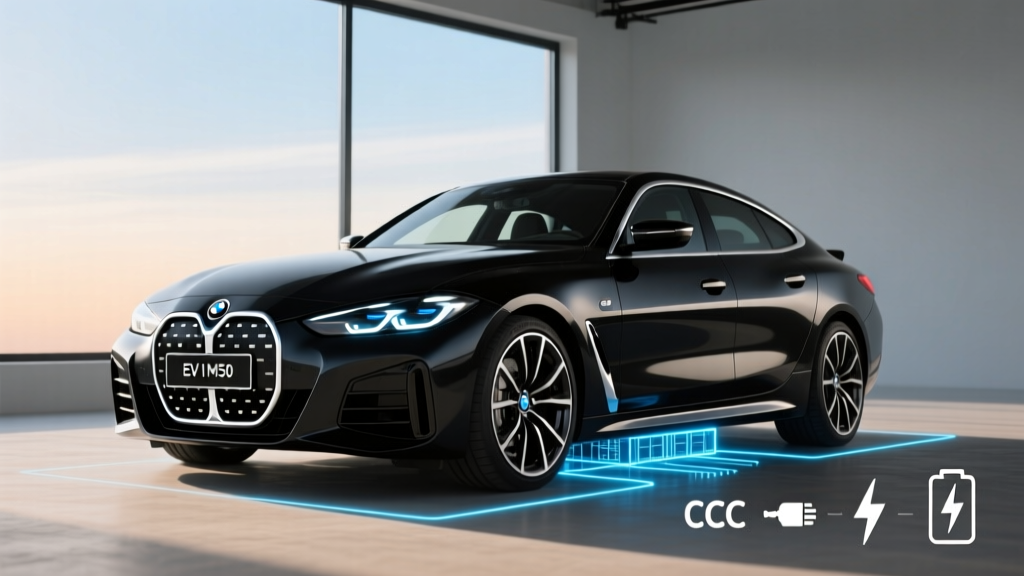
If you're shopping for a luxury electric gran coupe that blends BMW's driving dynamics with zero-emission efficiency, the BMW i4 M50 is likely on your radar. With dual motors, 536 horsepower, and a usable 81.5 kWh battery, it's positioned as the enthusiast's electric sedan. But before signing a lease or purchase agreement, you need the hard numbers: real-world range, charging speed, total cost after incentives, and whether competitors offer better value. This 2026 BMW i4 M50 review breaks down everything you need to evaluate current lease deals and ownership costs.
2026 BMW i4 M50: Core Specifications at a Glance
| Specification | BMW i4 M50 (2026) |
|---|---|
| EPA Range | 245 miles (with 19" wheels); 270 miles (18" wheels) |
| Battery Capacity | 81.5 kWh usable (NMC chemistry) |
| Drivetrain | Dual-motor AWD (xDrive) |
| Horsepower | 536 hp (400 kW) |
| 0-60 mph | 3.7 seconds |
| DC Fast Charge (Peak) | 205 kW (CCS/NACS adapter) |
| 10-80% DC Charge Time | ~31 minutes |
| Level 2 Home Charge | 11 kW (~30 miles/hour) |
| EPA Efficiency | 91 MPGe combined (27 kWh/100mi) |
| Cargo Volume | 16.6 cu ft (rear seats up); 45.2 cu ft (folded) |
| Rear Legroom | 33.4 inches |
| Base MSRP | $67,795 (before incentives) |
| Battery Warranty | 8 years / 100,000 miles (70% capacity retention) |
Real-World Range: EPA vs. Highway and Cold-Weather Reality
Real-World Highway (70-80 mph): Expect 210-230 miles in moderate weather
Cold-Weather Impact (below 32°F): Range drops to ~180-200 miles with cabin heating
The BMW i4 M50's EPA range is respectable for a 536-hp performance sedan, but real-world driving tells a more nuanced story. In mixed city/highway driving at moderate speeds (55-65 mph), owners report achieving 235-255 miles on a full charge—close to the EPA sticker. However, sustained highway cruising at 75-80 mph pushes consumption higher, reducing range to 210-230 miles.
Cold weather is the bigger concern. Lithium-ion batteries lose efficiency below freezing, and cabin heating (even with the i4's heat pump) draws significant power. In winter testing at 20-30°F, expect a 20-25% range reduction, putting real-world range at 180-200 miles. If you live in northern climates and commute more than 150 miles round-trip, the i4 M50's range may feel tight without reliable home or workplace charging.
According to EPA fuel economy data, the i4 M50 achieves 91 MPGe combined, translating to 27 kWh per 100 miles. That's less efficient than the Tesla Model 3 Performance (25 kWh/100mi) but competitive with the Audi e-tron GT (29 kWh/100mi).
Charging Speed: DC Fast Charging and Home Level 2 Setup
| Charging Level | Power (kW) | Miles Added per Hour | Time to Charge |
|---|---|---|---|
| Level 1 (120V household) | 1.4 kW | ~3-4 miles/hour | Not practical for daily use |
| Level 2 (240V home) | 11 kW | ~30 miles/hour | 8-9 hours (0-100%) |
| DC Fast Charge (CCS/NACS) | 205 kW peak | ~164 miles in 10 min | 10-80% in ~31 minutes |
The BMW i4 M50 supports up to 205 kW DC fast charging via CCS (or NACS with BMW's adapter, available for 2025+ models). At peak rate, you can add 164 miles of range in 10 minutes—but that's only sustained between 10-40% state of charge. Above 60%, the charge curve tapers significantly, dropping to 100 kW and then 50 kW near 80%. This is why the 10-80% charge takes 31 minutes, not 15.
For home charging, the i4's 11 kW onboard charger is a standout. Most competitors (including the Tesla Model 3) cap at 7.7-9.6 kW on Level 2, meaning the i4 charges ~20-30% faster overnight. With an 11 kW home charger (requiring a 50-amp circuit), you'll add 30 miles of range per hour, fully recharging the 81.5 kWh battery in 8-9 hours. Installation costs for a 50-amp Level 2 setup typically range from $800-$2,000, depending on panel capacity and wiring distance.
If your home electrical panel maxes out at 40 amps (common in older homes), you'll be limited to 9.6 kW charging, adding ~26 miles/hour. An electrician can assess whether a panel upgrade (to 200 amps) is necessary—budget $1,500-$3,000 for that work if needed.
Performance: 536 HP, Dual Motors, and BMW's Driving DNA
The i4 M50 is BMW's first M Performance electric vehicle, and it delivers: 536 horsepower, 586 lb-ft of torque, and a 3.7-second 0-60 mph time. The dual-motor xDrive all-wheel-drive system provides instant torque vectoring, making the i4 M50 feel agile despite its 4,800-pound curb weight.
In real-world driving, the M50's adaptive suspension (standard) and M Sport brakes (optional) give it a firm, controlled ride that's more sports sedan than luxury cruiser. The regenerative braking system offers adjustable levels (via paddle shifters), but unlike some competitors, it doesn't enable true one-pedal driving at the highest setting—you'll still need to use the brake pedal for full stops.
Compared to the Tesla Model 3 Performance (0-60 in 3.1 seconds, 510 hp), the i4 M50 is slightly slower but feels more refined in chassis tuning and interior build quality. The Audi e-tron GT (0-60 in 3.9 seconds, 522 hp) is a closer match in luxury positioning, though it's priced $15,000+ higher.
Pricing, Lease Deals, and Federal Tax Credit Eligibility
| Trim Level | Base MSRP (2026) | As-Tested Price (Typical Options) |
|---|---|---|
| i4 M50 | $67,795 | $72,000-$78,000 |
The BMW i4 M50 does NOT qualify for the $7,500 federal tax credit in 2026. Here's why:
- MSRP Cap: Sedans must be under $55,000; the i4 M50 starts at $67,795.
- Battery Sourcing: The i4's battery cells (Samsung SDI, NMC chemistry) do not meet the 2026 critical minerals and battery component requirements under IRS §30D rules.
- Buyer Income Cap: Even if it qualified, buyers with AGI above $150,000 (single) or $300,000 (joint) are ineligible.
Without the federal tax credit, the i4 M50's effective price remains $67,795+, which impacts lease deal attractiveness. However, BMW Financial Services frequently offers lease incentives ($2,000-$5,000) and below-market money factors (lease equivalent of interest rate) to move inventory. As of early 2026, typical i4 M50 lease deals look like this:
- 36-month lease, 10,000 miles/year: $850-$950/month with $5,000 down (MSD programs can reduce money factor further)
- 24-month lease, 10,000 miles/year: $950-$1,050/month with $5,000 down
Compare this to the Tesla Model 3 Performance ($52,990 MSRP, qualifies for $7,500 credit, effective price $45,490), which leases for $550-$650/month with similar terms. The i4 M50's lease premium is justified if you prioritize BMW's interior quality, driving dynamics, and brand cachet—but it's a $300-$400/month gap that adds up over 3 years.
Tech, Interior, and Standout Features
The i4 M50's interior is a blend of BMW's traditional luxury and modern EV tech:
- iDrive 8.5: 14.9-inch curved touchscreen with wireless Apple CarPlay/Android Auto, over-the-air updates, and BMW's Intelligent Personal Assistant voice control.
- Digital Cluster: 12.3-inch driver display with EV-specific readouts (range, energy flow, charge status).
- Harman Kardon Audio: 17-speaker, 535-watt system (standard on M50).
- Driver Assistance: Active Driving Assistant Professional (SAE Level 2) includes adaptive cruise, lane-keeping, and automatic emergency braking. Hands-free driving is not supported—BMW does not offer a Super Cruise/BlueCruise equivalent.
- Parking Assistant Plus: 360-degree cameras, automated parking, and Reversing Assistant (retraces your last 50 meters).
Notable drawbacks:
- Rear Seat Space: 33.4 inches of legroom is tight for a $70K+ sedan; the Tesla Model S offers 40.9 inches.
- No Frunk: Unlike purpose-built EVs, the i4 (based on the 4 Series Gran Coupe platform) has no front trunk.
- Touchscreen-Heavy Controls: Climate and seat controls are buried in menus, not physical buttons.
Pros and Cons: Is the BMW i4 M50 Worth It?
Pros
- Exceptional driving dynamics and chassis tuning (BMW M heritage)
- 11 kW Level 2 charging (faster than most competitors)
- Premium interior with iDrive 8.5 and curved display
- 245-270 mile range is adequate for most commuters
- Strong regenerative braking with adjustable levels
Cons
- No federal tax credit eligibility (MSRP + sourcing rules)
- Lease deals are $300-$400/month higher than Tesla Model 3 Performance
- Rear seat legroom is tight (33.4 inches)
- No front trunk (frunk) for extra storage
- Touchscreen-heavy controls frustrate some drivers
Who Should Lease the BMW i4 M50?
- You prioritize driving dynamics and interior luxury over max range or lowest cost.
- You have home Level 2 charging and a daily commute under 120 miles.
- You want a dual-motor AWD sedan with 500+ hp but don't need SUV cargo space.
- You're okay paying a lease premium for BMW's brand and build quality.
- Tesla Model 3 Performance: You want the $7,500 tax credit, 315-mile range, and lower lease payments.
- Audi e-tron GT: You need more rear seat space and don't mind a $85K+ price tag.
- Hyundai Ioniq 6: You prioritize 360-mile range and 800V ultra-fast charging (10-80% in 18 minutes).
Frequently Asked Questions
What is the real-world range of the BMW i4 M50?
The EPA rates the i4 M50 at 245 miles (19" wheels) or 270 miles (18" wheels). In real-world highway driving at 70-80 mph, expect 210-230 miles. In cold weather (below 32°F), range drops to 180-200 miles due to battery inefficiency and cabin heating demands.
How fast does the BMW i4 M50 charge?
On a DC fast charger, the i4 M50 peaks at 205 kW, charging from 10-80% in about 31 minutes. At home on a 240V Level 2 charger (11 kW), it adds 30 miles of range per hour, fully recharging in 8-9 hours. This is faster than most competitors, which cap at 7.7-9.6 kW.
Does the BMW i4 M50 qualify for the $7,500 federal EV tax credit?
No. The i4 M50 exceeds the $55,000 MSRP cap for sedans under IRS §30D rules, and its battery does not meet the 2026 critical minerals and component sourcing requirements. Buyers cannot claim the federal credit, though some states (California, Colorado, New York) offer separate rebates—check your local DMV or energy office.
How much does a BMW i4 M50 lease cost in 2026?
Typical 36-month leases (10,000 miles/year) range from $850-$950/month with $5,000 down, depending on incentives and money factor. This is $300-$400/month higher than a Tesla Model 3 Performance lease, largely due to the i4's higher MSRP and lack of federal tax credit offset.
Is the BMW i4 M50 worth it vs. the Tesla Model 3 Performance?
It depends on priorities. The i4 M50 offers superior interior quality, driving dynamics, and 11 kW home charging. The Model 3 Performance wins on range (315 miles), price ($45,490 after tax credit), and Autopilot functionality. If you value BMW's brand and chassis tuning, the i4 M50 justifies its premium. If you prioritize cost and range, the Model 3 is the better value.
What's the warranty on the BMW i4 M50 battery?
BMW covers the i4's high-voltage battery for 8 years or 100,000 miles, whichever comes first. The warranty guarantees at least 70% capacity retention during that period. If the battery degrades below 70% (measured by BMW's diagnostic tool), BMW will repair or replace it at no cost.