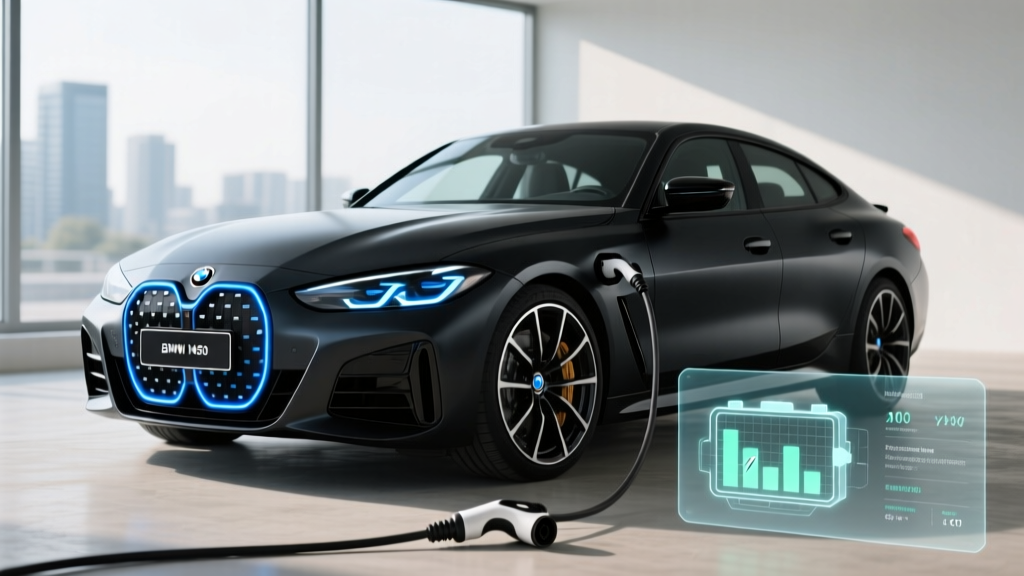
The BMW i4 M50 Gran Coupe occupies a rare position in the EV market: a dual-motor performance sedan that wears a legacy luxury badge, delivers legitimate sports-sedan acceleration, and packages it all in a sleek fastback silhouette. But with a starting price that pushes well into the $60,000s and a competitive set that includes the Tesla Model 3 Performance, Hyundai Ioniq 6, and BMW's own i4 eDrive40, buyers need hard numbers before writing a check. This review breaks down the 2026 BMW i4 M50's real-world range, charging behavior, ownership costs, and whether its driving dynamics justify the premium over rivals.
Quick Verdict: Who the BMW i4 M50 Gran Coupe Is For
The i4 M50 is engineered for the driver who wants a 0-60 time that embarrasses most sports cars, all-wheel-drive confidence, and BMW's signature chassis tuning — but also needs a daily-usable electric commuter with a real-world range near 250 miles. It is not the range champion in its class. It is not the most efficient. But it may be the most satisfying to drive on a back road while still delivering 270 miles of EPA-rated range and practical hatchback cargo space.
Choose the i4 M50 if: You prioritize acceleration, chassis dynamics, and build quality over maximum range or lowest cost per mile.
Look elsewhere if: You need 350+ miles of range (consider the i4 eDrive40 or Ioniq 6), want the lowest price per horsepower, or require Level 2 hands-free driving features like Ford BlueCruise or GM Super Cruise.
Range, Efficiency, and Real-World Expectations
The 2026 BMW i4 M50 carries an 83.9 kWh gross battery pack (approximately 81.5 kWh usable) using NMC (nickel manganese cobalt) lithium-ion chemistry. BMW prioritizes energy density and performance with NMC over the longer cycle life of LFP (lithium iron phosphate), which is a trade-off typical of European performance EVs.
EPA Estimated Range: 270 miles (with 19-inch wheels; drops to ~255 miles with optional 20-inch performance wheels)
Real-World Expectation: Expect 235–255 miles in mixed driving at highway speeds (70-80 mph). In cold weather (below 32°F), range can drop to 200–220 miles due to battery resistance and cabin heating demands. City driving with regenerative braking recovers more energy, pushing closer to the EPA sticker.
| Spec | Value |
|---|---|
| EPA Range | 270 miles (19" wheels) |
| Battery (Gross / Usable) | 83.9 kWh / ~81.5 kWh |
| Battery Chemistry | NMC (Nickel Manganese Cobalt) |
| MPGe (Combined) | 97 MPGe |
| Efficiency | 35 kWh / 100 miles |
| Drivetrain | Dual-motor AWD (xDrive) |
| Horsepower | 536 hp (400 kW) |
| Torque | 586 lb-ft |
| 0-60 mph | 3.7 seconds |
| Top Speed | 130 mph (electronically limited) |
| Max DC Fast Charge | 205 kW |
| 10-80% DC Charge Time | ~31 minutes |
| Level 2 Charge Rate | 11 kW (AC) |
| Connector | CCS1 (NACS adapter available) |
| Battery Warranty | 8 years / 100,000 miles |
| Base MSRP | $69,900 |
Efficiency lands at 97 MPGe combined (35 kWh per 100 miles) according to EPA data on fueleconomy.gov. That's competitive with the Audi e-tron GT but trails the more aerodynamic Hyundai Ioniq 6 (140 MPGe) and the Tesla Model 3 Performance (~113 MPGe). The M50's weight — approximately 4,900 lbs — and aggressive powertrain mapping explain the gap.
Charging Speed: DC Fast Charging and Home Level 2
Charging speed is where BMW's CLAR-platform EVs show maturity. The i4 M50 supports a peak DC fast-charge rate of 205 kW via its CCS1 connector. On a 350 kW charger (such as Electrify America or EVgo stations), the M50 can add approximately 90 miles of range in 10 minutes under ideal conditions, reaching from 10% to 80% state of charge in roughly 31 minutes.
| Charge Level | Power | Speed (Miles Added) | Notes |
|---|---|---|---|
| Level 1 (120V) | ~1.4 kW | ~3-4 miles/hour | Emergency/trickle only |
| Level 2 (240V, 48A) | 11 kW | ~30-33 miles/hour | Full charge in ~8.5 hours |
| DC Fast Charge | 205 kW peak | ~90 miles in 10 min | 10-80% in ~31 min |
Charging curve reality check: The 205 kW peak is achieved only between approximately 10-30% state of charge (SoC) with a preconditioned battery. Above 50% SoC, the rate tapers to roughly 120-150 kW, and above 80% it drops further to protect the NMC cells. This is standard behavior for NMC packs, but it means your last 20% of charge will take nearly as long as the first 50%.
For home charging, the i4 M50's onboard charger accepts up to 11 kW on a Level 2 (240V) connection. That translates to about 30-33 miles of range per hour of charging, meaning a full 0-100% charge takes roughly 8.5 hours on a 48-amp hardwired home station. Most owners charging overnight from a typical 20-80% daily window will replenish their battery in about 5 hours — well within a standard overnight window.
BMW provides a CCS1 inlet on the i4 M50. For Tesla Supercharger access, BMW offers a CCS-to-NACS adapter, expanding the available DC fast-charging network significantly for road trips. The Supercharger network's reliability advantage remains a meaningful consideration for buyers in areas with sparse Electrify America or EVgo coverage.
Performance: 536 Horsepower and BMW's Chassis DNA
The i4 M50's dual-motor all-wheel-drive system produces 536 horsepower (400 kW) and 586 lb-ft of torque. The 0-60 mph sprint takes 3.7 seconds as measured by BMW, though independent tests have recorded times as low as 3.5 seconds on prepped surfaces. That places the M50 in genuine sports-car territory — quicker to 60 than a Porsche 718 Cayman S and competitive with the Tesla Model 3 Performance (3.1 seconds) at a higher price point.
Where the M50 distinguishes itself from the Tesla is chassis dynamics. BMW M division tuning delivers precise steering weighting, well-controlled body motions, and a ride quality that balances compliance with sportiness. The adaptive M suspension is standard, and the car's low center of gravity (battery pack under the floor) gives it a planted feel that belies its ~4,900-lb curb weight. The M50 also includes launch control, an M-specific rear-biased torque distribution mode, and an electronic limited-slip differential on the rear axle.
One notable feature is BMW's IconicSounds Electric — synthetic motor sound piped through the cabin speakers. Some drivers appreciate the feedback; others find it artificial. It can be disabled.
Interior, Tech, and Cargo Practicality
The i4 M50 shares its cabin architecture with the BMW 4 Series Gran Coupe, which means a driver-focused layout with BMW's Curved Display — a 12.3-inch instrument cluster merged with a 14.9-inch central touchscreen running iDrive 8.5. The system supports wireless Apple CarPlay, Android Auto, and over-the-air updates. A head-up display, Harman Kardon surround sound (16 speakers), and a heated steering wheel are standard on the M50.
For driver assistance, the i4 M50 comes equipped with BMW's Driving Assistant Professional package: adaptive cruise control with stop-and-go, lane-keeping assist, automatic emergency braking, and cross-traffic alert. This is an SAE Level 2 system — the driver must remain attentive and keep hands on the wheel at all times. BMW does not currently offer a hands-free Level 2+ system comparable to GM's Super Cruise or Ford's BlueCruise on the i4.
Driver Assist Limitation: BMW's Driving Assistant Professional is a Level 2 driver-assist system. It does not enable hands-free or eyes-off driving. You must maintain steering-wheel contact and full situational awareness at all times. Do not confuse this with Level 4 autonomous systems like Waymo's driverless robotaxi service.
Cargo space benefits from the Gran Coupe's liftback design: 16.6 cubic feet behind the rear seats (compared to the 4 Series Gran Coupe's similar figure), expanding to approximately 45.6 cubic feet with the 40/20/40 rear seats folded. That's competitive with a small SUV and far more practical than a traditional sedan trunk. Rear legroom measures 34.4 inches — adequate for adults on shorter trips but tight for long journeys with taller passengers. Front legroom is generous at 41.5 inches.
Pricing, Tax Credit Eligibility, and Ownership Costs
The 2026 BMW i4 M50 starts at a base MSRP of $69,900, including destination. Our tested example, equipped with the Premium Package, 20-inch wheels, M Sport brakes, and Parking Assistance Package, reached approximately $76,500 before incentives.
| Item | Amount |
|---|---|
| Base MSRP (M50 xDrive) | $69,900 |
| As-Tested Price | ~$76,500 |
| Federal Tax Credit (§30D) | Up to $7,500* |
| Effective Price After Credit | ~$62,400 – $69,000* |
*Federal tax credit eligibility requires meeting multiple conditions under IRS §30D:
- MSRP cap: Sedans must have an MSRP at or below $55,000. The i4 M50's $69,900 base price exceeds this cap, meaning the M50 variant does NOT qualify for the new-vehicle §30D credit. (The lower-trim i4 eDrive40 at ~$52,200 may qualify — check current IRS rules.)
- Buyer income cap: Modified AGI must not exceed $150,000 (single), $225,000 (head of household), or $300,000 (joint filing).
- Battery sourcing: Critical minerals and battery components must meet phased-in domestic sourcing requirements per the Inflation Reduction Act.
- Point-of-sale transfer: Eligible credits can be transferred to the dealer at purchase for an immediate price reduction.
This is a critical consideration: the BMW i4 M50 does not qualify for the $7,500 federal new-vehicle tax credit because its MSRP exceeds the $55,000 sedan cap. Buyers should verify current rules at IRS.gov §30D guidance and consult a tax professional before purchase. Some state and local incentives may still apply — check your state's energy office or Alternative Fuels Data Center for regional programs.
On the ownership-cost side, BMW provides a 4-year/50,000-mile limited warranty and an 8-year/100,000-mile high-voltage battery warranty (covering defects and capacity loss below 70% of original capacity). Scheduled maintenance is minimal compared to combustion vehicles — no oil changes, no transmission fluid — though brake wear is reduced significantly thanks to regenerative braking. Insurance premiums for the M50 tend to run 15-25% higher than the eDrive40 due to the performance designation; get quotes before committing.
BMW i4 M50 vs. Key Competitors
| Spec | BMW i4 M50 | Tesla Model 3 Perf. | Hyundai Ioniq 6 AWD |
|---|---|---|---|
| EPA Range | 270 mi | 315 mi | 270 mi |
| 0-60 mph | 3.7 sec | 3.1 sec | 5.1 sec |
| Horsepower | 536 hp | 510 hp | 320 hp |
| Battery (usable) | ~81.5 kWh (NMC) | ~75 kWh (NMC) | 77.4 kWh (NMC) |
| Max DC Charge | 205 kW | 250 kW | 240 kW |
| 10-80% Time | ~31 min | ~27 min | ~18 min |
| Base MSRP | $69,900 | $54,990 | $49,250 |
| Federal Credit | No (MSRP cap) | Likely eligible | Likely eligible |
| Cargo Space | 16.6 cu ft | 23 cu ft | 12.3 cu ft |
Pros and Cons of the BMW i4 M50
Pros
- 536 hp and 3.7-sec 0-60 in a refined luxury sedan
- Exceptional chassis balance and steering feel — true M-car dynamics
- Practical liftback cargo area (16.6 cu ft)
- Quiet, well-insulated cabin with premium materials
- iDrive 8.5 is responsive and feature-rich
- Strong regenerative braking with one-pedal driving capability
- 8-year/100,000-mile battery warranty
Cons
- $69,900 base price exceeds $55K federal tax credit cap — no §30D credit
- 270-mile EPA range trails Tesla Model 3 Performance (315 mi)
- 205 kW peak DC charge rate is slower than Hyundai Ioniq 6 (240 kW) and Tesla (250 kW)
- No hands-free Level 2+ driving system available
- Rear legroom (34.4 in) is tight for tall adults on long trips
- Insurance premiums run 15-25% higher than eDrive40 trim
- IconicSounds Electric synthetic motor noise is divisive
Frequently Asked Questions
What is the real-world range of the BMW i4 M50 Gran Coupe?
The EPA rates the i4 M50 at 270 miles with 19-inch wheels. In real-world highway driving at 70-80 mph, expect 235-255 miles. In cold weather below freezing, range can drop to 200-220 miles due to battery chemistry limitations and cabin heating energy draw. City driving with frequent regenerative braking gets you closer to the EPA sticker.
How fast does the BMW i4 M50 charge at home and on DC fast chargers?
On a DC fast charger, the i4 M50 peaks at 205 kW and charges from 10-80% in approximately 31 minutes. At home on a Level 2 (240V, 48A) charger, it accepts up to 11 kW, adding roughly 30-33 miles of range per hour. A full charge from empty takes about 8.5 hours overnight.
Does the BMW i4 M50 qualify for the $7,500 federal EV tax credit?
No. Under current IRS §30D rules, new sedans must have an MSRP at or below $55,000 to qualify. The i4 M50's base MSRP of $69,900 exceeds this cap. The lower-trim i4 eDrive40 (starting around $52,200) may qualify if it meets battery-sourcing and buyer-income requirements. Always verify current rules on IRS.gov and consult a tax professional.
Is the BMW i4 M50 worth buying over the Tesla Model 3 Performance?
It depends on your priorities. The Model 3 Performance is quicker (3.1 sec 0-60), has longer range (315 mi), charges faster (250 kW peak), costs roughly $15,000 less, and likely qualifies for the federal tax credit. The i4 M50 wins on interior luxury, chassis refinement, cabin quietness, and traditional dealer service. If driving engagement and build quality matter most, the BMW earns its premium. If value and efficiency lead your decision, the Tesla is the stronger buy.
What is the BMW i4 M50's battery warranty?
BMW covers the high-voltage battery for 8 years or 100,000 miles, whichever comes first. The warranty covers defects and capacity degradation below 70% of the original rated capacity. The general vehicle warranty is 4 years / 50,000 miles.
Can the BMW i4 M50 use Tesla Superchargers?
Yes, with a CCS-to-NACS adapter. The i4 M50 has a CCS1 inlet natively. BMW offers an official adapter that enables access to Tesla's Supercharger network, which is a significant advantage for road-trip charging in areas where third-party DC networks are sparse.