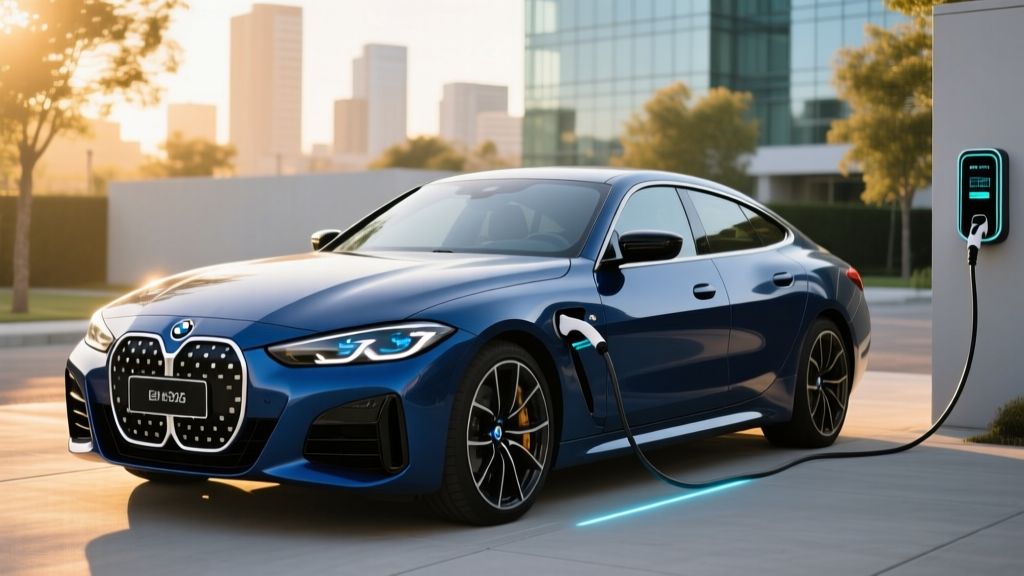
Quick Verdict: The BMW i4 Balances Classic Sedan Proportions With Real EV Substance
The BMW i4 has always occupied a specific niche: a premium electric gran coupe for drivers who want BMW's traditional sport-sedan dynamics without the tailpipe. For 2026, the i4 continues on the CLAR platform with meaningful updates to its battery chemistry and infotainment, while maintaining the proportions that make it one of the more elegant EVs on the road. If you've been searching for BMW i4 length and exterior dimensions to see whether it fits your garage or your life, this review covers every spec that matters — plus the real-world range, charging behavior, and ownership economics that spec sheets often bury.
The i4 isn't the longest-range EV in its class, nor the quickest-charging. But it delivers a driving experience that few electric sedans can match, wrapped in a body that reads as a proper BMW rather than an appliance. Here's the full breakdown.
BMW i4 Dimensions: Length, Width, and Garage Fit
Let's address the keyword question directly. The 2026 BMW i4 measures 188.5 inches in overall length, 72.9 inches wide (without mirrors), and 57.0 inches tall, riding on a 112.4-inch wheelbase. That puts it in the compact-to-midsize luxury sedan category — roughly the same footprint as the gas-powered 4 Series Gran Coupe it's derived from.
| Dimension | Measurement |
|---|---|
| Overall Length | 188.5 in (4,789 mm) |
| Overall Width (w/o mirrors) | 72.9 in (1,852 mm) |
| Overall Height | 57.0 in (1,448 mm) |
| Wheelbase | 112.4 in (2,856 mm) |
| Curb Weight (eDrive40) | 4,682 lbs |
| Ground Clearance | 4.9 in |
For garage planning, you'll need roughly 16 feet of depth to accommodate the i4 with room to walk behind it. Standard single-car garages (typically 12 ft wide × 20 ft deep) handle the i4 without issue. The 72.9-inch width also means you won't scrape door panels in a standard-width bay, though tighter urban parking structures may require some care.
Range, Battery, and Real-World Efficiency
eDrive40: EPA-estimated 318 miles (81.5 kWh usable battery)
xDrive40: EPA-estimated 287 miles
M50: EPA-estimated 269 miles
Real-world note: Expect 270–290 miles from the eDrive40 on mixed highway driving at 70+ mph. In cold weather (below 32°F), range can drop 20–30%, putting the eDrive40 closer to 220–255 miles on a full charge. The i4's heat pump (standard on 2026 models) helps mitigate winter losses compared to older EVs without thermal management, but physics still wins in deep cold. City driving with heavy regen use can push range slightly above the EPA figure.
The 2026 i4 uses an NMC (nickel manganese cobalt) lithium-ion battery pack. BMW quotes 81.5 kWh of usable capacity in the eDrive40 and xDrive40, with the M50 using the same pack but drawing more power from its dual-motor setup. NMC chemistry offers higher energy density than LFP (lithium iron phosphate), which is why BMW can package this much capacity into the i4's relatively low-slung floor. The trade-off: NMC batteries are generally more sensitive to sustained high state-of-charge storage, so BMW recommends keeping daily charging to 80–90% for longevity.
Efficiency varies by trim. Per fueleconomy.gov, the eDrive40 achieves an estimated 97 MPGe combined (roughly 34 kWh/100 mi), while the M50 drops to around 85 MPGe (39 kWh/100 mi) due to its 593-hp dual-motor configuration. These are respectable numbers for a performance-oriented sedan, though they trail the Tesla Model 3 Long Range (132 MPGe) and Hyundai Ioniq 6 (140 MPGe) in pure efficiency.
Charging Speed: DC Fast Charge and Home Level 2
Charging speed is where the i4 is competent but not class-leading. Here's what to expect across charging levels:
| Charge Level | Power / Rate | Speed |
|---|---|---|
| Level 1 (120V household) | ~1.4 kW | ~3–4 mi/hr |
| Level 2 (240V home/public) | 11 kW (onboard charger) | ~25–30 mi/hr; 0–100% in ~8.5 hrs |
| DC Fast Charge (CCS) | Peak 205 kW | 10–80% in ~31 min |
DC fast charging reality check: The i4 peaks at 205 kW on a compatible CCS station, but like most EVs, it doesn't sustain that rate. The charge curve holds near peak from roughly 10–40% state of charge, then tapers progressively. From 80–100%, expect significantly slower speeds — adding that final 20% can take as long as the 10–80% session. If you're road-tripping, plan your stops around the 10–80% window for maximum efficiency.
At home on a Level 2 charger (48-amp circuit recommended), the i4's 11 kW onboard charger replenishes the battery in about 8.5 hours from empty. Most owners charging overnight from 20–80% daily will see a full top-up in 4–5 hours. The 11 kW onboard charger is a strong point — some competitors (including earlier Model 3 variants) cap at 7.6 or 9.6 kW, making the i4 faster to fill at home.
The i4 uses a CCS1 connector for DC fast charging and a J1772 inlet for Level 2. BMW has not adopted NACS (Tesla's connector) for the i4 as of the 2026 model year, though a NACS adapter is available for Supercharger access on BMW's newer EV platforms. Check with your dealer for the latest adapter compatibility.
Performance: 0-60, Horsepower, and Drivetrain
| Trim | Drivetrain | Horsepower | Torque (lb-ft) | 0–60 mph |
|---|---|---|---|---|
| eDrive40 | RWD (single motor) | 335 hp | 317 | 5.5 sec |
| xDrive40 | AWD (dual motor) | 396 hp | 443 | 4.6 sec |
| M50 | AWD (dual motor) | 593 hp | 586 | 3.7 sec |
The eDrive40 is the volume seller and the sweet spot for most buyers. Its 335-hp single rear motor delivers the kind of effortless, linear acceleration that makes EVs addictive in daily driving. The rear-wheel-drive layout also preserves BMW's traditional handling balance — this is one of the few EVs that genuinely rewards on a back road.
The M50 is a different animal entirely. With 593 hp and launch control, it hits 60 in 3.7 seconds, putting it in sports-car territory. But the 4,900+ lb curb weight is noticeable in corners, and the range penalty (269 miles EPA) is steep. Unless you're chasing M-badge bragging rights, the eDrive40 or xDrive40 delivers the better ownership experience.
Regenerative braking offers adjustable levels via the iDrive system, including an adaptive mode that uses radar and navigation data to modulate regen based on traffic and upcoming curves. One-pedal driving is available but not as aggressive as Nissan's e-Pedal or Tesla's hold mode — BMW clearly tunes for drivers transitioning from ICE vehicles.
Interior, Cargo, and Tech
The i4's cabin uses BMW's Curved Display setup: a 12.3-inch digital instrument cluster merged with a 14.9-inch central touchscreen running iDrive 8.5. Wireless Apple CarPlay and Android Auto are standard, along with a head-up display, Harman Kardon surround sound (optional), and BMW's Digital Key Plus (UWB-based phone-as-key).
Interior space reflects the i4's gran coupe silhouette — it's a driver's car first, a people-hauler second:
- Front legroom: 42.1 inches
- Rear legroom: 34.5 inches (tight for tall adults on long trips)
- Cargo volume: 16.6 cu ft (hatchback-style liftgate improves usability vs. a traditional trunk)
- Cargo with rear seats folded: 45.5 cu ft
- No frunk — the CLAR platform adaptation doesn't include a front trunk
The hatchback liftgate is an underappreciated advantage. While 16.6 cu ft sounds modest on paper, the wide opening and fold-flat rear seats make the i4 surprisingly practical for weekend trips, IKEA runs, or airport luggage. That said, families with rear-facing car seats will find the rear quarters cramped — the i4 is not a family SUV substitute.
Driver assistance includes BMW's Driving Assistant Professional: adaptive cruise with stop-and-go, lane-keeping with active side collision avoidance, and automatic emergency braking. This is an SAE Level 2 system — the driver must remain engaged with hands on the wheel at all times. It's competent highway assistance, not autonomous driving.
Pricing, Trims, and Federal Tax Credit Eligibility
| Trim | Base MSRP | As-Tested (typical) | §30D Credit Eligibility |
|---|---|---|---|
| eDrive40 | $57,900 | $62,000–$65,000 | Likely ineligible (see below) |
| xDrive40 | $62,900 | $67,000–$72,000 | Likely ineligible |
| M50 | $70,700 | $76,000–$82,000 | Likely ineligible |
- MSRP cap: Sedans must be under $55,000 to qualify. All i4 trims exceed this threshold.
- Income caps: AGI limits of $150K single / $300K joint filers apply.
- Battery sourcing: Critical minerals and battery component requirements phase in annually through 2029.
- Point-of-sale transfer: Eligible buyers can transfer the credit to the dealer for an immediate price reduction — but only if the vehicle itself qualifies.
Without the federal credit, the i4's value proposition rests on its driving dynamics, build quality, and brand cachet rather than price competitiveness. A well-equipped eDrive40 lands in the low-to-mid $60K range, which is comparable to a Tesla Model S (more range, less refinement) or a Mercedes EQB (more space, less engaging to drive).
Warranty and Long-Term Ownership
BMW covers the i4 with a competitive warranty package:
- New vehicle limited warranty: 4 years / 50,000 miles
- Battery and high-voltage components: 8 years / 100,000 miles (capacity retention guaranteed above 70%)
- Corrosion perforation: 12 years / unlimited miles
- Roadside assistance: 4 years / unlimited miles
The 70% capacity retention threshold over 8 years is industry-standard. BMW's NMC pack has shown solid degradation curves in European-market i4s, with most owners reporting 93–96% state of health after 30,000 miles. Long-term data (100K+ miles) is still maturing for this generation, but BMW's thermal management system — which actively conditions the battery during charging and driving — is a positive indicator for longevity.
Who Should Buy the 2026 BMW i4?
- You prioritize driving dynamics and steering feel over maximum range
- You want a premium sedan that doesn't look like a tech pod
- Home Level 2 charging is available and your daily commute is under 80 miles round-trip
- You value build quality, cabin materials, and a quiet ride at highway speed
- You need 350+ miles of range for frequent road trips without charging stops
- Rear-seat space for adults or car seats is a priority (consider the iX or a Tesla Model Y)
- You want the lowest cost per mile — the Model 3 and Ioniq 6 are more efficient and cheaper
- Federal tax credit eligibility is a deal-breaker for your budget
Frequently Asked Questions
What is the real-world range of the BMW i4?
The eDrive40's EPA estimate is 318 miles, but real-world mixed driving typically yields 270–290 miles at highway speeds. In winter conditions below freezing, expect 220–255 miles. City driving with aggressive regen can push slightly above the EPA figure.
How fast does the i4 charge at home and on the road?
At home on Level 2 (240V, 48A), the i4 charges at 11 kW, adding roughly 25–30 miles per hour — a full overnight charge from 20% takes about 5 hours. On DC fast chargers, it peaks at 205 kW and reaches 10–80% in approximately 31 minutes, though sustained rates taper above 50% state of charge.
Does the BMW i4 qualify for the federal EV tax credit?
Likely not. The §30D credit caps sedan eligibility at $55,000 MSRP, and all 2026 i4 trims start above $57,900. Always verify current rules at IRS.gov and check for state or utility incentives that may still apply.
Is the BMW i4 worth buying over the Tesla Model 3 or Hyundai Ioniq 6?
It depends on your priorities. The Model 3 offers more range, faster Supercharger access, and a lower price. The Ioniq 6 is more efficient and charges faster (10–80% in ~18 min at 350 kW). But neither matches the i4's ride quality, steering precision, or cabin refinement. If driving engagement matters more than spec-sheet dominance, the i4 earns its premium.
What's the biggest drawback of the i4?
The lack of a frunk, tight rear-seat legroom, and a starting price that excludes it from the federal tax credit. Also, while 205 kW DC charging is adequate, it trails rivals like the Ioniq 6 (350 kW peak) and Porsche Taycan (270+ kW), meaning longer road-trip charging stops.