Quick Verdict: Is the BMW i4 Worth Leasing in 2026?
The BMW i4 remains one of the most driver-focused electric sedans on the market, blending BMW's trademark chassis tuning with a practical 81.5 kWh battery and up to 307 miles of EPA-estimated range. For buyers searching for BMW i4 lease specials, the value proposition hinges on trim selection: the rear-wheel-drive eDrive40 delivers the best range and efficiency, while the dual-motor xDrive40 adds all-weather traction, and the M50 brings serious performance. Lease deals can substantially lower monthly payments compared to financing, but understanding the real-world range, charging behavior, and federal tax credit eligibility is essential before signing.
| Spec | eDrive40 | xDrive40 | M50 |
|---|---|---|---|
| EPA Range | 307 mi | 282 mi | 257 mi |
| Battery (usable) | 81.5 kWh | 81.5 kWh | 81.5 kWh |
| Chemistry | NMC | NMC | NMC |
| Drivetrain | RWD | AWD (dual-motor) | AWD (dual-motor) |
| Horsepower | 335 hp | 396 hp | 536 hp |
| 0–60 mph | 5.5 sec | 4.6 sec | 3.7 sec |
| Max DC Fast Charge | 205 kW | 205 kW | 205 kW |
| 10–80% DC Time | ~31 min | ~31 min | ~31 min |
| Level 2 Rate | 11 kW | 11 kW | 11 kW |
| MPGe (combined) | 109 MPGe | 99 MPGe | 91 MPGe |
| Base MSRP | $57,900 | $62,900 | $70,700 |
Sources: EPA / fueleconomy.gov, BMW USA specifications.
Real-World Range: What to Actually Expect
The eDrive40's 307-mile EPA estimate is achievable in mixed city/suburban driving at moderate temperatures. Expect ~260–280 miles on highway trips at 70–75 mph, where aerodynamic drag reduces efficiency. In cold weather (below 30°F), range can drop 15–25%, bringing real-world winter highway range closer to 210–240 miles. The i4's heat pump (standard on 2026 models) mitigates some cabin-heating energy loss, but battery chemistry still suffers in deep cold.
BMW uses an 81.5 kWh usable NMC (nickel manganese cobalt) battery pack across all i4 trims. NMC chemistry offers higher energy density than LFP, enabling the i4's relatively compact floor packaging, but it's more sensitive to sustained high state-of-charge storage. For daily driving, BMW recommends setting the charge limit to 80–90% unless you need full range for a trip — this practice extends long-term battery health.
Efficiency in the eDrive40 works out to roughly 27 kWh/100 miles in mixed driving, which is competitive with the Tesla Model 3 Long Range (25–26 kWh/100mi) but slightly higher due to the i4's heavier curb weight (~4,800 lbs for the eDrive40).
Charging Speed: DC Fast Charging and Home Setup
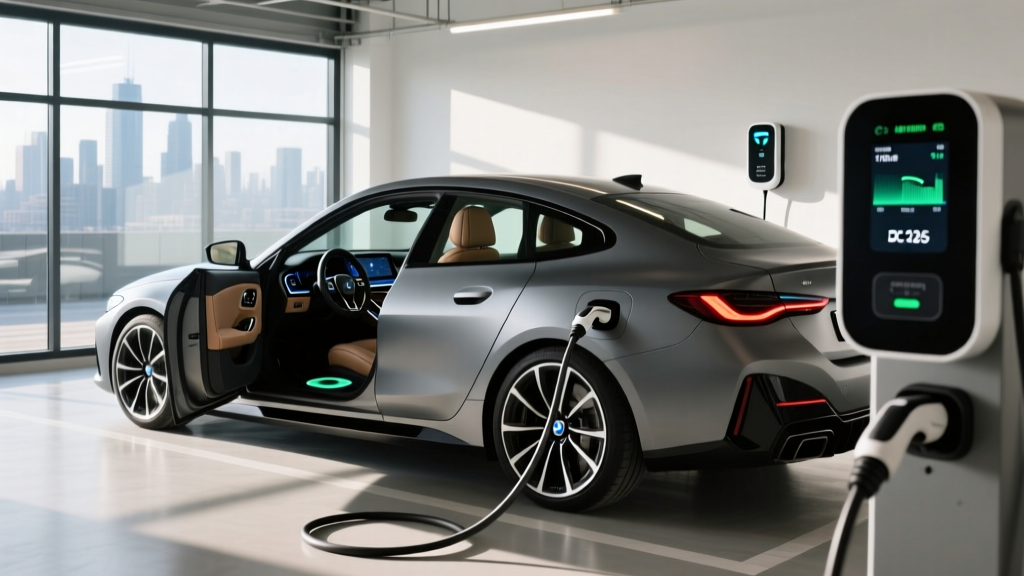
Charging speed is where the i4 delivers solid but not class-leading performance. All trims peak at 205 kW on DC fast chargers using a CCS1 connector (or NACS via BMW's included adapter on 2025+ models, now standard for 2026). The charge curve holds near peak power from roughly 10% to 45% state-of-charge, then tapers progressively. A 10–80% session takes approximately 31 minutes under ideal conditions at a 250+ kW station.
| Charging Level | Power | Speed (approx.) | Typical Use Case |
|---|---|---|---|
| Level 1 (120V) | 1.4 kW | ~5 mi/hr | Emergency/trickle |
| Level 2 (240V, 48A) | 11 kW | ~36 mi/hr | Home overnight |
| DC Fast (peak) | 205 kW | 10–80% in ~31 min | Road trips |
Home charging reality: At 11 kW, a full 0–100% charge takes roughly 8.5 hours. Most owners will plug in each evening and wake up with a full battery — the i4's onboard charger is fast enough that a 48-amp Level 2 wallbox (requiring a 60-amp circuit) is the ideal home setup. Installation costs for a Level 2 circuit typically range from $800 to $2,500 depending on panel proximity and whether your electrical panel needs an upgrade to 200 amps. Always consult a licensed electrician for final specs.
One practical note: BMW now equips 2026 i4 models with a NACS port, granting native access to Tesla's Supercharger network — the most reliable public DC network in the US. For existing CCS-equipped Electrify America or EVgo stations, the i4 communicates seamlessly via Plug & Charge.
Pricing, Lease Specials, and Federal Tax Credit Eligibility
The 2026 BMW i4 starts at $57,900 for the eDrive40, with the xDrive40 at $62,900 and the M50 at $70,700 (all before destination). A typical well-equipped eDrive40 with the Premium Package, Driving Assistance Professional, and larger wheels lands around $64,000–$67,000 as-tested.
Federal Tax Credit: Does the i4 Qualify?
The BMW i4 is assembled in Munich, Germany. Under current IRS §30D rules, the new clean vehicle credit of up to $7,500 requires final assembly in North America. The i4 does not qualify for the $7,500 federal purchase credit under standard rules due to its German assembly.
However, the lease loophole matters here: Under the commercial clean vehicle credit (§45W), vehicles leased through BMW Financial Services may pass a $7,500 credit to the lessor, who can then apply it as a capitalized cost reduction — effectively lowering your lease payments. This "lease loophole" has been a common way for foreign-built EVs to still deliver credit value. Whether BMW passes the full amount to lessees varies by dealer and current incentive programs. Always confirm with the dealer whether the lease special reflects this credit.
Additional buyer requirements for any §30D credit: modified adjusted gross income must not exceed $150,000 (single) / $300,000 (joint), and the vehicle MSRP must not exceed $55,000 for sedans. The i4's base MSRP exceeds this sedan cap, which is another reason the lease pathway (§45W) is the practical route to credit value.
What BMW i4 Lease Specials Typically Look Like
As of early 2026, competitive BMW i4 lease structures include:
- 36 months / 10,000 miles/year with $3,995–$5,500 due at signing on the eDrive40
- Monthly payments in the $550–$750 range depending on trim, down payment, and whether the lease credit is applied
- BMW often bundles loyalty credits ($1,000–$2,000) for current BMW owners or lessees
- Money factors (lease interest equivalent) typically run 0.00125–0.00175, roughly equivalent to 3.0–4.2% APR
Leasing the i4 sidesteps two concerns: long-term battery depreciation risk and the §30D purchase-credit ineligibility. If you plan to keep an EV for 7+ years, purchasing may still make sense financially, but you won't receive the federal credit.
Performance, Driving Dynamics, and Technology
The i4's CLAR-based platform (shared with the 4 Series Gran Coupe) gives it a driving character that stands apart from dedicated EV platforms. The eDrive40's 335 hp and rear-wheel-drive layout deliver responsive, tail-happy handling that feels authentically BMW. The M50's 536 hp and 3.7-second 0–60 time put it in genuine sports-sedan territory, rivaling the old M3 in straight-line acceleration.
Interior and Technology
BMW's Curved Display dominates the dashboard: a 12.3-inch instrument cluster flows into a 14.9-inch infotainment touchscreen running iDrive 8.5. The system supports wireless Apple CarPlay and Android Auto, over-the-air updates, and BMW's latest voice assistant. Build quality is a clear step above the Tesla Model 3, with soft-touch materials, genuine aluminum trim options, and excellent seat bolstering.
ADAS / Driver Assistance: The Driving Assistance Professional Package adds BMW's Highway Assistant — a Level 2 system (per SAE classification) that provides lane-centering and adaptive cruise, including hands-free driving at up to 85 mph on compatible divided highways. The driver must keep eyes on the road; a camera monitors attention. This is not autonomous driving — it's a supervised assist system comparable to GM's Super Cruise or Ford's BlueCruise in capability.
Cargo and Passenger Space
- Cargo volume: 16.6 cu ft (rear seats up) / 45.6 cu ft (rear seats folded) — the Gran Coupe hatchback design makes loading large items practical
- Rear legroom: 34.5 inches — adequate for adults on shorter trips, tight for tall passengers on long drives
- Front legroom: 41.5 inches — spacious and comfortable
- No frunk: The i4's adapted ICE platform means no front trunk, a notable omission versus the Hyundai Ioniq 6 or Tesla Model 3
Warranty Coverage and Battery Longevity
BMW covers the i4 with a competitive warranty package:
- Basic vehicle warranty: 4 years / 50,000 miles
- Battery and electric powertrain: 8 years / 100,000 miles (covers defects and capacity loss below 70% of original capacity)
- Corrosion protection: 12 years / unlimited miles
- Complimentary maintenance: 3 years / 36,000 miles (includes brake fluid, cabin filters, and wear items)
BMW's 70% capacity retention threshold is industry-standard, matching Tesla and most competitors. Real-world NMC degradation data from similar BMW packs (iX, i7) suggests most owners will see ~8–12% capacity loss over 100,000 miles, well within the warranty buffer. For lessees on a 36-month term, battery degradation is a non-issue — you'll return the car long before it becomes relevant.
BMW i4 vs. Key Competitors: Which Should You Choose?
| Attribute | BMW i4 eDrive40 | Tesla Model 3 LR | Hyundai Ioniq 6 SEL | Polestar 2 LR SM |
|---|---|---|---|---|
| EPA Range | 307 mi | 341 mi | 361 mi | 320 mi |
| Base MSRP | $57,900 | $47,740 | $43,750 | $52,500 |
| Max DC Charge | 205 kW | 250 kW | 240 kW | 205 kW |
| 0–60 mph | 5.5 sec | 4.2 sec | 5.1 sec | 5.9 sec |
| NA Assembly (Credit) | No (lease loophole) | Yes (Fremont/Austin) | No (Korea) | No (China/Europe) |
| Build Quality | Excellent | Good (improved) | Good | Very Good |
- Driving dynamics and interior refinement are top priorities
- You prefer a hatchback/Gran Coupe body style over a traditional sedan
- You plan to lease and can capture the §45W credit through BMW Financial
- You value BMW's dealer network and complimentary maintenance program
- Maximum range and lowest price are your primary goals
- You want direct eligibility for the $7,500 federal purchase credit (MSRP under $55K, US-built)
- Supercharger-native access without adapters matters to you
- You want the longest range in this segment at the lowest price point
- Ultra-fast 240 kW charging speed is a priority for road trips
- You're open to Hyundai's distinctive aerodynamic styling
Pros and Cons at a Glance
- Engaging driving dynamics uncommon in electric sedans
- Premium interior with excellent materials and iDrive 8.5 tech
- Practical hatchback cargo area (16.6 cu ft)
- 205 kW DC charging with NACS/Supercharger compatibility
- Lease pathway captures $7,500 credit value despite German assembly
- Standard heat pump for cold-weather efficiency
- High base MSRP — exceeds §30D sedan cap for purchase credit
- No front trunk (frunk) due to adapted platform
- Rear legroom is tight for tall passengers (34.5 in)
- Range trails Tesla Model 3 LR and Ioniq 6 by 30–50 miles
- Charging speed (205 kW) lags Hyundai/Kia's 800V architecture
- Options packages quickly push price above $65,000
Who the BMW i4 Suits Best
Ideal for: Daily commuters and driving enthusiasts who value a premium badge, refined cabin, and BMW's handling pedigree. The eDrive40's 307-mile range covers most commutes for a full week between charges. The hatchback design adds practicality for weekend trips and gear hauling.
Less ideal for: Families needing spacious rear seats (consider the BMW iX or Hyundai Ioniq 5), budget-focused buyers (the Model 3 LR and Ioniq 6 offer more range for significantly less), or road-trip-heavy drivers who want the fastest possible DC charging (Hyundai/Kia's 800V architecture charges 10–80% in ~18 minutes vs. the i4's ~31).
Frequently Asked Questions
What is the real-world range of the BMW i4?
The eDrive40's EPA-estimated 307 miles drops to roughly 260–280 miles in sustained highway driving and 210–240 miles in cold winter conditions. City driving with regenerative braking can match or slightly exceed the EPA figure.
How fast does the BMW i4 charge at home and on DC fast chargers?
On a Level 2 home charger (11 kW / 48 amps), the i4 gains about 36 miles of range per hour, fully charging overnight in ~8.5 hours. On DC fast chargers, it peaks at 205 kW and reaches 10–80% in approximately 31 minutes.
Does the BMW i4 qualify for the federal EV tax credit?
Not as a purchase — the i4 is assembled in Germany and its MSRP exceeds the §30D sedan cap of $55,000. However, leasing through BMW Financial may allow the lessor to claim a $7,500 commercial credit (§45W) and pass savings to you as a capitalized cost reduction. Confirm with your dealer.
Is the BMW i4 worth leasing vs. buying?
Leasing is the financially smarter path for most i4 shoppers in 2026. It unlocks credit value the purchase path cannot, protects against battery depreciation, and keeps monthly payments lower. Buying makes sense only if you plan to keep the car 6+ years and drive high annual miles that would incur lease penalties.
How does the i4 compare to the Tesla Model 3?
The Model 3 Long Range offers more range (341 vs. 307 miles), faster charging (250 vs. 205 kW), a lower price (~$10,000 less), and direct purchase-credit eligibility. The i4 wins on interior quality, driving engagement, hatchback practicality, and a more traditional luxury ownership experience with dealer service.
What battery chemistry does the BMW i4 use?
The i4 uses NMC (nickel manganese cobalt) lithium-ion cells, which prioritize energy density over cycle life compared to LFP. For lessees and typical owners charging to 80–90% daily, NMC degradation remains well within BMW's 8-year/100,000-mile warranty threshold.
Always verify current lease terms, incentive availability, and tax credit eligibility with your local BMW dealer and a qualified tax professional. IRS rules and manufacturer incentives change frequently. Pricing and specifications reflect 2026 model-year data available at time of publication.