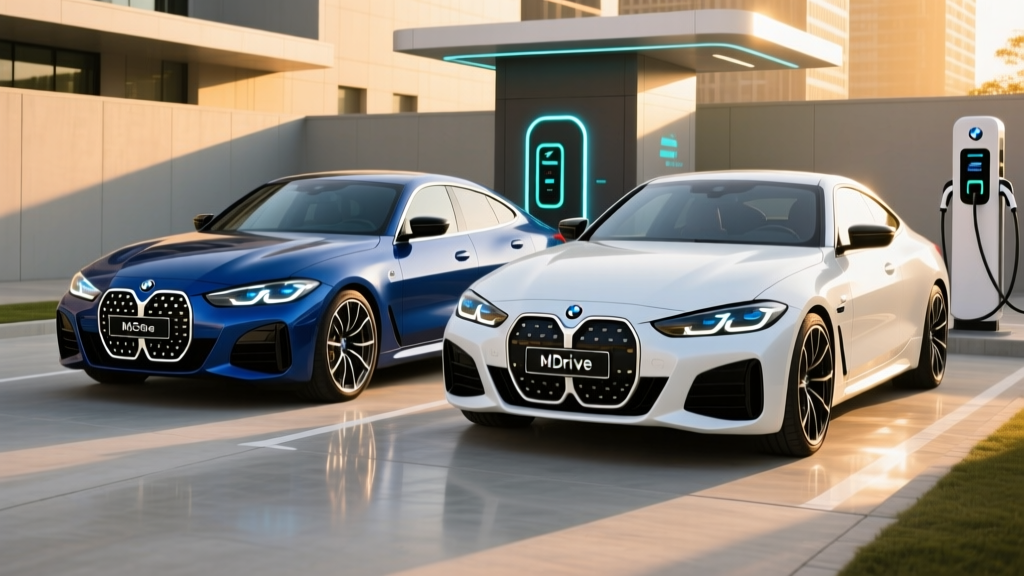
Quick Verdict: The BMW i4 Balances Performance and Practicality
The BMW i4 remains one of the most driver-focused electric sedans on the market, blending the 3 Series–like proportions with legitimate EV performance. For 2026, the i4 lineup spans the single-motor eDrive40 (335 hp) to the dual-motor M50 (536 hp), with the newer eDrive35 serving as the entry point at 281 hp. Range tops out at an EPA-estimated 318 miles in the eDrive40, while the M50 sacrifices some efficiency for a 3.7-second 0-60 mph sprint.
This review breaks down every trim's horsepower, real-world range expectations, charging behavior on DC fast chargers and Level 2 home setups, cargo practicality, and whether the i4 qualifies for the federal EV tax credit under current IRS §30D rules.
BMW i4 Specs at a Glance
| Spec | eDrive35 | eDrive40 | M50 |
|---|---|---|---|
| Horsepower | 281 hp | 335 hp | 536 hp |
| Torque (lb-ft) | 295 | 317 | 586 |
| Drivetrain | RWD (single motor) | RWD (single motor) | AWD (dual motor) |
| 0-60 mph | 5.8 sec | 5.5 sec | 3.7 sec |
| Battery (usable) | 66 kWh | 81 kWh | 81 kWh |
| Battery Chemistry | NMC | NMC | NMC |
| EPA Range | 252 mi | 318 mi | 270 mi |
| MPGe (combined) | 99 MPGe | 97 MPGe | 85 MPGe |
| kWh/100 mi | 34 | 35 | 40 |
| Max DC Charge Rate | 180 kW | 205 kW | 205 kW |
| 10-80% DC Time | ~31 min | ~31 min | ~31 min |
| Level 2 Charge Rate | 11 kW | 11 kW | 11 kW |
| Base MSRP | $52,200 | $57,900 | $69,700 |
Source: fueleconomy.gov and BMW USA official specifications for the 2026 model year.
Range and Efficiency: EPA vs. Real World
Real-World Expectation: Plan for 250-280 mi in the eDrive40 on highway-heavy trips at 70+ mph. In freezing temperatures (below 32°F), expect a 20-30% reduction, dropping the eDrive40 to roughly 220-255 mi depending on cabin heat usage and preconditioning.
The i4 eDrive40's 318-mile EPA rating is competitive with the Tesla Model 3 Long Range and Polestar 2 Long Range. However, the i4's aerodynamic profile (a Gran Coupe liftback rather than a teardrop sedan) creates slightly more drag at highway speeds than a Model 3, meaning real-world highway efficiency tends to fall in the 2.8-3.0 mi/kWh range rather than the 3.2 mi/kWh some owners achieve in mixed city driving.
The eDrive35's smaller 66 kWh battery limits its range to 252 miles EPA. That's adequate for most commutes, but road-trippers will want the eDrive40 or plan more frequent charging stops. The M50's 270-mile EPA figure drops noticeably in cold weather — dual-motor AWD systems and higher performance tuning draw more energy, so budget-conscious buyers prioritizing range should skip the M50.
BMW equips all i4 models with a heat pump as standard equipment, which mitigates cold-weather range loss compared to EVs using resistive cabin heating. Preconditioning the battery while plugged in also helps preserve range and optimize charge speed in cold conditions.
Charging Speed: DC Fast Charging and Home Level 2
The BMW i4 uses a CCS1 connector for DC fast charging in North America. BMW has not adopted the NACS (Tesla) port natively for the 2026 i4, so accessing Tesla Superchargers requires a CCS-to-NACS adapter — confirm compatibility with BMW before relying on this.
| Charging Level | Power | Miles Added Per Hour | Notes |
|---|---|---|---|
| Level 1 (120V) | ~1.4 kW | ~4 mi/hr | Emergency/trickle only |
| Level 2 (240V, 48A) | 11 kW | ~33-38 mi/hr | Full charge in ~8-9 hours |
| DC Fast Charge | Peak 205 kW (eDrive40/M50) | ~700-800 mi/hr at peak | 10-80% in ~31 min; tapers above 80% |
Charging curve reality: The i4 eDrive40 and M50 peak at 205 kW but only sustain that rate briefly between roughly 10-30% State of Charge (SoC). From 30-60%, expect sustained rates around 150-170 kW, and above 80% the rate drops sharply to protect the NMC battery cells — often below 50 kW. This means a 10-80% session takes about 31 minutes at a 250 kW or higher charger, but a 10-90% session will take closer to 48-52 minutes. Plan your road-trip stops around the 80% mark for efficiency.
For home charging, the i4's 11 kW onboard charger is slightly above average for its class. On a 48-amp Level 2 circuit (the most common home installation), you'll recover about 35 miles of range per hour — enough to fully replenish overnight. A BMW Wallbox or any quality J1772 Level 2 unit (ChargePoint Home Flex, Emporia, Wallbox Pulsar Plus) will work. Installation typically costs $800-$2,000 depending on panel capacity and wiring distance.
Performance: BMW i4 HP Across All Trims
The keyword that brings most shoppers to the i4 is horsepower, and BMW delivers across the lineup:
- eDrive35 (281 hp): The entry point. Rear-wheel drive with a single rear motor provides a 5.8-second 0-60 time. Adequate for daily driving and highway merging, with the classic BMW balanced weight distribution.
- eDrive40 (335 hp): The sweet spot. 335 hp and 317 lb-ft of torque from the single rear motor delivers a 5.5-second 0-60 while maximizing range. This is the trim most buyers should target.
- M50 (536 hp): BMW's first electric M performance model. Dual motors produce 536 hp and 586 lb-ft with xDrive AWD. The 3.7-second 0-60 time rivals the M3 Competition, and the M-specific chassis tuning, adaptive suspension, and M Sport brakes give it genuine corner-carving ability that most EVs lack.
All trims feature BMW's adaptive regenerative braking, which uses radar and navigation data to adjust regen intensity automatically — coasting when the road ahead is clear, braking harder when approaching slower traffic. You can also select manual regen levels or engage a one-pedal driving mode.
Pricing, Trims, and Federal Tax Credit Eligibility
| Trim | Base MSRP | Est. As-Tested* | §30D Credit Eligible? |
|---|---|---|---|
| eDrive35 | $52,200 | $55,000-$58,000 | Check sourcing rules |
| eDrive40 | $57,900 | $62,000-$68,000 | Check sourcing rules |
| M50 | $69,700 | $75,000-$82,000 | Exceeds MSRP cap |
*As-tested prices reflect typical option packages (Premium Package, Driving Assistance Professional, larger wheels).
Federal tax credit reality: Under IRS §30D rules, the BMW i4 faces two hurdles. First, the MSRP cap for sedans is $55,000, which immediately disqualifies the M50 and most eDrive40 configurations with options. The eDrive35's base MSRP of $52,200 falls under the cap, but adding packages can push the sticker above $55,000. Second, battery component and critical mineral sourcing requirements may reduce or eliminate the credit depending on BMW's supply chain for the specific model year. The i4's battery cells are produced in partnership with CATL and Samsung SDI, and sourcing compliance varies by production batch.
Additionally, buyer income caps apply: $150,000 single / $300,000 joint modified adjusted gross income. Always verify current eligibility on IRS.gov before purchasing, and consult a tax professional. The credit can now be transferred to the dealer at point of sale, reducing the purchase price directly.
Interior, Cargo, and Technology
The i4 uses BMW's Curved Display layout — a 12.3-inch instrument cluster merged with a 14.9-inch infotainment touchscreen running iDrive 8.5. Wireless Apple CarPlay and Android Auto are standard, along with a built-in navigation system that integrates with charging route planning (preconditioning the battery automatically when a DC fast charger is set as your destination).
Cargo and passenger dimensions:
- Rear cargo (behind second row): 16.6 cu ft (liftback design provides a wide opening)
- Cargo (rear seats folded): 45.6 cu ft
- Front legroom: 41.5 inches
- Rear legroom: 35.2 inches (tighter than a Model 3 or Hyundai Ioniq 6)
- No front trunk (frunk) — the i4's CLAR-based platform shares architecture with ICE models, so the motor occupies the space where a frunk would be
The lack of a frunk is a notable drawback compared to ground-up EV platforms. Rear-seat legroom is acceptable for adults on shorter trips but snug for taller passengers on longer drives. The liftback hatch, however, makes loading cargo significantly easier than a traditional sedan trunk.
Driver assistance: BMW's Driving Assistant Professional package (available on all trims) includes adaptive cruise control with stop-and-go, lane-keeping assist, and Highway Assistant (hands-off driving up to 85 mph on divided highways — SAE Level 2, requiring driver attention). This is competitive with Tesla Autopilot and Ford BlueCruise in capability, though BMW's system is less aggressive with lane changes.
Pros and Cons
Pros
- Class-leading driving dynamics and steering feel for an EV sedan
- eDrive40 offers strong 318-mi EPA range with 335 hp
- Heat pump standard on all trims (better cold-weather performance)
- Liftback cargo versatility with 45.6 cu ft max
- 205 kW DC fast charging with competitive 10-80% time
- iDrive 8.5 infotainment is responsive and well-organized
Cons
- No frunk — a miss compared to Tesla Model 3 and Hyundai Ioniq 6
- Rear legroom (35.2 in) is tighter than key rivals
- Tax credit eligibility uncertain due to battery sourcing and MSRP caps
- M50's 270-mi range is modest for a $70K+ EV
- CCS1 port requires adapter for Tesla Supercharger access
- Options quickly push price above the $55K sedan MSRP cap
Who Should Buy the BMW i4?
The i4 is best suited for driving enthusiasts transitioning from a 3 Series or 4 Series who want EV efficiency without sacrificing steering feel, chassis balance, and build quality. The eDrive40 hits the sweet spot for commuters covering 40-80 miles daily with periodic road trips. It's not the best family EV (rear space is tight, no frunk), and the M50 is a performance toy rather than an efficiency play.
If cargo space and rear-seat room are priorities, the Hyundai Ioniq 6 or Tesla Model 3 offer more interior volume. If you want luxury badge prestige with similar performance, the Mercedes EQB or Audi A6 e-tron are alternatives, though at different price points.
Battery Warranty and Longevity
BMW covers the i4's high-voltage battery for 8 years or 100,000 miles (whichever comes first), with a capacity retention threshold of 70%. This matches the industry standard set by most automakers and aligns with federal requirements. The general vehicle warranty is 4 years / 50,000 miles.
The NMC battery chemistry in the i4 provides high energy density but requires careful thermal management to minimize long-term degradation. BMW's liquid-cooled thermal system and the standard heat pump help maintain battery health. Based on industry data for similar NMC packs, expect roughly 8-12% degradation over the first 100,000 miles under normal use patterns — keeping routine charging between 20-80% SoC and avoiding repeated DC fast charging will extend longevity.
Frequently Asked Questions
What is the real-world range of the BMW i4?
The eDrive40 delivers an EPA-estimated 318 miles, but real-world highway driving at 70+ mph typically yields 250-280 miles. In cold weather below freezing, expect 220-255 miles. The eDrive35 achieves around 200-220 miles real-world, and the M50 drops to roughly 220-240 miles on the highway.
How fast does the BMW i4 charge at home and on road trips?
At home on a 48-amp Level 2 charger (240V), the i4 charges at up to 11 kW, adding roughly 35 miles of range per hour for a full overnight charge. On DC fast chargers, the eDrive40 and M50 peak at 205 kW and charge from 10-80% in approximately 31 minutes. The eDrive35 peaks at 180 kW with a similar 10-80% time due to its smaller battery.
Does the BMW i4 qualify for the $7,500 federal EV tax credit?
Eligibility is uncertain and varies by trim and production batch. The eDrive35 base MSRP ($52,200) falls under the $55,000 sedan cap, but battery critical-mineral and component sourcing rules under IRS §30D may reduce or eliminate the credit. The M50 exceeds the MSRP cap entirely. Buyer income limits also apply ($150K single / $300K joint). Always check IRS.gov and verify with your dealer before purchase.
Is the BMW i4 worth buying over the Tesla Model 3?
It depends on priorities. The i4 offers superior build quality, a more refined ride, and a traditional luxury interior. The Model 3 (Highland refresh) offers more range per dollar, a frunk, better Supercharger network access, and a more minimalist tech experience. If driving dynamics and premium materials matter most, the i4 wins. If value, range, and charging convenience top your list, the Model 3 is the stronger pick.
How much horsepower does the BMW i4 have?
The 2026 BMW i4 lineup offers three hp levels: 281 hp (eDrive35), 335 hp (eDrive40), and 536 hp (M50). The eDrive40's 335 hp is the best balance of performance and efficiency for most buyers.
Does the BMW i4 have all-wheel drive?
Only the M50 trim features AWD (BMW's xDrive dual-motor system). The eDrive35 and eDrive40 are rear-wheel drive only. If you need AWD for snow or inclement weather without the M50's price, consider the Tesla Model 3 Long Range AWD or the Hyundai Ioniq 6 AWD as alternatives.