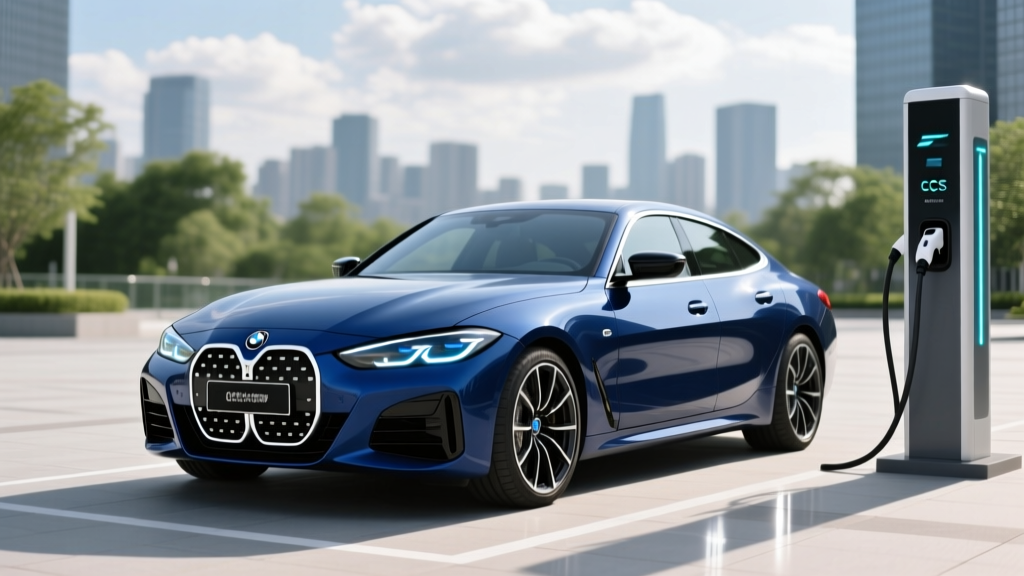
Yes, the BMW i4 is fully electric. It's a battery-electric vehicle (BEV) — no gas engine, no hybrid system — built on BMW's CLAR platform and packaged as a four-door Gran Coupe. Since its debut, the i4 has been one of the most convincing electric luxury sedans on the market, blending BMW's traditional driving dynamics with a practical electric powertrain. For 2026, the i4 lineup continues with the eDrive40 (rear-wheel drive), the xDrive40 (all-wheel drive), and the performance-focused M50, alongside the newly added i4 xDrive35 entry point.
If you've been searching "is the BMW i4 electric" to confirm it's a true BEV before diving into the specs, this review covers everything you need: real-world range, charging speeds, pricing after federal tax credits, and how it stacks up against the Tesla Model 3, Hyundai Ioniq 6, and Polestar 2.
2026 BMW i4 Quick Specs at a Glance
| Spec | i4 xDrive35 | i4 eDrive40 | i4 xDrive40 | i4 M50 |
|---|---|---|---|---|
| Drivetrain | AWD (dual-motor) | RWD (single-motor) | AWD (dual-motor) | AWD (dual-motor) |
| Horsepower | 312 hp | 335 hp | 396 hp | 536 hp |
| 0-60 mph | 5.7 sec | 5.5 sec | 5.1 sec | 3.7 sec |
| Battery (usable) | 81.5 kWh (NMC) | 81.5 kWh (NMC) | 81.5 kWh (NMC) | 81.5 kWh (NMC) |
| EPA Range | ~276 mi | 307 mi | 287 mi | 269 mi |
| MPGe (combined) | ~98 MPGe | 109 MPGe | 101 MPGe | 91 MPGe |
| Max DC Fast Charge | 205 kW | 205 kW | 205 kW | 205 kW |
| 10-80% DC Time | ~31 min | ~31 min | ~31 min | ~31 min |
| Level 2 Rate | 11 kW | 11 kW | 11 kW | 11 kW |
| Base MSRP (2026) | ~$53,900 | ~$57,900 | ~$61,900 | ~$70,700 |
Sources: EPA fueleconomy.gov, BMW USA product pages. Pricing subject to change; destination charge additional.
Range: EPA Sticker vs. Real-World Expectations
Real-World Expectation: Expect ~250-275 miles in mixed highway driving at 70+ mph in the eDrive40. In cold weather (below 32°F), plan for a 15-25% reduction — roughly 220-245 miles from the eDrive40. City driving with regenerative braking can push the eDrive40 close to or slightly above its EPA rating.
The i4's 81.5 kWh usable battery pack uses NMC (nickel manganese cobalt) chemistry, which offers high energy density but is more sensitive to extreme temperatures than LFP. BMW's thermal management system is competent — the i4 uses a heat pump as standard equipment, which helps preserve range in cold weather compared to resistance heating. Still, NMC packs lose more range in deep cold than LFP equivalents.
The eDrive40 achieves the longest range because it sends all 335 hp through the rear wheels only, avoiding the parasitic losses of a second motor. If you live in a snow-belt state and need AWD, the xDrive40 sacrifices about 20 miles of range for that traction. The M50, with its 536 hp dual-motor setup, drops to 269 miles EPA — and in aggressive driving, real-world figures closer to 210-230 miles are common.
Wheel size matters significantly. The 307-mile EPA rating applies to the eDrive40 with standard 18-inch wheels. Upgrading to 19- or 20-inch wheels can shave 10-20 miles off that figure due to increased rolling resistance and aerodynamic drag.
Charging Speed: DC Fast, Level 2, and Home Setup
| Charging Level | Power | Speed / Notes |
|---|---|---|
| Level 1 (120V household) | ~1.4 kW | ~3-4 miles per hour — overnight trickle only |
| Level 2 (240V home/public) | Up to 11 kW | ~25-30 miles per hour — full charge in ~9 hours |
| DC Fast Charge (CCS) | Up to 205 kW peak | 10-80% in ~31 minutes; tapers above 80% |
The i4 charges via CCS1 (Combined Charging System) for DC fast charging and J1772 for Level 2 AC. BMW has not adopted the NACS (Tesla) connector on the i4 as of the 2026 model year, though adapters are available for Tesla Supercharger access at reduced speeds.
At a DC fast charger, the i4 peaks at 205 kW — but that peak is not sustained. Like all EVs, the i4 follows a charging curve: it holds near peak power from roughly 10-50% state of charge (SoC), then progressively tapers. From 80-100%, charging slows dramatically to protect the battery. On a road trip, plan your stops around the 10-80% window for the best time efficiency — that ~31-minute window is realistic at a 350 kW Electrify America or similar station delivering full power.
At home, the i4's onboard charger accepts up to 11 kW on a 240V Level 2 circuit. That means a 48-amp hardwired wall connector (like a ChargePoint Home Flex or BMW's own Wallbox) will add roughly 25-30 miles of range per hour. A full charge from near-empty takes about 9 hours — easily achievable overnight. You'll need a 60-amp breaker for a 48-amp charger; consult a licensed electrician to confirm your panel can support it.
Preconditioning tip: The i4 will precondition the battery for faster DC charging when you set a DC fast charger as your navigation destination. This warms the NMC cells to optimal temperature, especially critical in cold weather. Skipping this step can add 10-15 minutes to your 10-80% time in winter.
Performance and Driving Dynamics
BMW's reputation for driving engagement carries into the i4 lineup. The eDrive40's 335 hp and single rear motor deliver a 5.5-second 0-60 mph time — quick enough for effortless highway merging and genuinely fun on a back road. The rear-wheel-drive layout gives the i4 a balance and steering feel that most electric crossovers can't match.
The xDrive40 adds a front motor for 396 hp total and AWD grip, dropping the 0-60 to 5.1 seconds. The M50 is the performance flagship: 536 hp, 3.7 seconds to 60, M-tuned adaptive suspension, and a Sport Boost function that temporarily increases output. It's legitimately fast — but the range penalty and price premium ($70,700 base) are substantial.
All i4 models feature adaptive regenerative braking with multiple levels, selectable through paddle shifters or the iDrive system. The strongest regen setting enables near-one-pedal driving in city traffic, though BMW doesn't offer a full one-pedal mode that brings the car to a complete stop and holds it without brake input.
Interior, Tech, and Cargo Practicality
The i4 uses BMW's Curved Display layout: a 12.3-inch instrument cluster and a 14.9-inch central touchscreen running BMW iDrive 8.5. The system is responsive, supports wireless Apple CarPlay and Android Auto, and includes a natural-language voice assistant. A head-up display and Harman Kardon surround sound are available on higher trims.
Driver-assistance features include BMW's Driving Assistant Professional package, which offers adaptive cruise control with stop-and-go, lane-keeping assist, and automated lane changes on compatible highways. This is an SAE Level 2 system — you must keep your hands on or near the wheel and remain fully engaged. It is not self-driving.
Cargo space is the i4's most notable compromise. The Gran Coupe liftback design offers 16.6 cubic feet behind the rear seats — less than a Tesla Model 3's 23 cu ft trunk+frunk combined, and far less than a Model Y or Hyundai Ioniq 5. Fold the rear seats (40/20/40 split), and you get about 45.9 cu ft. There is no front trunk (frunk); BMW uses that space for power electronics.
Rear-seat legroom measures 34.5 inches — adequate for average adults on shorter trips but tight for taller passengers on long drives. The transmission tunnel hump (a carryover from the CLAR platform's ICE origins) intrudes on the middle seat footwell, making the i4 most comfortable as a four-seater.
Pricing, Trims, and Federal Tax Credit Eligibility
| Trim | Base MSRP (2026) | Federal §30D Credit | Estimated Net Price |
|---|---|---|---|
| i4 xDrive35 | ~$53,900 | Up to $7,500* | ~$46,400* |
| i4 eDrive40 | ~$57,900 | Up to $7,500* | ~$50,400* |
| i4 xDrive40 | ~$61,900 | Up to $7,500* | ~$54,400* |
| i4 M50 | ~$70,700 | $0 (over MSRP cap) | ~$70,700 |
*Eligibility for the full $7,500 federal tax credit under IRS §30D depends on multiple factors. See checklist below.
The BMW i4 xDrive35, eDrive40, and xDrive40 fall under the IRS MSRP cap of $55,000 for sedans, making them potentially eligible for the full $7,500 federal clean vehicle credit. The M50, at $70,700, exceeds the cap and does not qualify.
- MSRP Cap: Vehicle must have MSRP ≤ $55,000 (sedans like the i4)
- Buyer Income Cap: Modified AGI ≤ $150,000 (single) / $300,000 (married filing jointly) / $225,000 (head of household)
- Battery Sourcing: Battery components must meet escalating domestic-content and critical-minerals thresholds — BMW's supply chain compliance varies by production batch
- Assembly: Final assembly must occur in North America — the i4 is built in Munich, Germany, which may disqualify it from the full credit depending on current-year rules
- Point-of-Sale Transfer: Eligible buyers can transfer the credit to the dealer at purchase for an upfront price reduction
Critical caveat: The BMW i4 is manufactured in Munich, Germany. Under the Inflation Reduction Act's North American final-assembly requirement, the i4 has faced eligibility challenges for the full §30D credit. BMW has worked to qualify certain configurations through battery-component sourcing adjustments, but eligibility is not guaranteed and changes frequently. Always verify current eligibility on fueleconomy.gov and consult a tax professional before relying on the credit in your purchase decision.
Pros, Cons, and the Verdict
- Genuine BMW driving dynamics — RWD balance, precise steering, adaptive suspension
- 307-mile EPA range (eDrive40) is competitive with the segment
- 205 kW DC fast charging with consistent real-world charge curves
- Heat pump standard — better cold-weather efficiency
- iDrive 8.5 is one of the best luxury infotainment systems available
- Liftback design improves cargo loading vs. traditional sedans
- No frunk — total cargo space trails Tesla Model 3 and Hyundai Ioniq 6
- Rear-seat legroom is tight for tall passengers (34.5")
- Transmission tunnel hump compromises the middle seat
- Tax credit eligibility uncertain due to German assembly
- CCS-only (no native NACS) — Tesla Supercharger access requires an adapter
- Starting price above $53K before options pushes well-configured models past $65K
How Does the BMW i4 Compare to Key Competitors?
The i4 competes directly with the Tesla Model 3, Hyundai Ioniq 6, and Polestar 2. Each has trade-offs:
- Tesla Model 3 Long Range: 341-mile EPA range, NACS native, access to the full Supercharger network, and a lower starting price (~$47,740). But the Model 3's minimalist interior and lack of physical controls won't appeal to traditional luxury buyers. The i4 offers a more premium cabin and better ride quality.
- Hyundai Ioniq 6 SE Long Range: 361-mile EPA range and 800V architecture enabling 10-80% in ~18 minutes at a 350 kW charger. Significantly cheaper (starting ~$42,500). However, the Ioniq 6's interior materials and noise isolation don't match BMW's luxury standard.
- Polestar 2 Long Range Single Motor: 320-mile EPA range, Google-based infotainment, and a starting price around $49,900. The Polestar 2 is a compelling Scandinavian-design alternative, but the i4 offers more rear-seat space and a more engaging driving experience.
The i4 wins on driving feel, interior quality, and brand cachet. It loses on range-per-dollar, charging infrastructure access (vs. Tesla), and cargo practicality. If you value the driving experience and luxury interior above all else, the i4 is the strongest choice. If maximizing range and minimizing cost is the priority, the Ioniq 6 or Model 3 is harder to argue against.
Warranty and Long-Term Ownership
BMW covers the i4's high-voltage battery for 8 years or 100,000 miles, whichever comes first, against defects and capacity loss below 70% of original capacity. The standard vehicle limited warranty is 4 years/50,000 miles, and BMW includes 3 years/36,000 miles of complimentary scheduled maintenance — a useful perk that reduces early-ownership costs.
NMC battery degradation in the i4 has been moderate in real-world owner reports. Expect roughly 8-12% capacity loss over the first 100,000 miles under normal use patterns. BMW recommends keeping the battery between 20-80% SoC for daily use and only charging to 100% when needed for long trips — a practice that extends NMC battery longevity significantly.
Insurance costs for the i4 tend to run 15-25% higher than comparable gas-powered BMW 4 Series Gran Coupes, reflecting the higher repair costs associated with EV battery systems and specialized bodywork. Get quotes before purchasing.
Who Should Buy the BMW i4?
- You want a luxury electric sedan with genuine driving engagement and BMW build quality
- You commute 30-60 miles daily and can charge at home overnight
- You value a premium interior, physical controls, and iDrive over Tesla's minimalism
- You don't regularly need to carry four adults or large cargo
- You need maximum range per dollar (consider Ioniq 6 or Model 3)
- You frequently carry rear-seat passengers (the legroom is tight)
- You rely on Tesla Superchargers for road trips (the i4 is CCS-native)
- You need the federal tax credit and cannot verify i4 eligibility for your specific purchase
Frequently Asked Questions
Is the BMW i4 fully electric or a hybrid?
The BMW i4 is a fully electric vehicle (BEV). It has no gasoline engine and no hybrid system. It runs solely on its 81.5 kWh (usable) battery pack and electric motors.
What is the real-world range of the BMW i4?
The eDrive40 achieves an EPA-estimated 307 miles, but real-world highway driving at 70+ mph typically yields 250-275 miles. In cold weather below 32°F, expect 220-245 miles. The M50 delivers roughly 210-240 miles in mixed real-world use despite its 269-mile EPA rating.
How fast does the BMW i4 charge?
On a DC fast charger, the i4 peaks at 205 kW and charges from 10-80% in approximately 31 minutes under ideal conditions. At home on a Level 2 charger (11 kW), a full charge takes about 9 hours, adding roughly 25-30 miles of range per hour.
Does the BMW i4 qualify for the federal EV tax credit?
Eligibility is uncertain and configuration-dependent. The i4 is built in Munich, Germany, and the North American final-assembly requirement under IRS §30D has historically limited its eligibility. The xDrive35, eDrive40, and xDrive40 fall under the $55,000 MSRP cap for sedans, but battery-sourcing and assembly rules must also be met. Always check fueleconomy.gov and consult a tax professional before purchase.
Is the BMW i4 worth buying over a Tesla Model 3?
It depends on your priorities. The i4 offers a more premium interior, better ride quality, physical controls, and BMW's driving dynamics. The Model 3 offers more range, a lower price, native NACS/Supercharger access, and more cargo space. For luxury and driving feel, the i4 wins. For value and charging convenience, the Model 3 wins.
Does the BMW i4 have a frunk?
No. The i4 does not have a front trunk. The space under the hood is occupied by power electronics and the HVAC system. Total cargo space is 16.6 cu ft behind the rear seats and 45.9 cu ft with seats folded.
What is the BMW i4 battery warranty?
BMW covers the high-voltage battery for 8 years or 100,000 miles against defects and capacity degradation below 70% of original capacity. The vehicle limited warranty is 4 years/50,000 miles.