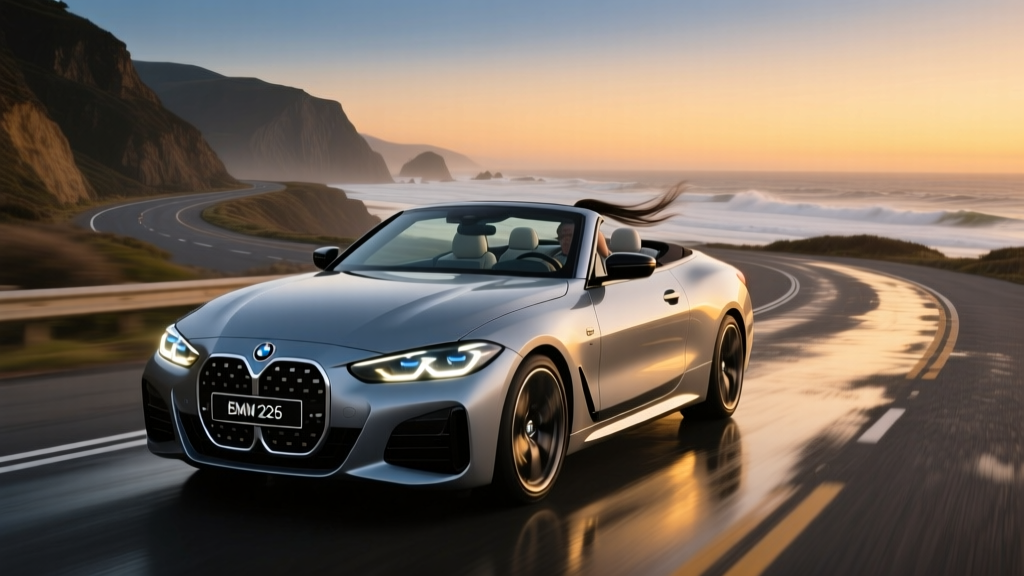
The open-air electric sports sedan has been one of the most requested body styles in the EV market, and BMW has answered with the 2026 BMW i4 convertible — a drop-top variant of its acclaimed Gran Coupe EV built on the CLAR platform. Combining the i4's proven electric powertrain with a retractable soft-top, this model targets drivers who want wind-in-the-hair motoring without tailpipe emissions. But does the convertible variant sacrifice range, structural rigidity, or practicality? We break down every spec that matters.
2026 BMW i4 Convertible: At-a-Glance Specifications
| Specification | eDrive40 Convertible | M50 Convertible |
|---|---|---|
| EPA Estimated Range | 278 miles | 245 miles |
| Battery (Usable Capacity) | 80.7 kWh (NMC) | 80.7 kWh (NMC) |
| Drivetrain | RWD (single motor) | AWD (dual motor) |
| Horsepower | 335 hp | 536 hp |
| 0–60 mph | 5.5 seconds | 3.7 seconds |
| Max DC Fast Charge | 205 kW | 205 kW |
| 10–80% DC Charge Time | ~31 minutes | ~31 minutes |
| Level 2 Home Charge Rate | 11 kW (~36 mi/hr) | 11 kW (~36 mi/hr) |
| MPGe (Combined) | 97 MPGe | 86 MPGe |
| Efficiency | 35 kWh/100 mi | 39 kWh/100 mi |
| Base MSRP | $64,300 | $76,300 |
| Battery/Powertrain Warranty | 8 years / 100,000 miles | 8 years / 100,000 miles |
Source: fueleconomy.gov and BMW USA official specifications for the 2026 model year.
Real-World Range: What the EPA Sticker Doesn't Tell You
eDrive40 Convertible: EPA 278 miles — expect approximately 240–260 miles in mixed real-world driving, 220–235 miles at sustained 75 mph highway speeds, and as low as 195–215 miles in freezing temperatures (below 32°F) with cabin heating.
M50 Convertible: EPA 245 miles — expect approximately 210–230 miles mixed, 195–210 miles highway, and 170–190 miles in cold weather.
The i4 convertible's range reduction compared to the Gran Coupe hardtop (which achieves up to 307 miles EPA in eDrive40 form) comes from two factors: added structural reinforcement for chassis rigidity without a fixed roof adds roughly 120 pounds, and the soft-top mechanism reduces aerodynamic efficiency slightly when raised. The 80.7 kWh usable battery capacity remains identical — BMW uses a net-usable figure, with a gross capacity closer to 83.9 kWh and a buffer protecting cell longevity.
The NMC (nickel-manganese-cobalt) chemistry prioritizes energy density over the LFP (lithium iron phosphate) chemistry found in some competitors. This means better range per pound but slightly more sensitivity to sustained 100% State of Charge. For daily driving, BMW recommends charging to 80–90% and only using 100% before long trips — a practice that significantly extends long-term battery health.
Charging Performance: DC Fast Charging and Home Setup
Charging speed remains a strong suit for the i4 platform. The 205 kW peak DC fast-charge rate is competitive within the segment, though it falls short of Hyundai/Kia's 800V architecture that enables 350 kW peaks. Here's what to expect at each charging level:
| Charging Level | Power / Rate | Range Added | Typical Use Case |
|---|---|---|---|
| Level 1 (120V household) | ~1.4 kW | ~4–5 miles/hour | Emergency / overnight trickle |
| Level 2 (240V home) | 11 kW (48A) | ~36 miles/hour | Daily home charging (~8.5 hrs empty-to-full) |
| DC Fast Charge | Peak 205 kW | ~190 miles in 31 min (10–80%) | Road trips, public stations |
Charging curve reality check: The 205 kW figure is a peak, not a sustained rate. In real-world DC fast charging, the i4 convertible holds approximately 180–205 kW between 10% and 45% State of Charge, then tapers progressively. From 60% to 80%, expect rates closer to 80–110 kW. This taper protects battery cells from heat damage but means the last 20% takes nearly as long as the first 60%. For road trip planning, plan your stops around 10–80% cycles rather than attempting full charges.
For home Level 2 charging, you'll need a 240V circuit rated for at least 60 amps to deliver the full 48 amps (11 kW) the i4's onboard charger accepts. Home installation typically costs $800–$2,500 depending on panel capacity and wiring distance — budget more if your electrical panel requires a 200-amp upgrade. The BMW Wallbox or a universal ChargePoint Home Flex both work well with the i4's J1772/NACS connector (BMW adopted NACS for the 2025 model year onward, giving native access to Tesla Superchargers).
Performance and Driving Dynamics
The eDrive40's single rear motor delivering 335 hp and 317 lb-ft of torque provides the kind of smooth, instant acceleration that defines the EV experience. The 5.5-second 0–60 mph time is brisk for a convertible grand tourer, and the rear-wheel-drive layout preserves the steering feel BMW enthusiasts expect. Low center of gravity from the floor-mounted battery pack keeps body roll well-controlled even without a fixed roof.
The M50 variant's dual-motor all-wheel-drive setup (536 hp, 586 lb-ft) transforms the i4 convertible into a genuine performance machine. The 3.7-second 0–60 time puts it in sports car territory, and the xDrive system manages torque distribution between axles to maximize grip. The trade-off is roughly 33 miles of EPA range and a $12,000 price premium.
Adaptive M Suspension comes standard on the M50 and is optional on the eDrive40. The convertible-specific tuning accounts for the reduced torsional rigidity of an open-top body, and BMW has added underbody bracing to compensate. The result is a car that feels remarkably composed for a drop-top, though it cannot fully match the Gran Coupe's structural stiffness during aggressive cornering.
Pricing, Trims, and Federal Tax Credit Eligibility
The 2026 BMW i4 convertible starts at $64,300 for the eDrive40 and $76,300 for the M50 — both prices including destination. Popular options include the Premium Package ($3,400), Driving Assistance Professional ($1,700), and the M Sport Package ($4,200 on eDrive40). A well-equipped eDrive40 typically lands between $68,000–$72,000, while a loaded M50 can approach $85,000.
| Factor | eDrive40 | M50 |
|---|---|---|
| Base MSRP | $64,300 | $76,300 |
| Under $55,000 Sedan MSRP Cap? | No — exceeds cap | No — exceeds cap |
| §30D New EV Credit Eligible? | Not as a sedan | Not as a sedan |
| Potential SUV/Truck Reclassification? | Unlikely | Unlikely |
| Estimated Credit | $0 (federal) | $0 (federal) |
Note: The IRS §30D credit imposes a $55,000 MSRP cap for sedans and $80,000 for SUVs/trucks/vans. As a sedan-class vehicle, the i4 convertible exceeds the sedan cap at both trim levels. Buyers should check IRS.gov for current classification rules and consult a tax professional. State and local incentives may still apply — check AFDC for your jurisdiction.
The lack of federal tax credit eligibility is a significant factor. Competitors priced under $55,000 or classified differently may qualify for up to $7,500, which narrows the i4 convertible's value proposition against more affordable EVs. However, BMW's lease programs sometimes pass through a $7,500 commercial clean vehicle credit (§45W) as a lease incentive — check with your dealer for current lease offers.
Interior, Cargo, and Daily Practicality
The i4 convertible's cabin carries over the curved display layout from the Gran Coupe: a 12.3-inch digital instrument cluster merges with a 14.9-inch central touchscreen running BMW's iDrive 8.5 operating system. Wireless Apple CarPlay and Android Auto are standard, along with a head-up display, Harman Kardon surround sound (16 speakers), and ambient lighting that takes on added drama with the top down.
Passenger space: Front legroom measures 42.1 inches, with rear legroom at 33.5 inches — adequate for adults on shorter trips but tighter than the Gran Coupe due to the reinforced rear bulkhead housing the soft-top mechanism. Rear headroom with the top up is 36.2 inches, competitive for the class.
Cargo volume: With the soft top raised, the trunk offers 11.0 cubic feet — reduced from the Gran Coupe's 16.6 cubic feet. With the top lowered, usable space drops to approximately 8.5 cubic feet. The 40/20/40 split-folding rear seatback adds flexibility for longer items, but this is not a car chosen for its cargo capacity.
The retractable soft top operates in approximately 18 seconds at speeds up to 25 mph. BMW uses a multi-layer acoustic fabric that keeps cabin noise remarkably low when raised — approximately 2–3 dB louder than the hardtop at highway speeds, a difference most occupants barely notice.
Driver Assistance and Technology
The i4 convertible comes standard with BMW's Active Driving Assistant, which includes forward collision warning, automatic emergency braking, lane departure warning, and blind-spot detection. The optional Driving Assistance Professional Package adds:
- Highway Assistant (hands-free driving up to 85 mph on divided highways — eyes-on, SAE Level 2)
- Active Cruise Control with Stop & Go
- Lane Keeping Assistant with side collision avoidance
- Automatic Lane Change (requires driver confirmation via turn signal)
- Parking Assistant Plus with surround-view cameras and Remote Parking
Pros, Cons, and the Verdict
- Open-air EV experience with genuine BMW driving dynamics
- 205 kW DC fast charging with NACS native Supercharger access
- 335–536 hp with instant electric torque
- Excellent build quality and premium cabin materials
- iDrive 8.5 is one of the best EV infotainment systems available
- 8-year/100,000-mile battery warranty
- No federal §30D tax credit (MSRP exceeds sedan cap)
- Reduced cargo space (11.0 cu ft top-up vs. 16.6 in Gran Coupe)
- ~30-mile range penalty vs. hardtop i4
- Rear seats best suited for children or short trips
- Premium pricing: well-equipped models approach $80K+
- 205 kW peak charge rate trails 800V competitors at 350 kW
Who Should Buy the BMW i4 Convertible?
The i4 convertible is best suited for:
- Enthusiast commuters who want an engaging daily driver with open-air capability and home charging convenience
- Existing BMW owners transitioning from a 4 Series convertible who want to go electric without changing brands or body style
- Warm-climate drivers in California, Florida, Texas, and the Southwest where top-down driving is viable year-round
- Two-person households who rarely need rear seats or large cargo capacity
It is less ideal for families needing rear-seat practicality, buyers who require maximum range for frequent road trips, or value-focused shoppers who prioritize tax credit eligibility. For those buyers, the standard i4 Gran Coupe or a Tesla Model 3 convertible alternative (if one emerges) may serve better.
BMW i4 Convertible vs. Key Competitors
The i4 convertible occupies a niche with few direct electric rivals. Here's how it compares against the closest alternatives:
| Attribute | BMW i4 Convertible eDrive40 | Mercedes-Benz CLE EV Cabriolet (Est.) | Tesla Model 3 (No Convertible) |
|---|---|---|---|
| EPA Range | 278 mi | ~260 mi (est.) | 363 mi (LR AWD) |
| Battery | 80.7 kWh NMC | ~85 kWh NMC | 79 kWh (NMC/LFP) |
| 0–60 mph | 5.5 sec | ~5.8 sec (est.) | 4.2 sec |
| Peak DC Charge | 205 kW | ~200 kW | 250 kW |
| Base MSRP | $64,300 | ~$68,000 (est.) | $42,380 |
| Federal Credit | No | No | Up to $7,500 |
| Convertible? | Yes | Yes | No |
Among dedicated electric convertibles, the i4's competition is sparse. Mercedes-Benz has signaled a CLE-based EV cabriolet, but specifications remain preliminary. The Tesla Model 3 offers superior range and pricing but no open-top variant. For buyers committed to an electric convertible today, the i4 is arguably the most complete package available.
Frequently Asked Questions
What is the real-world range of the BMW i4 convertible?
The eDrive40 convertible delivers an EPA-estimated 278 miles, but real-world mixed driving typically yields 240–260 miles. Sustained highway driving at 75 mph drops that to roughly 220–235 miles, and cold weather (below 32°F) can reduce range to 195–215 miles due to battery thermal management demands and cabin heating loads.
How fast does the i4 convertible charge at home and on DC fast chargers?
On a DC fast charger, the i4 peaks at 205 kW and charges from 10% to 80% in approximately 31 minutes — adding roughly 190 miles of range. At home on a Level 2 charger (240V, 48A), the 11 kW onboard charger adds about 36 miles per hour, meaning a full charge from empty takes roughly 8.5 hours. A standard 120V outlet (Level 1) adds only 4–5 miles per hour and is suitable only for emergencies or very low daily mileage.
Does the BMW i4 convertible qualify for the federal EV tax credit?
No — under current IRS §30D rules for 2026, the i4 convertible's MSRP ($64,300–$76,300) exceeds the $55,000 cap for sedans. Unless the IRS reclassifies the vehicle (unlikely for a convertible sedan), it does not qualify for the up-to-$7,500 new clean vehicle credit. However, BMW lease programs may pass through a commercial clean vehicle credit (§45W) as a lease incentive. Always verify current rules at IRS.gov and consult a tax professional.
Is the BMW i4 convertible worth buying vs. the Gran Coupe?
If open-air driving is a priority, the convertible delivers a unique experience with minimal compromise — you lose roughly 30 miles of range, some cargo space, and pay a premium, but gain the visceral joy of top-down electric motoring. If range, cargo, and value are your top concerns, the Gran Coupe is the more practical and economical choice. The powertrain, tech, and driving dynamics are otherwise identical.
What is the battery warranty on the i4 convertible?
BMW provides an 8-year/100,000-mile high-voltage battery warranty that covers capacity degradation below 70% of original capacity. The powertrain (electric motors, power electronics) is covered under the same 8-year/100,000-mile term. BMW's standard new-vehicle warranty covers 4 years/50,000 miles, and complimentary scheduled maintenance is included for 3 years/36,000 miles.
Does the i4 convertible use NACS or CCS for charging?
Starting with the 2025 model year, BMW adopted the NACS (North American Charging Standard) connector for all new EVs, including the i4 convertible. This provides native access to Tesla's Supercharger network — over 25,000 stations in North America — without an adapter. CCS adapters are available for legacy Electrify America and other CCS-only networks.