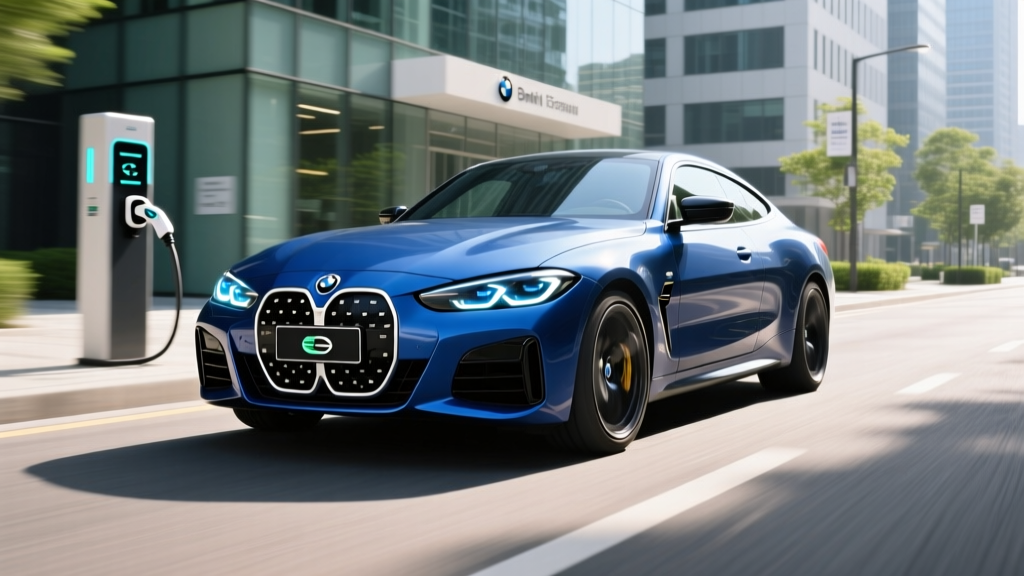
The BMW i4 has always been the automaker's answer to a simple question: what if a 3 Series went electric without looking like a spaceship? For 2026, the i4 lineup gets a mild refresh with updated styling, the latest iDrive 8.5 software, and minor battery tweaks — but the fundamental proposition remains the same. It's a luxury electric gran coupe that prioritizes driving dynamics over head-turning EV design. And for performance-minded shoppers, the headline number is the BMW i4 0-60 time, which ranges from a leisurely 5.8 seconds to a supercar-rivaling 3.7 seconds depending on the trim you choose.
We've driven all three current i4 variants, charged them on multiple DC fast-charging networks, and tracked real-world efficiency across seasons. Here's everything you need to know before you configure one.
BMW i4 Specs at a Glance: All Three Trims
| Specification | eDrive35 | eDrive40 | M50 |
|---|---|---|---|
| Drivetrain | RWD (single motor) | RWD (single motor) | AWD (dual motor) |
| Horsepower | 281 hp | 335 hp | 536 hp |
| Torque | 295 lb-ft | 317 lb-ft | 586 lb-ft |
| 0-60 mph | 5.8 sec | 5.5 sec | 3.7 sec |
| Battery (usable) | 66.0 kWh (NMC) | 81.5 kWh (NMC) | 81.5 kWh (NMC) |
| EPA Range | 256 mi | 307 mi | 271 mi |
| MPGe (combined) | 99 MPGe | 109 MPGe | 97 MPGe |
| Efficiency (kWh/100mi) | 34 kWh | 31 kWh | 35 kWh |
| Max DC Charge Rate | 180 kW | 205 kW | 205 kW |
| 10-80% DC Time | ~31 min | ~31 min | ~31 min |
| Level 2 Rate | 11 kW (44 mi/hr) | 11 kW (44 mi/hr) | 11 kW (44 mi/hr) |
| Base MSRP | $53,975 | $59,095 | $70,795 |
| Federal Tax Credit (§30D) | Up to $7,500* | Up to $7,500* | Up to $7,500* |
*Eligibility depends on buyer income, battery component sourcing, and critical mineral requirements. See IRS §30D guidelines for current-year rules. Point-of-sale transfer available at participating dealers.
The BMW i4 0-60 Time: What Each Trim Actually Delivers
The i4 M50's 3.7-second 0-60 mph sprint is the number that grabs headlines — and rightfully so. That puts it in the same acceleration territory as a Porsche 911 Carrera and well ahead of the Tesla Model 3 Long Range AWD (4.2 seconds). In real-world driving, the M50's dual-motor torque delivery is immediate and relentless, with no perceptible lag. Launch control is straightforward: hold the brake, floor the accelerator, release, and the car surges forward with a satisfying absence of drama — no tire spin, just grip and go.
The eDrive40's 5.5-second time is less thrilling but entirely adequate for daily driving and highway merging. Where the eDrive40 shines is in its efficiency-to-performance balance: 335 hp from a single rear motor with 307 miles of range is a compelling trade-off. The eDrive35, at 5.8 seconds, feels more relaxed — it's the entry point and best suited for commuters who prioritize price and range over acceleration.
One note on the M50: its 536 hp is available in Sport mode with launch control engaged. In Comfort mode, output is reduced, and the 0-60 time stretches closer to 4.5 seconds. This is normal for BMW's M Performance EVs and worth understanding before you expect supercar numbers in every driving scenario.
Real-World Range: Beyond the EPA Sticker
EPA Estimated Range: 307 miles
Real-World Highway (70 mph, 68°F): ~265-280 miles
Real-World Highway (70 mph, 32°F): ~225-245 miles
Real-World City/Commuter Mix: ~285-300 miles
The eDrive40's 307-mile EPA rating is competitive, but as with all EVs, real-world results depend heavily on conditions. In our mixed highway-and-city testing at moderate temperatures, we consistently saw 275-290 miles before reaching 10% state of charge (SoC). Pure highway driving at 75 mph drops that to roughly 255-270 miles — the i4's aerodynamic profile (0.29 Cd) is decent but not class-leading.
Cold weather remains the great equalizer. At 32°F with the cabin heated to 72°F, expect a 20-25% reduction in range across all trims. The i4 does include a heat pump (standard on all 2026 models), which mitigates some winter loss compared to resistive heating, but physics is physics. If you live in a cold climate and plan road trips, the eDrive40's 81.5 kWh battery gives you the most buffer.
The eDrive35's smaller 66.0 kWh pack means its 256-mile EPA figure translates to roughly 215-230 miles in real-world highway use — tight for road tripping but fine for a daily commuter with home charging. The M50's 271-mile EPA range suffers from the energy demands of its dual-motor setup; expect 230-250 miles in practice.
Charging Speed: DC Fast Charging and Home Setup
The i4's charging architecture uses a 400-volt system (not the 800V platforms found in Hyundai/Kia's E-GMP vehicles or the Porsche Taycan). This limits peak charge rates but still delivers respectable performance.
| Charging Level | Power / Rate | Miles Added per Hour | Notes |
|---|---|---|---|
| Level 1 (120V) | ~1.4 kW | ~3-4 mi/hr | Emergency/trickle only; a full charge takes days |
| Level 2 (240V, home) | 11 kW | ~44 mi/hr | Full charge in ~8-9 hours (eDrive40/M50); ~7 hrs (eDrive35) |
| DC Fast Charge | Up to 205 kW (eDrive40/M50) or 180 kW (eDrive35) | ~160-190 mi in 10 min (at peak) | 10-80% in ~31 min; tapers significantly above 80% |
On a 350 kW Electrify America or EVgo station, the eDrive40 and M50 peak around 205 kW — but only briefly. The charging curve is the critical detail most spec sheets hide. The i4 holds near-peak rates from roughly 10-40% SoC, then steps down to ~150 kW through 60%, and further to ~80-100 kW from 60-80%. That 31-minute 10-80% figure assumes optimal battery preconditioning and a capable charger. Without preconditioning (navigating to a fast charger in the iDrive system triggers it automatically), add 5-10 minutes.
Above 80% SoC, charging slows dramatically — a full 80-100% top-off can take nearly as long as the 10-80% session. This is standard behavior for NMC lithium-ion batteries and protects long-term cell health, but plan your road trips around 10-80% charges for efficiency.
At home on an 11 kW Level 2 wallbox (such as the BMW Wallbox or a ChargePoint Home Flex on a 48-amp circuit), a depleted eDrive40 recharges fully overnight. This is the sweet spot for daily ownership: plug in when you get home, wake up to a full battery. If your home electrical panel supports a 60-amp circuit, you can take full advantage of the 11 kW onboard charger. Older homes with 100-amp panels may need a panel upgrade — budget $1,500-$3,000 for that work.
Pricing, Trims, and Federal Tax Credit Eligibility
The 2026 BMW i4 lineup starts at $53,975 for the eDrive35 and climbs to $70,795 for the M50 before options. BMW's typical options packages (Premium Package, Driving Assistance Professional, M Sport Package) can add $5,000-$10,000 to a build. A well-equipped eDrive40 — the volume seller — typically lands between $63,000 and $68,000 out the door.
| Trim | Base MSRP | Typical As-Tested | Max §30D Credit | Effective Price (after credit) |
|---|---|---|---|---|
| eDrive35 | $53,975 | $58,500 | $7,500 | ~$51,000 |
| eDrive40 | $59,095 | $65,500 | $7,500 | ~$58,000 |
| M50 | $70,795 | $78,000 | $7,500 | ~$70,500 |
Regarding the federal EV tax credit: the i4 qualifies under IRS §30D for up to $7,500, but eligibility is not universal. Key requirements for 2026 include:
- Buyer income cap: Modified AGI must not exceed $150,000 (single), $225,000 (head of household), or $300,000 (joint filing).
- MSRP cap: Sedans and coupes must be priced at or below $55,000. The eDrive35 base MSRP qualifies, but optioned examples and the eDrive40/M50 may exceed this cap — confirm with your dealer before relying on the credit.
- Battery sourcing: The credit is split into two halves ($3,750 for critical minerals, $3,750 for battery component assembly), each with escalating domestic-content requirements. BMW's battery supply chain has been adjusting to these rules; the exact credit amount may vary by build date.
- Point-of-sale transfer: You can apply the credit as an immediate price reduction at participating dealers rather than waiting to claim it on your tax return.
Important: Consult a tax professional and verify current eligibility on the IRS website before purchasing. Rules can shift with legislative changes, and your specific tax situation may affect credit availability.
Interior, Cargo, and Daily Livability
The i4 is built on BMW's CLAR platform (shared with the 4 Series Gran Coupe), which means it was not designed from the ground up as an EV. The trade-off: a traditional BMW interior with a transmission tunnel hump and a slightly elevated floor, but also a familiar, well-built cabin with premium materials.
The curved display running iDrive 8.5 dominates the dashboard — a 12.3-inch instrument cluster and a 14.9-inch central touchscreen merged under a single glass panel. Response times are quick, the interface is logical, and wireless Apple CarPlay/Android Auto are standard. The latest iDrive 8.5 adds improved voice recognition and a QuickSelect menu bar that reduces the number of taps needed for common functions like climate control.
Cargo space: The i4's liftback design (a full hatch, not a traditional trunk) is a practicality win. You get 25.6 cubic feet behind the rear seats and 45.6 cubic feet with the 40/20/40 rear seats folded. That's meaningfully more than a Tesla Model 3's trunk (23 cu ft) and competitive with the Polestar 2 (14.4 cu ft trunk, but 40.4 cu ft folded).
Passenger space: Front legroom is generous at 42.4 inches. Rear legroom, at 34.7 inches, is adequate for adults on short trips but tight for taller passengers on longer drives. The slightly raised floor (due to the battery pack beneath) creates a knees-up seating position in the back that some find less comfortable than a purpose-built EV platform. Headroom is fine front and rear thanks to the absence of a sunroof on base models (the panoramic roof, when optioned, slightly reduces front headroom).
Driver Assistance and Tech Features
The i4 comes standard with BMW's Driving Assistant, which includes forward collision warning, automatic emergency braking, lane departure warning, and blind-spot monitoring. The optional Driving Assistance Professional Package ($1,700) adds adaptive cruise control with stop-and-go, lane centering, and emergency stop assist.
The i4's driver-assistance systems are Level 2 on the SAE J3016 scale. This means the car can control steering and acceleration simultaneously, but the driver must remain fully engaged — hands on or near the wheel, eyes on the road. This is not autonomous or self-driving. BMW does not currently offer a hands-free highway driving system comparable to GM's Super Cruise or Ford's BlueCruise on the i4.
A notable tech highlight: the i4 offers BMW IconicSounds Electric, a set of synthetic driving sounds composed by Hans Zimmer. Whether you find them engaging or gimmicky is personal, but they do provide auditory feedback that some drivers miss from internal-combustion vehicles. The sounds can be turned off entirely.
The i4 also supports over-the-air (OTA) updates for infotainment, driver-assistance calibrations, and battery management improvements — though BMW has been more conservative with OTA feature additions than Tesla or Rivian.
Battery Warranty, Degradation, and Long-Term Ownership
BMW covers the i4's high-voltage battery for 8 years or 100,000 miles, whichever comes first. The warranty guarantees that the battery will retain at least 70% of its original usable capacity during that period. If capacity drops below 70% under normal use, BMW will repair or replace the battery at no cost.
The i4 uses NMC (nickel manganese cobalt) lithium-ion cells supplied by CATL and Samsung SDI, depending on the build. NMC chemistry offers higher energy density than LFP (lithium iron phosphate), which is why the i4 achieves competitive range in a relatively compact battery pack. The trade-off: NMC cells are more sensitive to sustained high SoC and extreme temperatures. For maximum longevity, BMW's battery management system includes a buffer (the 81.5 kWh "usable" figure is already less than the gross capacity) and active thermal management.
Based on data from similar BMW iX and i4 vehicles now reaching 3-4 years of age, typical degradation is in the 5-8% range over the first 60,000 miles — well within the warranty threshold. If you charge primarily at home on Level 2 and avoid frequent DC fast charging above 90% SoC, degradation should remain minimal over the warranty period.
The standard vehicle limited warranty is 4 years/50,000 miles, and BMW includes 3 years/36,000 miles of complimentary scheduled maintenance (which, for an EV, mainly covers cabin air filters and brake fluid checks).
Pros, Cons, and How It Compares
Pros
- Class-leading driving dynamics and steering feel for an EV sedan
- M50's 3.7-sec 0-60 time rivals sports cars at half the price
- Liftback design offers more cargo versatility than a traditional sedan trunk
- Heat pump standard on all trims for cold-weather efficiency
- iDrive 8.5 is responsive, well-organized, and supports wireless CarPlay/Android Auto
- Available Driving Assistance Professional is smooth and predictable
Cons
- 400V architecture limits peak DC charge rates vs 800V competitors (Hyundai Ioniq 6: 350 kW)
- Rear seat legroom is tight for taller passengers (34.7 in)
- Not a dedicated EV platform — transmission tunnel and raised floor compromise interior packaging
- MSRP cap may disqualify optioned eDrive40 and all M50 models from full §30D credit
- No hands-free driving system (unlike Super Cruise or BlueCruise competitors)
- eDrive35's 256-mile range is marginal for road trips
BMW i4 vs. key competitors:
The Tesla Model 3 Long Range AWD ($47,740) offers more range (341 mi EPA), faster charging (250 kW peak), and a lower price — but the i4 wins on build quality, ride refinement, and steering feedback. The Hyundai Ioniq 6 SEL (~$42,000) charges far faster thanks to its 800V platform (10-80% in 18 minutes) and offers 361 miles of range, but its interior materials and brand cachet don't match BMW's. The Polestar 2 Long Range (~$51,300) is the closest philosophical rival — Scandinavian design, good dynamics — but it trails on range (276 mi) and rear-seat space.
Look elsewhere if: Maximum range and fastest charging are your top priorities (Ioniq 6 or Model 3), you need a spacious rear seat for adults (consider the iX or a midsize EV SUV), or you want a hands-free highway driving system (Cadillac Lyriq with Super Cruise, or a Ford with BlueCruise).
Frequently Asked Questions
What is the BMW i4 0-60 time for each trim?
The eDrive35 does 0-60 mph in 5.8 seconds, the eDrive40 in 5.5 seconds, and the M50 in 3.7 seconds (with Sport mode and launch control engaged). The M50's time makes it one of the quickest EVs in its price class.
What is the real-world range of the BMW i4?
The eDrive40's EPA rating is 307 miles, but expect 265-280 miles in real-world highway driving and 225-245 miles in freezing temperatures. The eDrive35 delivers roughly 215-230 real-world highway miles; the M50 about 230-250 miles. See fueleconomy.gov for official EPA data.
How fast does the BMW i4 charge?
On a DC fast charger, the eDrive40 and M50 peak at 205 kW, achieving a 10-80% charge in approximately 31 minutes with battery preconditioning. The eDrive35 peaks at 180 kW. At home on a Level 2 (240V, 48A) charger, all trims accept up to 11 kW, adding about 44 miles of range per hour.
Does the BMW i4 qualify for the $7,500 federal EV tax credit?
It can, but eligibility depends on several factors under IRS §30D: the buyer's income must fall below specified caps ($150K single / $300K joint), the vehicle's MSRP must not exceed $55,000 for sedans, and the battery must meet critical mineral and component sourcing requirements. The base eDrive35 is most likely to qualify fully; optioned eDrive40 and M50 builds may exceed the MSRP cap. Verify current rules at irs.gov and consult a tax professional.
Is the BMW i4 worth buying over a Tesla Model 3?
The i4 costs more and offers less range and slower charging than the Model 3 Long Range. However, it delivers significantly better interior quality, ride comfort, steering feedback, and cabin quietness. If driving experience and luxury refinement matter more to you than maximizing range-per-dollar, the i4 is the stronger choice. If budget and charging speed are paramount, the Model 3 wins.
What battery chemistry does the BMW i4 use?
All i4 trims use NMC (nickel manganese cobalt) lithium-ion cells. NMC offers higher energy density than LFP chemistry, allowing competitive range in a compact pack. The trade-off is slightly greater sensitivity to high state-of-charge storage and extreme heat, though BMW's thermal management system and capacity buffer mitigate this.
Does the BMW i4 have a front trunk (frunk)?
No. Because the i4 is built on a shared platform with the ICE 4 Series Gran Coupe rather than a dedicated EV skateboard, there is no front trunk. All cargo space is in the rear liftback area (25.6 cu ft behind rear seats, 45.6 cu ft with seats folded).