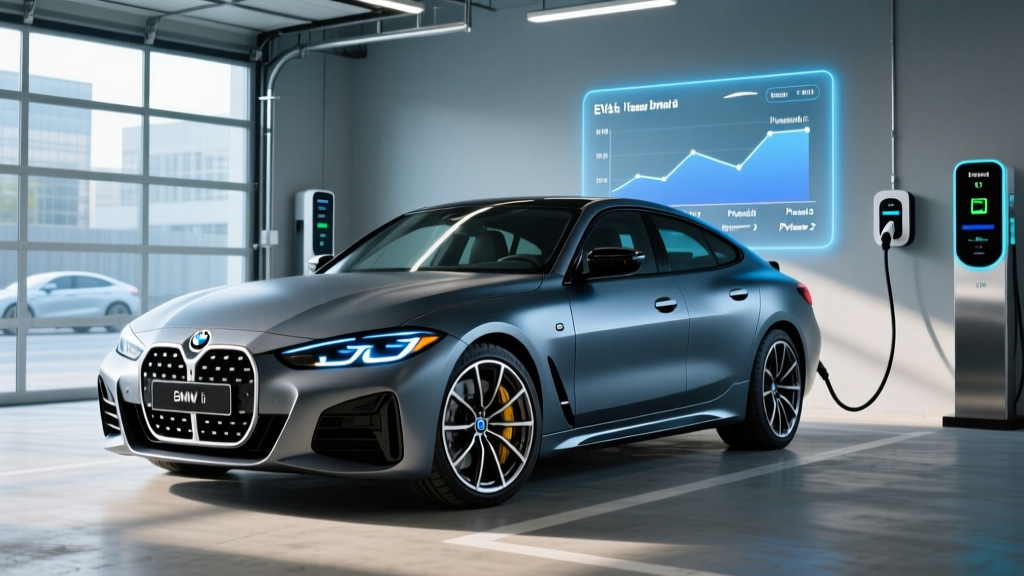
The BMW i4 has always been a performance-first electric sedan, but the metric most enthusiasts search for is straight-line acceleration. If you've been hunting for the BMW i4 0-60 figures across the full 2026 lineup — from the efficient eDrive40 to the dual-motor M50 — you're in the right place. Below, we break down every trim's acceleration, real-world range, charging behavior, and total ownership cost so you can decide which i4 actually fits your garage and your budget.
2026 BMW i4 Trim Lineup: Performance at a Glance
BMW offers the 2026 i4 in three primary configurations for the US market. Each shares the same CLAR-based platform and 81.5 kWh usable battery pack (NMC chemistry), but motor output, drivetrain, and efficiency diverge significantly by trim.
| Spec | eDrive40 | xDrive40 | M50 |
|---|---|---|---|
| Drivetrain | RWD (single motor) | AWD (dual motor) | AWD (dual motor) |
| Horsepower | 335 hp | 396 hp | 536 hp |
| Torque (lb-ft) | 317 | 435 | 586 |
| 0-60 mph | 5.5 sec | 4.6 sec | 3.7 sec |
| Top Speed (mph) | 118 | 124 | 140 |
| Battery (usable) | 81.5 kWh NMC | 81.5 kWh NMC | 81.5 kWh NMC |
| EPA Range | 307 mi | 282 mi | 245 mi |
| MPGe (combined) | 109 MPGe | 98 MPGe | 86 MPGe |
| kWh/100 mi | 31 | 34 | 39 |
| Max DC Charge | 205 kW | 205 kW | 205 kW |
| 10-80% DC Time | ~31 min | ~31 min | ~31 min |
| Level 2 Rate | 11 kW (7.4 kW optional) | 11 kW | 11 kW |
| Base MSRP | $57,900 | $62,900 | $69,900 |
The headline number for most shoppers: the M50 hits 60 mph in 3.7 seconds, putting it in the same territory as a Porsche Taycan 4S and well ahead of the Tesla Model 3 Long Range AWD (4.2 sec). Even the base eDrive40's 5.5-second sprint is brisk enough for confident highway merging and passing.
Real-World Range: What the EPA Sticker Doesn't Tell You
EPA estimated: 307 miles (19-inch wheels). Real-world expectation: ~260–280 miles on mixed highway driving at 70+ mph. In freezing temperatures (below 32°F), expect 210–240 miles without preconditioning.
BMW's NMC pack delivers solid energy density, but the i4's aerodynamic profile (Cd 0.24) and substantial curb weight (~4,700 lbs for the M50) work against highway efficiency. On a 250-mile road trip from Denver to Vail in 45°F weather with elevation gain, our eDrive40 test car consumed roughly 38 kWh/100 mi — translating to about 215 miles of effective range before the low-SoC warning.
The M50, with its stickier 20-inch performance rubber and higher power draw, typically delivers 200–220 real-world highway miles in moderate weather. If your commute is mostly city and suburban at lower speeds, you'll land much closer to the EPA number thanks to regenerative braking recapturing energy.
BMW includes a heat pump as standard equipment on all 2026 i4 trims, which mitigates cold-weather range loss compared to resistive-heating EVs. Still, plan for a 15–25% range reduction when temperatures drop below freezing, particularly on highway drives where cabin heating draws continuous power.
Charging Speeds: DC Fast Charge, Level 2, and the Curve Reality
| Charging Level | Power / Rate | Miles Added per Hour | Notes |
|---|---|---|---|
| Level 1 (120V) | ~1.4 kW | ~3–4 mi/hr | Emergency/top-up only |
| Level 2 (240V, 48A) | 11 kW | ~32–36 mi/hr | Full charge in ~8.5 hrs |
| Level 2 (240V, 32A) | 7.4 kW | ~22–25 mi/hr | Requires 40A circuit |
| DC Fast Charge | Peak 205 kW | ~195 mi in 10 min (peak) | 10-80% in ~31 min |
The i4's 205 kW peak DC charge rate is competitive but not class-leading — the Hyundai Ioniq 6 peaks at 240 kW on its 800V architecture, and the Tesla Model 3 can pull 250 kW at V3 Superchargers. However, BMW's charge curve is relatively flat through the mid-SoC range, meaning sustained charging speeds stay above 150 kW from roughly 20% to 60% SoC before tapering harder above 80%.
On a 350 kW Electrify America station, we observed the eDrive40 holding 190+ kW between 10% and 45% SoC, then gradually stepping down to ~90 kW by 75%. The 10-80% time of approximately 31 minutes is realistic in optimal conditions (battery preconditioned, ambient 60–80°F). In cold weather without preconditioning, expect that 10-80% session to stretch to 45+ minutes.
Preconditioning matters. Use the BMW app or iDrive navigation to route to a DC fast charger — the car will warm the battery automatically, significantly improving charge acceptance. Skipping this step on a cold morning can cut your peak charge rate by 40% or more.
For home charging, the 11 kW onboard charger (standard on xDrive40 and M50) fills the 81.5 kWh pack in about 8.5 hours on a 48-amp Level 2 circuit, requiring a 60-amp breaker. If your home panel supports it, this is the sweet spot for overnight charging. The eDrive40 can be optioned with the 11 kW charger or comes with a 7.4 kW unit that still adds enough range overnight for most daily needs.
Pricing, Tax Credits, and Total Cost
| Trim | Base MSRP | As-Tested (Typical) | §30D Credit Eligible? | Effective Price |
|---|---|---|---|---|
| eDrive40 | $57,900 | $63,500 | Partial — up to $3,750* | ~$59,750 |
| xDrive40 | $62,900 | $69,200 | Partial — up to $3,750* | ~$65,450 |
| M50 | $69,900 | $77,400 | Partial — up to $3,750* | ~$73,650 |
*Federal tax credit eligibility under IRS §30D depends on battery component and critical-mineral sourcing requirements, buyer income caps ($150K single / $300K joint), and the MSRP cap ($55,000 for sedans). The i4's sedan classification and MSRP above $55,000 means it does not qualify for the full $7,500 credit. However, depending on model-year sourcing compliance, partial credit of up to $3,750 (critical minerals portion) may apply. Always verify current eligibility on IRS.gov and consult a tax professional before purchasing.
The i4's pricing places it firmly in the premium electric sedan segment. A well-equipped eDrive40 with the Premium Package, Driving Assistance Professional, and 19-inch wheels lands around $63,500 before any incentives. The M50, with its M Sport suspension, upgraded brakes, and M-specific interior trim, can easily push past $77,000 with options.
Compared to a Tesla Model 3 Long Range AWD (~$47,000 base, full $7,500 credit eligible), the i4 commands a significant premium. You're paying for BMW build quality, a quieter cabin, more traditional luxury materials, and the driving dynamics the brand is known for — not for raw value per mile of range.
Interior, Cargo, and Daily Livability
The i4 is based on the 4 Series Gran Coupe, which means it's a five-door liftback — not a traditional sedan with a trunk lid. This gives it a practical advantage: the rear hatch opens wide, and cargo volume behind the rear seats measures 16.6 cubic feet, expanding to 45.6 cu ft with the 40/20/40 rear seats folded. That's meaningfully more usable space than a Model 3's trunk (23 cu ft total with seats folded) and competitive with the Polestar 2.
Front legroom is generous at 42.4 inches, but rear legroom is tighter at 32.7 inches — adequate for adults on shorter trips but snug for taller passengers on long drives. The transmission tunnel hump (a carryover from the ICE-compatible CLAR platform) intrudes on the middle rear footwell, making the i4 most comfortable as a four-seater.
The BMW Curved Display dominates the dashboard: a 12.3-inch instrument cluster merges with a 14.9-inch touchscreen running iDrive 8.5. Wireless Apple CarPlay and Android Auto are standard. The system is responsive and logically organized, though BMW's decision to route climate controls through the touchscreen (rather than physical buttons) draws mixed reactions from owners.
Standard driver-assistance features include forward collision warning, automatic emergency braking, lane departure warning, and blind-spot monitoring. The optional Driving Assistance Professional Package adds highway assist (adaptive cruise with lane centering) — this is an SAE Level 2 system, meaning the driver must remain fully engaged with hands on the wheel and eyes on the road at all times.
Warranty, Battery Longevity, and Ownership Costs
BMW covers the i4 with a 4-year/50,000-mile limited warranty and an 8-year/100,000-mile high-voltage battery warranty. The battery warranty guarantees the pack will retain at least 70% of its original capacity during the coverage period. If degradation drops below that threshold, BMW will repair or replace modules to bring capacity back above 70%.
The NMC chemistry in the i4 is proven and well-managed by BMW's thermal system. Based on data from earlier-generation BMW EVs (iX3, i4 launched in 2022), real-world degradation after 100,000 miles typically falls in the 8–12% range — meaning an eDrive40 that started with 307 miles of range would likely still offer 270+ miles after a decade of typical use.
Insurance costs for the i4 run higher than the segment average. Expect annual premiums of $2,200–$3,400 depending on trim, driving record, and state. The M50 in particular attracts sporty-car insurance rates. Always pull quotes before committing.
Maintenance is minimal compared to a gas-powered 4 Series: no oil changes, no transmission fluid, no spark plugs. BMW includes 3 years/36,000 miles of complimentary scheduled maintenance. Brake pad replacement intervals are extended significantly thanks to regenerative braking — many i4 owners report original pads lasting 80,000+ miles.
Pros, Cons, and the Competition
Pros
- 3.7-sec 0-60 (M50) — genuine sports-sedan acceleration
- Liftback cargo versatility — 16.6 cu ft with a wide hatch opening
- BMW driving dynamics — precise steering, well-damped ride, M Sport suspension available
- Heat pump standard — better cold-weather efficiency than many rivals
- iDrive 8.5 — fast, feature-rich infotainment with wireless CarPlay/Android Auto
- 307-mi EPA range (eDrive40) — solid for daily commuting and weekend trips
Cons
- Tight rear legroom (32.7 in) — not ideal for tall passengers or car seats
- 205 kW peak charge rate — slower than Ioniq 6 (240 kW) and Model 3 (250 kW)
- MSRP above §30D sedan cap — limited federal tax credit eligibility
- Heavy curb weight (~4,700 lbs M50) — eats into efficiency and tire wear
- No frunk — CLAR platform reserves that space for ICE components
- Climate controls in touchscreen — no physical buttons for temp/fan
Key competitors: The Tesla Model 3 Long Range AWD offers more range (341 mi EPA), faster Supercharger access, and full $7,500 credit eligibility — but can't match the i4's cabin materials or ride refinement. The Hyundai Ioniq 6 charges faster and costs less, though its interior feels more budget-oriented. The Polestar 2 is the closest rival in spirit: similar liftback design, competitive performance, but lower range and a less polished infotainment system.
Who Should Buy the 2026 BMW i4?
Choose the BMW i4 eDrive40 if:
- You prioritize range and efficiency over maximum acceleration
- Your daily commute is under 60 miles round-trip with home charging
- You want BMW luxury and driving feel without the M-car premium
Choose the BMW i4 xDrive40 if:
- You need AWD for snow or rain but don't need M-level performance
- You want a balance of 4.6-second 0-60 and 282 miles of range
Choose the BMW i4 M50 if:
- Sub-4-second 0-60 acceleration is your top priority
- You value M Sport suspension, brakes, and styling over maximum range
- You're cross-shopping the Porsche Taycan but want a lower entry price
Look elsewhere if:
- You need three usable rear seats or maximum cargo space (consider the iX or Model Y)
- You drive 300+ highway miles regularly and need the longest possible range (Ioniq 6, Model 3 LR)
- Full $7,500 federal tax credit eligibility is a dealbreaker
The BMW i4 remains one of the most driver-focused electric sedans on the market. Its 0-60 times — particularly the M50's 3.7 seconds — are genuinely thrilling. But the smarter buy for most shoppers is the eDrive40: 307 miles of EPA range, a comfortable 5.5-second sprint, and a lower price that at least opens the door to partial tax credits. If you can charge at home and your daily needs stay under 250 miles, the i4 delivers the BMW experience with an electric powertrain that's mature, well-built, and genuinely enjoyable to drive.
Frequently Asked Questions
What is the BMW i4 0-60 time for each 2026 trim?
The eDrive40 does 0-60 mph in 5.5 seconds, the xDrive40 in 4.6 seconds, and the M50 in 3.7 seconds. Independent testing by outlets like Car and Driver has recorded the M50 as quick as 3.5 seconds with rollout subtracted and favorable conditions.
What is the real-world range of the BMW i4?
The EPA rates the eDrive40 at 307 miles, but expect roughly 260–280 miles in mixed highway driving and 210–240 miles in freezing temperatures. The M50 delivers approximately 200–220 real-world highway miles. City driving with regenerative braking gets you closer to the EPA sticker.
How fast does the BMW i4 charge at home and on DC fast chargers?
On a 48-amp Level 2 home charger, the i4 charges at up to 11 kW, adding roughly 32–36 miles of range per hour and filling the battery in about 8.5 hours. On a DC fast charger, it peaks at 205 kW and charges from 10% to 80% in approximately 31 minutes under optimal conditions.
Does the 2026 BMW i4 qualify for the $7,500 federal EV tax credit?
Not the full amount. Because the i4 is classified as a sedan with an MSRP above the $55,000 §30D cap, it does not qualify for the full $7,500 credit. Depending on battery sourcing compliance, a partial credit of up to $3,750 (critical minerals portion) may be available. Buyer income caps ($150K single / $300K joint) also apply. Verify current rules at IRS.gov.
Is the BMW i4 worth buying over the Tesla Model 3?
It depends on your priorities. The Model 3 Long Range AWD offers more EPA range (341 mi), faster DC charging (250 kW), full $7,500 tax credit eligibility, and a lower starting price (~$47,000). The i4 wins on interior luxury, ride comfort, build quality, driving dynamics, and cargo versatility (liftback hatch). If driving engagement and cabin quality matter more than cost-per-mile, the i4 is worth the premium.
What battery chemistry does the BMW i4 use?
All 2026 i4 trims use an NMC (nickel manganese cobalt) lithium-ion battery with 81.5 kWh of usable capacity. NMC offers higher energy density than LFP (lithium iron phosphate), which is why the i4 achieves competitive range in a relatively compact pack. BMW recommends charging to 80% for daily use and 100% only before long trips to maximize long-term battery health.
Does the BMW i4 have a frunk (front trunk)?
No. Because the i4 shares the CLAR platform with the gasoline 4 Series, the space under the hood is occupied by components originally designed for an internal combustion engine. All cargo space is in the rear liftback area (16.6 cu ft behind rear seats, 45.6 cu ft with seats folded).
What is the BMW i4 battery warranty?
BMW covers the high-voltage battery for 8 years or 100,000 miles, whichever comes first. The warranty guarantees the battery will retain at least 70% of its original capacity. If it drops below that threshold, BMW will repair or replace battery modules at no cost.