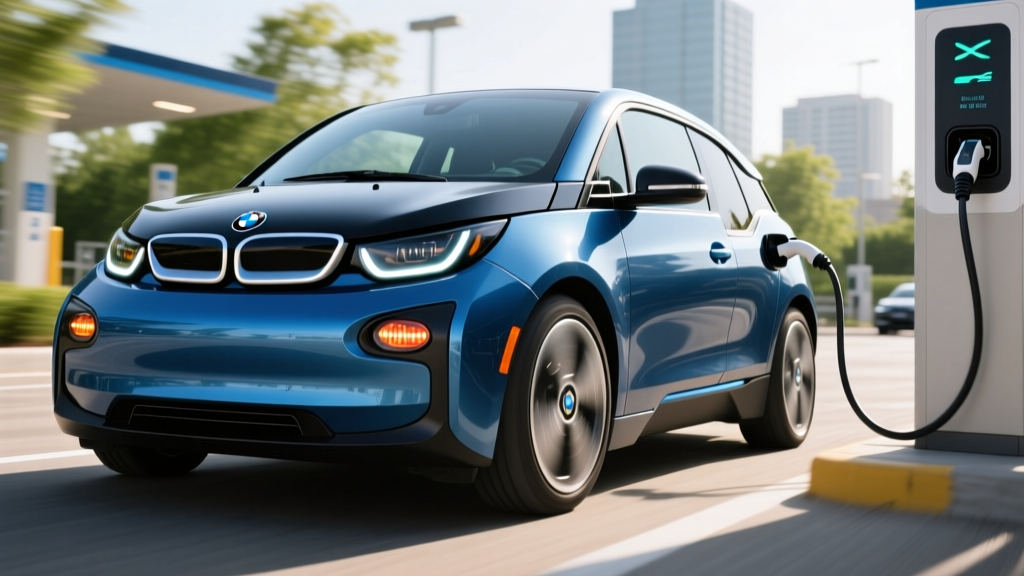
The BMW i3 occupies an unusual space in the electric vehicle landscape. Originally launched in 2014 as a radical carbon-fiber city car, it was discontinued after the 2021 model year in the United States. Yet in 2026, it remains one of the most sought-after used EVs — particularly among urban commuters who value its lightweight construction, tight turning radius, and surprisingly punchy acceleration. If you've been searching for BMW i3 zero to 60 figures and real-world performance data, this review breaks down every number that matters for buyers evaluating the i3 on the pre-owned market today.
Because the i3 is no longer sold new, this profile focuses on the final U.S. model years (2019–2021) equipped with the larger 42.2 kWh battery pack, which represents the most capable and relevant version for current buyers. We'll also touch on the earlier 33 kWh variant for context.
BMW i3 Performance: Zero to 60 and Drivetrain Specs
The BMW i3 is a rear-wheel-drive, single-motor electric vehicle built on BMW's innovative "Life Module" architecture — a passenger cell made from carbon-fiber-reinforced plastic (CFRP) bonded to an aluminum chassis. This construction keeps curb weight remarkably low for an EV, at approximately 2,976 lbs for the standard i3 and around 3,300 lbs for the i3s variant.
| Spec | i3 (Standard) | i3s (Sport) |
|---|---|---|
| Motor Output | 170 hp / 184 lb-ft torque | 184 hp / 199 lb-ft torque |
| 0–60 mph | 6.9 seconds | 6.2 seconds |
| Top Speed | 93 mph (electronically limited) | 100 mph (electronically limited) |
| Drivetrain | Rear-wheel drive (single motor) | Rear-wheel drive (single motor) |
| Curb Weight | ~2,976 lbs | ~3,300 lbs |
| 0–30 mph | ~3.5 seconds | ~3.1 seconds |
The BMW i3 zero to 60 time of 6.9 seconds (6.2 for the i3s) might not rival a Tesla Model 3 Performance, but it's genuinely quick for a subcompact hatchback and significantly faster than most gas-powered cars in its size class. The instant torque delivery from the electric motor means the i3 feels even quicker in city driving than the stopwatch suggests. Off-the-line acceleration from 0–30 mph is where the i3 truly shines — it will gap most traffic at stoplights.
The i3s adds a wider track, sport suspension tuning, larger 20-inch wheels (versus 19-inch on the standard i3), and a slightly more powerful motor. The 0.7-second improvement in the zero to 60 sprint is noticeable, and the i3s also gains a more aggressive stability control calibration that allows slightly more slip before intervening.
Battery, Range, and Real-World Efficiency
The 2019–2021 BMW i3 uses a 42.2 kWh gross battery pack (approximately 37.9 kWh usable) with Samsung SDI lithium-ion cells using NMC (nickel manganese cobalt) chemistry. Earlier 2017–2018 models used a 33 kWh pack (27.2 kWh usable), and the original 2014–2016 models had a 22 kWh pack. If you're shopping used, the 42.2 kWh version is the one to prioritize.
EPA Estimated Range: 153 miles (i3), 141 miles (i3s with larger wheels)
Real-World Range: Expect 120–140 miles in mixed city/highway driving in moderate temperatures. Highway-only driving at 70+ mph drops this to approximately 105–120 miles. In cold weather (below 32°F), range can fall to 90–110 miles due to cabin heating demands and reduced battery efficiency. The i3 lacks a heat pump, relying instead on resistive heating, which significantly impacts winter range.
The i3's efficiency is genuinely impressive. According to fueleconomy.gov, the 2021 BMW i3 achieves 113 MPGe combined (124 city / 102 highway), translating to roughly 30 kWh per 100 miles. That's among the most efficient EVs ever sold in the U.S., a direct result of the lightweight CFRP construction and narrow, low-rolling-resistance tires.
One critical note for used buyers: battery degradation on the i3 has proven relatively modest. Most 2019–2021 examples with the 42.2 kWh pack retain 85–92% of original capacity as of 2026, based on owner community data. Always request a battery health report or use an OBD-II reader with an app like BimmerCode to check actual State of Health (SoH) before purchasing.
Charging Speed: DC Fast, Level 2, and Level 1
The BMW i3 supports DC fast charging via CCS1 (Combo connector) on 2019–2021 models, as well as Level 2 AC charging through a J1772 inlet. Earlier models (pre-2018) may have CHAdeMO or only Level 2 capability depending on the optional equipment. Verify the connector type before buying a used example.
| Charging Level | Power Rate | Time (10–80%) | Miles Added per Hour |
|---|---|---|---|
| DC Fast Charge (CCS1) | 50 kW peak | ~45 minutes | N/A (session-based) |
| Level 2 (240V, 32A) | 7.4 kW | ~4.5 hours (full charge) | ~25 miles/hr |
| Level 2 (240V, 16A) | 3.7 kW | ~9 hours (full charge) | ~12 miles/hr |
| Level 1 (120V, 12A) | 1.4 kW | ~28+ hours (full charge) | ~4.5 miles/hr |
The i3's DC fast-charging speed is its most significant limitation by 2026 standards. A peak rate of 50 kW means you'll spend roughly 45 minutes going from 10% to 80% at a public fast charger — far slower than modern EVs like the Hyundai Ioniq 5 (which peaks at 240 kW and does 10–80% in about 18 minutes). The i3's charge curve also tapers noticeably above 70% SoC, making the final stretch to 80% disproportionately slow.
For home Level 2 charging, the i3's onboard charger accepts up to 7.4 kW, which is adequate for overnight replenishment. Plugging in after a typical day of 40–50 miles of driving will fully recharge the battery in roughly 3–4 hours on a standard 32-amp Level 2 home station. This is perfectly practical for daily use — the fast-charging limitation only matters on road trips.
Pricing on the Used Market and Tax Credit Eligibility
Since the BMW i3 was discontinued after 2021, all purchases in 2026 are on the pre-owned market. Prices have settled into an attractive range for budget-conscious EV shoppers.
| Model / Trim | Original MSRP | Typical Used Price (2026) | Used EV Tax Credit (IRC §25E) |
|---|---|---|---|
| 2019–2021 i3 (Standard) | $44,450–$48,000 | $18,000–$26,000 | Up to $4,000 (30% of sale price) |
| 2019–2021 i3s (Sport) | $47,650–$52,000 | $22,000–$30,000 | Up to $4,000 (30% of sale price) |
| 2017–2018 i3 (33 kWh) | $42,400–$47,000 | $12,000–$18,000 | Up to $4,000 (30% of sale price) |
Tax credit details: The federal Used Clean Vehicle Credit (IRC §25E) provides 30% of the sale price, up to a maximum of $4,000, for qualifying used EVs. Key eligibility requirements per IRS guidelines:
- The vehicle must be at least two model years old (all i3 models qualify)
- Sale price must be $25,000 or less to qualify for the full credit
- Buyer income caps: $75,000 single / $112,500 head of household / $150,000 joint filers (modified AGI)
- Must be purchased from a licensed dealer (private-party sales do not qualify)
- Credit can be transferred to the dealer as a point-of-sale discount
- Buyer must not have claimed the used EV credit in the prior 3 years
This means a well-equipped 2020 i3 selling for $23,500 from a dealer could net a $4,000 credit, bringing the effective cost to $19,500 — making it one of the most affordable ways to get into a premium-brand EV in 2026.
Interior, Cargo, and Daily Practicality
The i3's interior was ahead of its time in material innovation. BMW used renewable and recycled materials extensively: eucalyptus wood dash trim, recycled PET-bottle fabric, and kenaf fiber door panels. The result is a cabin that feels distinctly modern and airy, though it shows its age in infotainment technology compared to 2026 offerings.
| Dimension | Measurement |
|---|---|
| Front Headroom | 39.6 inches |
| Front Legroom | 40.5 inches |
| Rear Headroom | 37.2 inches |
| Rear Legroom | 31.9 inches |
| Cargo Volume (rear seats up) | 15.1 cu ft |
| Cargo Volume (rear seats folded) | 39.2 cu ft |
| Seating Capacity | 4 passengers |
The i3 is strictly a four-seater, and the rear-hinged "coach doors" (there's no B-pillar) create a wide opening but require the front doors to be opened first for rear passengers to exit. Rear legroom is tight at 31.9 inches — adequate for children or occasional adult passengers on short trips, but not comfortable for long journeys with tall rear occupants.
Cargo space is surprisingly generous at 15.1 cu ft behind the rear seats, and the flat load floor with folded seats (39.2 cu ft) can accommodate a week's worth of groceries or two carry-on suitcases. There is no frunk (front trunk); the space under the hood houses the motor and electronics.
Technology, Driver Assists, and Standout Features
The final-generation i3 (2019–2021) features BMW's iDrive 6.0 infotainment system with a 10.25-inch display, navigation, Apple CarPlay (wired), and a 360-watt Harman Kardon audio system on higher trims. Android Auto was not available on the i3. The system is functional but dated by 2026 standards — no wireless phone mirroring, no over-the-air updates, and the touchscreen response is sluggish compared to current BMWs.
Driver-assistance features are basic:
- Active Cruise Control (with stop-and-go on later models)
- Forward Collision Warning with City Collision Mitigation (automatic emergency braking)
- Lane Departure Warning (alert only — no lane-keeping assist)
- Park Distance Control (front and rear sensors)
- Rear-view camera
Notably absent are modern ADAS features like lane-centering steering assist, blind-spot monitoring, or any form of hands-free driving capability. The i3 operates at SAE Level 1 automation — it can assist with either steering or speed, but not both simultaneously.
• Carbon-fiber passenger cell (CFRP Life Module) — unique in its class, extremely rigid and lightweight
• Ultra-tight 32.8-foot turning circle — exceptional for city maneuvering
• One-pedal driving with aggressive regenerative braking (lift-off regen brings the car to a full stop)
• Optional Range Extender (REx) — a 647cc two-cylinder gasoline engine that acts as a generator, adding ~60–80 miles of range. Note: REx models have a smaller usable battery and slightly lower EV-only range.
Battery Warranty and Long-Term Ownership
BMW originally provided an 8-year / 100,000-mile battery warranty covering defects and capacity loss below 70% of original capacity. For 2019–2021 models, this warranty extends through 2027–2029, meaning most used i3 buyers will still have some factory battery coverage remaining.
Key ownership considerations:
- Battery replacement cost: If out of warranty, a replacement 42.2 kWh pack runs approximately $12,000–$16,000 including labor. However, complete pack failures are rare; individual module replacement is possible at lower cost.
- Tires: The i3 uses unusual narrow tires (155/70R19 standard, 175/60R20 on i3s) that can be more expensive and harder to source than conventional sizes. Budget $200–$300 per tire for quality replacements.
- Insurance: Typically $1,200–$1,800 annually depending on region and driving record — moderate for an EV, helped by the i3's low power output and strong safety structure.
- Maintenance: Minimal — cabin air filter, brake fluid, wiper blades, and tire rotation. The regenerative braking system means brake pads often last 100,000+ miles.
BMW i3 Pros and Cons
Pros
- Lightweight CFRP construction — best-in-class efficiency (113 MPGe)
- Quick 0–60 (6.9s / 6.2s i3s) with instant electric torque
- Ultra-tight turning circle ideal for city driving
- One-pedal driving with strong regen
- Used prices now very attractive ($18K–$26K)
- Eligible for up to $4,000 used EV tax credit
- Unique, futuristic interior design and materials
- Strong battery health retention (85–92% SoH typical)
Cons
- Limited EPA range (153 miles max, 141 for i3s)
- Slow DC fast charging (50 kW peak, ~45 min 10–80%)
- Only 4 seats, tight rear legroom
- No heat pump — significant cold-weather range loss
- Dated infotainment (no wireless CarPlay, no Android Auto)
- No modern ADAS (no lane-keeping, no blind-spot monitor)
- Unusual tire sizes — expensive and limited selection
- Discontinued — no new models or OTA updates
Who Should Buy the BMW i3 in 2026?
Choose the BMW i3 if:
• Your daily commute is under 60 miles round-trip and you have home charging
• You primarily drive in a city or urban environment where the tight turning circle and quick 0–30 mph acceleration shine
• You want a premium-brand EV on a budget (under $25K after tax credit)
• You value efficiency and unique design over range and tech
• You need a second car for errands and commuting, not a primary road-trip vehicle
Look elsewhere if:
• You regularly drive more than 100 miles in a day or need road-trip capability
• You need seating for more than 4 passengers
• You live in a very cold climate where the i3's winter range loss (potentially 30–40%) becomes a daily problem
• You want modern driver-assist features or cutting-edge infotainment
• You don't have access to home or workplace charging (the 50 kW DC fast charge is too slow for public-charging-only ownership)
Frequently Asked Questions
What is the BMW i3 zero to 60 time?
The standard BMW i3 (2019–2021) accelerates from 0 to 60 mph in 6.9 seconds. The sportier i3s variant does it in 6.2 seconds, thanks to its 184 hp motor and wider tires. Both versions feel quicker than the numbers suggest in city driving due to instant torque delivery.
What is the real-world range of the BMW i3?
The EPA rates the 2021 i3 at 153 miles (141 for the i3s). In real-world mixed driving, expect 120–140 miles. Highway-only driving at 70+ mph reduces this to 105–120 miles, and cold weather (below freezing) can drop range to 90–110 miles due to the lack of a heat pump.
How fast does the BMW i3 charge?
On DC fast charging, the i3 peaks at 50 kW, taking approximately 45 minutes from 10% to 80%. On a home Level 2 charger at 7.4 kW, a full charge takes about 4.5 hours, adding roughly 25 miles of range per hour of charging.
Does the BMW i3 qualify for any federal tax credit in 2026?
The i3 no longer qualifies for the new-vehicle §30D credit (the program was in transition and the i3 is discontinued). However, it does qualify for the Used Clean Vehicle Credit (IRC §25E) — up to $4,000 or 30% of the sale price, whichever is less. The vehicle must sell for $25,000 or less, the buyer must meet income caps ($75K single / $150K joint), and the purchase must be through a licensed dealer. See IRS.gov for full eligibility rules.
Is the BMW i3 worth buying vs. a used Chevrolet Bolt or Nissan Leaf?
It depends on your priorities. The Chevrolet Bolt EV offers 259 miles of EPA range and faster DC charging (55 kW, but with a larger battery enabling longer trips) for similar used prices. The Nissan Leaf Plus gives 226 miles of range but uses CHAdeMO (a declining connector standard). The i3 wins on efficiency, build quality, city maneuverability, and uniqueness — but loses on range and charging speed. If your daily driving is under 50 miles and you charge at home, the i3's shorter range is rarely an issue. If you need flexibility for longer trips, the Bolt is the more practical choice.
How long will the BMW i3 battery last?
Based on real-world data from owners of 2019–2021 models, the 42.2 kWh battery typically retains 85–92% of original capacity after 5–6 years. At that degradation rate, most i3 batteries should provide usable service for 150,000–200,000 miles before dropping below 70% capacity (BMW's warranty threshold). The original 8-year/100,000-mile battery warranty may still be active on 2019–2021 models through 2027–2029.