Quick Verdict: The BMW i3 in 2026
The BMW i3 occupies a distinct niche in the electric vehicle market: a premium compact hatchback built around sustainability, urban agility, and BMW's longstanding engineering ethos. For 2026, the i3 continues to attract buyers who want a city-friendly EV with upscale materials and a genuinely unique design language. However, with the EV segment now crowded with compelling alternatives offering 300+ miles of range, the i3's value proposition hinges on whether its charm, efficiency, and urban practicality outweigh its range and charging limitations.
This review breaks down every critical specification — from battery chemistry and real-world range to charging curves and federal tax credit eligibility — so you can decide if the i3 fits your driving life.
Range & Efficiency: EPA Numbers vs. Real-World Reality
Real-World Expectation: 130–145 miles in mixed driving; 110–125 miles on sustained highway trips at 70+ mph; 100–115 miles in freezing temperatures (below 32°F / 0°C)
The BMW i3's EPA-rated 153 miles reflects its lightweight carbon-fiber-reinforced plastic (CFRP) construction and efficient powertrain. But EPA numbers are generated under controlled laboratory conditions, and real-world results depend heavily on how and where you drive.
In city commuting with frequent regenerative braking opportunities, owners consistently report achieving close to or slightly above the EPA figure. Highway driving is a different story — the i3's boxy aerodynamic profile and relatively narrow tires create more drag at sustained speeds, pulling real-world range down to roughly 110–125 miles on a full charge at interstate velocities.
Cold weather compounds this further. Lithium-ion batteries lose efficiency in freezing temperatures, and cabin heating draws significant energy. Expect a 20–30% range reduction in winter conditions, bringing usable range to approximately 100–115 miles. BMW's available heat pump (standard on recent model years) mitigates some of this loss compared to resistive heating systems, but physics ultimately limits what's possible with a 42.2 kWh pack in sub-freezing climates.
| Metric | Value |
|---|---|
| EPA Combined MPGe | 113 MPGe |
| Energy Consumption | 30 kWh / 100 miles |
| EPA City Range | ~165 miles (est.) |
| EPA Highway Range | ~138 miles (est.) |
| Real-World Mixed Range | 130–145 miles |
| Cold-Weather Range (below 32°F) | 100–115 miles |
Source: EPA Fuel Economy Guide — BMW i3
Battery & Powertrain Specifications
The 2026-era BMW i3 (120 Ah variant, introduced for the 2019 model year and carried forward) uses a 42.2 kWh gross battery pack with approximately 37.9 kWh of usable capacity. BMW employs a conservative buffer strategy to protect long-term battery health, which is why the usable figure is lower than the gross number.
| Specification | Detail |
|---|---|
| Battery Chemistry | NMC (Nickel Manganese Cobalt) |
| Gross Battery Capacity | 42.2 kWh |
| Usable Battery Capacity | ~37.9 kWh |
| Motor Type | AC synchronous electric motor |
| Horsepower | 170 hp (125 kW) |
| Torque | 184 lb-ft |
| Drivetrain | Rear-wheel drive (RWD) |
| 0–60 mph | 6.9 seconds |
| Top Speed | 93 mph (electronically limited) |
| Battery Warranty | 8 years / 100,000 miles |
The NMC chemistry provides a good balance of energy density and power delivery, though it is more sensitive to sustained high-state-of-charge storage than LFP (lithium iron phosphate) alternatives. BMW recommends keeping the battery between 20–80% state of charge for daily use to maximize longevity, a practice supported by the vehicle's built-in charge-limit settings.
The 170-hp motor delivers brisk acceleration from a stop — the i3's instant electric torque makes it feel quicker than the 6.9-second 0–60 time suggests, particularly in urban environments where most acceleration happens between 0–40 mph. The rear-wheel-drive layout and low center of gravity give the i3 surprisingly engaging handling for a compact hatchback.
Charging Speed: DC Fast Charge, Level 2, and Level 1
Charging infrastructure compatibility is one of the i3's most important considerations for prospective buyers. Here's the complete picture:
| Charging Level | Power | Time / Rate | Connector |
|---|---|---|---|
| Level 1 (120V household) | ~1.4 kW | ~3–4 miles per hour of charging | J1772 (standard) |
| Level 2 (240V home/public) | Up to 7.4 kW (single-phase) / 11 kW (three-phase) | ~25–30 miles per hour; full charge in ~5 hours | J1772 (standard) / CCS Combo |
| DC Fast Charging | Up to 50 kW peak | 10–80% in approximately 45 minutes | CCS Combo 2 |
The i3's 50 kW peak DC fast-charge rate is the most significant limitation for road-trip-oriented buyers. While competitors in the compact EV segment now routinely accept 150–250 kW at DC fast chargers, the i3 tops out at 50 kW. This means a 10–80% session takes roughly 45 minutes — acceptable for occasional longer trips but noticeably slower than modern alternatives.
The charging curve also matters. The i3 sustains close to its peak 50 kW rate from approximately 10% to 50% state of charge, then tapers progressively. From 50–80%, expect average charging power closer to 30–35 kW, which is why the 10–80% time stretches to ~45 minutes rather than a theoretical 30 minutes at full peak rate.
For home charging, a Level 2 wallbox at 7.4 kW (32A, single-phase) will fully replenish the 42.2 kWh pack in about 5 hours — easily accomplished overnight. This is the i3's sweet spot: most owners charge at home and rarely use DC fast charging, making the 50 kW cap less relevant for daily life.
Interior, Cargo, and Practicality
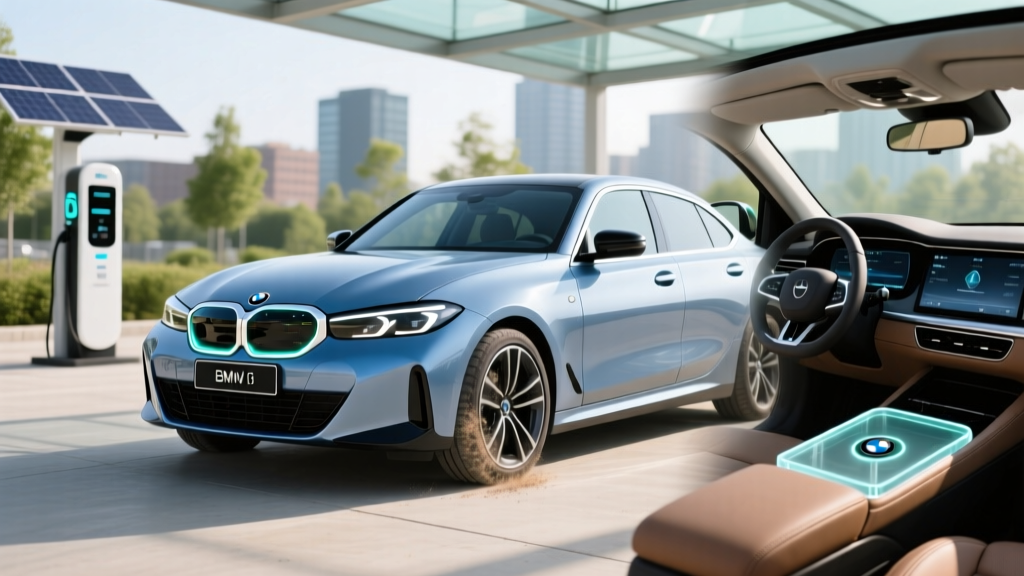
The i3's interior is where BMW's commitment to sustainability shines. The cabin uses renewable and recycled materials extensively — eucalyptus wood trim, recycled polyester upholstery, and natural fiber door panels create an ambiance that feels distinctly different from conventional luxury interiors.
| Dimension | Measurement |
|---|---|
| Front Legroom | 40.5 inches |
| Rear Legroom | 31.9 inches |
| Front Headroom | 39.6 inches |
| Cargo Volume (rear seats up) | 15.1 cu ft |
| Cargo Volume (rear seats folded) | 39.2 cu ft |
| Seating Capacity | 4 passengers |
The rear-hinged "coach doors" (suicide doors) give the i3 a unique entry experience and excellent access to the rear seats, though they require opening the front door first — a minor inconvenience in tight parking spaces. Rear legroom at 31.9 inches is tight for adults on longer trips but adequate for children or short commutes.
Cargo space at 15.1 cubic feet is competitive for the subcompact segment, roughly equivalent to a Honda Fit. Folding the rear seats opens up 39.2 cubic feet, sufficient for grocery hauls, luggage for two, or bulky items like a bicycle with the front wheel removed.
The i3 seats only four passengers — there is no middle rear seat. This is a hard constraint for families needing five-passenger capacity.
Pricing, Trims, and Federal Tax Credit Eligibility
The BMW i3 was discontinued after the 2021 model year in the United States. As of 2026, it is available exclusively on the used and certified pre-owned (CPO) market. Pricing reflects this reality:
| Category | Estimated Price Range |
|---|---|
| Original MSRP (2021 base) | $45,445 |
| Original MSRP (2021 i3s) | $48,895 |
| Used 2019–2021 i3 (2026 market) | $18,000–$28,000 |
| BMW CPO i3 (if available) | $24,000–$32,000 |
| Federal Used EV Tax Credit (§25E) | Up to $4,000 (30% of sale price, max $4,000) |
Federal Tax Credit Note: The i3 is no longer eligible for the new-vehicle §30D credit (up to $7,500) since it is no longer sold new. However, buyers may qualify for the IRS §25E Used Clean Vehicle Credit, which provides up to $4,000 (30% of the sale price, capped at $4,000) for qualifying used EVs. Eligibility requirements include:
- Sale price must be $25,000 or less
- Buyer income caps: $75,000 (single), $112,500 (head of household), $150,000 (joint)
- Vehicle must be at least 2 model years old
- Must be purchased from a licensed dealer (private-party sales excluded)
- Credit is non-refundable and can only be claimed once per vehicle (check VIN history)
A used 2020 i3 priced at $22,000 from a qualifying dealer could net a $4,000 credit for eligible buyers, bringing the effective cost to $18,000 — a compelling entry point into premium electric ownership.
Technology and Driver Assistance
The i3 features BMW's iDrive infotainment system with a 10.25-inch display, navigation, Apple CarPlay (wireless on later model years), and Bluetooth connectivity. The system is responsive and well-organized, though it lacks the large-screen drama of newer EV competitors.
Driver assistance features include:
- Active Driving Assistant (forward collision warning, automatic emergency braking, lane departure warning)
- Park Distance Control (front and rear parking sensors)
- Rear-view camera
- Adaptive cruise control (available on higher trims/packages)
These are SAE Level 1 driver-assistance features — they provide alerts and limited intervention but require full driver engagement at all times. The i3 does not offer Level 2 hands-free or semi-autonomous driving capabilities like Tesla Autopilot, GM Super Cruise, or Ford BlueCruise.
Pros, Cons, and Who Should Buy
Pros
- Unique, sustainable interior materials — no other EV in this class matches the i3's cabin ethos
- Lightweight CFRP construction delivers engaging, nimble handling
- Excellent city efficiency (113 MPGe combined)
- Tight turning radius (32.8 ft) ideal for urban parking
- Strong regenerative braking enables near one-pedal driving
- Low used-market pricing with potential $4,000 federal credit
- Distinctive design that still turns heads years after launch
Cons
- 153-mile EPA range limits road-trip practicality
- 50 kW DC fast-charge cap is slow by 2026 standards
- Only 4 seats — no 5-passenger option
- Rear coach doors impractical in tight parking spaces
- No Level 2 semi-autonomous driving features
- Narrow tires and FWD-biased weight distribution limit wet/snow traction
- Discontinued — no new-vehicle warranty or latest tech updates
Who the BMW i3 Suits Best
Choose the i3 if: You're an urban commuter with home charging access, your daily round trip is under 80 miles, you value distinctive design and sustainable materials, and you want an affordable entry into premium EV ownership via the used market.
Look elsewhere if: You need 200+ miles of range for regular road trips, you need 5-passenger seating, you want the latest ADAS technology, or you rely on public DC fast charging as your primary charging method.
Competitor Comparison
| Spec | BMW i3 (2021) | Chevy Bolt EV (2022) | Nissan Leaf (2022, 62 kWh) |
|---|---|---|---|
| EPA Range | 153 mi | 259 mi | 212 mi |
| Battery | 42.2 kWh (NMC) | 65 kWh (NMC) | 62 kWh (NMC) |
| DC Fast Charge | 50 kW (CCS) | 55 kW (CCS) | 100 kW (CHAdeMO) |
| 0–60 mph | 6.9 sec | 6.5 sec | 6.9 sec |
| Horsepower | 170 hp | 200 hp | 214 hp |
| Seats | 4 | 5 | 5 |
| Cargo (rear up) | 15.1 cu ft | 16.9 cu ft | 23.6 cu ft |
| Used Price (2026) | $18K–$28K | $16K–$24K | $14K–$22K |
The Chevrolet Bolt EV offers dramatically more range (259 miles EPA) and 5-passenger seating at similar or lower used prices, making it the pragmatic choice for most buyers. The Nissan Leaf provides solid range and the most cargo space, though its CHAdeMO connector is increasingly marginalized as CCS and NACS dominate North American charging networks.
The i3 wins on design uniqueness, material quality, urban maneuverability, and driving engagement. It's the choice for buyers who prioritize character and sustainability credentials over raw range and practicality metrics.
Frequently Asked Questions
What is the real-world range of the BMW i3?
In mixed driving conditions, expect 130–145 miles on a full charge. Highway driving at 70+ mph reduces this to 110–125 miles. In freezing weather, plan for 100–115 miles. The EPA rates the i3 at 153 miles, but real-world results depend heavily on speed, temperature, and terrain.
How fast does the BMW i3 charge?
On a DC fast charger, the i3 peaks at 50 kW, taking approximately 45 minutes to charge from 10–80%. At home on a Level 2 charger (7.4 kW / 32A), a full charge takes about 5 hours. Level 1 (standard 120V outlet) adds roughly 3–4 miles per hour — suitable only for emergency top-ups or very low daily mileage.
Does the BMW i3 qualify for the federal EV tax credit?
The i3 is no longer sold new, so it does not qualify for the §30D new-vehicle credit. However, it may qualify for the §25E used EV credit of up to $4,000, provided the sale price is $25,000 or less, the buyer meets income caps, and the vehicle is purchased from a licensed dealer. Always verify eligibility with a tax professional before purchase.
Is the BMW i3 worth buying in 2026?
For the right buyer — an urban commuter with home charging and sub-80-mile daily needs — the i3 is a compelling, affordable premium EV on the used market. Its sustainable materials, engaging driving dynamics, and potential $4,000 tax credit make it a strong value. However, buyers needing more range, 5 seats, or faster DC charging should consider the Chevrolet Bolt EV or Nissan Leaf instead.
What is the BMW i3's battery warranty?
BMW covers the i3's high-voltage battery for 8 years or 100,000 miles (whichever comes first) against defects and excessive capacity loss (below 70% of original capacity). For a 2021 model purchased in 2026, approximately 3 years / 50,000+ miles of factory battery warranty may remain. BMW CPO vehicles may carry extended coverage.
Can the BMW i3 use Tesla Superchargers?
The i3 uses the CCS Combo connector standard. As of 2026, Tesla has opened a limited number of Supercharger stations to non-Tesla EVs via the Magic Dock adapter, but availability remains sparse. The i3 cannot natively use NACS (Tesla's proprietary connector) without an adapter, and its 50 kW charge cap means even compatible Superchargers won't deliver meaningful speed advantages.
Sources: EPA Fuel Economy, IRS Used Clean Vehicle Credit, BMW USA specifications archive.