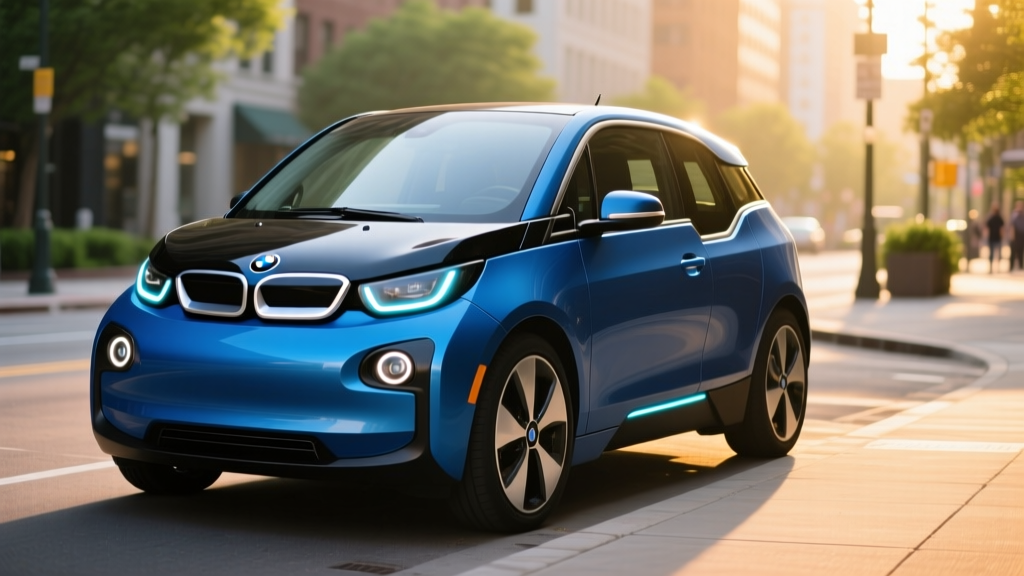
The BMW i3 s occupies a strange space in electric-vehicle history: a carbon-fiber urban runabout that was equal parts engineering showcase and design provocation. BMW discontinued the i3 line after the 2021 model year in the United States, but thousands remain on the used-EV market, and their distinctive character keeps them relevant for a specific kind of buyer. If you're researching the BMW i3 s as a potential used purchase, this review covers every number that matters — range, charging speed, ownership cost, and whether the §30D used-EV tax credit applies.
Quick Verdict: Who Should Consider a Used BMW i3 s?
The i3 s is not a family hauler, a road-trip champion, or a tech-tour de force by 2026 standards. It's a lightweight, rear-wheel-drive city car with a 42.2 kWh battery, an EPA range of 153 miles, and a personality no current EV replicates. The carbon-fiber-reinforced plastic (CFRP) passenger cell, suicide doors, and sustainably sourced interior materials make it a conversation piece that happens to be genuinely efficient. Buy one if you need a dedicated commuter with a short daily drive, can charge at home, and value driving dynamics over range. Skip it if you regularly exceed 120 miles round-trip, need back-seat practicality, or expect modern ADAS.
Choose the BMW i3 s if:
- Your daily round-trip commute is under 80 miles
- You have reliable home Level 2 charging
- You want a lightweight, agile city car with premium build quality
- You qualify for the up-to-$4,000 used-EV tax credit (IRS §25E)
Look elsewhere if:
- You need 200+ miles of range or frequent highway road trips
- You regularly carry rear-seat passengers or bulky cargo
- DC fast charging speed is a priority
- You want current-generation driver-assistance features
Range, Battery, and Real-World Efficiency
| Spec | Value |
|---|---|
| EPA Range | 153 miles |
| Battery Capacity (Usable) | 42.2 kWh (NMC lithium-ion) |
| Motor / Drivetrain | Single rear motor, RWD |
| Horsepower / Torque | 184 HP / 199 lb-ft |
| 0–60 mph | 6.9 seconds |
| EPA Efficiency | 111 MPGe combined (30 kWh/100 mi) |
| Max DC Fast Charge | 50 kW (CCS) |
| Level 2 Charge Rate | 7.4 kW (~25 mi/hr) |
| Cargo Volume (rear seats up / folded) | 15.1 / 36.0 cu ft |
| Curb Weight | ~2,976 lbs |
| Battery Warranty (original) | 8 years / 100,000 miles (≥70% capacity) |
The 42.2 kWh battery pack uses Samsung SDI NMC (nickel-manganese-cobalt) cells arranged in eight modules. BMW's thermal management system uses a combination of liquid cooling and refrigerant-based heating to keep the pack in its optimal temperature window. This was advanced for its era, though it lacks the sophisticated heat-pump systems found in 2024+ EVs like the Hyundai Ioniq 5 or Tesla Model Y.
EPA Sticker: 153 miles
Real-World Expectation:
- City / mild weather (65–75°F): 145–160 miles — the i3 s excels in stop-and-go driving thanks to aggressive regenerative braking and low curb weight.
- Highway (70–75 mph, mild weather): 115–130 miles — the narrow, tall tires and boxy profile create more aero drag than expected for a small car.
- Cold weather (20–35°F, no preconditioning): 95–115 miles — NMC chemistry loses 25–35% range in freezing temps without active battery warming. Preconditioning while plugged in recovers roughly 10–15 miles.
The i3 s's efficiency of 30 kWh/100 mi (111 MPGe combined per fueleconomy.gov) remains competitive with modern EVs. For context, the 2025 Chevrolet Equinox EV achieves 115 MPGe combined — the i3 s's lightweight construction offsets its older powertrain.
Charging Speed: DC Fast and Home Level 2
| Charging Level | Power / Rate | Time or Miles Added |
|---|---|---|
| Level 1 (120V household) | ~1.4 kW | ~5 miles per hour |
| Level 2 (240V, 32A) | 7.4 kW | ~25 miles per hour; 0–100% in ~6.5 hours |
| DC Fast Charge (CCS) | 50 kW peak | 10–80% in ~38 minutes |
The 50 kW DC fast-charging cap is the i3 s's most significant limitation by 2026 standards. Modern competitors routinely accept 150–350 kW. At a CCS-equipped station (Electrify America, EVgo, or ChargePoint DC), the i3 s will peak near 47–50 kW up to approximately 50% state of charge, then taper to roughly 30 kW through 80%, and drop further to under 15 kW above 80%. This charge curve means the 10–80% session takes about 38 minutes — functional for a lunch stop but noticeably slower than current EVs.
For daily use, home Level 2 charging is where the i3 s shines adequately. A 7.4 kW Level 2 charger (such as a ChargePoint Home Flex or Emporia Vue set to 32 amps) replenishes the 42.2 kWh pack from near-empty in about 6.5 hours. Since most owners drive 30–50 miles daily, an overnight charge easily restores full capacity. Installation of a 240V/40A circuit typically costs $500–$1,500 depending on panel proximity and local permitting — budget for a licensed electrician to assess your panel's available amperage before purchasing.
Connector note: The i3 s uses CCS1 for DC fast charging and J1772 for Level 1/2 AC charging. With the industry's shift to NACS (Tesla's connector), adapters are available but not necessary for this vehicle since public CCS infrastructure remains widespread through 2026.
Performance and Driving Dynamics
The "s" in i3 s stands for sport — and the upgrades over the standard i3 are meaningful. The electric motor produces 184 horsepower and 199 lb-ft of torque (vs. 170 HP / 184 lb-ft in the base i3). BMW also fitted wider 175/55R20 front and 195/50R20 rear tires (the standard i3 uses ultra-narrow 155/70R19s), a sport-tuned suspension with a 10 mm lower ride height, and a wider track. The result is a 0–60 mph time of 6.9 seconds — brisk for a sub-3,000-pound city car.
The driving experience is the i3 s's secret weapon. The CFRP chassis is exceptionally rigid, the center of gravity is low (battery pack under the floor), and the steering is quick with a tight 32.3-foot turning circle. On twisty urban roads, the i3 s feels more like a hot hatch than an efficiency-focused EV. The single-pedal driving mode is among the most aggressive in the industry — lift off the accelerator and the car decelerates at roughly 0.20g, enough to bring it to a complete stop without touching the brake pedal in most city driving.
Limitations are real: the narrow tires struggle for grip in heavy rain, the tall body generates noticeable crosswind sensitivity at highway speeds, and the 2,976-pound curb weight — light for an EV — still means the suspension transmits sharp impacts from potholes. There is no all-wheel-drive option, no towing capacity, and no frunk (the front compartment houses the motor and power electronics).
Interior, Cargo, and Technology
The i3's interior was radical in 2014 and still looks distinctive. BMW used eucalyptus wood trim, recycled PET plastic textiles, and kenaf (a plant fiber) door panels. The dashboard layout is clean, with a freestanding 10.25-inch infotainment display running BMW's iDrive 6.0 system. Apple CarPlay is supported (wireless on later models); Android Auto was not offered on the i3 in the US market.
Passenger and cargo dimensions:
- Front legroom: 40.5 inches — generous for the vehicle's footprint
- Rear legroom: 31.9 inches — tight for adults on anything beyond short trips
- Cargo (rear seats up): 15.1 cu ft — comparable to a subcompact hatchback
- Cargo (rear seats folded): 36.0 cu ft — useful for a Costco run, not for furniture
- Rear door access: Rear-hinged "coach doors" require the front door open first — awkward in tight parking spots
Driver-assistance technology is basic by 2026 standards: forward collision warning with automatic emergency braking, lane-departure warning, and adaptive cruise control were available. There is no lane-centering assist, no blind-spot monitoring on early models, and no hands-free driving system. The i3 s is firmly an SAE Level 1 vehicle — the driver is always fully responsible.
The optional Range Extender (REx) model added a 647cc two-cylinder BMW motorcycle engine that acted as a generator, adding roughly 60–70 miles of extended range once the battery depleted to ~5% SoC. However, the REx adds weight, complexity, and requires gasoline — and it disqualified the vehicle from some state HOV-lane and incentive programs. Most used i3 s models on the market are the pure BEV variant.
Pricing and Used-EV Tax Credit Eligibility
When new, the 2021 BMW i3 s started at an MSRP of approximately $47,650 (before destination). A well-equipped example with the Technology + Driving Assistance Package and Premium Package reached the mid-$50,000s. As of early 2026, used i3 s models typically list between $18,000 and $28,000 depending on mileage, condition, and battery state of health.
| Item | Amount |
|---|---|
| Used i3 s (typical, ~40,000 mi) | $20,000–$25,000 |
| Federal Used Clean Vehicle Credit (§25E, up to $4,000 or 30% of sale price, whichever is less) | –$4,000 (if eligible) |
| Home Level 2 charger + installation | $500–$1,500 |
| Estimated out-of-pocket (after credit, before state incentives) | $16,500–$22,500 |
Federal used-EV tax credit (§25E): The i3 s can qualify for up to $4,000 — but eligibility has specific requirements that buyers must verify before purchase. Per IRS guidelines:
- Sale price cap: The vehicle must sell for $25,000 or less. Many i3 s examples exceed this — negotiate or search carefully.
- Buyer income limits (modified AGI): $75,000 single / $112,500 head of household / $150,000 joint filers.
- Vehicle age: Must be at least two model years old (all i3 models qualify).
- Dealer requirement: Must be purchased from a licensed dealer (private-party sales do not qualify).
- Transfer election: The credit can be transferred to the dealer at point of sale as a price reduction, or claimed on your tax return.
- Battery capacity: Must have at least 7 kWh (the i3 s's 42.2 kWh qualifies).
- One-time use per buyer: You can only claim the used-EV credit once every three years.
Important: The original new-vehicle §30D credit no longer applies since the i3 is discontinued and no longer sold new. Tax rules can change — consult a tax professional and verify current IRS guidance before finalizing a purchase.
Battery Longevity, Warranty, and Replacement
The i3 s's 42.2 kWh NMC pack was engineered for longevity. BMW's original battery warranty guaranteed at least 70% capacity retention over 8 years or 100,000 miles. Real-world data from i3 owner communities and fleet operators suggests most 42.2 kWh packs retain 85–92% state of health (SoH) at 60,000–80,000 miles when charged primarily on Level 2 and not repeatedly DC fast-charged to 100%.
The i3's battery is modular — it contains eight individual modules that can be replaced individually rather than swapping the entire pack. Independent BMW specialists report single-module replacement costs of $1,500–$3,000 per module (parts and labor), making targeted repair significantly cheaper than a full pack swap. A complete replacement pack, should it ever be necessary, runs $12,000–$18,000 installed at a dealership — though this scenario is rare for packs under 100,000 miles.
Pre-purchase tip: Request a battery health report from any used i3 s you're considering. BMW dealerships can run a diagnostic that shows each module's voltage deviation and overall SoH percentage. A pack showing under 80% SoH or significant module imbalance is a negotiation point or a walk-away signal.
Pros and Cons
Pros
- Lightweight CFRP construction delivers agile, engaging handling unlike any other EV in its price range
- Exceptional city efficiency — 111 MPGe combined, 30 kWh/100 mi
- Strong regenerative braking enables true one-pedal driving
- Premium, sustainable interior materials that age well
- Tight turning circle (32.3 ft) makes parking effortless
- Modular battery design allows cheaper targeted repairs
- Eligible for up to $4,000 federal used-EV credit
Cons
- 153-mile EPA range limits highway and road-trip utility
- 50 kW DC fast-charging is slow by 2026 standards (~38 min 10–80%)
- Rear coach doors are impractical in tight parking spaces
- Minimal driver-assistance tech — no lane-centering, no blind-spot monitoring on most examples
- Narrow tires compromise wet-weather grip
- No Android Auto support
- Discontinued — no new-vehicle warranty, limited dealer support network
Frequently Asked Questions
What is the real-world range of the BMW i3 s?
The EPA rates the i3 s at 153 miles. In real-world city driving at moderate temperatures, expect 145–160 miles. Highway driving at 70+ mph drops that to 115–130 miles, and freezing winter conditions without preconditioning can reduce range to 95–115 miles. The i3 s is best suited for daily commutes under 80 miles round-trip where you can charge at home overnight.
How fast does the BMW i3 s charge?
On a DC fast charger, the i3 s peaks at 50 kW and takes approximately 38 minutes to charge from 10% to 80% state of charge. At home on a 240V Level 2 charger (7.4 kW), a full charge takes about 6.5 hours, adding roughly 25 miles of range per hour. Level 1 (120V) charging is very slow at about 5 miles per hour and is only practical as a backup.
Does the BMW i3 s qualify for a federal tax credit?
The i3 s is no longer sold new, so the §30D new-vehicle credit does not apply. However, it can qualify for the §25E used clean vehicle credit — up to $4,000 or 30% of the sale price (whichever is less). The vehicle must sell for $25,000 or less, be purchased from a licensed dealer, and the buyer must meet income caps ($75K single / $150K joint). Verify current IRS rules before purchasing.
Is the BMW i3 s worth buying vs. competitors?
Against a used Chevrolet Bolt EV (239-mile EPA range, faster DC charging, more cargo space), the i3 s trades practicality for character. The Bolt is the rational choice for most buyers. But the i3 s offers superior build quality, lighter weight, more engaging handling, and a genuinely unique ownership experience. If range and charging speed are your top priorities, the Bolt wins. If you want a premium urban runabout and your commute is short, the i3 s is compelling — especially after the $4,000 used-EV credit.
How long will the BMW i3 s battery last?
Real-world data shows most 42.2 kWh i3 packs retain 85–92% capacity at 60,000–80,000 miles with proper care (primarily Level 2 charging, avoiding frequent 100% SoC storage). BMW's original warranty guaranteed ≥70% capacity at 8 years/100,000 miles. The modular design means individual degraded modules can be replaced for $1,500–$3,000 each rather than replacing the entire $12,000–$18,000 pack.
Can I use the BMW i3 s for road trips?
You can, but it requires planning. With 153 miles of EPA range and 50 kW DC charging, expect to stop every 90–110 highway miles for a 35–40-minute charge session. Apps like PlugShare and A Better Routeplanner are essential. For frequent road-trippers, the i3 s is not the right tool — consider a used Tesla Model 3, Hyundai Kona Electric, or Chevrolet Bolt EUV instead.