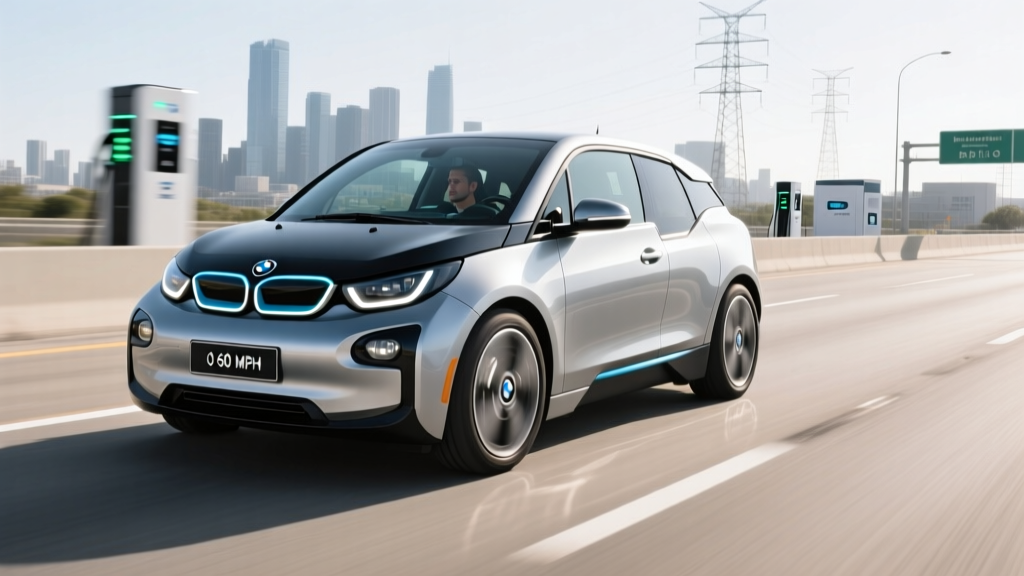
The BMW i3 was never designed to win drag races or cross continents on a single charge. Launched in 2014 and discontinued after the 2021 model year, it was BMW's first mass-production battery electric vehicle — a carbon-fiber-reinforced plastic (CFRP) city car with a radical design and an unapologetically urban mission. In 2026, the i3 exists exclusively on the used market, where it has become one of the most affordable entry points into premium EV ownership. But for buyers researching the BMW i3 0-60 mph time and overall performance, the question is whether this pioneer still holds up against modern alternatives.
This review focuses on the final-generation i3 (2019–2021) equipped with the 42.2 kWh battery pack, which represents the most capable and widely available version on the used market today. We'll break down its acceleration, real-world range, charging behavior, and ownership economics with the precision you need to make an informed purchase.
BMW i3 0-60 MPH and Performance Specs
The 2019–2021 BMW i3 (BEV, no range extender) produces 170 horsepower and 184 lb-ft of torque from a single rear-mounted electric motor driving the rear wheels. BMW officially rated the i3 0-60 mph time at 6.9 seconds, and independent testing by outlets like Car and Driver confirmed figures in the 6.8–7.0 second range.
That acceleration figure tells only part of the story. The i3's electric motor delivers peak torque from 0 RPM, which gives it an immediate, punchy feel in city driving that belies the 6.9-second 0-60 time. At stoplights and in urban merging scenarios, the i3 feels quicker than its numbers suggest. Where it falls behind modern EVs is highway passing acceleration — above 50 mph, the single-speed transmission and modest power output mean the i3 runs out of breath faster than a Tesla Model 3 or Chevrolet Bolt EUV.
| Spec | Value |
|---|---|
| 0-60 mph | 6.9 seconds |
| Horsepower | 170 hp |
| Torque | 184 lb-ft |
| Drivetrain | Rear-wheel drive (single motor) |
| Top Speed | 93 mph (electronically limited) |
| Curb Weight | ~2,976 lbs |
| 0-30 mph (est.) | ~2.8 seconds |
The i3s variant — available alongside the standard i3 from 2018 onward — bumps output to 184 hp and 199 lb-ft, lowering the 0-60 mph time to approximately 6.2 seconds. It also adds a sport suspension, wider tires, and a slightly lower ride height. If acceleration matters to you, the i3s is the trim to target on the used market, though it commands a $2,000–$4,000 premium.
EPA Range and Real-World Driving Expectations
The 2019–2021 BMW i3 with the 42.2 kWh battery pack carries an EPA-estimated range of 153 miles. The i3s, due to its wider tires and sport tuning, drops slightly to 153 miles EPA as well (BMW rated both identically, though real-world results favor the standard i3 marginally).
EPA Estimate: 153 miles
Real-world highway (70 mph, moderate temps): ~120–135 miles
Real-world city/mixed driving: ~135–150 miles
Cold weather (below 32°F, highway): ~95–115 miles
The i3's tall, narrow tires (155/70R19) minimize rolling resistance in city driving but limit highway efficiency. Expect 20–25% range reduction at sustained highway speeds and up to 35% loss in freezing temperatures without preconditioning. The i3 does include a battery preconditioning function when a charging station is set as the navigation destination.
According to fueleconomy.gov, the 2021 BMW i3 achieves 113 MPGe combined (120 city / 106 highway), translating to approximately 30 kWh per 100 miles. That efficiency figure is respectable but not class-leading — the Hyundai Kona Electric achieves 120 MPGe combined, and the Tesla Model 3 Standard Range hits 132 MPGe.
The i3's relatively small battery (42.2 kWh gross, approximately 37.9 kWh usable) is the limiting factor. BMW designed this car for urban commuting, not road trips. If your daily round-trip commute is under 80 miles and you have home charging, the i3's range is more than adequate. If you regularly drive 100+ miles or need highway range flexibility, this is not the right EV for you.
Battery Chemistry, Capacity, and Longevity
The final-generation i3 uses a 42.2 kWh (gross) Samsung SDI lithium-ion NMC (nickel manganese cobalt) battery pack. The usable capacity is approximately 37.9 kWh, with the battery management system reserving a buffer to protect against over-discharge and extend longevity.
BMW warranties the i3 battery for 8 years or 100,000 miles (whichever comes first) against defects and excessive capacity loss. BMW defines "excessive" as dropping below 70% of original capacity. For a 2021 model, that warranty extends through the 2029 model year or 100,000 miles.
| Parameter | Detail |
|---|---|
| Gross Capacity | 42.2 kWh |
| Usable Capacity | ~37.9 kWh |
| Chemistry | NMC (Samsung SDI cells) |
| Thermal Management | Active liquid cooling/heating |
| Battery Warranty | 8 years / 100,000 miles (70% capacity retention) |
| Real-World Degradation (5 yr est.) | ~8–12% capacity loss |
Real-world degradation data from i3 owner communities and fleet studies suggests the Samsung SDI NMC cells hold up well. Most 2017–2018 i3s (the 33 kWh generation) report 85–92% state of health (SoH) after 5–6 years and 50,000–70,000 miles. The 42.2 kWh pack in the 2019–2021 models benefits from improved cell chemistry and thermal management, so similar or better retention is expected.
One important note: the i3's battery is not a structural pack like modern skateboard-platform EVs. It's mounted under the floor in an aluminum enclosure, and individual module replacement is possible but rarely performed outside warranty. Full pack replacement cost, if needed out of warranty, has been reported in the $12,000–$16,000 range through BMW dealerships — a figure that can exceed the vehicle's current market value.
Charging Speed: DC Fast Charging and Home Level 2
Charging is where the i3 shows its age most clearly. In an era of 250 kW and 350 kW DC fast-charging EVs, the i3's peak charge rate of 50 kW is modest. Here's what that means in practice:
| Charging Level | Power / Rate | Time / Range Added |
|---|---|---|
| Level 1 (120V household) | ~1.4 kW | ~5 miles per hour of charging |
| Level 2 (240V, 32A) | 7.4 kW | ~25 miles per hour; full charge in ~5.5 hours |
| DC Fast Charge (CCS) | 50 kW peak | 10–80% in ~42 minutes |
The i3's DC fast-charging curve is relatively flat compared to modern EVs. It sustains close to 45–50 kW from roughly 10% to 60% state of charge, then tapers to 30–35 kW through 80%, and drops further above 80%. The 10–80% charge takes approximately 42 minutes at a 50 kW CCS charger — roughly double the time of a Hyundai Ioniq 5 or Tesla Model 3 at their respective Supercharger/DC networks.
The i3 uses the CCS1 (Combined Charging System) connector for DC fast charging and a J1772 inlet for Level 1 and Level 2 AC charging. In 2026, CCS1 remains widely supported across Electrify America, EVgo, and ChargePoint networks, though the industry is shifting toward NACS (Tesla's connector). CCS adapters for NACS-equipped Tesla Superchargers are available but add a step.
For home charging, the i3's onboard charger accepts up to 7.4 kW on a 240V Level 2 circuit (32 amps). A standard 40-amp Level 2 home charger (like a ChargePoint Home Flex or Emporia Level 2) will fully replenish the i3's battery from empty in about 5.5 hours — easily overnight. This is where the i3 excels: its small battery means even modest home charging infrastructure is more than sufficient.
Interior, Cargo Space, and Daily Practicality
The i3's interior is one of its most distinctive features — and one of its most divisive. BMW used sustainable materials extensively: the dashboard incorporates eucalyptus wood trim, recycled plastic fibers, and natural wool-blend upholstery in higher trims. The result is an airy, modernist cabin that feels nothing like a conventional BMW.
Practicality, however, is constrained by the i3's compact footprint:
| Dimension | Measurement |
|---|---|
| Front Headroom | 39.6 inches |
| Front Legroom | 40.5 inches |
| Rear Headroom | 37.2 inches |
| Rear Legroom | 31.9 inches |
| Cargo Volume (rear seats up) | 15.1 cu ft |
| Cargo Volume (rear seats folded) | 39.2 cu ft |
| Seating Capacity | 4 passengers |
| Rear Door Type | Reverse-hinged "coach doors" (suicide doors) |
The rear seats are best suited for children or occasional adult passengers on short trips — the 31.9 inches of rear legroom is tight by any standard. The coach doors (rear-hinged back doors) require the front doors to be opened first, which is quirky but functional in parking lots. Cargo space at 15.1 cu ft is comparable to a subcompact hatchback; folding the rear seats opens up 39.2 cu ft, enough for a week's groceries or a couple of suitcases.
Technology in the 2019–2021 i3 centers on BMW's iDrive 6.0 infotainment system displayed on a 10.25-inch screen. Wireless Apple CarPlay was added for the 2019 model year, but Android Auto was never offered — a notable omission. The i3 includes a basic suite of driver-assistance features (parking sensors, rear camera, available adaptive cruise control), but it lacks the sophisticated ADAS suites found in modern EVs. There is no semi-autonomous lane-centering system; the i3's driver assists are strictly SAE Level 1.
Pricing, Used Market Value, and Tax Credit Eligibility
Because BMW discontinued the i3 after the 2021 model year, no new i3 is available in 2026. All purchases are through the used market, where prices have settled into an accessible range:
| Model Year / Trim | Typical Used Price Range |
|---|---|
| 2019 BMW i3 (42.2 kWh) | $16,000–$21,000 |
| 2019 BMW i3s (42.2 kWh) | $18,000–$23,000 |
| 2020 BMW i3 (42.2 kWh) | $18,000–$23,000 |
| 2020 BMW i3s (42.2 kWh) | $20,000–$25,000 |
| 2021 BMW i3 (42.2 kWh) | $20,000–$26,000 |
| 2021 BMW i3s (42.2 kWh) | $22,000–$28,000 |
For comparison, the i3's original MSRP ranged from approximately $44,450 (2019 base i3) to $52,000+ (2021 i3s with options). Depreciation has been steep — typical for early-generation EVs — making the i3 a compelling used value.
Under the current IRS §25E used clean vehicle credit, buyers may qualify for up to $4,000 or 30% of the sale price (whichever is less) on a used i3 purchased from a licensed dealer. Key requirements:
- Sale price must be $25,000 or less
- Buyer income caps: $75,000 single / $112,500 head of household / $150,000 joint (modified AGI)
- Vehicle must be at least 2 model years old (all i3s qualify)
- Must purchase from a licensed dealer (private-party sales excluded)
- Credit is non-refundable; point-of-sale transfer available through registered dealers
A $20,000 used i3 could yield a $4,000 credit (30% of $20,000 = $6,000, capped at $4,000), bringing the effective cost to $16,000. A $24,000 i3s would yield $4,000 (capped at the $25,000 sale-price threshold for maximum benefit). Always verify current-year rules with a tax professional, as credit parameters may shift.
How the BMW i3 Compares to Key Used EV Alternatives
The i3 occupies a specific niche: premium-badge city EV at a bargain used price. Here's how it stacks up against other used EVs in a similar price bracket:
| Model (Year Range) | EPA Range | 0-60 mph | DC Fast Charge | Used Price (2026) |
|---|---|---|---|---|
| BMW i3 (2019–2021) | 153 mi | 6.9s | 50 kW / ~42 min | $16K–$28K |
| Chevrolet Bolt EV (2020–2022) | 259 mi | 6.5s | 55 kW / ~55 min | $14K–$22K |
| Nissan LEAF SV+ (2019–2022) | 226 mi | 6.9s | 100 kW / ~45 min | $13K–$21K |
| Hyundai Kona Electric (2019–2021) | 258 mi | 6.4s | 75 kW / ~47 min | $17K–$24K |
| Tesla Model 3 SR+ (2019–2020) | 250 mi | 5.3s | 170 kW / ~30 min | $20K–$27K |
The i3's range and charging speed are the weakest in this group. The Chevrolet Bolt EV offers 106 more miles of EPA range for comparable or lower money. The Tesla Model 3 crushes the i3 on both performance and charging infrastructure access. The Kona Electric is the balanced all-rounder.
Where the i3 wins: build quality (the carbon-fiber passenger cell is genuinely premium), interior material uniqueness, turning radius (32.3 feet — exceptional for city parking), and the intangible appeal of its avant-garde design. If you value driving character and urban maneuverability over range and charging speed, the i3 has no direct rival.
Pros, Cons, and Who Should Buy the BMW i3
- Instant torque makes city driving lively (0-30 mph in ~2.8s)
- Carbon-fiber construction keeps weight under 3,000 lbs
- Tight 32.3-ft turning radius — best-in-class for urban parking
- Premium, sustainable interior materials unlike any competitor
- Small battery charges fully overnight on basic Level 2
- Strong depreciation = excellent used value
- Eligible for up to $4,000 used EV tax credit (§25E)
- Distinctive design turns heads even a decade after launch
- 153-mile EPA range is the lowest in its price bracket
- 50 kW DC fast charging is painfully slow by 2026 standards
- Rear seats are cramped; only 4-passenger capacity
- No Android Auto support
- Driver assists limited to SAE Level 1 (no lane centering)
- Narrow 155-section tires limit wet-weather grip
- Out-of-warranty battery replacement could total the car
- Discontinued — no dealer support for new parts/software updates
Buy it if: You're a city commuter with reliable home charging, a sub-80-mile daily round trip, and you value premium build quality and distinctive design over range and tech. It's an excellent second car, a compelling first EV for budget-conscious buyers, and a genuinely fun urban runabout.
Skip it if: You need road-trip capability, live in a cold climate without garage parking, regularly carry rear-seat passengers, or want modern ADAS features and fast DC charging. The Bolt EV, Kona Electric, or a used Model 3 will serve those needs far better.
Frequently Asked Questions
What is the real-world range of the BMW i3?
The 2019–2021 BMW i3 has an EPA-estimated range of 153 miles. In real-world mixed driving, expect 135–150 miles. At highway speeds (70+ mph), plan for 120–135 miles. In freezing weather with highway driving, range can drop to 95–115 miles without preconditioning.
How fast does the BMW i3 charge at home and on DC fast chargers?
On a 240V Level 2 home charger (7.4 kW), the i3 charges from empty to full in approximately 5.5 hours, adding about 25 miles of range per hour. On a 50 kW DC fast charger, the 10–80% charge takes about 42 minutes. The i3 does not support charging above 50 kW DC.
Does the used BMW i3 qualify for any federal tax credit?
Yes — under IRS §25E, a used i3 purchased from a licensed dealer for $25,000 or less may qualify for up to $4,000 (30% of sale price, capped at $4,000). Income caps apply ($75K single / $150K joint). The credit can be transferred at the point of sale to reduce the purchase price directly. Consult a tax professional for your specific situation.
Is the BMW i3 worth buying in 2026 versus a Chevrolet Bolt or Tesla Model 3?
It depends on your priorities. If range and charging speed matter most, the Bolt EV (259 miles EPA, similar price) or Model 3 (250+ miles, Supercharger access) are objectively better choices. The i3 is worth buying if you prioritize urban maneuverability, premium interior quality, distinctive design, and the lowest possible used price for a badge-premium EV. It's a superb city car but a compromised road-trip vehicle.
How long will the BMW i3 battery last?
BMW warranties the i3 battery for 8 years/100,000 miles against dropping below 70% capacity. Real-world data from earlier i3 generations suggests 85–92% state of health after 5–6 years. A 2021 i3's battery warranty extends through 2029. With proper care (avoiding prolonged 100% or 0% states of charge, using preconditioning in cold weather), the pack should remain functional well beyond 100,000 miles, albeit with gradual range reduction.
What is the BMW i3's 0-60 mph time compared to other EVs?
The standard i3 (170 hp) hits 0-60 mph in 6.9 seconds; the i3s (184 hp) does it in approximately 6.2 seconds. That's competitive with the Nissan LEAF and Chevrolet Bolt but significantly slower than the Tesla Model 3 (5.3s for SR+) and Hyundai Kona Electric (6.4s). In city driving below 40 mph, the i3's instant torque makes it feel quicker than these numbers suggest.