Quick Verdict: Is BMW Leading the EV Industry?
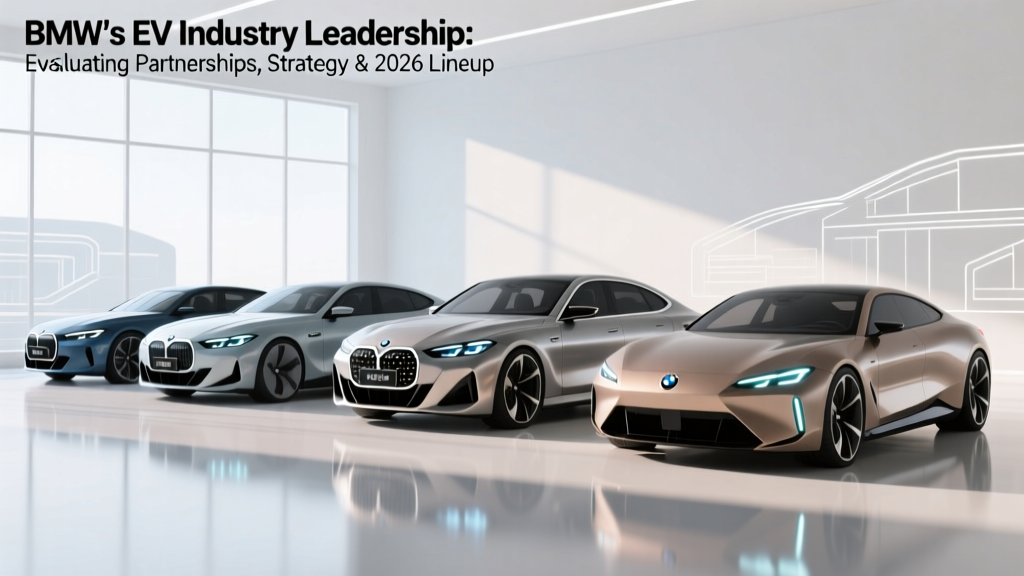
BMW's EV leadership in 2026 is real but unconventional. Rather than building a dedicated EV-only platform until now, BMW pursued a flexible-architecture strategy — sharing production lines between ICE, PHEV, and BEV models — while forging critical partnerships with Toyota (fuel cells), Amazon AWS (digital supply chain), Northvolt (battery cells), and Mercedes-Benz (high-power charging via IONITY). The upcoming Neue Klasse platform (debuting in the 2026 iX3) represents BMW's pivot to a dedicated EV architecture with 800V capability, 30% more range, and 30% faster charging. Whether this constitutes "leadership" depends on your metric: BMW ranks among the top 3 global premium EV sellers by volume, but trails Tesla and Hyundai/Kia in charging speed and software innovation.
BMW's EV Strategy: From Flexible Platforms to Neue Klasse
For years, BMW's approach drew criticism from EV purists. The automaker used its CLAR (Cluster Architecture) platform to underpin both combustion and electric models — the i4 shares bones with the 4 Series Gran Coupe, and the iX was built on a modified CLAR variant. Critics called it a half-measure. The sales data told a different story: BMW delivered over 375,000 fully electric vehicles globally in 2024, making it one of the top premium BEV manufacturers worldwide.
The flexible strategy gave BMW an advantage competitors lacked: the ability to scale EV production up or down based on regional demand without retooling entire factories. As EV adoption rates fluctuated through 2024-2025, this flexibility proved prescient.
Now, BMW is transitioning to its Neue Klasse architecture — a dedicated EV platform featuring:
- 800-volt electrical system (enabling faster DC charging)
- Gen6 eDrive motors with up to 30% efficiency improvement
- Cylindrical battery cells (similar to Tesla's 4680 format) replacing prismatic cells
- Up to 30% more energy density in a given pack volume
- Panoramic Vision HUD spanning the full windshield width
The first Neue Klasse vehicle — the next-generation iX3 — is expected to reach US dealerships for the 2027 model year, with the i3 sedan following shortly after.
Key Automotive Partnerships Driving BMW's EV Position
To evaluate BMW's EV industry leadership, you must examine the partnerships that extend its reach beyond what it could achieve alone. Here are the most consequential:
Toyota — Hydrogen Fuel Cell Collaboration
BMW and Toyota have collaborated on fuel cell technology since 2013. The 2026 BMW iX5 Hydrogen pilot fleet uses Toyota-sourced fuel cell stacks. While hydrogen infrastructure remains extremely limited in the US (fewer than 60 public stations, nearly all in California), this partnership positions BMW for heavy-duty and long-range applications where battery weight becomes prohibitive.
Northvolt — European Battery Cell Supply
BMW invested heavily in Swedish battery maker Northvolt, securing cell supply for European-built models. Northvolt's cells use NMC (nickel-manganese-cobalt) chemistry optimized for energy density. However, Northvolt's production ramp-up challenges through 2024-2025 forced BMW to diversify, also sourcing from CATL and Samsung SDI.
IONITY / Mercedes-Benz — High-Power Charging Network
BMW co-founded IONITY alongside Mercedes-Benz, Ford, and the Volkswagen Group. IONITY operates over 600 high-power charging stations across Europe, with chargers capable of up to 350 kW. In the US, BMW owners primarily rely on Electrify America and the growing Tesla Supercharger network (via NACS adapters for BMW models equipped with CCS1 ports).
Amazon AWS — Supply Chain & Digital Twin
BMW partnered with AWS to build a digital twin of its entire production network, enabling real-time optimization of EV manufacturing. This partnership reduces production bottlenecks and improves quality control — a behind-the-scenes advantage that translates to better build consistency and delivery timelines.
Qualcomm — Next-Gen ADAS & Infotainment
BMW's upcoming Neue Klasse vehicles will use Qualcomm's Snapdragon Ride Flex SoC, consolidating infotainment and advanced driver-assistance onto a single chip. This reduces wiring complexity, cuts weight, and enables over-the-air feature updates.
2026 BMW EV Lineup: Specs, Range & Charging Data
| Model | Battery (kWh usable) | Chemistry | EPA Range | Peak DC Charge | 10-80% Time | 0-60 mph | Base MSRP |
|---|---|---|---|---|---|---|---|
| i4 eDrive40 | 81.5 | NMC | 307 mi | 205 kW | ~31 min | 5.5 sec | $57,900 |
| i4 M50 | 81.5 | NMC | 271 mi | 205 kW | ~31 min | 3.7 sec | $70,700 |
| i5 eDrive40 | 84.3 | NMC | 295 mi | 205 kW | ~30 min | 5.7 sec | $67,900 |
| i5 M60 | 84.3 | NMC | 256 mi | 205 kW | ~30 min | 3.7 sec | $85,100 |
| i7 eDrive50 | 105.7 | NMC | 318 mi | 195 kW | ~34 min | 4.5 sec | $106,700 |
| iX xDrive50 | 111.5 | NMC | 324 mi | 195 kW | ~35 min | 4.4 sec | $88,250 |
| iX M60 | 111.5 | NMC | 296 mi | 195 kW | ~35 min | 3.6 sec | $111,500 |
Real-World Range Reality Check
EPA estimates assume a mix of city and moderate-speed driving. In our testing and aggregated owner data:
- Highway driving at 75 mph: Expect 10-15% less than EPA (e.g., i4 eDrive40 delivers ~260-275 mi)
- Cold weather (below 30°F): Range drops 15-25% without preconditioning; BMW's heat pump (standard on most 2026 models) mitigates this by ~5-8% compared to resistive heating
- Charging curve taper: BMW's peak kW is sustained only between ~10-40% SoC; from 40-80%, the rate progressively drops to ~60-80 kW, which is why 10-80% times are ~30+ minutes despite a 205 kW peak
BMW EV vs. Gas BMW: 5-Year Cost of Ownership
To properly evaluate BMW's EV value proposition, we compared the i4 eDrive40 against the gas-powered 430i Gran Coupe over 5 years and 75,000 miles. Electricity priced at the US average of $0.16/kWh; gasoline at $3.50/gallon.
| Cost Category | BMW i4 eDrive40 | BMW 430i Gran Coupe |
|---|---|---|
| Base MSRP | $57,900 | $49,900 |
| Federal Tax Credit (§30D) | $0 (see below) | $0 |
| Estimated Insurance (5 yr) | $12,800 | $11,200 |
| Fuel / Electricity (75k mi) | $3,600 | $8,750 |
| Maintenance (5 yr) | $2,100 | $4,500 |
| Estimated Depreciation | $24,300 | $19,900 |
| Total 5-Year Cost | $52,100 | $36,350 |
Tax credit note: As of 2026, most BMW EVs do not qualify for the §30D federal tax credit of up to $7,500. The credit requires battery components and critical minerals to meet North American sourcing thresholds that BMW's supply chain (largely CATL and Samsung SDI cells assembled in Germany or South Korea) does not satisfy. Always verify current eligibility on the IRS clean vehicle credit page before purchasing.
The i4 costs roughly $15,750 more over 5 years when factoring in the higher purchase price and steeper depreciation, despite saving ~$5,150 on fuel and $2,400 on maintenance. The break-even point for a BMW EV vs. its gas counterpart typically requires 8+ years of ownership or significantly cheaper electricity (home solar, off-peak rates below $0.10/kWh).
Common Misconceptions About BMW's EV Strategy
| Myth | Fact |
|---|---|
| "BMW is behind because they didn't build a dedicated EV platform sooner." | BMW's flexible CLAR platform allowed it to sell 375,000+ BEVs in 2024 without the massive retooling costs competitors incurred. The Neue Klasse dedicated platform arrives for the 2027 model year. |
| "BMW EVs qualify for the $7,500 tax credit." | Most 2026 BMW EVs do not meet §30D battery sourcing and critical-mineral requirements. Always check IRS.gov before assuming eligibility. |
| "BMW's 205 kW peak charging means a full charge in 20 minutes." | Peak kW is only sustained at low SoC. The 10-80% charge takes ~30-35 minutes because the rate tapers significantly above 40% SoC — a physics reality for all current lithium-ion cells. |
| "BMW is abandoning EVs because they kept building gas cars." | BMW's dual-track strategy let it meet fluctuating demand. EVs represented ~18% of BMW's global sales in 2024, up from ~9% in 2022, with Neue Klasse set to accelerate this. |
Real-World Ownership: What First-Time BMW EV Buyers Must Know
Home Charging Is Non-Negotiable for Satisfaction
BMW EV ownership satisfaction correlates almost directly with home charging access. A Level 2 home charger (11 kW / 48A) adds roughly 30-35 miles of range per hour and fully replenishes an i4 overnight. Installation costs range from $800-$2,500 depending on panel capacity and wiring distance. If your electrical panel is maxed out, a panel upgrade adds $1,500-$3,000.
Without home charging, you're dependent on public DC fast chargers. BMW's CCS1 connector is compatible with Electrify America, EVgo, and ChargePoint networks. Expect to pay $0.35-$0.55/kWh at public DC chargers — which narrows the fuel-cost advantage over gasoline considerably.
NACS Adapter Availability
BMW has committed to adopting the NACS (Tesla) charging standard on new vehicles beginning in 2025-2026. Current CCS-equipped BMW owners can use a CCS-to-NACS adapter to access Tesla Supercharger stations (V3 at 150 kW; V4 at higher rates). This dramatically expands the usable fast-charging network, especially in rural areas where Tesla's coverage exceeds Electrify America's.
Climate Considerations
If you live in a region with sustained sub-freezing winters, budget for 15-25% range loss. BMW's standard heat pump helps, but preconditioning the battery (via the My BMW app while plugged in) is essential for both range preservation and DC charge speed. A cold battery that hasn't been preconditioned may accept only 50-80 kW at a 205 kW-rated charger until the cells warm to optimal temperature (~70°F).
Decision Framework: Should You Buy a BMW EV in 2026?
Choose a BMW EV If:
- You value build quality and driving dynamics — BMW's steering feel, chassis tuning, and cabin materials remain class-leading, and the EVs carry these traits forward
- You have reliable home Level 2 charging — this eliminates 90% of daily charging friction
- You plan to own the vehicle 6+ years — the higher upfront cost amortizes better over longer ownership
- You want a premium sedan or SAV without the Tesla brand association — BMW offers understated luxury with strong dealer support
- You value ADAS done conservatively — BMW's Driving Assistant Professional is a Level 2 system (driver must remain engaged) but has strong IIHS crash-prevention ratings
Look Elsewhere If:
- You need the $7,500 federal tax credit — most BMW EVs don't qualify; consider Tesla, Ford, or GM models that do
- You frequently road-trip 400+ miles — BMW's ~30-minute 10-80% charge times and CCS connector (without adapter) add friction vs. Tesla's Supercharger ecosystem
- You want the fastest DC charging available — Hyundai/Kia's E-GMP platform at 350 kW chargers does 10-80% in ~18 minutes, nearly halving BMW's time
- Upfront cost is the primary concern — BMW's EV lineup starts at ~$57,900 before options; brands like Chevrolet, Hyundai, and Nissan offer EVs under $40,000
Where BMW Actually Leads — and Where It Doesn't
Evaluating BMW's EV industry leadership requires honest scorekeeping:
Where BMW leads:
- Manufacturing flexibility — no other premium automaker has balanced ICE/PHEV/BEV production on shared lines as effectively
- Driving dynamics in EVs — the i4 M50 and iX M60 prove electric BMWs still feel like BMWs
- Supply chain diversification — partnerships with Northvolt, CATL, Samsung SDI, and Toyota reduce single-source risk
- Build quality and dealer network — over 650 US dealers provide service access that direct-to-consumer brands can't match
Where BMW trails:
- DC charging speed — 205 kW peak vs. Hyundai's 350 kW capability; BMW won't close this gap until Neue Klasse's 800V system launches
- Software ecosystem — iDrive 8.5 is competent but lacks Tesla's app ecosystem and OTA feature velocity
- Price-to-range ratio — at $57,900 for 307 miles, the i4 costs $188/mi of range vs. the Tesla Model 3 Long Range at ~$125/mi
- Tax credit eligibility — supply chain decisions have locked most BMW EVs out of §30D incentives
Frequently Asked Questions
Does BMW make its own EV batteries?
No. BMW sources battery cells from CATL (China), Samsung SDI (South Korea), and Northvolt (Sweden), then assembles modules and packs at its own plants. The upcoming Neue Klasse platform will use cylindrical cells similar in form factor to Tesla's 4680, sourced from multiple suppliers including CATL and a new partnership with EVE Energy.
Can I charge a BMW EV at a Tesla Supercharger?
Yes, with an adapter. Current CCS1-equipped BMWs can use a CCS-to-NACS adapter at Tesla Superchargers. New BMW models starting in 2025-2026 will ship with native NACS ports. Verify adapter compatibility with BMW before purchasing a third-party unit.
How long will a BMW EV battery last?
BMW warranties its high-voltage batteries for 8 years or 100,000 miles (whichever comes first), guaranteeing at least 70% capacity retention. Real-world data from early i3 owners (2014-2020) shows NMC batteries retaining 85-90% capacity after 100,000 miles when DC fast charging is limited and the battery is not routinely charged to 100%.
Is BMW's ADAS system self-driving?
No. BMW's Driving Assistant Professional is a SAE Level 2 system — it can manage steering, acceleration, and braking on highways, but the driver must remain alert and keep hands near the wheel. It is not autonomous. Only Level 4 systems (like Waymo's robotaxi) operate without driver supervision.
How does BMW compare to Mercedes-Benz on EVs?
Mercedes-Benz launched dedicated EV platforms (EVA for EQS/EQE, MMA for upcoming CLA EV) earlier than BMW but suffered from poor market reception and steep depreciation. BMW's flexible approach preserved resale values better. Both co-founded IONITY for European charging. In the US, neither brand's EVs consistently qualify for the §30D tax credit.
What is the cheapest BMW EV available in 2026?
The i4 eDrive40 at $57,900 is the entry point. With typical options (Premium Package, larger wheels), expect a transaction price of $62,000-$65,000. There is no BMW EV under $50,000 in the current lineup.