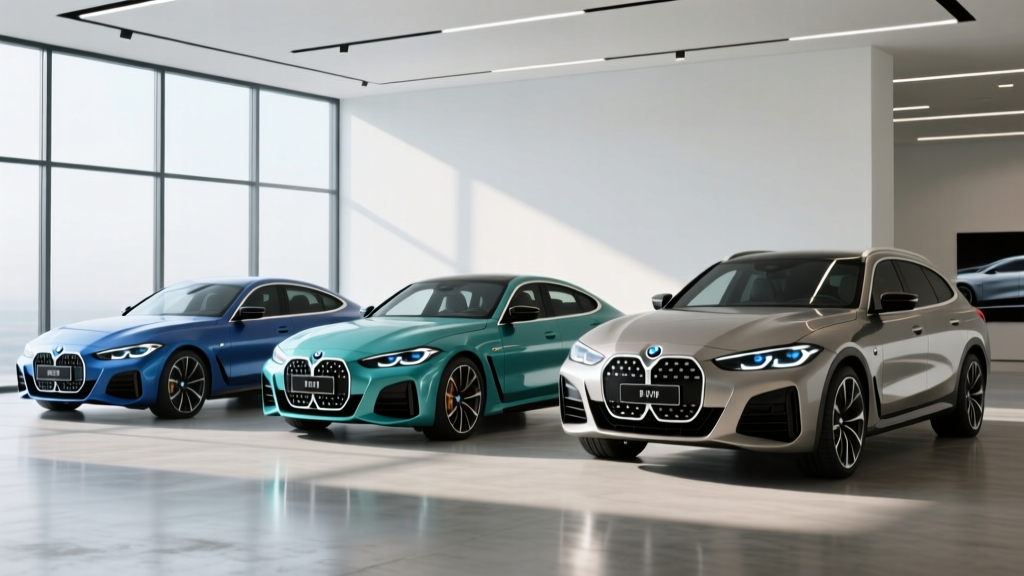
Current BMW EV Offers at a Glance
BMW's 2026 all-electric lineup spans four core models: the i4 Gran Coupé (from $52,200), the i5 sedan (from $66,800), the flagship i7 (from $105,700), and the iX SUV (from $87,250). Federal §30D tax credit eligibility varies by model, trim, and battery-sourcing compliance — currently, the i4 and select iX trims qualify for up to $7,500 at point of sale for income-eligible buyers, while the i5 and i7 generally fall outside credit caps or sourcing requirements. Lease customers on any BMW EV may benefit from the $7,500 commercial EV credit passed through by BMW Financial Services, regardless of income. Always verify current incentive status with your dealer and the IRS §30D guidance before signing.
The 2026 BMW EV Lineup: Specs, Range & Pricing
BMW's "Neue Klasse" architecture is still rolling out, meaning the 2026 lineup continues on the CLAR platform shared with ICE models. That brings practical trade-offs: decent interior space and familiar BMW driving dynamics, but not the flat-floor packaging efficiency of a dedicated EV skateboard. Here's how the four models stack up on paper and in practice.
| Model | Trim | Battery (kWh usable) | EPA Range | Peak DC Charge | 10–80% Time | 0–60 mph | MSRP |
|---|---|---|---|---|---|---|---|
| i4 Gran Coupé | eDrive40 | 81.5 (NMC) | 307 mi | 205 kW | ~31 min | 5.5s | $52,200 |
| i4 Gran Coupé | M50 | 81.5 (NMC) | 270 mi | 205 kW | ~31 min | 3.7s | $67,300 |
| i5 Sedan | eDrive40 | 81.2 (NMC) | 295 mi | 205 kW | ~30 min | 5.7s | $66,800 |
| i5 Sedan | M60 | 81.2 (NMC) | 256 mi | 205 kW | ~30 min | 3.7s | $84,100 |
| i7 Sedan | eDrive50 | 101.7 (NMC) | 318 mi | 195 kW | ~34 min | 5.4s | $105,700 |
| i7 Sedan | M70 | 101.7 (NMC) | 291 mi | 195 kW | ~34 min | 3.5s | $146,700 |
| iX SUV | xDrive50 | 111.5 (NMC) | 324 mi | 200 kW | ~35 min | 4.4s | $87,250 |
| iX SUV | M60 | 111.5 (NMC) | 288 mi | 200 kW | ~35 min | 3.6s | $111,500 |
Real-World Range Reality: EPA estimates assume mixed driving. On sustained 75 mph highway runs, expect 85–90% of sticker range. In freezing temperatures (below 32°F), range drops 20–30% due to cabin heating and battery resistance — a 307-mile i4 eDrive40 may deliver 215–245 miles in a Midwestern winter. All BMW EVs include a heat pump, which partially mitigates cold-weather losses compared to resistance-heater-equipped rivals.
BMW EV Offers vs. Gas and Hybrid Alternatives
Buyers cross-shopping BMW EVs often compare them against the 3 Series, 5 Series, and X5 — or luxury hybrids like the 530e and X5 xDrive50e PHEV. The math shifts depending on how much you drive and where you charge.
| Metric | i4 eDrive40 | 430i Gran Coupé (Gas) | i5 eDrive40 | 530e PHEV |
|---|---|---|---|---|
| MSRP (base) | $52,200 | $48,300 | $66,800 | $60,900 |
| Fed. Tax Credit | Up to $7,500* | $0 | $0 (exceeds MSRP cap) | Up to $3,750* |
| Effective Price | ~$44,700 | $48,300 | $66,800 | ~$57,150 |
| EPA Efficiency | 97 MPGe | 29 MPG combined | 97 MPGe | 64 MPGe / 28 MPG |
| Annual Fuel/Energy (15k mi) | ~$540 | ~$1,725 | ~$555 | ~$950 |
| 5-Year Fuel Cost | ~$2,700 | ~$8,625 | ~$2,775 | ~$4,750 |
*Tax credit subject to income caps, battery sourcing rules, and MSRP limits. Verify at fueleconomy.gov and with a tax professional.
The i4 eDrive40, after the credit, undercuts the gas 430i on purchase price and saves roughly $5,900 in fuel over five years (assuming home charging at $0.14/kWh national average). The i5 vs. 530e comparison is tighter: the PHEV's lower base price and partial credit narrow the gap, and if you can't charge at home, the 530e's gas flexibility may be more practical.
Charging Infrastructure: What BMW EV Owners Need to Know
BMW's 2026 EVs use the NACS (Tesla-style) connector on new models, with CCS1 adapters available for legacy units. BMW has partnered with Electrify America and Tesla Superchargers for public charging access.
| Level | Power | Miles Added/Hour | Where | Typical Cost |
|---|---|---|---|---|
| Level 1 (120V) | 1.4 kW | ~4 mi/hr | Standard outlet | $0.10–0.14/kWh |
| Level 2 (240V) | 7.4–11 kW | 22–35 mi/hr | Home / workplace | $0.10–0.20/kWh |
| DC Fast | 150–205 kW | ~500–800 mi/hr | Public stations | $0.30–0.55/kWh |
Home Charging Setup: BMW recommends a 48-amp Level 2 home charger (like the BMW Wallbox or ChargePoint Home Flex) on a 60-amp dedicated circuit. Installation costs range from $800 to $2,500 depending on panel capacity and run distance. Homes with 100-amp panels may need a $1,500–$3,000 service upgrade to 200 amps.
Public Charging Reality: At a 205 kW Electrify America station, the i4 can add ~180 miles in 20 minutes (10–80% SoC). However, charging speed tapers significantly above 80% — the final 20% can take as long as the first 70%. For road trips, plan stops around the 10–80% sweet spot and precondition the battery via the iDrive navigation system for optimal charge rates.
Total Cost of Ownership: 5-Year Breakdown
Purchase price is just the start. Here's what five years of BMW EV ownership actually costs compared to gas and hybrid alternatives, based on 15,000 miles/year.
| Cost Category | i4 eDrive40 | 430i Gran Coupé | 530e PHEV |
|---|---|---|---|
| Purchase (after credit) | $44,700 | $48,300 | $57,150 |
| Fuel / Energy (5 yr) | $2,700 | $8,625 | $4,750 |
| Maintenance (5 yr) | $1,800 | $3,200 | $2,800 |
| Insurance (5 yr avg) | $9,500 | $7,800 | $8,400 |
| Depreciation (est.) | $18,500 | $16,200 | $19,800 |
| Total 5-Year Cost | $77,200 | $84,125 | $92,900 |
EVs save on fuel and maintenance (no oil changes, fewer brake replacements due to regen), but insurance premiums run 15–25% higher due to repair costs and battery replacement risk. Depreciation on luxury EVs remains steeper than gas equivalents, though the gap is narrowing as the used-EV market matures.
Tax Credits, Incentives & BMW Lease Deals
Federal §30D tax credits for 2026 remain subject to three constraints: buyer income caps ($150k single / $300k joint for new EVs), vehicle MSRP limits ($55k for sedans, $80k for SUVs/vans), and battery critical-mineral sourcing thresholds. As of early 2026:
- i4 eDrive40 ($52,200): Eligible for up to $7,500 if battery sourcing requirements are met and buyer income qualifies. Point-of-sale transfer available.
- i4 M50 ($67,300): Still under the $55k sedan cap? No — exceeds it. Not eligible for §30D new-vehicle credit.
- i5 / i7: Both exceed MSRP caps. No §30D credit for purchase.
- iX xDrive50 ($87,250): Under the $80k SUV cap? No — exceeds it. Not eligible.
The Lease Loophole: BMW Financial Services typically passes through the $7,500 commercial EV credit (IRC §45W) on all leased electric models, regardless of buyer income or MSRP caps. This makes leasing the i5, i7, or iX significantly more attractive than purchasing if you're comfortable with a 36-month commitment and mileage restrictions.
Decision Framework: Which BMW EV (or Alternative) Is Right for You?
Choose the i4 eDrive40 if: You want the most affordable entry into BMW electric, qualify for the §30D credit, have home Level 2 charging, and drive under 300 miles/day. Best value in the lineup.
Choose the i4 M50 if: Performance matters more than range or tax credits, and you're okay paying $67k+ for a 3.7-second 0–60 time with all-wheel drive.
Choose the i5 eDrive40 if: You need 5 Series space and refinement, plan to lease (to capture the $7,500 credit pass-through), and value a quiet, torque-rich luxury sedan over outright sportiness.
Choose the i5 M60 if: You want M-level acceleration in a midsize sedan and budget is secondary. Expect ~256 miles real-world range and higher insurance costs.
Choose the i7 if: You're in the 7 Series luxury tier, want 318 miles of range in a full-size sedan, and lease economics work for your situation. Rear-seat entertainment and Executive Lounge seating justify the premium.
Choose the iX xDrive50 if: You need SUV practicality (cargo, towing, ground clearance), want 324 miles of EPA range, and lease to access the credit. Best all-around BMW EV for families.
Stick with a gas BMW or PHEV if: You lack home charging access, frequently drive 400+ miles in a day, live in a charging desert, or your budget can't absorb the insurance and depreciation premiums of a luxury EV.
Common BMW EV Misconceptions — Myth vs. Fact
| Myth | Fact |
|---|---|
| "BMW EVs can't use Tesla Superchargers." | 2026 BMW EVs with NACS ports access Tesla Superchargers natively. CCS-equipped older models use a BMW-approved adapter. |
| "The battery will need replacing in 5 years." | BMW warranties the high-voltage battery for 8 years/100,000 miles against defects and capacity loss below 70%. Real-world NMC degradation averages 10–15% over 8 years with proper care. |
| "I'll save money on every BMW EV." | Without the tax credit, an i5 or i7 costs more to buy and insure than its gas counterpart. Savings depend on credit eligibility, home charging access, and annual mileage. |
| "Charging takes too long for road trips." | At 205 kW, a 10–80% charge takes ~30 minutes — comparable to a rest stop. Plan routes using the iDrive EV route planner, which accounts for charger availability and battery preconditioning. |
| "Cold weather kills BMW EV range." | Range drops 20–30% in sub-freezing temps, but the heat pump and battery preconditioning mitigate losses. Garage parking and scheduled departure heating help significantly. |
First-Time BMW EV Buyer Checklist
- Verify home charging feasibility. Confirm your electrical panel can support a 60-amp, 240V circuit. Get a quote from a licensed electrician before purchasing.
- Check §30D credit eligibility. Use the IRS VIN lookup tool and confirm your AGI falls under income caps. Ask the dealer about point-of-sale transfer.
- Compare lease vs. buy economics. For i5/i7/iX, leasing often captures the $7,500 credit that purchase cannot. Run both scenarios.
- Test-charge before you buy. Visit a local Electrify America or Tesla Supercharger station with the demo vehicle to confirm connector compatibility and app-based payment flow.
- Factor in insurance. Get quotes from your provider before signing — BMW EV premiums can be 20%+ higher than gas equivalents.
- Plan your first road trip. Use the BMW iDrive navigation or A Better Routeplanner to map a 200+ mile drive and identify reliable DC fast chargers along the route.
Frequently Asked Questions
Are there any BMW EV incentives beyond the federal tax credit?
Many states and utilities offer additional rebates — California's CVRP, Colorado's state credit, and utility off-peak charging rebates can stack with federal incentives. Check AFDC's state incentive database for current programs in your area.
How long does a BMW EV battery last before replacement?
BMW's high-voltage batteries are designed for 15+ years of service with gradual capacity loss. The 8-year/100,000-mile warranty covers defects and capacity below 70%. Full battery replacement (rare) costs $12,000–$18,000 depending on model, but most owners will trade or sell before needing one.
Can I install a BMW Wallbox charger myself?
No. BMW requires professional installation by a licensed electrician for warranty and safety compliance. The Wallbox itself costs ~$700; installation adds $800–$2,500 depending on your home's electrical setup.
Do BMW EVs hold their resale value?
Luxury EV depreciation remains steeper than gas equivalents — expect 45–55% value retention after 5 years vs. 55–65% for a comparable gas BMW. However, strong lease residuals and certified pre-owned demand are stabilizing the market.
What's the difference between the i4 eDrive40 and M50?
The eDrive40 is rear-wheel drive with 335 hp and 307 miles of range. The M50 adds a front motor for all-wheel drive, 536 hp, and a 3.7-second 0–60 — but range drops to 270 miles and the price jumps $15,100. Choose based on whether performance or efficiency matters more.