The Real Math Behind BMW EV Deals in 2026
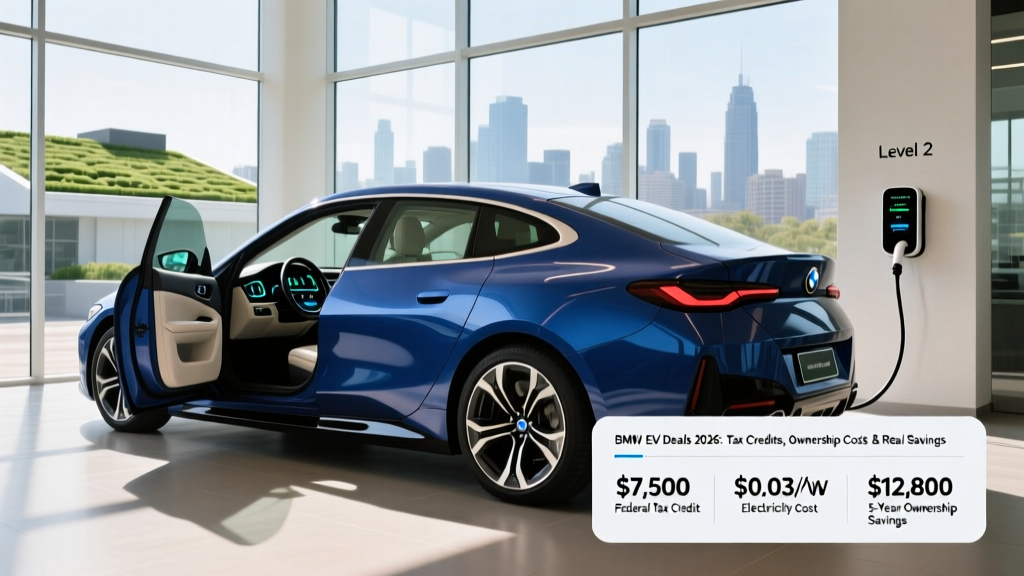
If you've been searching for BMW EV deals, you've likely seen aggressive lease offers, dealer incentives, and headlines about federal tax credits stacking up to make a luxury electric BMW surprisingly attainable. But the sticker price is only the opening move. The real question is what a BMW electric vehicle costs to own over the first five years — factoring in charging, insurance, maintenance, depreciation, and whether you actually qualify for the incentives that make the math work.
This guide dissects the 2026 BMW EV lineup — the i4 Gran Coupe, i5 sedan, and iX SUV — with exact figures for total cost of ownership, federal and state incentives, per-mile fuel savings, insurance premiums, and resale value trends. No marketing gloss, just the numbers you need before you sign.
2026 BMW EV Lineup: Specs and Starting Prices
Before we get into ownership costs, here's what BMW's current electric lineup looks like for the 2026 model year. All three models ride on BMW's flexible CLAR platform with fifth-generation eDrive powertrains and use NMC (nickel manganese cobalt) battery chemistry.
| Spec | 2026 BMW i4 eDrive40 | 2026 BMW i5 eDrive40 | 2026 BMW iX xDrive50 |
|---|---|---|---|
| Base MSRP | $57,900 | $70,200 | $87,250 |
| Battery (usable) | 81.5 kWh (NMC) | 81.2 kWh (NMC) | 105.2 kWh (NMC) |
| EPA Range | 307 mi | 295 mi | 324 mi |
| Real-World Range (hwy/cold) | ~250–270 mi | ~240–260 mi | ~265–285 mi |
| MPGe (combined) | 109 MPGe | 99 MPGe | 86 MPGe |
| Peak DC Fast Charge | 205 kW | 205 kW | 195 kW |
| 10–80% DC Charge Time | ~31 min | ~30 min | ~34 min |
| Level 2 Charge Rate | 11 kW | 11 kW | 11 kW |
| Horsepower | 335 hp | 335 hp | 516 hp |
| 0–60 mph | 5.5 sec | 5.7 sec | 4.4 sec |
| Battery Warranty | 8 yr / 100,000 mi | 8 yr / 100,000 mi | 8 yr / 100,000 mi |
Sources: fueleconomy.gov, BMW USA press specifications. Real-world range estimates reflect highway driving at 70+ mph and cold-weather conditions below 40°F, where EVs typically lose 15–25% of EPA-rated range due to cabin heating and increased battery resistance.
Federal Tax Credit: Do BMW EVs Qualify for §30D?
The federal EV tax credit under IRS §30D can deliver up to $7,500 off a qualifying new EV purchase — and as of current rules, it can be transferred to the dealer at the point of sale, effectively reducing your purchase price on the spot. But qualifying is not automatic. The rules have tightened significantly, and BMW's global supply chain means eligibility varies by model and model year.
- Income caps: Modified AGI must not exceed $300,000 (married filing jointly), $225,000 (head of household), or $150,000 (single filers)
- MSRP caps: Vans/SUVs/pickups must be under $80,000 MSRP; sedans/coupes under $55,000 MSRP
- Battery sourcing: Increasing percentages of critical minerals and battery components must be sourced from the U.S. or free-trade-agreement countries — thresholds escalate annually
- Assembly: Vehicle must undergo final assembly in North America
- Point-of-sale transfer: Buyers can elect to transfer the credit to the dealer for an immediate price reduction, or claim it on their tax return
- New-vehicle only: Used EVs qualify under a separate §25E credit (up to $4,000, with lower income caps)
Rules subject to change. Always verify current eligibility at IRS.gov and confirm with your tax professional before purchasing.
Which 2026 BMW EVs Qualify?
Here's where BMW buyers need to pay close attention. The BMW i4 starts at $57,900 — above the $55,000 MSRP cap for sedans. The i5 at $70,200 also exceeds the sedan cap. The iX xDrive50 at $87,250 is above the $80,000 SUV cap. This means that at their base MSRPs, none of the current 2026 BMW EV models automatically qualify for the full §30D credit based on price alone.
However, there are pathways to eligibility:
- Dealer negotiations: If a dealer discounts the i4 below $55,000 or the iX below $80,000 on the final sale agreement, the credit may apply — but the IRS uses MSRP (including factory-installed options) as reported by the manufacturer, not the negotiated price. Confirm the manufacturer-reported MSRP with the VIN lookup tool at fueleconomy.gov.
- Leasing loophole (§45W): When you lease a BMW EV, the leasing company (BMW Financial Services) may claim the commercial clean vehicle credit under §45W and pass savings to you as a reduced monthly payment. This has been a common strategy for luxury EVs that exceed MSRP caps. Ask your dealer how the lease incentive is structured.
- Battery sourcing compliance: Even if price qualifies, the battery must meet critical-mineral and component-sourcing thresholds. BMW sources cells from CATL and Samsung SDI, and compliance status can shift annually. Check the latest DOE/Fuel Economy sourcing list.
Bottom line: Don't assume a $7,500 credit on any BMW EV. Verify eligibility by VIN before committing, and compare lease deals against purchase scenarios carefully.
5-Year Total Cost of Ownership: BMW i4 vs. Gas Equivalent
To understand whether a BMW EV deal is genuinely competitive, we need to compare the 5-year total cost of ownership (TCO) against a comparable gas-powered BMW. We'll use the 2026 BMW i4 eDrive40 ($57,900) against the 2026 BMW 430i Gran Coupe ($49,900) — both midsize luxury coupes with similar performance profiles.
Assumptions: 12,000 miles/year (60,000 miles total), home charging at $0.14/kWh national average, premium gasoline at $4.20/gallon, 28 MPG combined for the 430i.
| Cost Category | BMW i4 eDrive40 | BMW 430i Gran Coupe |
|---|---|---|
| Purchase Price (MSRP) | $57,900 | $49,900 |
| Federal Tax Credit (if eligible) | –$7,500* | $0 |
| Effective Purchase Price | $50,400* | $49,900 |
| Fuel / Charging (5 years) | $3,456 | $9,000 |
| Maintenance (5 years) | $1,800 | $4,200 |
| Insurance (5 years) | $14,400 | $11,700 |
| Depreciation (est. 5-yr) | –$22,000 | –$20,500 |
| Total 5-Year Cost | $48,056* | $54,300 |
*Tax credit shown for illustration. Actual eligibility depends on MSRP caps, income limits, and battery-sourcing rules. Verify at IRS.gov.
Charging vs. Gas: The Per-Mile Cost Breakdown
This is where EVs consistently win, and BMW's efficient eDrive powertrains make the gap meaningful.
| Metric | BMW i4 eDrive40 | BMW 430i (Gas) |
|---|---|---|
| Energy Consumption | 31 kWh/100 mi | 28 MPG combined |
| Energy Cost | $0.14/kWh (home avg) | $4.20/gal (premium) |
| Cost per Mile | $0.043 | $0.15 |
| Annual Cost (12,000 mi) | $516 | $1,800 |
| 5-Year Cost (60,000 mi) | $2,580 | $9,000 |
Savings: ~$6,420 over 5 years on energy alone. That's roughly $1,284/year or $107/month back in your pocket.
A few caveats that matter in practice:
- Public DC fast charging costs more. Networks like Electrify America and EVgo typically charge $0.35–$0.55/kWh. If you rely on public charging for more than 30% of your miles, your per-mile cost rises to $0.11–$0.17/mi — narrowing or eliminating the savings advantage.
- Time-of-use rates help. Many utilities offer off-peak EV charging rates as low as $0.06–$0.08/kWh overnight, which would drop the i4's cost per mile to under $0.025.
- Cold weather increases consumption. Expect 15–25% higher kWh/100mi in winter conditions, which proportionally increases your per-mile cost during those months.
Maintenance Savings: Fewer Parts, Less Wear
EVs eliminate the most common recurring maintenance items on gas cars. Here's what BMW EV owners skip entirely versus what gas BMW owners pay for over 60,000 miles:
| Maintenance Item | BMW i4 (EV) | BMW 430i (Gas) |
|---|---|---|
| Oil Changes (every 10k mi) | $0 | $900–$1,200 |
| Transmission Fluid | $0 (single-speed) | $300–$500 |
| Spark Plugs | $0 | $400–$600 |
| Brake Pads (front + rear) | $0–$400* | $1,200–$1,800 |
| Cabin Air Filter | $150–$250 | $150–$250 |
| Coolant / Misc. | $200–$400 | $400–$700 |
| Total (5 yr / 60k mi) | ~$1,800 | ~$4,200 |
*Regenerative braking significantly extends brake pad life. Many EV owners report original brake pads lasting 80,000–100,000+ miles. However, BMW recommends periodic brake inspections and occasional rotor resurfacing since infrequent friction-brake use can lead to surface corrosion.
Maintenance savings: ~$2,400 over 5 years. Combined with fuel savings, the i4 returns roughly $8,800 in operating savings over five years versus the gas 430i.
Insurance: The Cost BMW EV Buyers Often Miss
Here's the line item that catches many first-time EV buyers off guard: EV insurance premiums are typically 15–30% higher than equivalent gas vehicles. For the BMW i4, expect annual premiums in the range of $2,600–$3,100 depending on your state, driving record, and coverage levels — versus $2,100–$2,500 for the 430i.
Why the premium?
- Higher repair costs: EV battery packs and power electronics are expensive to replace after collision damage. Even minor rear-end impacts can trigger battery safety inspections costing thousands.
- Specialized labor: High-voltage system repairs require certified EV technicians, and fewer shops have them — driving up labor rates.
- Vehicle value: The i4's higher MSRP means higher comprehensive and collision payouts for insurers.
- Parts availability: BMW EV-specific body panels and battery modules can have longer lead times, increasing rental-car and storage costs during claims.
5-year insurance difference: ~$2,700 more for the i4. This partially offsets the fuel and maintenance savings. Shop quotes from multiple carriers — some insurers (like Geico and Progressive) have started offering EV-specific discounts that narrow the gap.
Depreciation and Resale Value: BMW EVs vs. Gas BMWs
Depreciation is the single largest ownership cost for any vehicle, and EVs have historically depreciated faster than gas equivalents. According to data from iSeeCars and Kelley Blue Book, luxury EVs have seen 3-year depreciation rates of 45–55%, compared to 35–45% for luxury gas vehicles.
For the BMW i4, expect roughly 38–42% depreciation over 5 years (roughly $22,000–$24,000 in value lost from MSRP). The gas 430i typically holds slightly better at 35–40% depreciation (~$20,000–$22,000 lost).
Factors affecting BMW EV resale:
- Battery health concerns: Used buyers scrutinize state of health (SoH). BMW's 8-year/100,000-mile battery warranty (covering degradation below 70% capacity) provides reassurance, but the market still prices in uncertainty.
- Tax credit resets: When new buyers can access $7,500 credits on new EVs, used EV prices face downward pressure since the used credit (§25E) is capped at $4,000 with stricter income limits.
- Rapid tech advancement: Newer EVs with faster charging and longer range make older models look dated faster than in the gas-car market.
- Leasing impact: High lease volumes for BMW EVs mean large numbers of off-lease vehicles hitting the used market simultaneously, suppressing prices.
Practical advice: If depreciation is a primary concern, leasing a BMW EV often makes more financial sense than buying — you transfer the depreciation risk to BMW Financial Services, and lease deals frequently include the tax credit benefit baked into the monthly payment.
State, Local, and Utility Incentives
Beyond the federal §30D credit, many BMW EV buyers can stack additional incentives depending on where they live. These vary significantly by jurisdiction, so always verify with your state energy office and local utility.
- California (CVRP): Up to $2,000 rebate for income-qualified buyers on new EVs; additional $1,500–$4,500 through the Clean Fuel Reward at point of sale
- Colorado: State tax credit up to $5,000 for new EVs (varies by price and battery size)
- New York (Drive Clean Reset): Point-of-sale rebate up to $2,000
- Utility rebates: Many utilities (PG&E, ConEdison, Xcel Energy) offer $500–$1,500 rebates for home Level 2 charger installation, plus off-peak charging rate discounts
- HOV lane access: Several states grant single-occupant HOV lane access for EVs — a significant non-monetary benefit in congested metro areas
- Property/sales tax exemptions: States like Washington, Oregon, and New Jersey exempt EVs from sales tax, saving $4,000–$8,000+ at purchase
These are examples and may have changed. Check afdc.energy.gov for current state and local incentive listings.
BMW EV Lease Deals: The Smart Path for Many Buyers
Given the MSRP-cap challenges for the §30D purchase credit, leasing has become the dominant strategy for BMW EV buyers. Here's why:
- §45W commercial credit: When BMW Financial Services owns the vehicle (as in a lease), the transaction may qualify for the §45W commercial clean vehicle credit, which has different MSRP and sourcing rules. BMW typically passes this savings through as a "lease cash" incentive, reducing your effective monthly payment.
- No depreciation risk: You return the car at lease end. If EV resale values continue to soften, that's BMW's problem, not yours.
- Lower monthly outlay: A 36-month BMW i4 lease with typical incentives can land in the $600–$750/month range (depending on money factor, down payment, and region), compared to $900–$1,100/month on a financed purchase.
- Tech refresh: EV technology is advancing rapidly. A 3-year lease lets you upgrade to faster-charging, longer-range models as they arrive without the hassle of selling a used EV.
The tradeoff: you don't build equity, you're subject to mileage limits (typically 10,000–15,000 mi/year), and wear-and-tear charges at lease return can be unpleasant. But for luxury EVs where depreciation is steep, leasing is often the mathematically superior choice.
Frequently Asked Questions
How much does it really cost to own a BMW EV over 5 years?
For the 2026 BMW i4 eDrive40, expect roughly $48,000–$55,000 in total 5-year cost depending on whether you qualify for the federal tax credit, your insurance rates, and your local electricity costs. Without the credit, the i4 costs roughly the same or slightly more than the gas 430i over five years, with savings coming from lower fuel and maintenance but offset by higher insurance and purchase price.
Do I qualify for the federal tax credit on a BMW EV?
Possibly, but it's not guaranteed. The §30D credit requires your income to be below the caps ($150k single / $300k joint), the vehicle MSRP to be under $55,000 for sedans or $80,000 for SUVs, and the battery to meet critical-mineral sourcing thresholds. Most 2026 BMW EVs exceed MSRP caps at list price. Leasing may unlock savings through the §45W commercial credit pathway. Always verify with the VIN lookup at fueleconomy.gov and consult a tax professional.
How much do I save on fuel and maintenance with a BMW EV?
Combined fuel and maintenance savings for a BMW i4 versus a gas BMW 430i average roughly $8,800 over five years (60,000 miles) — about $6,400 in fuel savings and $2,400 in maintenance savings. These savings assume primarily home charging at national-average electricity rates. Heavy reliance on public DC fast charging reduces fuel savings significantly.
Are BMW EVs more expensive to insure?
Yes, typically 15–30% more than equivalent gas BMWs. Expect to pay roughly $2,600–$3,100/year for the i4 versus $2,100–$2,500 for the 430i. Higher repair costs, specialized EV technician requirements, and elevated vehicle values drive the premium. Shop multiple carriers and ask about EV-specific discounts.
How well do BMW EVs hold their value?
BMW EVs depreciate somewhat faster than their gas counterparts — expect roughly 38–42% value loss over 5 years for the i4, compared to 35–40% for the gas 430i. Factors include rapid EV tech advancement, battery health uncertainty in the used market, and the effect of new-vehicle tax credits suppressing used prices. Leasing transfers depreciation risk to the manufacturer.
Should I buy or lease a BMW EV?
For most buyers eyeing BMW EV deals in 2026, leasing offers the better financial outcome. Lease incentives often incorporate tax-credit-equivalent savings, you avoid depreciation risk on a rapidly evolving vehicle category, and monthly payments are typically lower. Buying makes sense if you drive fewer than 10,000 miles/year, plan to keep the car 7+ years, and can confirm full §30D credit eligibility for your specific VIN.