Quick Answer: Which BMW EV Should You Buy?
BMW's 2026 EV lineup spans five core models built on the flexible CLAR platform, offering EPA ranges from 263 to 340 miles and starting prices from roughly $52,200 (i4 eDrive40) to over $120,000 (i7 M70). The i4 is the entry point for sedan buyers wanting 300+ miles of range. The i5 delivers the best balance of range (up to 340 mi EPA), luxury, and daily usability. The iX remains the flagship electric SUV with standard AWD and up to 324 miles. The i7 is the ultra-luxury electric 7 Series alternative. The newly launched iX3 (Neue Klasse-based) slots in as a compact luxury SUV for 2026. None of BMW's US-market EVs currently qualify for the full $7,500 federal §30D tax credit due to battery-sourcing requirements — a critical factor in your purchase math.
The 2026 BMW EV Lineup at a Glance
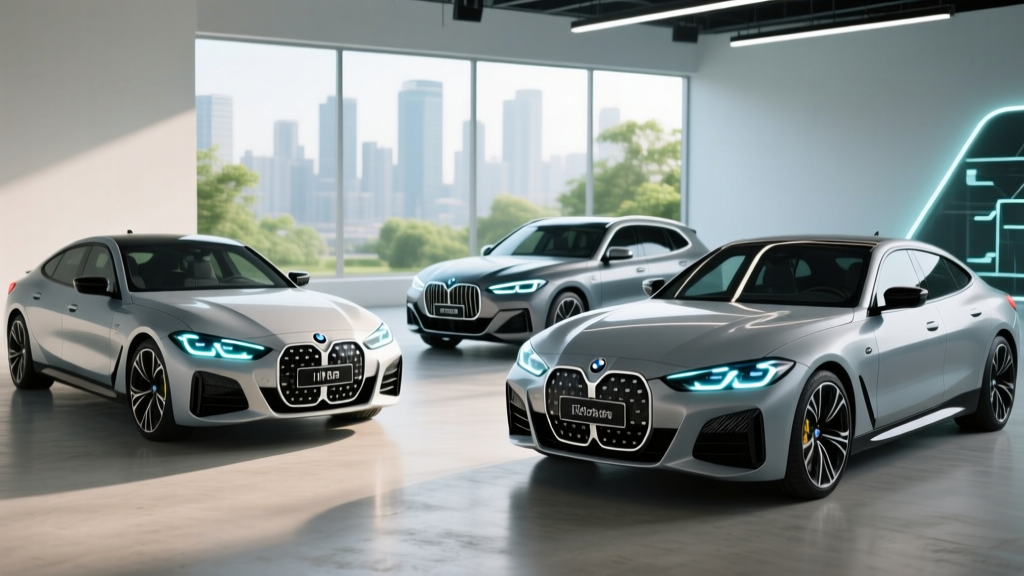
BMW took a different path than most legacy automakers by building EVs on shared platforms with their ICE counterparts rather than dedicated EV architectures. The result: BMW EV cars look, feel, and drive like BMWs first, and EVs second. For 2026, the lineup covers compact sedan through full-size luxury SUV, with the Neue Klasse-based iX3 introducing BMW's next-generation 800V architecture and cylindrical battery cells.
| Model | Body Style | EPA Range | Battery (usable kWh) | Peak DC Charge | 0-60 mph | Starting MSRP |
|---|---|---|---|---|---|---|
| i4 eDrive40 | Gran Coupe | 307 mi | 83.9 kWh (NMC) | 205 kW | 5.5 sec | $52,200 |
| i4 M50 | Gran Coupe | 263 mi | 83.9 kWh (NMC) | 205 kW | 3.7 sec | $67,300 |
| i5 eDrive40 | Sedan | 340 mi | 84.3 kWh (NMC) | 205 kW | 5.7 sec | $57,900 |
| i5 M60 | Sedan | 288 mi | 84.3 kWh (NMC) | 205 kW | 3.7 sec | $84,100 |
| iX xDrive50 | Midsize SUV | 324 mi | 105.2 kWh (NMC) | 200 kW | 4.4 sec | $87,250 |
| iX M60 | Midsize SUV | 296 mi | 105.2 kWh (NMC) | 200 kW | 3.6 sec | $111,500 |
| i7 eDrive50 | Full-size Sedan | 318 mi | 101.7 kWh (NMC) | 195 kW | 4.5 sec | $105,700 |
| iX3 (Neue Klasse) | Compact SUV | ~310 mi (est.) | ~80 kWh (cylindrical) | ~270 kW (800V) | ~5.0 sec | ~$55,000 (est.) |
Sources: fueleconomy.gov, BMW USA press materials. iX3 specs are preliminary estimates for the 2026 model year.
Real-World Range: What the EPA Sticker Doesn't Tell You
EPA range estimates for BMW EV cars are generally achievable in mixed suburban driving at moderate temperatures. But real-world conditions tell a more nuanced story, and understanding the variables is essential before you buy.
Range Reality Check: BMW i5 eDrive40
EPA Rating: 340 miles
Highway (70-75 mph, 65°F): ~280-300 miles
Highway (70-75 mph, 30°F): ~235-260 miles
City/Suburban mixed: ~310-335 miles
Cold-weather city (20°F, heater on): ~260-285 miles
BMW's heat pump (standard on i5, i7, iX; optional on i4) recovers waste heat from the drivetrain to warm the cabin, reducing cold-weather range loss by roughly 10-15% compared to resistive heating. If you live in a cold climate, spec the heat pump.
The i4 eDrive40's 307-mile EPA figure typically translates to 255-275 miles on a sustained highway trip at 75 mph. The iX xDrive50, despite its larger 105.2 kWh battery, loses proportionally more range at highway speeds due to its boxier SUV aerodynamics — expect roughly 260-285 real highway miles from its 324-mile sticker.
Charging Speed and Infrastructure
BMW's CLAR-platform EVs (i4, i5, i7, iX) use a 400V architecture with peak DC fast-charging rates around 200-205 kW. That's competitive but not class-leading — Hyundai/Kia's E-GMP platform hits 350 kW, and the new Neue Klasse iX3 moves to 800V for roughly 270 kW peak.
| Charging Level | Power | i4/i5 (400V) | iX (400V) | iX3 (800V) | Miles Added/Hour |
|---|---|---|---|---|---|
| Level 1 (120V) | ~1.4 kW | ~4 mi/hr | ~4 mi/hr | ~5 mi/hr | 3-5 |
| Level 2 (240V, 48A) | 11.5 kW | ~35 mi/hr | ~35 mi/hr | ~40 mi/hr | 30-40 |
| DC Fast (peak) | 200-270 kW | 10-80% in ~31 min | 10-80% in ~35 min | 10-80% in ~20 min | N/A |
Charging curve reality: The 205 kW peak rate on the i4 and i5 holds from roughly 10-30% state of charge, then tapers to ~150 kW through 50%, ~100 kW through 70%, and drops sharply above 80%. A 10-80% session takes about 31 minutes at a capable 350 kW Electrify America or Tesla Supercharger station (with BMW's included CCS adapter for NACS Superchargers). Don't expect 205 kW sustained — the average rate across a 10-80% session is closer to 130-140 kW.
For home charging, BMW includes a Flexible Fast Charger (Level 1/Level 2 capable) with a NEMA 14-50 plug adapter. A dedicated Level 2 wallbox (BMW Wallbox or third-party like ChargePoint Home Flex) at 48 amps/11.5 kW will fully replenish an i5 overnight in about 8-9 hours. Budget $800-$2,500 for professional Level 2 installation depending on your panel capacity and conduit run — more if your home needs a 200A service upgrade.
BMW EV Cars vs. Gas BMWs: The Cost Breakdown
Let's compare the i5 eDrive40 against its closest gas sibling, the 530i xDrive, over five years and 75,000 miles. This is where ownership math either validates or kills the EV decision.
| Cost Factor | BMW i5 eDrive40 | BMW 530i xDrive (Gas) |
|---|---|---|
| Base MSRP | $57,900 | $58,900 |
| Federal Tax Credit (§30D) | $0 (battery sourcing) | $0 |
| Estimated fuel/energy (75K mi) | $2,625 (home L2, $0.14/kWh avg) | $9,375 (26 MPG comb., $3.25/gal) |
| Maintenance (5 yr) | ~$1,800 | ~$4,200 |
| Insurance (5 yr avg.) | ~$12,500 | ~$10,800 |
| Estimated depreciation | ~$28,000 | ~$25,000 |
| 5-Year Total Cost | ~$102,825 | ~$108,275 |
Energy costs assume 80% home charging at $0.14/kWh and 20% public DC at $0.40/kWh. Gas costs assume national average. Insurance based on national BMW averages. Depreciation estimates from industry data. Your numbers will vary by state, utility rate, and driving pattern.
The i5 saves roughly $5,450 over five years in this scenario — primarily from fuel and maintenance. But this assumes reliable home charging access. If you're forced to rely primarily on public DC fast charging at $0.35-$0.50/kWh, the energy cost advantage shrinks significantly, potentially to near parity with gas.
Maintenance differences: BMW EV cars eliminate oil changes, transmission fluid, spark plugs, and exhaust system repairs. Brake pad life extends to 80,000-100,000+ miles thanks to regenerative braking doing most of the deceleration work. You'll still need tire rotations, cabin air filters, brake fluid checks, and windshield washer fluid. Budget roughly $350-$400/year for EV maintenance versus $800-$900/year for the gas equivalent.
Federal Tax Credit and Incentive Reality
This is where BMW EV buyers face a frustrating truth. Under the current IRS §30D clean vehicle credit rules, BMW's US-market EVs do not qualify for the $7,500 federal tax credit. The reason: BMW's battery cells and modules are sourced from suppliers (primarily Samsung SDI and CATL) that don't yet meet the critical-minerals and battery-component sourcing requirements tied to US free-trade agreements.
§30D Credit Checklist for BMW EVs (2026)
- MSRP cap: Sedans ≤$55,000 / SUVs ≤$80,000 — i4 eDrive40 qualifies on price; i5, iX, i7 exceed caps
- Buyer income cap: AGI ≤$150K single / $300K joint — must meet independently
- Battery sourcing: Critical minerals + components must meet escalating thresholds — BMW does NOT currently meet requirements
- North American final assembly: All US-market BMW EVs are built in Germany (Dingolfing/Munich) — fails assembly requirement
- Result: $0 federal credit for new BMW EV purchases
What you can get: Many states offer separate EV rebates and incentives — California's CVRP, Colorado's innovative motor vehicle credit, New York's Drive Clean Rebate, and others. These range from $1,000 to $7,500 depending on income and vehicle price. Check your state's energy or DMV website for current programs. Additionally, the used EV credit (§25E) offers up to $4,000 (30% of sale price, max $4,000) for qualifying pre-owned EVs purchased from a dealer — a 2-year-old i4 eDrive40 at $35,000 could qualify for the full $4,000 if income caps are met.
Leasing is a workaround: under §45W (commercial clean vehicle credit), the leasing company claims the $7,500 credit and may pass savings to you as reduced monthly payments. Many BMW EV lease deals in 2026 reflect this "lease loophole" — ask your dealer whether the lease rate incorporates the credit.
Myths vs. Facts About BMW EV Ownership
| Myth | Fact |
|---|---|
| "BMW EV batteries need replacing every 5 years" | BMW warranties the high-voltage battery for 8 years/100,000 miles against degradation below 70% of original capacity. Real-world data from earlier i3 and iX3 fleets shows ~5-8% degradation at 100K miles. Replacement, if ever needed out of warranty, runs $15,000-$25,000 depending on model. |
| "You can't road-trip an EV" | BMW's navigation system preconditions the battery when a DC fast charger is set as your next waypoint, optimizing charge speed. With 200+ kW charging and the growing NACS/CCS network, a 300-mile highway leg requires one 25-30 minute stop. Plan around charging, not against it. |
| "EVs cost more to insure" | Generally true: BMW EV insurance runs 10-20% higher than equivalent gas models due to higher repair costs and battery replacement risk. Shop quotes from EV-friendly insurers (Geico, Progressive, Tesla Insurance in some states) before buying. |
| "Regenerative braking makes one-pedal driving standard" | BMW offers adjustable regen (low, medium, high, and adaptive) but does not default to full one-pedal driving like Nissan or Tesla. The "B" mode on the gear selector increases regen significantly, and the adaptive mode uses radar and navigation data to modulate regen based on traffic and upcoming curves. Expect a learning curve of 1-2 weeks. |
| "BMW's CLAR platform is a compromise vs. dedicated EV platforms" | Partly true: the shared platform means no frunk (front trunk) and slightly less interior packaging efficiency than a dedicated skateboard. But it also means proven build quality, consistent driving dynamics, and BMW didn't have to pass R&D costs for a wholly new architecture to buyers. |
Who Should Buy a BMW EV — and Who Shouldn't
Not every buyer is best served by a BMW EV. Here's a practical framework based on real ownership variables:
Decision Framework: Is a BMW EV Right for You?
Choose a BMW EV if:
- You have Level 2 home charging (or can install it) — this is non-negotiable for cost-effective ownership
- You value driving dynamics and interior build quality over maximum range-per-dollar
- Your daily commute is under 100 miles round-trip, with occasional 200-300 mile road trips
- You want luxury-badge EV ownership without Tesla's polarizing brand or minimalist interior
- You're open to leasing to capture the §45W commercial credit passed through as lower payments
Look elsewhere if:
- You need the $7,500 federal purchase credit to make the math work — consider Hyundai Ioniq 6, Ford Mustang Mach-E, or Tesla Model 3/Y (credit eligibility varies by trim and sourcing)
- You live in an apartment without charging access and your area has sparse public DC infrastructure
- You regularly drive 400+ mile highway trips in cold weather — the Lucid Air (400+ mi EPA) or Tesla Model S (402 mi) offer more buffer
- Cargo space is a priority and you need a frunk — BMW's CLAR-platform EVs have no front trunk
- You want the absolute fastest charging — Hyundai Ioniq 5 (350 kW peak) or Porsche Taycan (270 kW on 800V) charge faster than current CLAR-based BMWs
Frequently Asked Questions
Do BMW EV cars use NACS or CCS connectors?
BMW's current US-market EVs (i4, i5, i7, iX) are equipped with CCS1 charge ports. BMW has announced adoption of the NACS (Tesla) connector for future models, and provides a CCS-to-NACS adapter for Supercharger access. The Neue Klasse-based iX3 for 2026 is expected to ship with NACS natively. For now, you can charge at Electrify America, EVgo, ChargePoint, and other CCS networks directly, and use the adapter at Tesla Superchargers.
How long does a BMW EV battery last?
BMW warranties the high-voltage battery for 8 years or 100,000 miles, whichever comes first, against capacity loss below 70% of original. All current BMW EVs use NMC (nickel-manganese-cobalt) chemistry, which offers high energy density but slightly faster degradation than LFP (lithium iron phosphate). Real-world fleet data suggests you'll see roughly 90-95% state of health at 100,000 miles with normal charging habits. To maximize longevity, BMW recommends daily charging to 80% and only charging to 100% when you need the full range for a trip.
Are BMW EVs reliable compared to gas BMWs?
Early data is encouraging. EVs have far fewer moving parts — no turbocharger, no multi-speed transmission, no exhaust system, no fuel pump. BMW's electric drivetrains have shown fewer warranty claims than their B48/B58 gas engines in equivalent timeframes, according to European reliability surveys. The main risk areas are 12V auxiliary battery issues (common across all EV brands), software glitches in the iDrive system, and charging port hardware. Overall, expect better-than-average BMW reliability from the EV lineup.
What's the cheapest BMW EV to own?
The i4 eDrive40 at $52,200 MSRP offers the lowest entry price, best efficiency (roughly 3.2-3.5 kWh/mile), and lowest insurance costs in the lineup. Over five years with home charging, total cost of ownership undercuts the gas 430i Gran Coupe by roughly $3,000-$5,000 depending on your electricity rate and mileage. If you can find a certified pre-owned i4, the used EV tax credit (§25E) may knock an additional $4,000 off the purchase price.
Can I tow with a BMW EV?
The iX xDrive50 and iX M60 are rated to tow up to 4,400 pounds when properly equipped — adequate for a small boat or utility trailer. The i5 is rated for 2,200 pounds (light-duty). The i4 is not rated for towing. Keep in mind that towing cuts EV range by 30-50% depending on trailer weight and aerodynamics. A 324-mile iX towing a 3,500-pound trailer at highway speeds may deliver only 170-200 miles between charges.
BMW's EV strategy prioritizes driving feel, interior quality, and incremental electrification over spec-sheet dominance. If that philosophy aligns with how you drive and what you value, the 2026 lineup offers compelling options — just go in with clear eyes on the tax-credit gap and real-world range expectations.