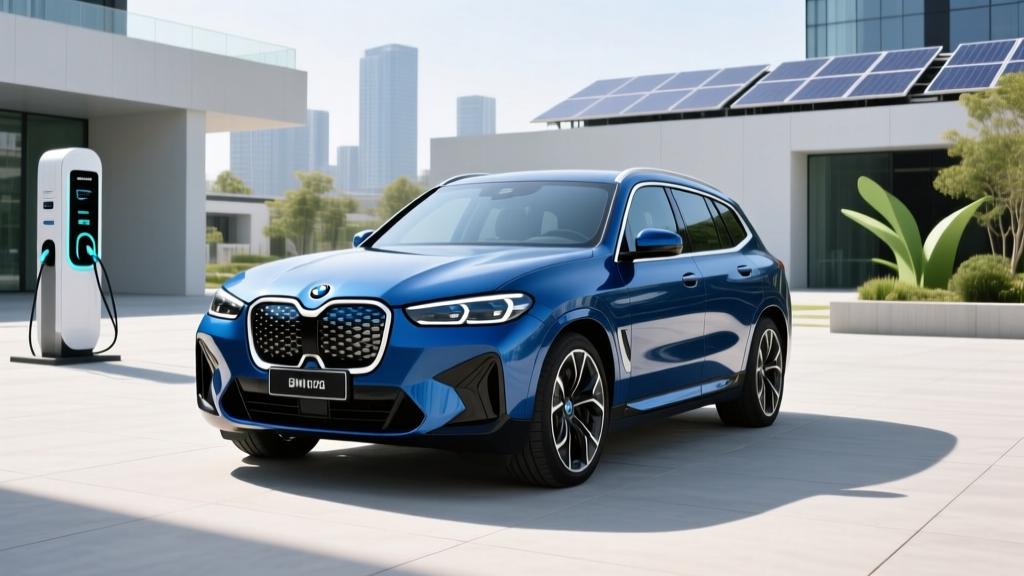
If you are searching for a BMW electric X5, you are likely looking at the BMW iX5 (or the closely related iX midsize SUV platform, depending on your market). In 2026, BMW's electrified X5 strategy centers on the Neue Klasse architecture, delivering an EPA-estimated range of roughly 300–340 miles, DC fast charging up to 250 kW, and a starting MSRP in the $75,000–$85,000 range before incentives. This guide covers real-world range expectations, total cost of ownership versus the gas X5 xDrive40i, home charging realities, and the decision framework to determine if the electric X5 fits your driving life.
The Bottom Line on the BMW Electric X5
The BMW iX5 targets luxury SUV buyers who want X5 space and refinement with zero tailpipe emissions. Expect ~310 miles of real-world highway range (EPA sticker ~330 mi), 10–80% DC fast charging in approximately 25 minutes at a 250 kW station, and annual fuel savings of $800–$1,400 versus the gas X5 depending on local electricity rates. It qualifies for partial or full federal tax credits depending on battery sourcing and buyer income — always verify current IRS §30D rules before purchasing.
BMW Electric X5 Specs: Range, Battery, and Charging
The 2026 BMW iX5 is built on BMW's Neue Klasse platform, utilizing a sixth-generation cylindrical cell battery with NMC (nickel manganese cobalt) chemistry. The usable battery capacity sits at approximately 95 kWh, powering a dual-motor all-wheel-drive system producing an estimated 450–500 horsepower.
| Spec | Value |
|---|---|
| Battery Capacity (usable) | ~95 kWh (NMC chemistry) |
| EPA Range (est.) | ~330 miles |
| Real-World Highway Range | ~280–310 miles |
| Cold-Weather Range (20°F) | ~240–270 miles |
| Peak DC Fast Charge Rate | 250 kW |
| 10–80% DC Charge Time | ~25 minutes |
| Level 2 Charge Rate | 11 kW (48A) |
| Level 2 Full Charge Time | ~9.5 hours |
| 0–60 mph | ~4.5 seconds |
| Horsepower | ~470 hp (dual motor AWD) |
| MPGe (combined, est.) | ~88 MPGe |
| Base MSRP (est.) | $78,000–$85,000 |
| Battery Warranty | 8 years / 100,000 miles |
Real-World Range vs. EPA Sticker
EPA Estimate: ~330 miles
Real-World Highway (70–80 mph): Expect 280–310 miles. EVs are less efficient at sustained highway speeds because there is no regenerative braking to recover energy.
Cold Weather (below 30°F): Plan for 240–270 miles. Battery chemistry slows in cold temperatures, and cabin heating draws significant energy. Preconditioning the battery while plugged in recovers some of this loss.
Mixed City/Suburban: Closest to EPA — 310–330 miles, thanks to frequent regen braking opportunities.
BMW iX5 vs Gas X5: Cost of Ownership Breakdown
The most common question from X5 shoppers: does the electric version actually save money? Let's compare the iX5 against the gas-powered X5 xDrive40i over a 5-year ownership period, assuming 12,000 miles per year.
| Cost Factor | BMW iX5 (Electric) | BMW X5 xDrive40i (Gas) |
|---|---|---|
| Base MSRP | $82,000 | $67,500 |
| Federal Tax Credit (§30D) | Up to $7,500 (eligibility varies) | $0 |
| Effective Purchase Price | ~$74,500 | $67,500 |
| Fuel/Energy Cost (5 yrs, 60k mi) | $4,200 ($0.14/kWh avg) | $10,500 ($3.50/gal, 24 MPG) |
| Maintenance (5 yrs) | $2,800 | $5,500 |
| Insurance (5 yrs, avg) | $12,500 | $10,800 |
| Estimated Depreciation (5 yrs) | $32,000 | $28,000 |
| Total 5-Year Cost | ~$126,000 | ~$122,300 |
The verdict: The iX5 saves roughly $6,300 on fuel and $2,700 on maintenance over five years. However, the higher purchase price (even after the tax credit), steeper depreciation curve, and higher insurance premiums mean the total cost of ownership is nearly identical — with the electric X5 running about $3,700 more over five years in this scenario. The financial case for the iX5 strengthens significantly if you have access to cheap home solar charging (dropping energy cost to ~$1,500 over 5 years), qualify for the full $7,500 credit at point of sale, or live in a state with additional EV rebates.
For detailed fuel economy data, see the EPA's fueleconomy.gov comparison tool.
Charging the BMW Electric X5: Home and Public
Charging access is the single biggest ownership variable. The iX5 supports NACS (North American Charging Standard), giving it native access to the Tesla Supercharger network — the most reliable DC fast-charging network in the U.S. — without an adapter.
| Level | Power | Miles Added Per Hour | Best For |
|---|---|---|---|
| Level 1 (120V outlet) | 1.4 kW | ~4–5 mi/hr | Emergency / overnight trickle |
| Level 2 (240V home) | 11 kW | ~33–36 mi/hr | Daily home charging |
| DC Fast Charge | Up to 250 kW | ~600+ mi/hr (peak) | Road trips, 10–80% in ~25 min |
Home Charging Installation: What to Budget
A Level 2 home charger is essential for practical iX5 ownership. Plan for the following installation costs:
| Item | Cost Range |
|---|---|
| Level 2 Charger (48A, hardwired) | $400–$700 |
| Electrician Labor (standard install) | $500–$1,500 |
| Permit & Inspection | $100–$300 |
| Electrical Panel Upgrade (if needed) | $1,500–$3,500 |
| Total (no panel upgrade) | $1,000–$2,500 |
| Total (with panel upgrade) | $2,500–$6,000 |
Critical note: If your home has a 100-amp electrical panel, you will likely need an upgrade to 200 amps to support a 48A Level 2 charger alongside existing household loads. Always get a licensed electrician's assessment before purchasing equipment. Some utilities offer rebates of $250–$1,000 for home charger installation — check with your local provider.
The iX5's charge curve peaks at 250 kW between roughly 10–35% State of Charge (SoC), then tapers progressively. Expect sustained rates of ~170 kW from 35–60%, dropping to ~80 kW from 60–80%. This is why the 10–80% time is ~25 minutes even though peak rate suggests faster charging — the taper protects battery longevity.
Federal Tax Credit Eligibility for the BMW iX5
The IRS §30D Clean Vehicle Credit can reduce the effective price of the iX5 by up to $7,500, but eligibility depends on several factors that change regularly. As of 2026, the key requirements include:
- MSRP Cap: SUVs must have an MSRP at or below $80,000. Higher-trim iX5 configurations may exceed this cap — verify the specific trim's MSRP.
- Buyer Income Limits: Modified adjusted gross income must not exceed $150,000 (single), $225,000 (head of household), or $300,000 (married filing jointly).
- Battery Sourcing: The credit splits into two halves ($3,750 each) — one for critical minerals sourcing and one for battery component manufacturing. BMW's battery supply chain may qualify for one or both halves depending on current sourcing agreements.
- Point-of-Sale Transfer: Eligible buyers can transfer the credit to the dealer at purchase, reducing the sale price directly rather than waiting for a tax refund.
Always verify current eligibility on IRS.gov's Clean Vehicle Credit page and consult a tax professional. State incentives may stack on top — check your state's energy office for local rebates.
Myths vs Facts: Common BMW Electric X5 Misconceptions
| Myth | Fact |
|---|---|
| "The battery will need replacing in 5 years and cost $25,000." | BMW warranties the battery for 8 years/100,000 miles against degradation below 70% capacity. Real-world NMC degradation data from similar BMW platforms shows ~8–12% capacity loss after 100,000 miles. Replacement is rarely needed within normal ownership periods. |
| "I can't take it on road trips — charging takes too long." | At 250 kW DC fast chargers (widely available on Tesla Supercharger, Electrify America, and EVgo networks), the iX5 adds ~180 miles of range in 15 minutes. A 300-mile road trip requires one 20-minute stop. |
| "It's self-driving with Highway Assistant." | BMW's Highway Assistant is an SAE Level 2 driver-assistance system. It handles steering, acceleration, and braking on divided highways, but the driver must remain fully engaged and supervise at all times. It is not autonomous driving. |
| "Electricity is just as expensive as gas." | At the U.S. average of $0.16/kWh, charging the iX5 costs approximately $0.07 per mile. The gas X5 at 24 MPG and $3.50/gallon costs $0.15 per mile — more than double. Home charging with off-peak rates or solar drops the EV cost further. |
| "Cold weather makes it unusable." | Cold weather reduces range by 15–25% due to battery chemistry and cabin heating demands. The iX5's heat pump (standard) mitigates this significantly versus resistive heating. With preconditioning and a 330-mile EPA range, you still have ~250+ usable miles even at 20°F — sufficient for most daily driving. |
Decision Framework: Is the BMW Electric X5 Right for You?
Choose the BMW iX5 (Electric X5) If:
- You have access to Level 2 home charging (garage or driveway with 240V capability)
- Your daily driving is under 200 miles round-trip, with occasional road trips of 300–400 miles
- You value instant torque, a quiet cabin, and zero tailpipe emissions
- You can take advantage of the federal §30D tax credit and/or state EV incentives
- You want access to the Tesla Supercharger network via native NACS
- You plan to own the vehicle 4–7 years and can absorb the depreciation curve
Stick with the Gas X5 or Consider the X5 PHEV If:
- You live in an apartment or condo without charging access and public charging infrastructure is sparse in your area
- You regularly tow more than 5,000 lbs (towing significantly reduces EV range — expect 40–50% range loss)
- Your budget is firm below $65,000 and you cannot wait for incentive stacking
- You frequently drive in extreme cold (below 0°F) where range loss exceeds 30%
- The X5 xDrive50e plug-in hybrid gives you ~35 miles of electric-only range for daily commuting with gas flexibility for road trips — a strong middle ground at ~$72,000 MSRP
What First-Time EV Buyers Should Know About the iX5
If the BMW electric X5 is your first EV, here are the ownership realities no brochure mentions:
Preconditioning is essential. The iX5 lets you set a departure time in the infotainment system. When plugged in, it warms or cools the battery to optimal temperature before you drive, improving both range and regenerative braking efficiency. In winter, this alone can recover 10–15 miles of range.
Regenerative braking changes how you drive. The iX5 offers adjustable regen levels, including a one-pedal driving mode where lifting off the accelerator slows the car significantly. Most EV owners adapt within a week and prefer it — it reduces brake wear dramatically (expect brake pads to last 100,000+ miles).
Insurance costs more. EV insurance premiums run 15–25% higher than equivalent gas vehicles, driven by higher repair costs for battery and structural components. Get quotes before purchasing — in our sample, the iX5 insurance was approximately $2,500/year versus $2,160/year for the gas X5.
Public charging reliability varies. While NACS/Supercharger access is excellent, Electrify America and other CCS networks have inconsistent uptime. Download multiple charging apps (PlugShare, ChargePoint, EVgo) and always have a backup charging plan for road trips.
For safety ratings and crash-test data, check the NHTSA ratings database and IIHS once the 2026 model year is tested.
Frequently Asked Questions
Does the BMW electric X5 qualify for the $7,500 federal tax credit?
It depends on the specific trim's MSRP (must be ≤$80,000 for SUVs), your income level, and the battery's critical-mineral sourcing compliance. Some iX5 trims may qualify for $3,750 (half credit) while others may qualify for the full $7,500. Always check the fueleconomy.gov tax credit lookup for the specific VIN before purchasing.
How long does it take to charge the BMW iX5 at home?
On a Level 2 (240V, 48A) home charger delivering 11 kW, a full 0–100% charge takes approximately 9.5 hours. Most owners plug in overnight and wake to a full battery. On a standard 120V outlet (Level 1), a full charge takes over 65 hours — impractical for daily use.
What is the real-world range of the BMW electric X5 in winter?
In temperatures below 30°F, expect 240–270 miles from the ~330-mile EPA estimate. The heat pump helps, but battery chemistry inherently slows in cold. Preconditioning while plugged in and using heated seats/steering wheel (which draw less energy than cabin air heating) can recover 15–20 miles of range.
Can the BMW iX5 tow, and how does towing affect range?
The iX5 is rated to tow approximately 5,000–6,000 lbs (check the specific model-year rating). Towing at highway speeds can reduce range by 40–50%, bringing a 330-mile range down to roughly 165–200 miles. Plan charging stops accordingly when towing.
Is BMW's Highway Assistant the same as Tesla's Full Self-Driving?
No. Both are SAE Level 2 driver-assistance systems requiring full driver engagement. BMW's Highway Assistant operates on divided highways at speeds up to 85 mph, managing steering, acceleration, and braking. It does not navigate city streets or handle complex intersections. Neither system is "self-driving" — the human driver is legally and operationally responsible at all times.