If you've been eyeing the i4, iX, or i5 at your local BMW dealer, you've likely noticed the monthly lease offers. BMW has been aggressively pricing its electric lineup to move metal, and a BMW electric vehicle lease can be one of the smartest ways to get into a premium EV — but only if you understand the math behind the monthly payment, the federal tax credit pass-through, and what you'll actually spend on charging, insurance, and depreciation over the lease term.
This guide breaks down the real ownership economics of leasing a BMW EV in 2026, using current EPA data, IRS §30D rules, and real-world charging costs. We'll focus primarily on the 2026 BMW i4 eDrive40 and 2026 BMW iX xDrive50 — BMW's two highest-volume electric models — so you can walk into the dealership knowing exactly what the numbers mean.
Why a BMW Electric Vehicle Lease Works Differently Than Buying
Leasing an EV involves a unique financial mechanic that doesn't apply to purchases: the federal EV tax credit can be passed through to the lessee as a capitalized cost reduction. Here's how it works:
Under IRS §30D, the $7,500 Clean Vehicle Credit technically belongs to the vehicle's legal owner — the leasing company (BMW Financial Services). However, most automakers, including BMW, pass this credit to the lessee as a reduction in the vehicle's capitalized cost (the "cap cost"). This effectively lowers your monthly payment as if you'd made a $7,500 down payment — but without the income or MSRP caps that apply to a direct purchase.
This is a critical distinction. When you buy an EV, §30D eligibility requires:
- Income caps: Modified AGI ≤ $150,000 (single), $225,000 (head of household), $300,000 (joint) — per IRS guidelines
- MSRP caps: ≤ $55,000 for sedans; ≤ $80,000 for SUVs, vans, and trucks
- Battery sourcing: Critical minerals and battery components must meet escalating domestic/free-trade sourcing thresholds
- Point-of-sale transfer: Buyers can elect to transfer the credit to the dealer for an immediate price reduction (available since Jan 2024)
- Tax liability: Credit is non-refundable — you need sufficient federal tax liability to claim it on a purchase
When you lease, none of those buyer-side restrictions apply to you directly. The leasing company claims the credit and (typically) passes the savings on. This means high-income earners who exceed the §30D income caps can still benefit from the credit via a lease — a significant advantage for many BMW shoppers.
Important caveat: The credit pass-through is not guaranteed by law. It's a business decision by the automaker. Always confirm with your BMW dealer that the full $7,500 (or applicable amount) is being applied as a cap cost reduction in your specific lease agreement. Get it in writing on the lease worksheet.
2026 BMW i4 and iX: Lease-Relevant Specs at a Glance
Before we run the ownership numbers, here's what you're leasing. These specs matter because they determine your real-world fuel savings, charging convenience, and whether you'll actually enjoy the car for 36 months.
| Spec | 2026 BMW i4 eDrive40 | 2026 BMW iX xDrive50 |
|---|---|---|
| MSRP (base) | $57,900 | $87,250 |
| EPA Range | 307 miles | 324 miles |
| Real-World Range (highway/cold) | ~250–275 mi | ~265–290 mi |
| Battery (usable) | 81.5 kWh (NMC) | 105.2 kWh (NMC) |
| Efficiency | 97 MPGe combined | 86 MPGe combined |
| DC Fast Charge (peak) | 205 kW | 195 kW |
| 10–80% DC Fast Charge | ~31 min | ~34 min |
| Level 2 Charge Rate | 11 kW (AC) | 11 kW (AC) |
| 0–60 mph | 5.5 sec | 4.4 sec |
| Horsepower | 335 hp | 516 hp |
| Drivetrain | RWD (single motor) | AWD (dual motor) |
| Battery Warranty | 8 yr / 100,000 mi | 8 yr / 100,000 mi |
5-Year Total Cost of Ownership: BMW i4 Lease vs. Purchase vs. Gas Equivalent
A lease is typically 36 months, but we'll model costs over 5 years (60 months) to give you a complete ownership picture — including what happens when the lease ends and you either lease again or transition to a purchase. For the gas comparison, we're using the 2026 BMW 430i Gran Coupe (MSRP ~$48,000, 28 MPG combined) as the ICE baseline.
| Cost Category | i4 eDrive40 (Lease, 2x 36-mo terms*) | i4 eDrive40 (Purchase) | BMW 430i Gran Coupe (Purchase, Gas) |
|---|---|---|---|
| Vehicle Acquisition** | $5,000 (drive-offs & fees) | $57,900 (MSRP) | $48,000 (MSRP) |
| Monthly Payments (60 mo) | $729 × 60 = $43,740 | $850 × 60 = $51,000 (loan) | $720 × 60 = $43,200 (loan) |
| Federal Tax Credit | –$7,500 (cap cost reduction) | –$7,500 (if eligible) | $0 |
| Fuel / Charging (60 mo, 12K mi/yr) | $4,320 | $4,320 | $10,800 |
| Maintenance (60 mo) | $1,800 | $1,800 | $4,200 |
| Insurance (60 mo) | $12,600 | $12,600 | $9,600 |
| Depreciation / Equity at 5 yr | $0 (returned) | –$28,000 (residual equity) | –$22,000 (residual equity) |
| Net 5-Year Cost | ~$59,960 | ~$92,120 (gross) / ~$64,120 (net) | ~$95,400 (gross) / ~$73,400 (net) |
* Assumes two consecutive 36-month leases. Second lease terms may differ.
** Purchase prices before dealer negotiation, destination, or incentives. Loan assumes 6.5% APR, $5,000 down. Lease assumes $5,000 drive-off (first month + fees + cap reduction). Your actual numbers will vary by dealer, region, and credit tier.
The headline: leasing the i4 can be competitive with buying a gas 430i on a monthly cash-flow basis, especially when the $7,500 credit is applied. But the purchase path builds equity, and the net cost after accounting for residual value narrows the gap significantly. The right choice depends on your cash-flow preference, mileage habits, and how long you plan to keep the car.
Charging vs. Gas: The Per-Mile Cost Breakdown
This is where EVs earn their keep — but the savings depend heavily on how and where you charge. Let's run the math with concrete numbers.
| Scenario | Cost per kWh / Gallon | Vehicle Efficiency | Cost per Mile | Annual Cost (12K mi) |
|---|---|---|---|---|
| i4 — Home Level 2 (national avg electricity) | $0.16/kWh | 3.0 mi/kWh (97 MPGe) | $0.053 | $636 |
| i4 — Home Level 2 (CA / high-rate state) | $0.28/kWh | 3.0 mi/kWh | $0.093 | $1,116 |
| i4 — Public DC Fast Charging | $0.42/kWh | 3.0 mi/kWh | $0.140 | $1,680 |
| BMW 430i — Gasoline (national avg) | $3.40/gal | 28 MPG combined | $0.121 | $1,452 |
| BMW 430i — Gasoline (CA / high-cost state) | $4.80/gal | 28 MPG combined | $0.171 | $2,052 |
The takeaway: If you charge at home on a national-average electricity rate, the i4 costs roughly $0.05/mile to fuel vs. $0.12/mile for gas — a 56% savings. Even in high-cost electricity states like California, home charging still undercuts gas. But if you rely exclusively on public DC fast chargers at $0.40+/kWh, your per-mile cost actually exceeds the gas car. Home charging access is the single biggest variable in EV ownership economics.
For the 5-year TCO table above, we modeled a blended rate: 80% home charging at $0.16/kWh and 20% public DC at $0.42/kWh, yielding an average of ~$72/month or $4,320 over 60 months for the i4.
Maintenance Savings: What You Won't Pay For
BMW EVs eliminate many of the recurring maintenance items that make ICE vehicles expensive to own. Here's the comparison:
| Maintenance Item | BMW i4 (Electric) | BMW 430i (Gas) |
|---|---|---|
| Oil changes | None | ~$150/change × 5 = $750 |
| Transmission fluid | None (single-speed) | ~$300 at 60K mi |
| Brake pads/rotors | $0–$400 (regen extends life 2–3×) | $800–$1,200 |
| Spark plugs | None | ~$400 at 60K mi |
| Engine air filter | None | ~$100 |
| Cabin air filter | $100–$150 | $100–$150 |
| Coolant / brake fluid flush | $200–$300 (brake fluid only) | $300–$400 (both) |
| Tire rotation | $100–$150 (EVs can wear tires faster due to weight/torque) | $100–$150 |
| Estimated 5-Year Total | ~$1,200–$1,800 | ~$3,500–$4,200 |
The i4's regenerative braking system handles most deceleration, meaning the friction brakes see far less use. Many BMW EV owners report original brake pads at 60,000+ miles. The maintenance savings of $2,000–$2,400 over 5 years are real and measurable.
One area where EVs can cost more: tires. The i4 weighs approximately 4,700 lbs (about 800 lbs more than the gas 430i), and instant electric torque accelerates tread wear. Budget for a tire replacement around 30,000–40,000 miles, especially if you opt for performance summer tires.
Insurance Cost Reality: The Premium EV Surcharge
This is the cost category that catches many new EV lessees off guard. BMW EVs typically cost 15–35% more to insure than their gas counterparts. Here's why:
- Higher repair costs: Battery packs and high-voltage components require specialized repair facilities and certified technicians. A minor rear-end collision that would cost $2,000 to fix on a gas car can total an EV if the battery enclosure is compromised.
- Higher vehicle value: The i4's MSRP is roughly $10,000 higher than the 430i, so collision and comprehensive coverage premiums scale accordingly.
- Limited parts availability: EV-specific body panels, battery modules, and power electronics can have longer lead times, increasing rental-car and labor costs for insurers.
- Driver demographics: Actuarial data is still catching up to EV ownership patterns, and insurers tend to price conservatively for newer technology.
In our modeling, we used $210/month for the i4 vs. $160/month for the 430i — a $50/month or $3,000 over 5 years insurance premium for going electric. Your actual rate will depend on your driving record, location, coverage levels, and insurer. We recommend getting quotes from at least three carriers (Geico, State Farm, and Progressive tend to be competitive for BMW EVs) before signing the lease.
Pro tip: Some insurers offer EV-specific discounts. Check whether your carrier participates in any green-vehicle programs, and always bundle with homeowners/renters for multi-policy savings.
Depreciation and Resale Value: What Happens at Lease-End
EV depreciation has been one of the most volatile metrics in the auto industry over the past few years. After steep declines in 2023–2024 (driven by Tesla price cuts, rapid model proliferation, and battery-technology anxiety), the used EV market has stabilized considerably heading into 2026.
Here's what current data suggests for BMW EVs:
- BMW i4 3-year residual value: ~48–55% of MSRP, depending on trim, mileage, and market conditions. The eDrive40 holds value better than the M50 due to lower initial cost and broader buyer appeal.
- BMW iX 3-year residual value: ~42–50% of MSRP. Luxury SUVs depreciate more aggressively in general, and the iX's high starting price amplifies the dollar-amount loss.
- Gas BMW 430i 3-year residual: ~52–58% of MSRP — still slightly ahead of the i4, but the gap has narrowed.
If you lease, depreciation is the leasing company's problem, not yours. BMW Financial Services sets the residual value at lease signing. If the car is worth less at turn-in, you walk away. If it's worth more, you can purchase it at the residual price and capture the equity — or simply lease a new one. This downside protection is one of the strongest arguments for leasing an EV in a market where long-term resale values remain uncertain.
One factor working in BMW's favor: the brand's strong certified pre-owned (CPO) program and dealer network support used EV values better than some competitors. According to IIHS, the i4 earned a Top Safety Pick+ designation, which also supports resale demand.
State, Local, and Utility Incentives: Stacking Savings on Top of Federal Credits
Beyond the federal §30D credit, many BMW EV lessees can stack additional incentives:
- California: The Clean Fuel Reward (up to $1,000 at point of sale, income-dependent) plus potential CVRP rebates for income-qualified buyers. Some utilities (PG&E, SCE) offer $500–$1,500 for home charger installation.
- Colorado: State tax credit of up to $5,000 for new EVs (with income and price caps), stackable with the federal credit.
- New York: Drive Clean Rebate up to $2,000 (point-of-sale), plus utility incentives for off-peak charging and Level 2 installation.
- Texas: No state EV tax credit, but some utilities (Austin Energy, Oncor) offer $250–$1,200 for home charger installation and time-of-use rate discounts.
- Utility TOU (Time-of-Use) rates: Many utilities offer off-peak electricity rates as low as $0.06–$0.09/kWh for EV charging between 10 PM and 6 AM. This can cut your charging costs by 40–50% compared to standard residential rates.
For a BMW i4 lessee in California with access to all applicable incentives, the total stacked savings could reach $9,500–$10,500 ($7,500 federal + $1,000 state + $1,000 utility charger rebate + ongoing TOU savings) — a meaningful reduction in effective lease cost.
Is a BMW Electric Vehicle Lease Right for You? Decision Framework
- You want to drive a premium EV with lower monthly cash outflow than a purchase
- Your income exceeds the §30D caps but you still want the $7,500 credit benefit (via cap cost reduction)
- You have reliable home Level 2 charging access (garage or driveway with a 240V outlet)
- You drive under 12,000–15,000 miles per year (typical lease limits; excess mileage costs $0.20–$0.30/mi)
- You want downside protection against uncertain EV depreciation
- You prefer driving a new car every 3 years with the latest tech and full warranty coverage
- You drive more than 15,000 miles per year (lease penalties add up fast)
- You lack home charging access and would rely entirely on public DC fast charging (fuel cost advantage disappears)
- You plan to keep the car 7+ years (buying builds equity; leasing is a perpetual payment)
- You want to modify the vehicle (leases prohibit aftermarket changes)
- Your state has no additional incentives and your electricity rates are above $0.25/kWh (the math gets tight)
Frequently Asked Questions
How much does it really cost to own a BMW EV over 5 years?
For a 2026 BMW i4 eDrive40 on a lease with the $7,500 federal credit applied as a cap cost reduction, expect approximately $55,000–$65,000 in total out-of-pocket costs over 5 years (including two consecutive lease terms, charging, insurance, and maintenance). This is competitive with purchasing a gas BMW 430i when you factor in the gas car's higher fuel and maintenance costs. The iX, at a higher MSRP, will run $75,000–$85,000 over the same period.
Do I qualify for the federal tax credit on a BMW EV lease?
On a lease, you don't need to qualify — the leasing company (BMW Financial Services) claims the credit and typically passes it to you as a cap cost reduction. This bypasses the §30D income caps ($150K single / $300K joint), MSRP caps ($55K sedans / $80K SUVs), and tax-liability requirements. However, you must confirm with your dealer that the credit is being passed through. On a purchase, the i4 eDrive40 (MSRP ~$57,900) exceeds the $55,000 sedan cap, meaning it would not qualify for §30D if purchased outright — making the lease path significantly more attractive. The iX qualifies under the $80,000 SUV cap. Always verify current rules at IRS.gov.
How much do I save on fuel and maintenance vs. a gas BMW?
With 80% home charging, expect to save $5,000–$6,500 on fuel over 5 years compared to a gas BMW 430i (assuming $3.40/gal national average and $0.16/kWh electricity). Add $2,000–$2,400 in maintenance savings from eliminated oil changes, reduced brake wear, and fewer scheduled services. Total operational savings: roughly $7,000–$9,000 over 5 years. These savings shrink if you rely heavily on expensive public DC fast charging or live in a high-electricity-rate state.
Are BMW EVs more expensive to insure?
Yes, typically 15–35% more than equivalent gas models. For the i4 vs. 430i, expect roughly $40–$60/month higher premiums, or $2,400–$3,600 over 5 years. The higher cost is driven by expensive battery repair/replacement, higher vehicle values, and specialized labor requirements. Shop quotes from multiple insurers before signing your lease — the spread between carriers can be $50+/month for the same coverage.
How well do BMW EVs hold their value?
The i4 retains approximately 48–55% of MSRP after 3 years, while the iX retains roughly 42–50%. These figures have improved since the 2023–2024 EV depreciation spike but still lag slightly behind gas BMW models. When you lease, residual risk belongs to BMW Financial Services — if the car is worth less than projected at turn-in, you simply hand back the keys. This makes leasing a hedge against EV value uncertainty.
What happens if I exceed the lease mileage limit?
Most BMW EV leases offer 10,000, 12,000, or 15,000 miles per year. Excess mileage is charged at $0.20–$0.30 per mile at turn-in. If you think you'll drive 18,000 miles per year, either negotiate a higher-mileage lease upfront (which increases the monthly payment but at a lower per-mile rate) or consider purchasing instead. High-mileage drivers almost always come out ahead buying.
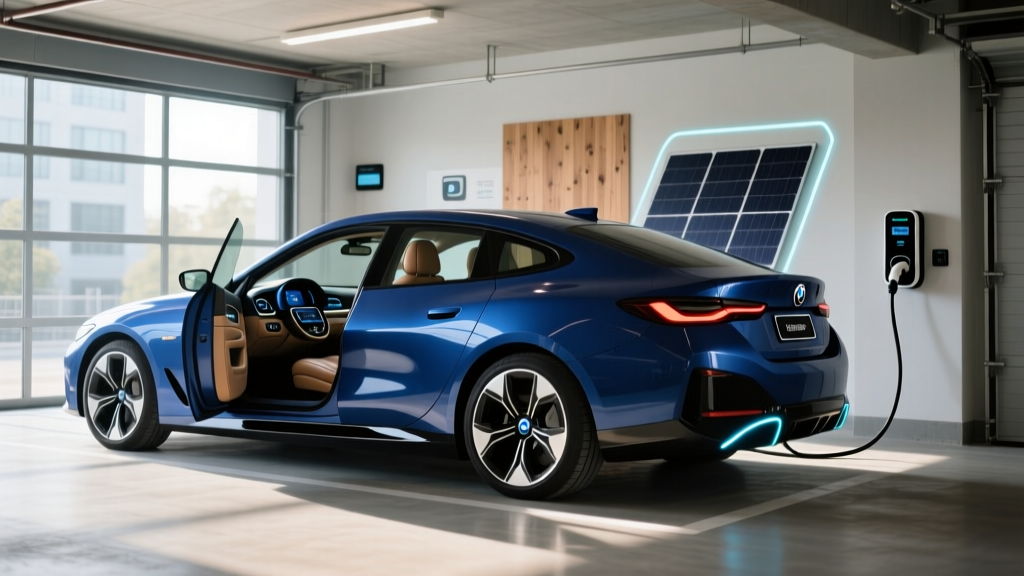
Can I install a Level 2 charger at home for my leased BMW?
Absolutely — and you should. BMW offers the Wallbox Home Charger (11 kW, ~$600–$700), or you can use any J1772-compatible Level 2 unit. Professional installation of a 240V/48A circuit typically costs $800–$2,000 depending on your electrical panel's capacity and the run length from panel to garage. If your panel needs upgrading from 100A to 200A, add $1,500–$3,000. Check with your utility for installation rebates that can offset $500–$1,500 of this cost. A licensed electrician should always perform the final installation and pull the required permit.