The BMW Electric Lease Decision: What the Numbers Actually Show
If you're researching a BMW electric lease in 2026, you've likely seen the headline appeal: premium German engineering, zero tailpipe emissions, and the chance to drive a $55,000–$90,000 EV without committing to long-term battery ownership. But lease economics for electric vehicles work differently than for gas cars — and the math depends heavily on federal incentives, charging costs, and how BMW's EVs depreciate relative to their ICE counterparts.
This guide runs the real numbers on leasing BMW's core electric lineup — the i4, iX, and i7 — using 2026 model-year pricing, current IRS §30D tax credit rules, and real-world energy costs. We'll show you the 5-year total cost of ownership, where you save, where you pay more, and how to structure a lease that actually makes financial sense.
| Model | Battery (kWh usable) | EPA Range | Peak DC Charge | 10–80% Time | 0–60 mph | Base MSRP |
|---|---|---|---|---|---|---|
| i4 eDrive40 | 81.5 kWh (NMC) | 307 mi | 205 kW | ~31 min | 5.5 sec | $57,900 |
| i4 M50 | 81.5 kWh (NMC) | 271 mi | 205 kW | ~31 min | 3.7 sec | $70,700 |
| iX xDrive50 | 105.2 kWh (NMC) | 324 mi | 200 kW | ~35 min | 4.4 sec | $87,250 |
| i7 eDrive50 | 101.7 kWh (NMC) | 318 mi | 205 kW | ~34 min | 4.5 sec | $105,700 |
Real-world highway range at 70 mph typically runs 10–15% below EPA; cold-weather (below 30°F) can reduce range 20–30%. Source: fueleconomy.gov, BMW USA.
How Much Does a BMW Electric Lease Really Cost Over 5 Years?
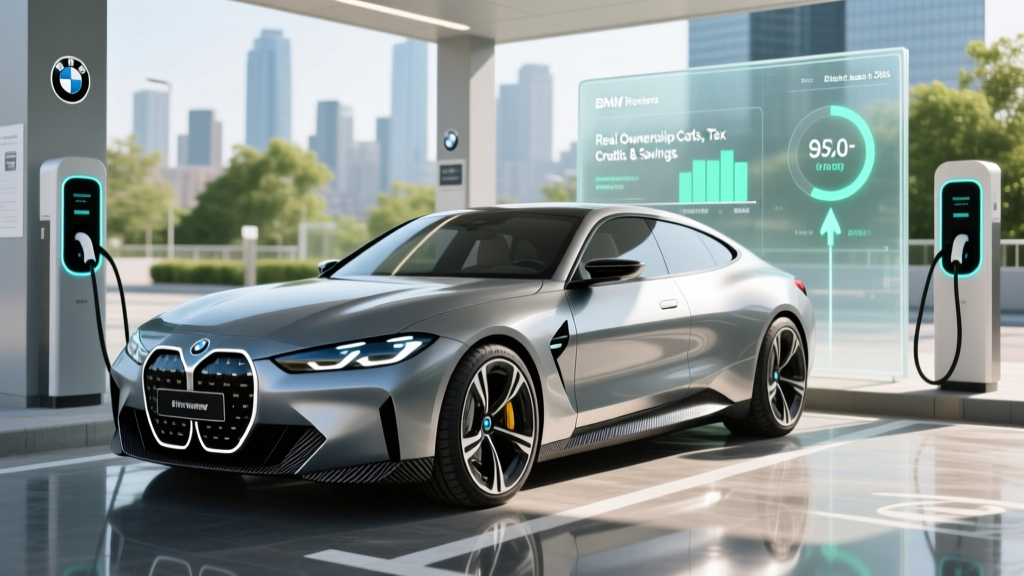
A typical BMW EV lease runs 36 months, but many buyers extend to a second lease or purchase at residual. To give you a complete picture, we're modeling a 5-year ownership horizon — either a 36-month lease followed by a purchase at residual, or two consecutive leases. The table below uses the i4 eDrive40 as our baseline, driven 12,000 miles/year (60,000 total).
| Cost Category | i4 eDrive40 (Lease) | BMW 430i Gran Coupe (Gas) | Difference |
|---|---|---|---|
| Vehicle Payments (60 mo) | $38,400 ($640/mo) | $33,000 ($550/mo) | +$5,400 |
| Energy (Fuel/Charging) | $4,680 | $9,000 | −$4,320 |
| Insurance (5 yr) | $14,400 | $11,400 | +$3,000 |
| Maintenance | $1,800 | $4,200 | −$2,400 |
| Federal Tax Credit | −$7,500* | $0 | −$7,500 |
| 5-Year Net Cost | $51,780 | $57,600 | −$5,820 |
*Tax credit applied via point-of-sale lease pass-through; eligibility depends on income, battery sourcing, and lessor cooperation. See §30D details below. Gas cost assumes $3.50/gal at 28 MPG combined. EV charging assumes 80% home at $0.14/kWh, 20% public DC at $0.40/kWh. Insurance based on national EV averages for luxury compacts.
The i4 lease comes out roughly $5,800 cheaper over 5 years than its gas equivalent — but only if you qualify for the full federal credit and charge predominantly at home. Without the credit, the math flips to a ~$1,700 premium for electric.
Federal Tax Credit: Do You Qualify for §30D on a BMW Lease?
The federal EV tax credit under IRS §30D offers up to $7,500 for qualifying new clean vehicles — but eligibility is anything but automatic. For 2026, the rules are stringent, and BMW's battery supply chain means not every model qualifies for the full amount every month.
- Buyer Income Caps: Modified AGI must not exceed $300,000 (joint), $225,000 (head of household), or $150,000 (single). Exceed these by $1 and you get $0.
- MSRP Caps: Vans/SUVs/pickups: ≤$80,000. Sedans and other vehicles: ≤$55,000. The i4 eDrive40 ($57,900) is classified as a sedan and exceeds the $55K cap — meaning it may NOT qualify unless the dealer classifies the Gran Coupe body style differently. The i4 M50, iX, and i7 all exceed their respective caps.
- Battery Sourcing — Critical Minerals (≥$3,750): A percentage of critical minerals must be extracted or processed in the US or a free-trade-agreement country, or recycled in North America. BMW sources from multiple suppliers; compliance varies by production batch.
- Battery Sourcing — Components (≥$3,750): A percentage of battery components must be manufactured or assembled in North America. BMW's cells come primarily from CATL (China) and Samsung SDI (South Korea), with assembly in Germany and the US. FEOC (foreign entity of concern) restrictions may disqualify certain battery lots.
- Point-of-Sale Transfer: As of 2024+, you can transfer the credit to the dealer at purchase for an immediate price reduction — or in a lease, the lessor (BMW Financial Services) claims the credit and may pass it through as a capitalized-cost reduction. This is not guaranteed; confirm with the dealer.
- Final Assembly: Vehicle must undergo final assembly in North America. The i4 and iX are built in Dingolfing, Germany — this is a potential disqualifier unless BMW has shifted production for specific trims.
Bottom line: Many 2026 BMW EVs face significant §30D hurdles — MSRP caps, German assembly, and battery-sourcing requirements. Always verify eligibility on the specific VIN at fueleconomy.gov before signing. Rules are subject to change; consult a tax professional.
Charging vs. Gas: The Per-Mile Cost Reality
The single largest ongoing savings in any BMW electric lease comes from energy. But the gap between home charging and public DC fast charging is enormous — and it determines whether your "fuel" bill actually beats a gas BMW.
| Scenario | Energy Cost | i4 eDrive40 Cost/Mile | 430i (28 MPG) Cost/Mile |
|---|---|---|---|
| Home Level 2 (100%) | $0.14/kWh | $0.038 | $0.125 |
| 80% Home / 20% DC Fast | Blended $0.19/kWh | $0.052 | $0.125 |
| 100% Public DC Fast | $0.40/kWh | $0.109 | $0.125 |
| 100% Electrify America Pass+ | $0.48/kWh | $0.131 | $0.125 |
i4 efficiency: 3.65 mi/kWh (EPA combined 120 MPGe). Gas price: $3.50/gal. DC fast charging rates from Electrify America and EVgo published pricing, 2026.
At a realistic 80/20 home-to-public mix, the i4 costs $0.052/mile in energy vs. $0.125/mile for gas — a savings of $0.073/mile, or $4,380 over 60,000 miles. But if you live in an apartment without charging access and rely entirely on premium DC networks, the savings nearly vanish. Home Level 2 charging is the economic linchpin of any BMW EV lease.
Maintenance Savings: Where EVs Quietly Win
BMW maintenance on gas vehicles is notoriously expensive. The electric drivetrain eliminates the costliest service items, and this is where a BMW electric lease delivers its most underappreciated financial advantage.
| Service Item | Gas BMW (5 yr / 60K mi) | BMW i4 (5 yr / 60K mi) |
|---|---|---|
| Oil Changes (synthetic) | $1,200 (6× at ~$200) | $0 |
| Brake Pads & Rotors | $1,400 (1–2 replacements) | $0–$200 (regen extends life 2–3×) |
| Transmission Fluid | $350 | $0 (single-speed reducer) |
| Spark Plugs | $400 | $0 |
| Coolant / Cabin Filter / Wipers | $850 | $750 |
| Tire Rotation & Replacement | $1,400 | $1,600 (EVs wear tires ~15% faster due to weight/torque) |
| Total 5-Year Maintenance | $5,600 | $2,550 |
BMW's included maintenance program (3 yr/36K mi) covers some items for both. EV tire wear is higher — budget for one set of replacement rubber during a 5-year horizon. Regenerative braking dramatically reduces friction brake wear; many EV owners report original pads at 80,000+ miles.
Net maintenance savings: roughly $3,000 over 5 years. This is real money, and it's one area where the EV advantage is consistent regardless of charging habits.
Insurance: The Cost EV Lease Shoppers Often Overlook
EV insurance premiums run 15–25% higher than equivalent gas vehicles, and BMW's luxury positioning amplifies the gap. For the i4 eDrive40, expect annual premiums of $2,600–$3,100 depending on your state, driving record, and coverage levels — compared to $2,100–$2,500 for the 430i Gran Coupe.
Why the premium? Three factors drive it:
- Repair costs: EV battery packs and specialized high-voltage components are expensive to replace after collision damage. Even minor rear-end impacts can total a battery.
- Higher vehicle value: Insurers price premiums partly on replacement cost. The i4's MSRP premium over the 430i translates directly to higher comprehensive/collision rates.
- Limited body-shop expertise: Fewer shops are certified for high-voltage BMW repairs, which drives up labor rates and claim processing times.
Over 5 years, budget an additional $2,500–$3,500 in insurance for the i4 versus gas. Always pull quotes from your insurer before signing the lease — some carriers (GEICO, Progressive, State Farm) have narrowed the EV gap, while others still charge steep premiums.
Depreciation and Resale: How BMW EVs Hold Value
This is where BMW electric leases carry a structural advantage over purchasing. EV depreciation has been volatile — Tesla's aggressive price cuts in 2023–2024 cratered used EV values across the industry, and luxury EVs in particular have seen steeper drops than their gas counterparts.
Current 3-year depreciation estimates for BMW EVs:
- i4 eDrive40: ~45–50% depreciation at 36 months / 36,000 miles
- iX xDrive50: ~50–55% depreciation
- BMW 430i (gas): ~38–42% depreciation
When you lease, the residual value is BMW Financial Services' problem, not yours. If the i4 depreciates 50% but your lease residual was set at 55%, you walk away with no penalty. If the market crashes further, you simply hand back the keys. This is the core financial argument for leasing over buying a BMW EV — you're hedging against battery technology obsolescence, shifting tax credit rules, and volatile luxury-EV resale markets.
BMW's 8-year/100,000-mile battery warranty (covering defects and capacity below 70% of original) provides some floor to resale values, but it doesn't prevent the market from repricing used EVs as new models with better range and faster charging arrive annually.
State, Local, and Utility Incentives: Check Your Zip Code
State and utility incentives can add $500–$7,500 on top of federal credits, but they're hyper-local. Examples as of early 2026:
- California (CVRP): Up to $2,000 rebate for income-qualified buyers; plus utility rebates of $500–$1,500 for home charger installation (PG&E, SCE, SDG&E programs vary).
- Colorado: State tax credit up to $5,000 for EVs under $80,000 MSRP — stacks with federal.
- New York (Drive Clean): Point-of-sale rebate up to $2,000 (income-adjusted).
- Utility Programs: Many utilities offer off-peak charging rates ($0.06–$0.09/kWh) and $300–$1,000 Level 2 charger rebates. Check your provider.
- HOV Lane Access: Several states (CA, CO, FL, GA, MD, NJ, NY, VA) offer single-occupant HOV lane access for EVs — a non-monetary perk with real commute value.
These programs change frequently. Check your state's energy office and utility provider for current availability. The AFDC state law database maintains an updated list.
Structuring a BMW Electric Lease That Makes Financial Sense
Given all the variables, here's a decision framework for whether a BMW electric lease is the right move:
Choose a BMW electric lease if:
- You can install a Level 2 home charger (or already have one) — this is non-negotiable for cost savings
- You drive 10,000–15,000 miles/year (high mileage kills lease economics with per-mile penalties)
- You want to hedge against EV depreciation risk and technology obsolescence
- Your modified AGI is under the §30D income caps and the specific VIN qualifies
- You value the driving experience — the i4 M50's 536 hp and instant torque are genuinely compelling
Skip the lease (or choose gas/hybrid) if:
- You lack reliable home charging and would rely on public DC networks exclusively
- You exceed the income caps for §30D and no state incentive fills the gap
- You drive over 15,000 miles/year (lease overage fees of $0.20–$0.30/mile erase energy savings)
- You plan to keep the vehicle 7+ years (buying becomes more economical than consecutive leases)
Frequently Asked Questions
How much does it really cost to own a BMW i4 over 5 years?
With the federal tax credit and predominantly home charging, a 5-year / 60,000-mile horizon on the i4 eDrive40 totals approximately $51,800 including lease payments, energy, insurance, and maintenance — about $5,800 less than the gas 430i. Without the credit, the i4 costs roughly $1,700 more.
Do I qualify for the $7,500 federal tax credit on a BMW EV lease?
It depends on four factors: your modified AGI (must be under $150K single / $300K joint), the vehicle's MSRP relative to the cap ($55K for sedans, $80K for SUVs), whether the battery meets critical-mineral and component sourcing requirements, and whether final assembly occurred in North America. Many 2026 BMW EVs face challenges on MSRP caps and assembly location. Always verify on the specific VIN at fueleconomy.gov before committing.
How much do I save on fuel and maintenance with a BMW electric lease?
At a realistic 80/20 home-to-public charging mix, expect to save roughly $4,300 on energy over 60,000 miles versus a comparable gas BMW. Maintenance savings add another $3,000, primarily from eliminated oil changes, extended brake life via regenerative braking, and no transmission service. Combined savings: ~$7,300 over 5 years.
Are BMW electric vehicles more expensive to insure?
Yes. Expect premiums 15–25% higher than equivalent gas BMWs — roughly $500–$700 more per year for the i4 vs. the 430i. Higher repair costs for battery and high-voltage components, elevated vehicle values, and limited certified body shops all contribute. Get quotes before signing.
How well do BMW EVs hold their value?
BMW electric vehicles currently depreciate faster than their gas counterparts — the i4 loses an estimated 45–50% of value over 3 years vs. 38–42% for the gas 430i. This is precisely why leasing is advantageous: the residual-value risk belongs to BMW Financial Services, not you. At lease end, you walk away regardless of market conditions.
Does BMW include free charging with an EV lease?
BMW has periodically offered complimentary charging credits on Electrify America (typically 2 years / limited kWh). For 2026 models, check current promotions with your dealer — these offers change quarterly and vary by model and trim.
What happens if the battery degrades during my lease?
BMW's high-voltage battery warranty covers defects and capacity loss below 70% for 8 years / 100,000 miles. During a typical 36-month lease, measurable degradation is minimal — usually 3–5% under normal use. You're unlikely to encounter a warranty claim during the lease term.
Sources: fueleconomy.gov (EPA range and efficiency data), IRS §30D clean vehicle credit rules, BMW USA official specifications. Tax credit rules are current as of early 2026 and subject to legislative change. Consult a tax professional for personal eligibility. State and utility incentives vary by jurisdiction — verify with official sources.