The Real Math Behind BMW Electric Lease Deals in 2026
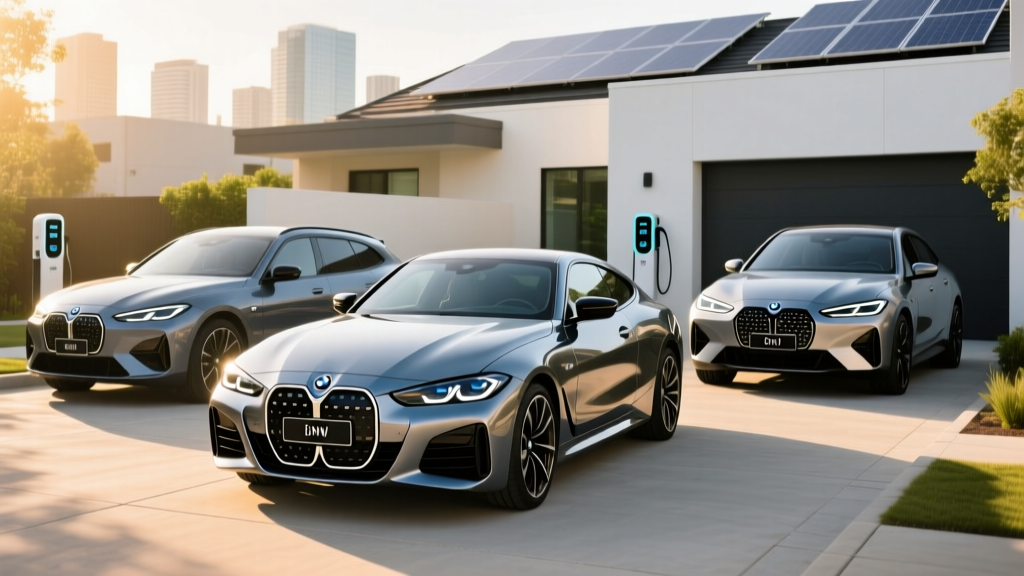
BMW's electrified lineup has matured into one of the most compelling lease propositions in the luxury EV segment. The 2026 i4, i5, and iX span from a sporty gran coupe to a three-row flagship SUV, each leveraging BMW's fifth-generation eDrive powertrain. But the sticker price and monthly lease payment tell only a fraction of the ownership story. To evaluate whether a BMW electric lease deal actually saves money, you need a full five-year cost model that factors in federal incentives, electricity costs, insurance premiums, maintenance, and the depreciation curve that has reshaped luxury EV resale values.
This guide breaks down the total cost of ownership (TCO) for BMW's core EV trio using 2026 model-year specs, current IRS §30D tax credit rules, and real-world charging and insurance data. Whether you're cross-shopping a Tesla Model 3, a Mercedes EQE, or a gas-powered 3 Series, the numbers below give you a precise framework for decision-making.
2026 BMW EV Lineup: Specs That Drive Cost
Before modeling costs, here are the hard numbers for each model. Battery chemistry matters for longevity and degradation: the i4 and i5 use NMC (nickel manganese cobalt) packs, while the iX also uses NMC in a larger format. All three support DC fast charging via the CCS1 connector (BMW has confirmed NACS adapter availability for Supercharger access).
| Spec | i4 eDrive40 | i5 eDrive40 | iX xDrive50 |
|---|---|---|---|
| Base MSRP | $57,900 | $67,900 | $87,250 |
| Battery (usable kWh) | 81.5 kWh (NMC) | 81.2 kWh (NMC) | 105.2 kWh (NMC) |
| EPA Range | 307 mi | 295 mi | 324 mi |
| Real-World Range (highway/cold) | ~245–275 mi | ~235–265 mi | ~260–290 mi |
| Peak DC Charge Rate | 205 kW | 205 kW | 198 kW |
| 10–80% DC Fast Charge | ~31 min | ~30 min | ~35 min |
| Level 2 Charge Rate (11 kW onboard) | ~8.5 hrs (0–100%) | ~8.25 hrs | ~10.5 hrs |
| Horsepower | 335 hp | 335 hp | 516 hp |
| 0–60 mph | 5.5 sec | 5.7 sec | 4.4 sec |
| MPGe (combined) | 99 MPGe | 97 MPGe | 86 MPGe |
| Battery Warranty | 8 yr / 100,000 mi | 8 yr / 100,000 mi | 8 yr / 100,000 mi |
Federal Tax Credit: §30D Eligibility for BMW EVs
The federal EV tax credit under IRS §30D can reduce your effective cost by up to $7,500 — but eligibility depends on a web of requirements that trip up many buyers. As of 2026, the credit is available as a point-of-sale transfer, meaning the dealer applies it as a down-payment reduction at purchase, rather than waiting for a tax refund.
- Income Caps: Modified AGI must not exceed $300,000 (joint filers), $225,000 (head of household), or $150,000 (single filers)
- MSRP Caps: Sedans/wagons must be under $55,000; SUVs/pickups/vans under $80,000
- Battery Sourcing: Critical minerals and battery components must meet phased-in domestic/free-trade-agreement sourcing thresholds (increasing annually through 2030)
- FEOC Exclusion: Vehicles with battery components from a Foreign Entity of Concern (primarily Chinese manufacturers) are disqualified
- Point-of-Sale Transfer: Credit can be applied at purchase through a registered dealer — reduces out-of-pocket immediately
- Lease Loophole: §30D applies to purchases. For leases, the lessor (BMW Financial Services) claims the commercial clean vehicle credit under §45W and typically passes savings through as a capitalized-cost reduction — this is why BMW electric lease deals often advertise the credit even when the purchase version may not qualify
Source: IRS.gov — Clean Vehicle Credits. Rules are subject to change; consult a tax professional for your specific situation.
How this applies to BMW's 2026 lineup: The i4 eDrive40 at $57,900 MSRP exceeds the $55,000 sedan cap for purchase credit eligibility. However, when leased, BMW Financial Services can claim the §45W commercial credit and pass it through as a lease incentive — this is precisely why you'll see BMW electric lease deals advertising "$7,500 off" even when the purchase version doesn't qualify. The i5 faces the same sedan-cap issue. The iX, classified as an SUV, falls under the $80,000 cap, so the xDrive50 at $87,250 MSRP exceeds it — but lower trims or dealer discounts may bring it under the threshold. Always verify the final negotiated MSRP against the cap.
5-Year Total Cost of Ownership: i4 vs. Gas 3 Series
The most common cross-shop for the i4 is BMW's own 3 Series (330i xDrive). Here's a side-by-side 5-year / 75,000-mile ownership model using national averages. The i4 assumes home Level 2 charging at $0.14/kWh (national residential average) and occasional DC fast charging at $0.40/kWh. The 330i assumes $3.60/gallon regular and 28 MPG combined.
| Category | i4 eDrive40 | 330i xDrive |
|---|---|---|
| Base MSRP | $57,900 | $47,300 |
| Lease/Finance Adjustment (after incentives) | −$7,500 (lease credit) | $0 |
| Effective Starting Cost | $50,400 | $47,300 |
| Energy/Fuel (75,000 mi) | $3,850 | $9,640 |
| Maintenance (5 years) | $2,100 | $5,400 |
| Insurance (5-year avg) | $14,200 | $11,500 |
| Estimated Depreciation | $22,500 | $19,800 |
| Total 5-Year Cost | $93,050 | $93,640 |
The i4 achieves near-parity with the gas 3 Series over five years despite a higher starting price, primarily through fuel savings (~$5,800) and reduced maintenance (~$3,300). However, higher insurance premiums (+$2,700) and steeper depreciation (+$2,700) offset a significant portion of those gains. The lease credit is the swing factor — without it, the i4 costs roughly $7,500 more over five years.
Charging vs. Gas: The Per-Mile Cost Reality
EV efficiency is measured in kWh per 100 miles (lower is better). The i4 averages roughly 30 kWh/100mi in mixed driving, which translates directly to your electricity rate.
| Scenario | Cost/Mile | Assumptions |
|---|---|---|
| i4 Home Charging (Level 2) | $0.042/mi | 30 kWh/100mi × $0.14/kWh |
| i4 DC Fast Charging (road trips) | $0.12/mi | 30 kWh/100mi × $0.40/kWh |
| i4 Blended (80% home / 20% DCFC) | $0.058/mi | Weighted average |
| 330i Gas | $0.129/mi | 28 MPG × $3.60/gallon |
| iX Home Charging | $0.053/mi | 38 kWh/100mi × $0.14/kWh |
| X5 xDrive40 Gas | $0.164/mi | 22 MPG × $3.60/gallon |
At a blended $0.058/mile, the i4 costs less than half per mile compared to the 330i. Over 15,000 annual miles, that's $1,065 in annual electricity costs versus $1,935 in gasoline — an $870 annual fuel saving. The iX versus the X5 yields an even wider gap: $795/year for electricity versus $2,460/year for gas.
Maintenance Savings: Where EVs Quietly Win
BMW's EV powertrains eliminate the most frequent service items on gas vehicles. The electric motor has a single moving rotor versus hundreds of components in an internal combustion engine. Regenerative braking handles most deceleration, dramatically extending brake pad life.
| Service Item | i4 (EV) | 330i (Gas) |
|---|---|---|
| Oil Changes | $0 | $1,200 (8 changes × $150) |
| Brake Pads (front + rear) | $0–$400 (regen extends life 2–3×) | $1,600 (2 replacements × $800) |
| Transmission Fluid | $0 (single-speed) | $350 |
| Coolant / Spark Plugs / Filters | $200 (cabin filter only) | $900 |
| Tire Rotation & Replacement | $1,500 (EV tires wear ~15% faster) | $1,200 |
| BMW Scheduled Service | $0 (Condition-Based Service included 3yr/36k) | $150 (after included period) |
| Total Maintenance | $2,100 | $5,400 |
The net maintenance saving is approximately $3,300 over five years. The one area where EVs cost more is tires — the instant torque and heavier curb weight (the i4 weighs ~4,680 lbs vs. the 330i at ~3,860 lbs) accelerate tread wear. Budget for a tire replacement around year 3 or 4.
Insurance Premiums: The Cost EV Owners Often Overlook
EV insurance premiums run 15–25% higher than equivalent gas vehicles, according to industry data. For the i4, expect annual premiums in the $2,600–$3,100 range (national average, varies significantly by state, driving record, and coverage level). The 330i averages $2,100–$2,500.
The reasons are structural, not arbitrary:
- Higher repair costs: Battery pack damage in a collision can total a vehicle that would otherwise be repairable. BMW's battery replacement cost exceeds $20,000 for the i4/i5 and approaches $30,000 for the iX.
- Specialized labor: High-voltage system repairs require certified technicians, and fewer body shops have this capability, driving up labor rates.
- Parts pricing: EV-specific components (power electronics, charge ports, thermal management modules) carry premium pricing versus mass-produced ICE parts.
- Vehicle value: Higher MSRP means higher comprehensive and collision payouts.
Shop quotes from EV-friendly insurers (Geico, Progressive, and Tesla Insurance where available have competitive EV rates). Bundling home and auto, maintaining a clean record, and opting for a higher deductible can narrow the premium gap to under $300/year.
Depreciation and Resale Value Trends
Luxury EV depreciation has been a painful reality for early adopters. Industry data from 2024–2025 showed luxury EVs losing 45–55% of value over three years, compared to 35–40% for luxury gas vehicles. Several factors drove this:
- Tesla price cuts in 2023–2024 reset the used EV market, dragging all competitors down.
- Lease returns flooded the used market with 2- and 3-year-old luxury EVs.
- Range/charging obsolescence fear: Buyers of used EVs worry about battery degradation and outdated charging speeds.
For 2026, the depreciation picture has stabilized somewhat. BMW's strong brand equity, the 8-year/100,000-mile battery warranty (covering capacity below 70% of original), and growing consumer familiarity with EVs have narrowed the gap. Expect the i4 to retain approximately 45–50% of value after 5 years, the i5 around 42–47%, and the iX around 40–45%. Compare this to the 3 Series at 50–55% and the X5 at 48–53%.
Lease implication: If you lease, depreciation is BMW Financial Services' problem, not yours. The monthly payment reflects their residual value estimate. If they set the residual too high (as happened industry-wide in 2023–2024), your lease deal improves because you're paying less in depreciation during the lease term. This is one reason BMW electric lease deals can be attractive even when the purchase math is less favorable — you're insulated from resale risk.
State, Local, and Utility Incentives
Federal incentives are uniform, but state, local, and utility incentives depend entirely on your location. These can stack with the federal credit and significantly improve the lease equation:
- California: Up to $2,000 CVRP rebate (income-dependent) + $1,000–$2,000 utility rebates (PG&E, SCE, SDG&E vary)
- Colorado: Up to $5,000 state tax credit for EVs under $80,000 MSRP
- New York: Up to $2,000 Drive Clean Rebate (point-of-sale)
- Massachusetts: Up to $2,500 MOR-EV rebate
- Utility programs: Many utilities offer $500–$1,500 rebates for home Level 2 charger installation, plus off-peak charging rates
Check AFDC's incentive database for your specific state and zip code. Incentive programs change frequently and may have funding caps.
Lease vs. Buy Decision Framework for BMW EVs
- You want to capture the $7,500 lease credit that may not be available on purchase (due to MSRP caps on sedans)
- You plan to drive 10,000–15,000 miles/year (within standard lease limits)
- You prefer to upgrade every 3 years and avoid long-term depreciation risk
- You want warranty coverage for the entire ownership period (BMW's 4yr/50k basic covers a 36-month lease fully)
- You're uncertain about long-term EV satisfaction and want an exit strategy
- You drive more than 15,000 miles/year (lease overage penalties are $0.25–$0.30/mile)
- The specific trim qualifies for the §30D purchase credit (iX under $80k negotiated)
- You plan to keep the vehicle 7+ years, riding out the depreciation curve
- You want to modify the vehicle (aftermarket wheels, wraps, etc.)
- You can pay cash or secure a low-rate loan, avoiding lease money-factor costs
Frequently Asked Questions
How much does it really cost to own a BMW i4 over 5 years?
Approximately $93,000 over 5 years / 75,000 miles, including the effective vehicle cost after lease incentives ($50,400), electricity ($3,850), maintenance ($2,100), insurance ($14,200), and estimated depreciation ($22,500). This is near-parity with a gas 330i xDrive at ~$93,600, with the lease credit being the critical factor that closes the gap.
Do I qualify for the $7,500 federal tax credit on a BMW EV?
It depends. For purchases, the §30D credit requires your income to be under $150k–$300k (filing status dependent), the vehicle MSRP to be under $55,000 (sedans) or $80,000 (SUVs), and the battery to meet domestic sourcing requirements. The i4 and i5 exceed the sedan MSRP cap; the iX may exceed the SUV cap depending on trim. However, leasing bypasses these caps because the lessor claims the §45W commercial credit and passes savings through as a capitalized-cost reduction. This is why BMW electric lease deals often include the full $7,500 incentive.
How much do I save on fuel and maintenance vs. a gas BMW?
Fuel savings run approximately $870/year for the i4 versus a 330i, or $1,665/year for the iX versus an X5. Maintenance savings total roughly $3,300 over 5 years, primarily from eliminated oil changes, extended brake pad life, and fewer fluid services. Combined, fuel and maintenance savings approach $7,600 over five years for the i4.
Are BMW electric vehicles more expensive to insure?
Yes, typically 15–25% more than their gas counterparts. Expect to pay $2,600–$3,100/year for the i4 versus $2,100–$2,500 for a 330i. Higher repair costs (especially battery replacement at $20,000+), specialized labor requirements, and the higher MSRP all contribute. Shopping multiple insurers and bundling policies can reduce the gap.
How well do BMW EVs hold their value?
Luxury EV depreciation remains steeper than gas vehicles, but the gap has narrowed. Expect the i4 to retain 45–50% after 5 years, the i5 around 42–47%, and the iX around 40–45%. The 8-year/100,000-mile battery warranty provides a floor against catastrophic battery failure costs. Leasing transfers depreciation risk to BMW Financial Services, which is one reason lease deals can be financially attractive even when purchase depreciation is a concern.
What about home charging installation costs?
A Level 2 home charger (240V, 40–48 amp circuit) typically costs $500–$800 for the hardware (e.g., ChargePoint Home Flex, BMW Wallbox) plus $800–$2,500 for electrician installation, depending on panel capacity and wiring distance. If your electrical panel needs a 200-amp upgrade, add $1,500–$3,000. Many utilities offer $500–$1,500 rebates that offset these costs. BMW's Wallbox is rated at 11 kW, matching the i4/i5/iX onboard charger capacity for optimal Level 2 speeds.
Data sources: fueleconomy.gov (EPA range and MPGe), IRS.gov (§30D and §45W credit rules), BMW USA press materials (2026 model-year specifications). All pricing and incentive data reflects 2026 model year and is subject to change. Consult a tax professional for credit eligibility specific to your situation.