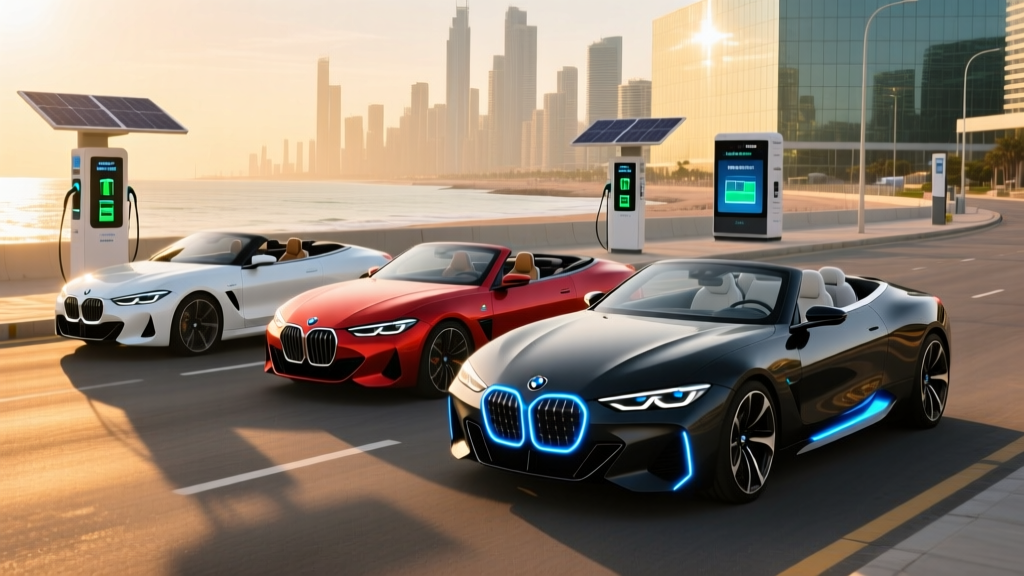
The Quick Answer: Does a BMW Electric Convertible Exist?
As of the 2026 model year, BMW does not sell a fully electric (BEV) convertible. There is no battery-electric version of the Z4 roadster, the 4 Series Convertible, or the 8 Series Convertible. If you want open-air driving with some electrification from BMW today, your closest option is the BMW 430i Convertible (gas) or the plug-in-hybrid BMW XM (an SUV, not a convertible). BMW's Neue Klasse EV platform — which underpins the upcoming iX3 and future i3 sedans — has not been adapted for a drop-top body style.
For buyers specifically searching for a BMW electric convertible, the honest path forward requires understanding what BMW currently offers, what's rumored for 2027+, and whether adjacent options (like the MINI Cooper SE Convertible or non-BMW electric roadsters) fit your needs.
BMW's 2026 Convertible Lineup: Gas, Hybrid, and Electric Reality
BMW's current convertible portfolio is entirely internal-combustion. Here's what's on dealer lots for 2026:
| Model | Powertrain | Engine / Motor | HP | 0–60 mph | EPA Combined MPG | Base MSRP |
|---|---|---|---|---|---|---|
| BMW Z4 sDrive30i | Gas (ICE) | 2.0L turbo I4 | 255 | 5.2 sec | 28 MPG | $54,500 |
| BMW Z4 M40i | Gas (ICE) | 3.0L turbo I6 | 382 | 4.0 sec | 25 MPG | $66,700 |
| BMW 430i Convertible | Gas (ICE) | 2.0L turbo I4 | 255 | 5.8 sec | 28 MPG | $55,900 |
| BMW M440i Convertible | Gas + 48V mild hybrid | 3.0L turbo I6 + 48V | 386 | 4.5 sec | 27 MPG | $66,200 |
| BMW 840i Convertible | Gas (ICE) | 3.0L turbo I6 | 335 | 4.6 sec | 25 MPG | $93,300 |
Notable: the M440i's 48-volt mild-hybrid system provides stop-start smoothing and marginal efficiency gains, but it cannot drive on electric power alone. This is not a plug-in hybrid and does not qualify for any federal EV tax credit under IRS §30D rules.
Why Hasn't BMW Built an Electric Convertible?
Building a battery-electric convertible presents engineering challenges that explain BMW's hesitation:
- Structural rigidity. Convertibles lack a fixed roof, requiring reinforced sills and floor pans. Adding a 400–500 kg battery pack to an already reinforcement-heavy chassis creates weight and packaging conflicts.
- Low volume, high cost. Convertibles represent a tiny fraction of BMW sales. Developing a dedicated EV convertible platform (or adapting Neue Klasse for a soft-top) is difficult to justify on unit economics.
- Thermal management complexity. Battery cooling systems add underbody mass that competes with the structural bracing a convertible needs.
- Range penalty. Convertibles are aerodynamically compromised (open top = higher drag coefficient). Combined with heavy structural reinforcement, an electric convertible would likely deliver 15–25% less range than its coupe equivalent.
For context, even Tesla's Roadster (announced 2017, still not in production as of 2026) is technically a removable-hardtop roadster, not a traditional soft-top convertible. The only recent production electric convertible from a major brand was the MINI Cooper SE Convertible — a limited run of 999 units sold in Europe for the 2023 model year, based on the older 32.6 kWh battery platform with roughly 115 miles of WLTP range. BMW Group owns MINI, making that car the closest thing to a BMW-affiliated electric convertible that has ever been sold.
Cost Comparison: BMW Z4 Gas vs. What an Electric Equivalent Would Cost
Since no BMW electric convertible exists, let's model what ownership would look like if you bought a Z4 sDrive30i today versus what a hypothetical electric roadster at similar performance might cost. We'll use the Tesla Roadster's announced specs and the Porsche Boxster EV (announced for ~2027) as reference points.
| Cost Category | BMW Z4 sDrive30i (2026) | Hypothetical EV Roadster (~$80K) |
|---|---|---|
| Purchase Price (MSRP) | $54,500 | $80,000 (est.) |
| Federal Tax Credit (§30D) | $0 | $0–$7,500 (depends on sourcing & MSRP cap) |
| Fuel / Electricity (5 yrs, 60K mi) | $9,200 (premium gas @ $4.50/gal, 28 MPG) | $2,700 (home charging @ $0.14/kWh, 3.5 mi/kWh) |
| Maintenance (5 yrs) | $3,800 (oil, brakes, filters) | $1,200 (cabin filter, wipers, tire rotation) |
| Insurance (5 yrs avg) | $12,500 | $14,000 (EV premium typical) |
| Estimated Depreciation | $22,000 | $28,000 (EVs depreciate faster currently) |
| Total 5-Year Cost | $102,000 | $118,500 – $111,000 (with credit) |
Key takeaway: Even if a BMW electric convertible existed at ~$80,000, the higher purchase price and steeper EV depreciation would offset fuel and maintenance savings over five years. The math improves significantly if you keep the car 8–10 years, drive more than 15,000 miles annually, or have access to free/cheap workplace charging.
What About the Future? BMW's EV Convertible Prospects (2027+)
BMW has not officially announced an electric convertible. However, here's what we know about the company's direction:
- Neue Klasse platform (debuted with the 2026 iX3) supports rear-wheel and all-wheel-drive configurations and is designed for sedans and SUVs initially. No roadster variant has been confirmed.
- Z4 future uncertain. The current G29-generation Z4 (co-developed with Toyota's Supra) is expected to end production without a direct ICE successor. Industry reports suggest BMW may discontinue the Z4 entirely rather than develop a standalone EV roadster.
- 4 Series / 8 Series convertibles are also low-volume products. BMW has been consolidating its lineup, making an electric successor for these niche models unlikely before 2030.
If BMW does eventually build an electric drop-top, the most plausible candidate would be a Neue Klasse-based 4 Series Convertible arriving around 2028–2029, sharing components with the next-generation i4 sedan. This is speculation — not an announced product.
Alternatives: Electric Open-Air Driving in 2026
If the core desire is an electric car you can drive with the top down, here's what actually exists or is orderable in 2026:
| Vehicle | Type | EPA Range | Battery | 0–60 mph | Price | Status |
|---|---|---|---|---|---|---|
| Tesla Roadster (2nd gen) | Removable glass roof | ~620 mi (claimed, unverified) | 200 kWh (claimed) | <2.0 sec (claimed) | $200,000+ | Announced; not in production |
| MG Cyberster | Soft-top convertible | ~270 mi (WLTP; ~230 EPA est.) | 77 kWh NMC | 4.9 sec | ~£55,000 (UK) | On sale in UK/EU; not US-certified |
| Fiat 500e La Prima Cabrio | Soft-top convertible | ~150 mi (WLTP est.) | 42 kWh NMC | 9.0 sec | ~€36,000 (EU) | EU only; not available in US |
| Porsche Boxster EV | Roadster (expected) | TBD | TBD (PPE platform) | TBD | TBD | Announced for ~2027 |
US buyers face a thin market. The MG Cyberster is not certified for US sale, the Fiat 500e Cabrio isn't imported, and the Tesla Roadster remains vaporware. The Porsche Boxster EV is the most credible upcoming option but won't arrive before 2027 at the earliest.
Myths vs. Facts: BMW Electric Convertible Searches
| Myth | Fact |
|---|---|
| "The BMW i4 comes as a convertible." | False. The i4 is available only as a four-door Gran Coupe. No convertible variant exists or has been announced. |
| "The BMW Z4 has a hybrid or electric version." | False. The Z4 is gas-only (sDrive30i, M40i). No mild-hybrid, PHEV, or BEV variant is offered. |
| "I can convert a BMW EV to a convertible aftermarket." | Technically possible but extremely impractical. Cutting the roof of an i4 would compromise the structural integration with the battery enclosure, void all warranties, and likely be uninsurable. |
| "BMW will definitely launch an electric Z4." | Unconfirmed. Multiple industry reports suggest the Z4 nameplate may be discontinued rather than electrified. |
| "The MINI Cooper SE Convertible is available in the US." | False. It was a 999-unit EU-only limited edition (2023 model year). No US sales occurred. |
Decision Framework: What Should You Actually Buy?
If you want a BMW convertible today:
Buy the BMW M440i Convertible ($66,200). You get 386 HP, a refined 48V mild-hybrid inline-six, and the best balance of performance and daily comfort in BMW's current drop-top lineup. Accept that it's gas-powered and ineligible for any EV tax credit.
If you want an electric BMW and can wait:
Watch for the next-generation 4 Series (expected ~2027–2028 on Neue Klasse). If BMW offers a convertible body style on the EV platform, it would likely be badged as an i4 Convertible. No confirmation exists — set a reminder, not a deposit.
If open-air electric driving is the priority (brand-agnostic):
Wait for the Porsche Boxster EV (~2027) or investigate importing an MG Cyberster (complex, costly, not recommended without a registered importer). If you're in Europe, the MG Cyberster is orderable now.
If you need an electric BMW now and can skip the convertible:
Buy the BMW i4 eDrive40 ($57,900, EPA 307 miles, 335 HP, 81.5 kWh NMC battery, peak 205 kW DC charging, 10–80% in ~31 minutes). It's the closest thing to what an electric 4 Series Convertible might feel like — minus the open top.
Real-World Ownership Considerations for Any BMW EV Buyer
If you're pivoting from the convertible search to a BMW EV, keep these practical factors in mind:
- Home charging is essential. BMW's EVs (i4, iX, i7) accept 11 kW on Level 2 AC, adding roughly 30–35 miles per hour of charging. A full home charge from 10–100% takes about 8 hours. Without home charging, EV ownership becomes significantly less convenient.
- Cold-weather range loss. Expect 15–30% range reduction in freezing temperatures, depending on whether the model has a heat pump (the i4 does). A 307-mile i4 may deliver 215–260 miles on a cold highway day.
- Charging curve reality. The i4's 205 kW peak charge rate applies only between roughly 10–30% State of Charge. Above 80%, charging slows dramatically to protect the NMC battery. Plan DC fast stops around the 10–80% window (~31 minutes) rather than 0–100%.
- Federal tax credit (§30D). As of 2026, the BMW i4 assembled in Germany does not qualify for the $7,500 new clean vehicle credit because it fails the North American final assembly requirement. The point-of-sale transfer option is irrelevant if the vehicle doesn't meet baseline eligibility. Always verify current rules at IRS.gov and check fueleconomy.gov for eligible vehicle lists.
- Battery warranty. BMW covers its high-voltage batteries for 8 years / 100,000 miles against defects and capacity loss below 70% of original capacity — standard among German automakers.
Frequently Asked Questions
Will BMW ever make an electric convertible?
BMW has not announced any electric convertible as of early 2026. The company's Neue Klasse EV platform currently targets sedans and SUVs. A convertible variant is theoretically possible on future iterations but has not been confirmed for any model year.
Is the BMW Z4 being discontinued?
Industry reports indicate the current Z4 (G29 generation, co-developed with Toyota) will end production without a direct successor. BMW has not made an official announcement, but a next-generation Z4 — electric or otherwise — appears unlikely before 2030.
Does the BMW i4 qualify for the $7,500 federal EV tax credit?
No. The BMW i4 is assembled in Munich, Germany, and does not meet the North American final assembly requirement under §30D. It is ineligible for the new clean vehicle credit regardless of buyer income or battery sourcing. Always confirm current eligibility at IRS.gov.
What is the cheapest electric convertible I can buy in the US?
As of 2026, there is no affordable, mass-production electric convertible available for US purchase. The market segment effectively does not exist domestically. The MG Cyberster and Fiat 500e Cabrio are EU/UK-only. The Tesla Roadster remains unproduced.
Can I lease a BMW convertible and swap to an EV later?
Yes. Leasing a BMW M440i Convertible for 36 months lets you enjoy open-air driving now while waiting for BMW's electric lineup to expand. When the lease ends (~2029), the Neue Klasse platform will have matured, and an electric 4 Series Convertible — if BMW greenlights one — may be available.
How much does it cost to charge a BMW EV at home vs. public DC fast charging?
Home Level 2 charging costs approximately $0.10–$0.18 per kWh depending on your utility rate, translating to roughly $0.03–$0.05 per mile. Public DC fast charging (Electrify America, EVgo) typically runs $0.35–$0.55 per kWh, or $0.10–$0.16 per mile — still cheaper than premium gasoline at $4.50/gallon in a 28 MPG car ($0.16/mile), but the savings shrink significantly versus home charging.