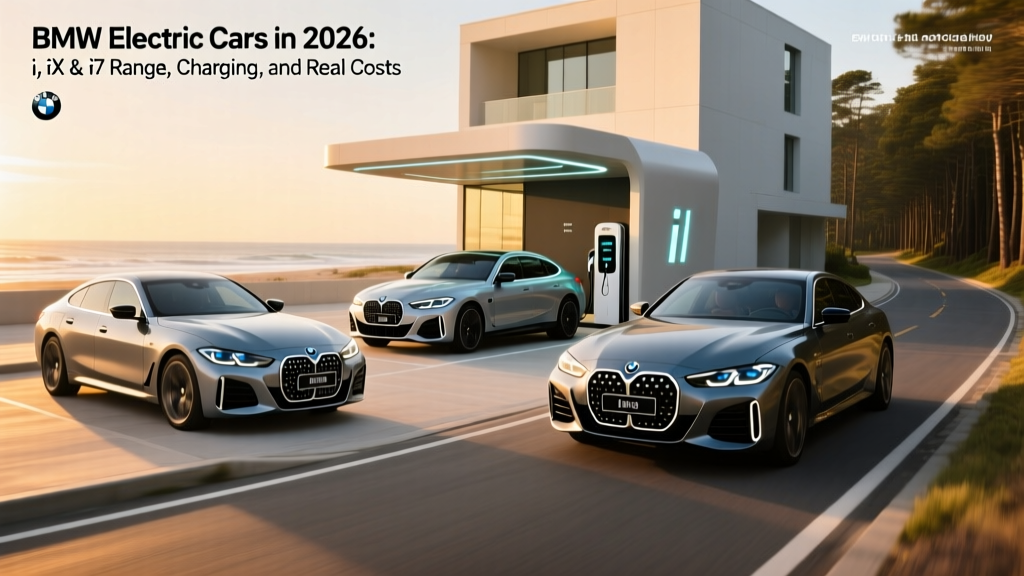
Quick Answer: Are BMW Electric Cars Worth It in 2026?
BMW's electric lineup centers on three models: the i4 gran coupe (up to 307 miles EPA, from ~$52,000), the iX SUV (up to 324 miles EPA, from ~$75,000), and the i7 luxury sedan (up to 318 miles EPA, from ~$105,000). All use BMW's fifth-generation eDrive powertrain with NMC battery chemistry and support DC fast charging up to 205 kW (i4/iX) or 195 kW (i7), achieving a 10–80% charge in roughly 28–31 minutes at a compatible station. For current BMW sedan or SUV owners, switching to electric saves an estimated $1,200–$1,800 annually on fuel and maintenance, though higher insurance premiums and upfront pricing remain real trade-offs. None of these models currently qualify for the full $7,500 federal §30D tax credit due to battery-sourcing requirements — always verify current eligibility at IRS.gov.
BMW's 2026 EV Lineup: i4, iX, and i7 at a Glance
BMW doesn't build a dedicated EV platform the way Hyundai's E-GMP or Tesla's unibody architecture work. Instead, the i4 shares its CLAR underpinnings with the 4 Series Gran Coupe, the iX is a standalone electric SUV, and the i7 mirrors the 7 Series sedan. This shared-platform approach means familiar BMW driving dynamics, but packaging compromises — the i4's rear floor hump, for instance, persists from its ICE sibling.
| Spec | 2026 BMW i4 eDrive40 | 2026 BMW iX xDrive50 | 2026 BMW i7 eDrive50 |
|---|---|---|---|
| EPA Range | 307 mi | 324 mi | 318 mi |
| Battery (usable) | 81.5 kWh (NMC) | 105.2 kWh (NMC) | 101.7 kWh (NMC) |
| Horsepower | 335 hp | 516 hp | 455 hp |
| 0–60 mph | 5.5 sec | 4.4 sec | 4.5 sec |
| Peak DC Charge Rate | 205 kW | 205 kW | 195 kW |
| 10–80% DCFC Time | ~31 min | ~35 min | ~34 min |
| Level 2 (11 kW) Time | ~8.25 hr | ~11 hr | ~10.5 hr |
| MPGe (combined) | 99 MPGe | 86 MPGe | 84 MPGe |
| Base MSRP | $52,200 | $75,150 | $105,700 |
| Battery Warranty | 8 yr / 80,000 mi | 8 yr / 80,000 mi | 8 yr / 80,000 mi |
| NACS Port | Yes (2025+) | Yes (2025+) | Yes (2025+) |
Sources: fueleconomy.gov, BMW USA specifications. EPA estimates; real-world range varies.
Real-World Range: What the EPA Sticker Doesn't Tell You
EPA vs. Reality: The i4 eDrive40's 307-mile EPA rating assumes a mix of city and highway driving at moderate temperatures. Expect ~250–270 miles on sustained highway runs at 70–75 mph, and as low as ~210–230 miles in sub-freezing winter conditions. The iX xDrive50's taller, heavier profile means highway efficiency drops more sharply — plan for ~260–280 real-world highway miles despite its 324-mile sticker.
BMW's thermal management system includes a heat pump (standard on all three models), which mitigates cold-weather range loss compared to resistive heating. In testing, BMW iX owners report roughly 15–20% range reduction at 20°F, which is competitive with the segment but still meaningful for drivers in northern climates. If your daily commute is under 60 miles round-trip, even worst-case winter range won't matter — you'll charge at home overnight and never notice.
Charging-curve taper is also worth understanding. The i4's 205 kW peak only holds from roughly 10% to 35% state of charge. Above 50%, the curve drops to ~120 kW, and above 80%, it slows to under 50 kW to protect the NMC cells. That's why BMW (and every automaker) quotes 10–80% times rather than 0–100%. For road-trip planning, plan to charge to 80% and move on — the last 20% can add 15–20 minutes at the stall.
BMW EV vs. Gas BMW: 5-Year Cost Breakdown
Let's compare the i4 eDrive40 against the closest gas equivalent, the BMW 430i Gran Coupe, over five years and 75,000 miles. This is where the EV economics get concrete.
| Cost Category | BMW i4 eDrive40 | BMW 430i Gran Coupe |
|---|---|---|
| Base MSRP | $52,200 | $49,300 |
| Est. Federal Tax Credit (§30D) | $0–$3,750* | $0 |
| Fuel / Electricity (75k mi) | $3,150** | $8,250*** |
| Maintenance (5 yr) | $1,200 | $3,800 |
| Insurance (5 yr avg) | $11,500 | $9,500 |
| Estimated Depreciation | $22,000 | $19,500 |
| 5-Year Total Cost | ~$40,050 | ~$51,350 |
* §30D credit eligibility for BMW EVs is limited by battery critical-mineral and component sourcing rules. Check current status at IRS.gov. Some buyers may qualify for partial credit or none.
** Assumes $0.14/kWh national average, 70% home / 30% public DCFC mix.
*** Assumes premium gasoline at $4.10/gal, 28 MPG combined (per EPA).
The i4 wins on total cost primarily through fuel and maintenance savings — no oil changes, fewer brake replacements (regen braking saves pads), and electricity that costs roughly a third of premium gasoline per mile. The gap narrows if you can't charge at home and rely entirely on public DC fast chargers at $0.35–$0.50/kWh, which pushes the i4's fuel cost closer to $5,500 over five years.
Charging at Home and on the Road: What You Actually Need
Starting with the 2025 model year, BMW transitioned all US-market EVs to the NACS (Tesla-style) charge port, giving native access to the Tesla Supercharger network — over 20,000 stalls nationwide. This was a major practical upgrade; earlier CCS-port BMWs required an adapter for Supercharger access.
| Charging Level | Power (kW) | Miles Added per Hour | Typical Use Case |
|---|---|---|---|
| Level 1 (120V outlet) | ~1.4 kW | ~4–5 mi/hr | Emergency / trickle only |
| Level 2 (240V, 48A) | ~11 kW | ~30–35 mi/hr | Home daily charging |
| DC Fast (NACS Supercharger) | Up to 205 kW | ~180 mi in 10 min | Road trips |
Home charging setup: Most BMW EV owners install a 240V Level 2 wallbox on a 60-amp circuit (delivering 48A continuous). Equipment costs $400–$700 (BMW's own Wallbox or third-party options like ChargePoint or Emporia), and professional installation runs $800–$2,500 depending on your electrical panel's proximity to the garage. If your panel is maxed out at 100A or 150A, a panel upgrade to 200A adds $1,500–$3,000. Always get a quote from a licensed electrician before committing.
Public charging reality: The Supercharger network is the most reliable DCFC option, with typical pricing of $0.28–$0.40/kWh. Electrify America and EVgo also support NACS vehicles, but real-world reliability varies. Plan road trips using BMW's built-in navigation, which preconditions the battery for optimal charge speed when a DCFC is set as your destination — this can shave 5–8 minutes off your 10–80% time in cold weather.
Federal Tax Credits and Incentives: The §30D Reality for BMW
This is where BMW buyers face a frustrating truth. The federal §30D clean vehicle credit offers up to $7,500, split into two halves: $3,750 for meeting critical-mineral sourcing requirements and $3,750 for battery-component sourcing. As of 2026, BMW's battery supply chain (cells sourced from Samsung SDI and CATL) has not fully met the domestic-content thresholds required for the full credit.
§30D Requirements to Check:
- MSRP cap: Sedans (i4, i7) must be under $55,000; SUVs/vans (iX) under $80,000. The i7 exceeds the sedan cap entirely.
- Buyer income cap: AGI must be ≤$150,000 (single), $225,000 (head of household), or $300,000 (joint).
- Battery sourcing: Critical minerals and components must meet escalating domestic/FHA-partner thresholds per IRS guidelines.
- Point-of-sale transfer: If eligible, you can transfer the credit to the dealer for an immediate price reduction at purchase.
Some BMW EV buyers may qualify for a partial $3,750 credit (critical-mineral half only, depending on the model year and sourcing updates). Others may qualify for none. Always check the latest eligibility list at fueleconomy.gov before purchase. State-level incentives (California's CVRP, Colorado's innovative motor vehicle credit, etc.) may partially offset the gap — check your state's energy office for current programs.
Common Misconceptions About BMW Electric Cars
| Myth | Fact |
|---|---|
| "The battery will need replacing in 5 years." | BMW's NMC batteries are warranted for 8 years/80,000 miles at 70%+ capacity. Industry data shows typical degradation of ~10–12% over 100,000 miles with proper charging habits. |
| "BMW EVs can't use Tesla Superchargers." | All 2025+ BMW EVs have native NACS ports and full Supercharger access. Pre-2025 CCS models can use a BMW-approved adapter. |
| "Electric BMWs aren't fun to drive." | The i4 M50 (593 hp, 0–60 in 3.3 sec) and iX M60 (610 hp) are among the quickest vehicles BMW makes. Even the base i4's instant torque and low center of gravity deliver responsive handling. |
| "Charging takes too long for road trips." | A 10–80% DC fast charge takes ~31 minutes in the i4 — roughly the length of a rest-stop lunch break. Plan 2–3 stops on a 600-mile trip. |
| "I need a special electrical setup." | A standard NEMA 14-50 outlet (the same as a dryer outlet) delivers ~30 miles of range per hour of charging — sufficient for most daily needs. A hardwired wallbox is faster but not mandatory. |
Decision Framework: Which BMW Electric Car Is Right for You?
Choose the BMW i4 eDrive40 if: You want a sporty daily-driver sedan with 300+ miles of range, mostly commute under 80 miles round-trip, and want the lowest entry price in BMW's EV lineup. Best for: current 3/4 Series owners ready to go electric.
Choose the BMW i4 M50 if: Performance matters most — 593 hp and M-tuned suspension, but you sacrifice ~40 miles of range (270 mi EPA) and pay ~$67,000.
Choose the BMW iX xDrive50 if: You need an SUV with family-hauling cargo space (35.5 cu ft behind the rear seats), all-wheel drive for snow-belt winters, and don't mind a $75K+ starting price. Best for: current X5 owners.
Choose the BMW i7 eDrive50 if: You're cross-shopping a Mercedes EQS or Porsche Taycan and want a full-size luxury sedan. The $105K+ price and likely §30D ineligibility (MSRP exceeds the $55K sedan cap) mean this is a purchase driven by preference, not incentives.
Stick with gas or consider a PHEV if: You lack home charging access, regularly drive 400+ miles between charging stops in rural areas, or your budget can't absorb the higher upfront cost and insurance premiums of an EV.
Frequently Asked Questions
Do BMW electric cars hold their resale value?
BMW EVs have seen steeper depreciation than Tesla or Porsche EVs in recent years — the i4 and iX typically lose 45–55% of value over three years, versus 35–40% for comparable gas BMWs. This gap is narrowing as the used-EV market matures, but leasing (often with BMW's subsidized money factor) can be a smart way to hedge depreciation risk.
Can I charge a BMW EV at a Tesla Supercharger today?
Yes — all 2025 and newer BMW EVs sold in the US have the NACS port built in and can use any Supercharger stall without an adapter. For 2022–2024 models with CCS ports, BMW offers an official NACS adapter (~$200) that enables Supercharger access.
What happens if the battery degrades significantly?
BMW's high-voltage battery warranty covers capacity loss below 70% for 8 years or 80,000 miles. If your battery falls below that threshold within the warranty period, BMW will repair or replace it at no cost. Out-of-warranty replacement costs are estimated at $12,000–$18,000 depending on the model, though few owners report needing this within the first decade of ownership.
Is BMW's driver-assistance system self-driving?
No. BMW's Driving Assistant Professional is a SAE Level 2 system — it combines adaptive cruise control and lane-centering but requires the driver to remain fully engaged and hands on or near the wheel at all times. BMW's Highway Assistant (available on the i7 and iX) allows hands-off driving at speeds up to 85 mph on divided highways, but the driver must still monitor the road and remain ready to take over immediately. This is not autonomous driving.
How does BMW EV insurance compare to gas BMWs?
Expect to pay 15–25% more for insurance on a BMW EV versus its gas counterpart. Average annual premiums for the i4 run $2,100–$2,500 depending on your state, driving record, and coverage level. The higher repair costs for EV-specific components (battery pack, power electronics) drive this premium. Shop quotes from GEICO, Progressive, and EV-specialty insurers before purchasing.
Should I buy or lease a BMW EV in 2026?
Leasing has advantages for BMW EVs: BMW frequently offers aggressive lease money factors, you avoid long-term depreciation risk, and some lease deals pass through a $7,500 commercial clean-vehicle credit (§45W) as a capitalized-cost reduction — even when the vehicle doesn't qualify for the consumer §30D credit. If you drive under 12,000 miles/year and prefer a new car every 36 months, leasing is often the more economical path.