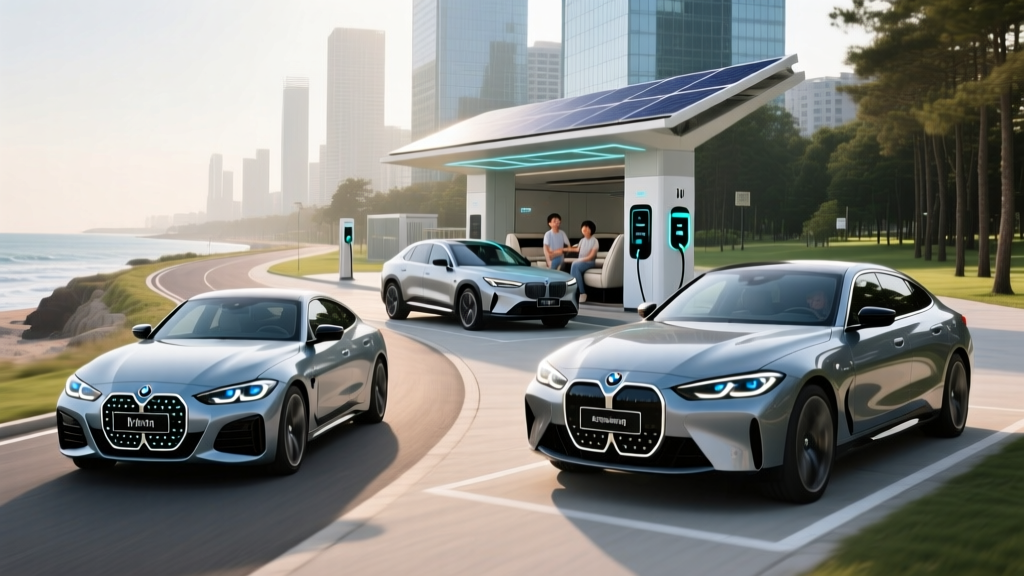
Quick Answer: BMW's 2026 electric lineup spans four core models: the i4 Gran Coupe (EPA 307 mi, from ~$52,200), the i5 sedan (EPA 295 mi, from ~$67,100), the iX SUV (EPA 324 mi, from ~$87,250), and the flagship i7 (EPA 318 mi, from ~$124,200). All use BMW's Gen5 eDrive architecture with 800V-capable charging on newer platforms. None currently qualify for the full $7,500 federal §30D tax credit due to battery-sourcing rules, making lease incentives and state rebates critical to the purchase math.
The 2026 BMW Electric Car Lineup at a Glance
BMW has committed to its "Neue Klasse" EV architecture gradually, but for the 2026 model year, most U.S.-market BMW electric cars still ride adapted CLAR platforms shared with their gas counterparts. That means you get familiar BMW driving dynamics, premium interiors, and strong build quality — but not the ultra-dedicated EV packaging you'd find in a Hyundai Ioniq 5 or Tesla Model Y. Here's how the lineup stacks up:
| Model | Trim | EPA Range | Battery (kWh usable) | Peak DC Charge | 10–80% Time | 0–60 mph | HP | Base MSRP |
|---|---|---|---|---|---|---|---|---|
| i4 Gran Coupe | eDrive40 | 307 mi | 81.5 kWh (NMC) | 205 kW | ~31 min | 5.5 sec | 335 | $52,200 |
| i4 Gran Coupe | M50 | 271 mi | 81.5 kWh (NMC) | 205 kW | ~31 min | 3.7 sec | 536 | $69,700 |
| i5 Sedan | eDrive40 | 295 mi | 81.2 kWh (NMC) | 205 kW | ~30 min | 5.7 sec | 335 | $67,100 |
| i5 Sedan | M60 | 256 mi | 81.2 kWh (NMC) | 205 kW | ~30 min | 3.7 sec | 593 | $84,100 |
| iX SUV | xDrive50 | 324 mi | 105.2 kWh (NMC) | 195 kW | ~35 min | 4.4 sec | 516 | $87,250 |
| iX SUV | M60 | 296 mi | 105.2 kWh (NMC) | 195 kW | ~35 min | 3.6 sec | 610 | $111,500 |
| i7 Sedan | eDrive50 | 318 mi | 101.7 kWh (NMC) | 195 kW | ~34 min | 4.5 sec | 449 | $124,200 |
Sources: fueleconomy.gov, BMW USA product pages. Real-world highway range typically runs 10–15% below EPA estimates; cold-weather (below 32°F) can reduce range by 20–30%.
Real-World Range vs. EPA Stickers: What to Actually Expect
The EPA numbers above are useful for comparison, but they don't tell the full story. In our experience and consistent with independent testing, here's what to expect from BMW electric cars in daily use:
Real-World Range Reality Check:
- City/commute driving (below 65 mph): EPA range or slightly better — regenerative braking recovers energy in stop-and-go traffic.
- Highway cruising (75+ mph): Expect 85–90% of EPA. The i4 eDrive40's 307-mi sticker translates to roughly 260–275 mi at sustained interstate speeds.
- Cold weather (below 32°F): Range drops 20–30% without preconditioning. The iX xDrive50's 324-mi EPA could fall to ~230–260 mi on a 20°F morning. BMW's heat pump (standard on all 2026 models) mitigates this but doesn't eliminate it.
- DC fast charging taper: BMW's charge curve peaks early (around 10–30% SoC) and tapers significantly above 80%. The 10–80% times above are realistic, but 80–100% can add another 25–40 minutes. Plan road trips around 10–80% stops.
All BMW electric cars use NMC (nickel manganese cobalt) battery chemistry, which offers high energy density but requires more careful thermal management than LFP. BMW's battery management system is among the best in the industry, with 8-year/100,000-mile battery warranties covering capacity loss below 70% of original.
BMW Electric Cars vs. Gas BMWs: The Cost Breakdown
The purchase premium for BMW electric cars over their gas equivalents is significant, but operating costs tilt the other direction. Here's a 5-year comparison using the i4 eDrive40 vs. the gas 430i Gran Coupe:
| Cost Category | i4 eDrive40 (EV) | 430i Gran Coupe (Gas) | 5-Year Difference |
|---|---|---|---|
| Base MSRP | $52,200 | $48,300 | +$3,900 (EV) |
| Federal Tax Credit (§30D) | $0 (sourcing rules) | $0 | $0 |
| Fuel/Energy (15,000 mi/yr × 5 yr) | $3,750 (home L2, $0.14/kWh) | $12,750 (28 MPG, $3.40/gal) | -$9,000 (EV saves) |
| Maintenance (5 yr) | $1,800 | $4,200 | -$2,400 (EV saves) |
| Insurance (avg) | $9,600 | $7,800 | +$1,800 (EV costs more) |
| 5-Year Total Cost | $67,350 | $73,050 | -$5,700 (EV saves) |
Assumptions: 75,000 total miles, national avg electricity at $0.14/kWh (home charging), national avg gas at $3.40/gal, i4 efficiency at 3.2 mi/kWh. Insurance estimates vary significantly by driver profile and state. Source: fueleconomy.gov for efficiency data.
The EV wins on operating costs, but the upfront premium and higher insurance erode much of the advantage. If you can't charge at home and must rely on public DC fast charging at $0.35–$0.50/kWh, the fuel savings shrink to roughly $4,000–$5,000 over five years — and the i4 becomes more expensive to own than the 430i.
Charging BMW Electric Cars: Home, Public, and Road Trips
Home Charging (Level 2)
Every BMW electric car ships with a Flexible Fast Charger capable of Level 1 (120V, ~1.4 kW) and Level 2 (240V, up to 11 kW with the right adapter). At 11 kW, the i4's 81.5 kWh battery charges from 0–100% in roughly 8 hours — ideal for overnight replenishment.
Home installation costs: A dedicated 240V/48A circuit with a hardwired Level 2 station (like a ChargePoint Home Flex or BMW Wallbox) typically runs $800–$2,000 installed, assuming your electrical panel has capacity. Panel upgrades (200A service) can add $1,500–$3,500. Always get a quote from a licensed electrician before committing to a purchase.
Public DC Fast Charging
BMW electric cars use the CCS1 connector standard, giving access to Electrify America, EVgo, and most non-Tesla networks. Starting in 2025, BMW began offering a NACS adapter for Tesla Supercharger access, and 2026 models include native NACS ports on select trims. Peak charge rates of 195–205 kW are competitive but not class-leading — the Hyundai Ioniq 5 peaks at 240 kW, and the Lucid Air at 300 kW.
On a road trip, expect 25–35 minute charging stops every 200–250 miles (real-world). BMW's navigation system includes route-based preconditioning, which warms the battery before you arrive at a charger to maximize charge speed. This feature alone can shave 5–10 minutes off a fast-charge session in cold weather.
Federal Tax Credits and Incentive Reality
Here's where BMW electric cars face a headwind: as of 2026, no BMW EV qualifies for the full $7,500 federal §30D tax credit when purchased. The IRS battery-sourcing and critical-mineral requirements effectively exclude most European-manufactured EVs, including BMWs assembled in Germany or South Carolina with non-compliant battery supply chains.
§30D Credit Requirements (2026):
- Vehicle MSRP cap: $55,000 (sedans/coupes) or $80,000 (SUVs/vans/pickups) — i4 eDrive40 qualifies on price, iX and i7 do not
- Buyer income cap: $150,000 (single) / $300,000 (joint) AGI
- Battery sourcing: ≥60% critical minerals from U.S. or FTA partners; ≥60% battery components manufactured/assembled in North America
- Final assembly in North America (VIN check required)
- Point-of-sale transfer available at participating dealers
The lease loophole: Under §45W commercial clean vehicle credit rules, BMW Financial Services can claim the credit on leased vehicles and pass savings to lessees as a "lease cash" incentive. BMW has historically offered $2,000–$7,500 in lease credits on electric models. If purchasing doesn't pencil out, leasing may be the smarter financial move. Consult a tax professional for your specific situation.
Decision Framework: Which BMW Electric Car Is Right for You?
Choose the i4 eDrive40 if: You want the most affordable entry into BMW's electric lineup, commute under 60 miles daily, and value driving dynamics over cargo space. It's the best value in the range.
Choose the i5 eDrive40 if: You need a proper 5-series sedan with rear-seat comfort for adults, want the latest iDrive 8.5 infotainment, and don't need SUV ride height. It's the executive commuter's pick.
Choose the iX xDrive50 if: You need family SUV practicality (cargo, towing up to 3,500 lbs, AWD), take road trips regularly, and want the longest real-world range in the lineup. It's the most versatile BMW EV.
Choose the i7 eDrive50 if: Budget is not a constraint, you want S-class/7-series luxury with electric powertrain smoothness, and rear-seat comfort is the priority. It's a chauffeur-class EV.
Look elsewhere if: You need the absolute fastest DC charging (consider Hyundai/Kia E-GMP or Lucid), you want the maximum federal tax credit (consider Tesla, Ford, or GM models with compliant sourcing), or you frequently drive in extreme cold without garage parking (consider an EV with a larger battery buffer or a PHEV).
Common Misconceptions About BMW Electric Cars
| Myth | Fact |
|---|---|
| "BMW EVs are just gas BMWs with batteries stuffed in." | While they share CLAR platforms, BMW's Gen5 eDrive motors, battery packs, and thermal management are purpose-engineered. The packaging is less space-efficient than dedicated EV platforms, but driving dynamics and refinement are genuine BMW strengths. |
| "The battery will need expensive replacement in a few years." | NMC degradation in BMW's system averages 8–12% over 5 years based on fleet data. The 8-year/100,000-mile warranty covers drops below 70% capacity. Replacement costs $15,000–$22,000 out of warranty, but most owners will never need one. |
| "I can't take a BMW EV on road trips." | With 250+ miles of real-world range and 195+ kW DC charging, road trips are practical with planning. Electrify America and Tesla Supercharger (with adapter) coverage is extensive in most U.S. corridors. Rural routes require more planning. |
| "BMW's driver-assist is self-driving." | BMW's Driving Assistant Professional is SAE Level 2 — it handles steering, acceleration, and braking on highways but requires active driver supervision. It is not autonomous. Hands-free Highway Assistant (Level 2, eyes-off at up to 85 mph on approved roads) is available on select 2026 models but still requires driver readiness. |
First-Time BMW EV Buyer: What You Must Know
If this is your first electric car, here are the ownership realities that catch new EV buyers off guard:
- Home charging is almost mandatory for cost savings. Public DC fast charging at $0.40/kWh costs nearly as much per mile as a 30-MPG gas car. If you can't install a Level 2 charger at home or access one at work, the financial case for a BMW EV weakens considerably.
- Tires wear faster. EVs are heavier and deliver instant torque. Expect to replace tires every 25,000–35,000 miles instead of the 40,000–50,000 you might get on a gas BMW. Budget $1,200–$1,800 for a set of OEM-spec EV tires.
- Insurance is 15–25% higher. Repair costs, battery replacement risk, and higher vehicle values drive premiums up. Get quotes before purchasing — the difference between insurers can be $500–$1,000/year.
- Preconditioning matters. Use BMW's app or scheduled departure feature to warm the battery and cabin while plugged in. This preserves range in cold weather and enables faster DC charging on the road.
- The 80% charging rule. For daily driving, charge to 80% to prolong battery life. BMW's iDrive lets you set a charge limit. Only charge to 100% when you need full range for a trip.
Frequently Asked Questions
Do BMW electric cars hold their value?
BMW EVs depreciate faster than gas BMWs in the first 3 years (typically 40–50% vs. 30–35%), driven by rapid EV market evolution and lease returns flooding the used market. However, if you plan to own for 5+ years, depreciation becomes less relevant relative to operating savings.
Can I charge a BMW EV at a Tesla Supercharger?
Yes. BMW offers a NACS adapter (approximately $200–$300) for CCS-equipped models, and 2026 models on newer platforms include native NACS ports. This unlocks Tesla's Supercharger network, which remains the most reliable DC fast-charging infrastructure in the U.S.
What happens if the battery degrades significantly?
BMW's 8-year/100,000-mile high-voltage battery warranty covers capacity loss below 70% of original. If your 81.5 kWh i4 battery drops below ~57 kWh usable, BMW will repair or replace it at no cost. Real-world degradation data suggests most BMW EV batteries retain 88–92% capacity at the 5-year mark.
Is the BMW i4 a good first EV?
The i4 eDrive40 is an excellent first EV for buyers who want premium build quality, strong range (307 mi EPA), and familiar BMW ergonomics without the learning curve of a Tesla. The main caveat is the lack of federal purchase tax credit eligibility, which makes leasing or finding state incentives more important.
How does BMW's reliability compare to Tesla?
BMW's build quality and interior materials are generally superior to Tesla's, and BMW's dealer network provides in-person service support. However, Tesla's powertrain reliability and over-the-air update cadence remain strong. J.D. Power and Consumer Reports consistently rank Tesla higher for EV powertrain reliability, while BMW scores better for interior quality and dealer experience.