The Real Cost of Leasing a BMW Electric Car in 2026
If you're considering a BMW electric car lease, you're likely weighing the allure of Bavarian engineering against the practicalities of EV ownership: monthly payments, charging costs, insurance premiums, and how federal incentives actually apply when you don't own the vehicle outright. This guide cuts through the marketing to give you the exact numbers behind leasing a 2026 BMW i4, i5, or iX — including the often-misunderstood mechanics of how the §30D federal tax credit works in a lease scenario.
Leasing an EV operates differently than purchasing one. The leasing company (BMW Financial Services, in this case) technically claims the vehicle, and any federal tax credit benefit may or may not be passed through to you as a capitalized cost reduction. Understanding this distinction — along with real-world charging costs, insurance realities, and depreciation trends — is essential before you sign.
2026 BMW Electric Lineup: Lease Pricing at a Glance
BMW's 2026 electric portfolio spans three core models. Here's what the lease landscape looks like at base MSRP before any incentives or dealer adjustments:
| Model | Trim | MSRP | Battery (kWh) | EPA Range | Est. Monthly Lease (36 mo) |
|---|---|---|---|---|---|
| BMW i4 | eDrive40 | $57,900 | 83.9 kWh (NMC) | 307 mi | $620–$720 |
| BMW i4 | xDrive40 | $62,900 | 83.9 kWh (NMC) | 282 mi | $680–$780 |
| BMW i5 | eDrive40 | $70,200 | 84.3 kWh (NMC) | 295 mi | $750–$870 |
| BMW i5 | xDrive40 | $75,200 | 84.3 kWh (NMC) | 266 mi | $820–$940 |
| BMW iX | xDrive50 | $87,900 | 111.5 kWh (NMC) | 324 mi | $980–$1,150 |
| BMW iX | M60 | $111,500 | 111.5 kWh (NMC) | 296 mi | $1,250–$1,450 |
Lease estimates assume 10,000 miles/year, $5,000 down, and tier-1 credit. Actual offers vary by dealer and region.
How the Federal Tax Credit Works on a BMW Lease
This is where most BMW EV shoppers get confused. Under IRS §30D rules, the federal clean vehicle credit of up to $7,500 is technically claimed by the vehicle's owner — which in a lease is BMW Financial Services, not you.
However, under the commercial clean vehicle credit (§45W), leasing companies can claim the credit and pass it through to lessees as a capitalized cost reduction (effectively lowering your monthly payment). Most major automakers, including BMW, have been structuring leases to pass this benefit through — but it is not guaranteed by law. Always confirm with your dealer that the lease agreement explicitly reflects the credit as a cap cost reduction.
- MSRP Cap: Sedans/wagons (i4, i5) must have an MSRP ≤ $55,000; SUVs/trucks/vans (iX) must be ≤ $80,000 to qualify for purchase credit. In a lease under §45W, the MSRP cap does not apply — a significant advantage for the iX.
- Buyer Income Limits (purchase only): AGI ≤ $300K joint / $225K head of household / $150K single. Lease structures under §45W bypass these income caps.
- Battery Sourcing: At least 80% of critical minerals must be sourced from the US or FTA partners; 100% of battery components must be manufactured or assembled in North America (2026 phase-in thresholds). BMW's NMC cells are supplied by CATL and Samsung SDI — verify current-year sourcing compliance with your dealer.
- Point-of-Sale Transfer: For purchases, the credit can be transferred to the dealer at sale. For leases, the benefit appears as a cap cost reduction on your lease agreement.
- FEOC Restriction: Vehicles with battery components from a Foreign Entity of Concern (China, Russia, North Korea, Iran) are disqualified. BMW's supply chain has been adjusting — confirm the specific VIN's compliance.
Key takeaway for BMW lessees: The lease structure under §45W often makes it easier to capture the full $7,500 benefit on higher-priced models like the iX (which exceeds the $80K MSRP cap for purchases) and for buyers above the income thresholds. This is one of the strongest arguments for leasing a BMW EV rather than purchasing.
5-Year Total Cost of Ownership: BMW i4 eDrive40 Lease vs. Gas Equivalent
To understand whether a BMW electric car lease makes financial sense, we need to compare the full 5-year picture. Below, we model two consecutive 36-month leases of a BMW i4 eDrive40 against purchasing and holding a comparably equipped BMW 430i Gran Coupe (gas) over the same period.
| Cost Category | BMW i4 eDrive40 (2x 36-mo leases) | BMW 430i Gran Coupe (purchase, 5 yr) |
|---|---|---|
| Vehicle Acquisition (down payments + monthly) | $31,440 ($5K × 2 + $670 × 36 × 2 − $7,500 × 2 cap reduction) | $34,200 ($5K down + $580/mo × 60 at 5.9% APR on ~$52K financed) |
| Fuel / Charging | $4,320 (15,000 mi/yr × 5 yr × $0.058/mi at $0.16/kWh home rate) | $10,500 (15,000 mi/yr × 5 yr × $0.14/mi at $3.50/gal, 25 MPG combined) |
| Insurance | $14,400 ($240/mo avg) | $11,400 ($190/mo avg) |
| Maintenance | $1,800 (cabin filter, wipers, tire rotation, brake fluid) | $4,500 (oil changes, brake pads, filters, spark plugs, transmission fluid) |
| Depreciation / Equity | $0 (returned at lease end; no residual risk) | −$8,500 (vehicle retains ~40% of $55K MSRP = $22K equity) |
| Net 5-Year Cost | $51,960 | $52,100 |
The numbers are remarkably close — and that's before factoring in state incentives, utility rebates, or time-of-use charging discounts that can push the i4 further ahead. The gas 430i benefits from equity at trade-in, but the i4 lease avoids depreciation risk entirely, which matters in a market where EV resale values have been volatile.
Charging vs. Gasoline: The Per-Mile Math
The single largest operational savings in any EV ownership scenario is energy cost. Here's the precise breakdown for the BMW i4 eDrive40:
| Scenario | Rate | Efficiency | Cost Per Mile |
|---|---|---|---|
| Home Level 2 (national avg electricity) | $0.16/kWh | 3.0 mi/kWh (99 MPGe combined) | $0.053/mi |
| Home Level 2 (off-peak TOU rate) | $0.09/kWh | 3.0 mi/kWh | $0.030/mi |
| Public DC Fast Charging (avg) | $0.42/kWh | 2.7 mi/kWh (charging losses) | $0.156/mi |
| BMW 430i Gas (regular unleaded) | $3.50/gal | 25 MPG combined | $0.140/mi |
At home on an off-peak rate, the i4 costs less than a third per mile compared to gasoline. Even at public DC fast chargers — the most expensive way to charge — the i4 is only marginally more costly per mile than the gas 430i. Over 15,000 miles per year, home charging saves roughly $1,300–$1,600 annually versus gasoline.
The i4 supports peak DC charging at 205 kW (CCS/NACS with adapter), reaching 10–80% in approximately 31 minutes. On a Level 2 home charger at 11 kW, a full charge takes about 8.25 hours — plug in overnight and wake up full.
Maintenance Savings: What You'll Never Pay For Again
EVs eliminate the majority of routine powertrain maintenance. BMW's i4 and i5 use a single-speed reduction gear and AC synchronous motor with no transmission fluid, spark plugs, timing belts, or oil to change. Here's what the maintenance delta looks like:
| Service Item | BMW i4 (EV) | BMW 430i (Gas) | 5-Year Savings |
|---|---|---|---|
| Oil Changes (synthetic, every 10K mi) | $0 | $1,050 (7 changes × $150) | $1,050 |
| Brake Pads (front + rear) | $0–$300 (regen extends life 2–3×) | $1,200 (2 replacements × $600) | $900–$1,200 |
| Transmission Fluid | $0 | $350 | $350 |
| Engine Air Filter | $0 | $200 | $200 |
| Spark Plugs | $0 | $400 | $400 |
| Cabin Air Filter (both) | $400 | $400 | $0 |
| Tire Rotation / Replacement | $1,400 (EV tires wear ~15% faster due to weight + torque) | $1,100 | −$300 |
| Total 5-Year Maintenance | $1,800 | $4,700 | $2,900 |
Regenerative braking is the hidden hero here. BMW's adaptive regen system recovers energy during deceleration, dramatically reducing friction brake wear. Many EV owners report original brake pads lasting 100,000+ miles. The tradeoff: EV-specific tires (like the Hankook iON or Michelin Pilot Sport EV) cost more and wear slightly faster due to the i4's ~4,700 lb curb weight and instant torque delivery.
Insurance: The Cost Category Where EVs Lose
Let's address the elephant in the room: insuring a BMW electric car costs more than its gas counterpart, typically 15–25% higher. For the i4 eDrive40, expect annual premiums of $2,600–$3,200 depending on your state, driving record, and coverage level, compared to $2,000–$2,500 for the 430i Gran Coupe.
The reasons are structural, not arbitrary:
- Higher repair costs: EV battery packs, power electronics, and specialized aluminum structures require certified technicians and OEM parts. A minor rear collision that would cost $3,000 to repair on a gas car can total an EV if the battery enclosure is compromised.
- Vehicle MSRP: The i4 starts ~$5,000–$8,000 higher than a comparable 4 Series, and insurers price replacement cost accordingly.
- Limited collision repair network: Fewer body shops have BMW EV high-voltage certification, concentrating repair demand and raising labor rates.
- Total-loss frequency: Insurers are more likely to declare an EV a total loss after battery-adjacent damage due to the cost and complexity of battery diagnostics.
Many states offer additional rebates that can offset higher insurance or lease costs. Examples (verify current availability):
- California: Up to $2,000 Clean Fuel Rebate (income-dependent); some utilities (PG&E, SCE) offer $500–$1,500 EV charging rebates
- Colorado: State tax credit up to $5,000 for EVs (lease-eligible); Xcel Energy offers $500 home charger rebate
- New York: Drive Clean Rebate up to $2,000 (point-of-sale); ConEdison offers $500 smart charger incentive
- Utility TOU Programs: Most major utilities (National Grid, Duke, Dominion) offer time-of-use rates that cut charging costs 30–50% with off-peak scheduling
Check your state energy office and local utility for current programs. These change annually and some are first-come, first-served.
Depreciation and Residual Values: Why Leasing Reduces Risk
EV depreciation has been the most volatile variable in ownership economics over the past three years. After aggressive price cuts by Tesla in 2023–2024 rippled across the entire EV market, used EV values dropped 25–35% in some segments. BMW electric models were not immune: early i4 and iX examples saw steeper-than-expected depreciation as the market adjusted.
Current 36-month residual value projections for 2026 BMW EVs:
- BMW i4 eDrive40: ~52–56% residual (moderate; benefits from strong sedan demand)
- BMW i5 eDrive40: ~48–52% residual (executive sedans depreciate faster)
- BMW iX xDrive50: ~45–50% residual (luxury EV SUVs face the steepest drops)
This is precisely why leasing a BMW electric car shifts depreciation risk to BMW Financial Services. If residual values continue to soften, you simply return the car at lease end with no negative equity concern. If they recover, BMW benefits — but you've still enjoyed 3 years of driving at a locked-in cost.
BMW's battery warranty provides additional protection: 8 years / 100,000 miles against capacity loss below 70% of original. This transfers to subsequent owners on purchased vehicles but is moot during a typical 36-month lease. BMW's high-voltage battery uses NMC (nickel manganese cobalt) chemistry from Samsung SDI, which offers excellent energy density but requires active thermal management — the i4/i5/iX all feature liquid-cooled packs with preconditioning for optimized DC charging speeds.
Charging Infrastructure: What BMW Lessees Need to Know
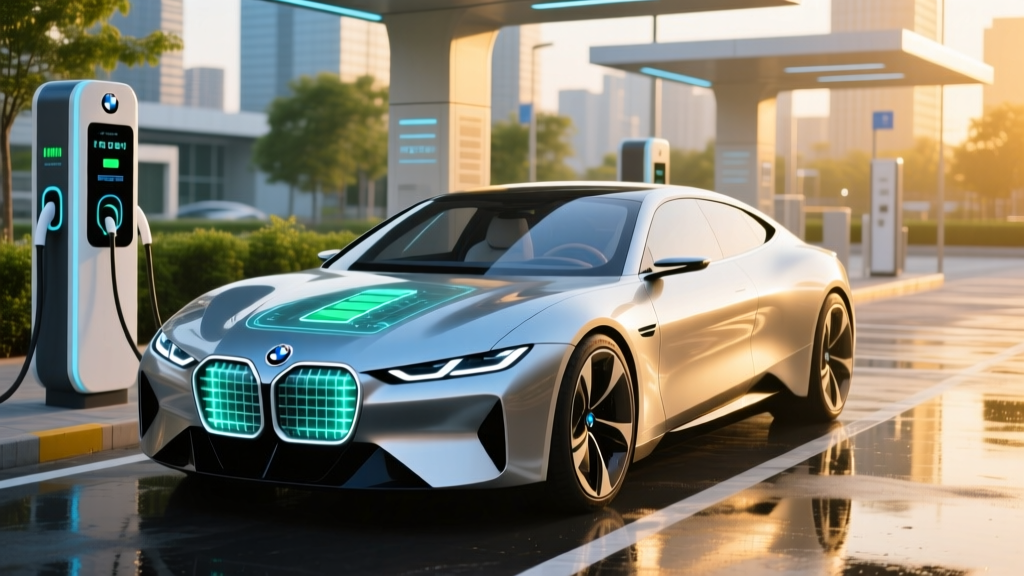
BMW has adopted the NACS (Tesla) charging port for its 2026 EV lineup, granting access to Tesla's Supercharger network — the most reliable DC fast-charging network in North America, with over 25,000 stalls. The i4, i5, and iX also support CCS1 charging via the included adapter for Electrify America, EVgo, and other networks.
| Charging Level | Power (kW) | Miles Added Per Hour | Typical Use Case |
|---|---|---|---|
| Level 1 (120V household) | 1.4 kW | ~4 mi/hr | Emergency / overnight trickle |
| Level 2 (240V, 48A home charger) | 11 kW | ~33 mi/hr | Daily home charging |
| DC Fast (Tesla Supercharger V3) | Peak 205 kW | ~180 mi in 15 min | Road trips |
| DC Fast (Electrify America 350) | Peak 205 kW | ~180 mi in 15 min | Road trips (CCS adapter) |
For home Level 2 installation, budget $800–$2,500 for a BMW Wallbox or ChargePoint Home Flex, plus $500–$2,000 for electrician labor (depending on panel capacity and conduit run). If your home has a 200-amp electrical panel with available capacity, expect the lower end. A panel upgrade to 200A can add $1,500–$3,000.
Frequently Asked Questions
How much does it really cost to own a BMW electric car over 5 years?
Based on our modeling of two consecutive 36-month leases of the i4 eDrive40, total 5-year cost lands around $52,000 including acquisition, charging, insurance, and maintenance. This is comparable to purchasing a gas BMW 430i over the same period, with the EV winning on fuel and maintenance but losing on insurance premiums. Your actual cost depends heavily on local electricity rates, insurance market, and available state incentives.
Do I qualify for the federal tax credit on a BMW EV lease?
In a lease, the credit is claimed by BMW Financial Services under §45W (commercial clean vehicle credit), and the benefit is typically passed to you as a capitalized cost reduction. Unlike the purchase credit (§30D), the lease credit has no MSRP cap and no buyer income limit — making the iX eligible even though its MSRP exceeds $80,000. However, battery sourcing (FEOC and critical mineral rules) still applies. Confirm with your dealer that the specific VIN qualifies and that the credit is reflected in your lease agreement.
How much do I save on fuel and maintenance with a BMW EV?
Home charging at the national average electricity rate ($0.16/kWh) costs approximately $0.053/mile in the i4, versus $0.14/mile for gasoline in a comparable BMW 4 Series — saving roughly $1,300/year at 15,000 miles. Maintenance savings add another $2,900 over 5 years by eliminating oil changes, spark plugs, transmission fluid, and most brake pad replacements thanks to regenerative braking.
Are BMW electric cars more expensive to insure?
Yes, typically 15–25% more than their gas counterparts. The i4 eDrive40 averages $2,600–$3,200/year versus $2,000–$2,500 for the 430i. Higher repair costs for battery and power electronics, elevated MSRP, and a smaller certified repair network drive the premium difference. Shop quotes from EV-friendly insurers (GEICO, Progressive, and State Farm all have EV-specific rating models) to find the best rate.
How well do BMW electric cars hold their value?
36-month residual values for 2026 BMW EVs range from 45–56% depending on model, with the i4 sedan performing best and the iX SUV facing steeper depreciation. This volatility is exactly why leasing makes sense: BMW Financial Services absorbs the residual risk. If you prefer to own, plan to hold the vehicle 5+ years to ride out depreciation curves, and take advantage of the full 8-year/100,000-mile battery warranty.
Should I lease or buy a BMW electric car in 2026?
Lease if: you want the latest tech every 3 years, your income exceeds §30D caps but you can capture the §45W lease credit, you want to avoid EV depreciation risk, or you're uncertain about long-term charging access at your residence. Buy if: you drive under 12,000 miles/year (lease overage penalties are steep at $0.25–$0.30/mi), you want to build equity, you plan to hold 5+ years, and your specific VIN qualifies for the full purchase credit under current IRS rules.