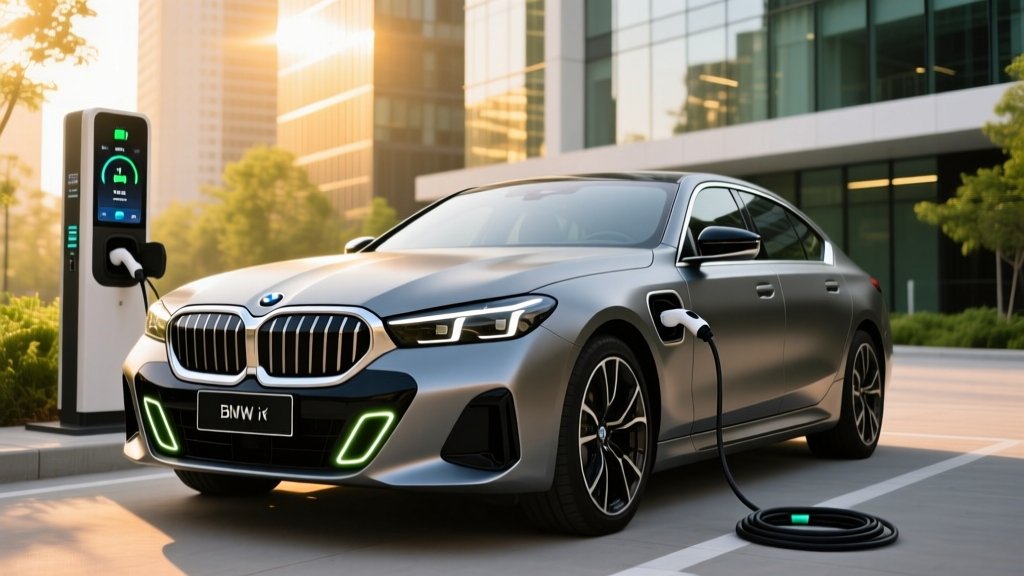
The BMW i5 arrived as the electric counterpart to the iconic 5 Series sedan, and for the 2026 model year, it remains one of the most complete luxury electric sedans on the market. If you're researching the BMW electric car i5, you're likely weighing it against the Mercedes-Benz EQE, Tesla Model S, and Audi e-tron GT. This review breaks down every number that matters — from EPA range and real-world highway efficiency to DC fast-charging curves, battery chemistry, and federal tax credit eligibility under current IRS §30D rules.
2026 BMW i5 Lineup: Trims, Drivetrains, and Pricing
BMW offers the 2026 i5 in three distinct trims, each targeting a different buyer profile. The eDrive40 serves as the efficiency-focused entry point with rear-wheel drive, the xDrive40 adds all-wheel grip, and the M60 xDrive delivers serious performance. Here's the full spec breakdown:
| Spec | eDrive40 | xDrive40 | M60 xDrive |
|---|---|---|---|
| Base MSRP | $66,275 | $69,275 | $87,575 |
| Drivetrain | RWD (single motor) | AWD (dual motor) | AWD (dual motor) |
| Horsepower | 335 hp | 389 hp | 593 hp |
| Torque (lb-ft) | 295 | 435 | 586 |
| 0–60 mph | 5.7 sec | 5.2 sec | 3.7 sec |
| EPA Range | 295 mi | 266 mi | 256 mi |
| MPGe (combined) | 93 MPGe | 87 MPGe | 82 MPGe |
| Efficiency (kWh/100 mi) | 36 | 39 | 41 |
All trims include BMW's $995 destination charge. The as-tested price for a well-equipped eDrive40 with the Premium Package, Driving Assistance Professional, and 20-inch wheels typically lands between $73,000 and $76,000. The M60, loaded with M Carbon exterior trim and Executive Package, can push past $100,000.
Battery, Chemistry, and Real-World Range
Every 2026 i5 variant shares the same battery pack: an 84.3 kWh usable capacity (gross approximately 101.7 kWh) lithium-ion module using NMC (nickel manganese cobalt) cell chemistry. BMW sources cells from CATL and Samsung SDI, assembled into modules at BMW's Dingolfing plant. NMC offers higher energy density than LFP, which matters in a sedan where packaging space is at a premium — but it also means BMW recommends keeping daily charge between 20% and 80% for optimal longevity, unlike LFP packs that tolerate routine 100% charges.
Real-World Range vs. EPA Estimates
EPA Sticker: 295 mi (eDrive40) / 266 mi (xDrive40) / 256 mi (M60)
Real-World Highway (70 mph, 72°F): Expect approximately 250–270 mi from the eDrive40; 225–245 mi from the xDrive40; and 215–230 mi from the M60.
Cold Weather (32°F or below, highway): Plan for 15–25% range reduction across all trims. The eDrive40 drops to roughly 210–235 mi on a cold highway run. The i5's heat pump (standard on all trims) helps mitigate cabin energy draw, but battery chemistry still loses efficiency in freezing temps.
City / Commute Driving: Regenerative braking recovers meaningful energy in stop-and-go traffic. Many owners report matching or slightly exceeding EPA estimates in predominantly urban driving.
The i5's efficiency of 36 kWh/100 mi (eDrive40) translates to roughly 2.8 miles per kWh. On a 300-mile road trip, you'll consume approximately 107 kWh of energy — which, at the national average public DC charging rate of $0.48/kWh, works out to about $51 in charging, compared to roughly $38 in gasoline for a comparable gas 5 Series averaging 27 MPG combined at $3.40/gallon.
Charging Speed: DC Fast Charging and Home Level 2
Charging speed is where luxury EV buyers have high expectations, and the i5 delivers competent — though not class-leading — performance. The i5 uses the CCS1 connector for DC fast charging and the J1772 connector for AC Level 2. BMW has not adopted NACS for the i5 as of 2026, though an adapter solution may be available for Tesla Supercharger access depending on network agreements.
| Charging Level | Power | Speed / Time | Notes |
|---|---|---|---|
| Level 1 (120V household) | 1.4 kW | ~4 mi/hr | Emergency/trickle only; ~60+ hrs for full charge |
| Level 2 (240V home, 48A) | 11.5 kW | ~31 mi/hr; 0–100% in ~9.5 hrs | Requires NEMA 14-50 outlet or hardwired Wallbox/BMW charger; overnight-ready |
| DC Fast Charge (peak) | 205 kW | 10–80% in ~30 min | Peak rate sustained to ~40% SoC, then tapers; 80–100% adds another 20–25 min |
The 205 kW peak DC rate is respectable but trails the Hyundai Ioniq 5's 240 kW and the Lucid Air's 300+ kW capability. In practice, the i5's charging curve holds above 150 kW through roughly 50% state of charge, then steps down progressively. On a road trip, the 10–80% window is what matters most, and 30 minutes is competitive with most stops for food and restrooms. The i5 supports plug-and-charge at Electrify America and other major networks, eliminating the need to open an app at compatible stations.
Preconditioning tip: When you set a DC fast-charging station as your navigation destination, the i5 automatically warms the battery to optimal temperature, shaving 3–5 minutes off your charge time. Always navigate to your charger rather than pulling in cold.
Performance, Ride, and Driving Dynamics
The eDrive40's 5.7-second 0–60 time won't embarrass anyone merging onto a highway, and its RWD layout preserves the balanced chassis feel BMW is known for. The xDrive40 adds dual-motor AWD traction — valuable in rain and snow — with only a modest 29-mile EPA range penalty. The M60 xDrive is the performance flagship: 593 hp and a 3.7-second 0–60 sprint put it in sports-sedan territory, with adaptive M suspension and rear-axle steering sharpening the handling further.
All i5 trims feature adaptive regenerative braking that adjusts regen intensity based on traffic and road conditions, plus a maximum-regen mode that enables near one-pedal driving in urban settings. The brake pedal feel — a common complaint in early EVs — is well-calibrated in the i5, with a natural transition between regen and friction braking.
Interior, Cargo, and Technology
The i5's cabin is unmistakably BMW: a curved display panel houses a 12.3-inch digital instrument cluster and a 14.9-inch central touchscreen running BMW iDrive 8.5. The system supports wireless Apple CarPlay and Android Auto, over-the-air updates, and BMW's Intelligent Personal Assistant voice control. The optional Interaction Bar adds ambient lighting with crystalline trim across the dash.
Passenger space is generous for a mid-size luxury sedan:
- Front legroom: 41.5 inches
- Rear legroom: 36.7 inches
- Front headroom: 39.8 inches (without panoramic roof); 38.9 inches with roof
- Rear headroom: 37.2 inches
Cargo volume: 17.3 cubic feet in the trunk. The i5 does not offer a frunk (front trunk), which is a notable omission versus competitors like the Lucid Air (which offers a combined 32 cu ft). The rear seats do fold 40/20/40 for longer items, but the trunk opening is narrower than a liftback or SUV.
Driver Assistance: The i5 offers BMW's Driving Assistance Professional Package, which includes Highway Assistant — a hands-free driving feature on divided highways at speeds up to 85 mph (with eyes-on monitoring via interior camera). This is an SAE Level 2 system: the driver must remain attentive and ready to take over at all times. It is not autonomous driving.
⚠️ Highway Assistant Is NOT Self-Driving
BMW's Highway Assistant (and the related Active Driving Assistant Pro) is classified as SAE Level 2 driver assistance. You must keep your eyes on the road, and the system will issue escalating warnings — then disengage — if it detects inattention. It does not navigate interchanges, stoplights, or construction zones autonomously. Only Level 4 services like Waymo operate without a human driver.
Federal Tax Credit and Ownership Costs
The BMW i5 faces a complex tax credit picture under the current IRS §30D rules. Here's what buyers need to know:
§30D Federal Tax Credit Requirements for the 2026 i5
- MSRP Cap: Sedans must be priced at or below $55,000 MSRP to qualify. The i5 starts at $66,275 — it exceeds the sedan cap and does NOT qualify for the §30D new-vehicle credit.
- Buyer Income Cap: Even if the vehicle qualified, AGI limits are $150,000 (single) / $300,000 (joint). Most i5 buyers likely fall within these limits, but the MSRP cap is the disqualifying factor.
- Battery Sourcing: The i5's battery cells are sourced from CATL (China) and Samsung SDI (South Korea), which may not meet critical-mineral and battery-component requirements for partial credit even on eligible vehicles.
- Point-of-Sale Transfer: Available for qualifying vehicles, but moot here since the i5 does not meet the MSRP cap.
The bottom line: The 2026 BMW i5 does not qualify for the $7,500 federal EV tax credit due to its MSRP exceeding the $55,000 sedan cap. However, buyers should check their state's individual EV incentives — California, Colorado, New York, and others offer rebates or credits that may apply regardless of the federal MSRP cap. Always consult IRS.gov §30D guidance and a tax professional before making purchase decisions based on credits.
| Trim | Base MSRP | Federal Credit | Effective Price | Est. 5-Year TCO* |
|---|---|---|---|---|
| eDrive40 | $66,275 | $0 | $66,275 | ~$78,000 |
| xDrive40 | $69,275 | $0 | $69,275 | ~$82,000 |
| M60 xDrive | $87,575 | $0 | $87,575 | ~$103,000 |
*Estimated 5-year total cost of ownership includes depreciation, insurance, electricity, maintenance, and repairs. Source: fueleconomy.gov and industry estimates. Actual costs vary by state, driving habits, and electricity rates.
Battery Warranty and Long-Term Durability
BMW provides an 8-year / 100,000-mile high-voltage battery warranty, guaranteeing the pack will retain at least 70% of its original capacity during that period. The standard vehicle warranty is 4 years / 50,000 miles, with 4 years of complimentary scheduled maintenance — a meaningful perk that reduces early-ownership costs.
NMC battery degradation in BMW's current-generation packs has proven moderate based on early iX and i4 data: expect approximately 5–8% capacity loss over the first 100,000 miles under normal use. Following BMW's recommended 20–80% daily charge window and avoiding repeated DC fast-charging sessions in extreme heat will help preserve State of Health (SoH). The i5's thermal management system actively cools the pack during fast charging, which is essential for long-term durability.
A full battery replacement out of warranty is estimated at $18,000–$24,000 including labor — a significant sum, but one that most owners will never face given the 8-year coverage and typical degradation curves.
BMW i5 vs. Key Competitors
The i5 competes in a tight luxury EV sedan segment. Here's how it stacks up against the three most cross-shopped rivals:
| Attribute | BMW i5 eDrive40 | Mercedes EQE 350+ | Tesla Model S LR | Lucid Air Pure |
|---|---|---|---|---|
| Base MSRP | $66,275 | $76,050 | $79,990 | $69,900 |
| EPA Range | 295 mi | 305 mi | 402 mi | 419 mi |
| Max DC Charge | 205 kW | 170 kW | 250 kW | 200+ kW |
| 0–60 mph | 5.7 sec | 6.2 sec | 3.1 sec | 5.0 sec |
| Cargo (cu ft) | 17.3 | 15.0 | 28.0 | 32.0 |
| Federal Credit | No (MSRP cap) | No (MSRP cap) | No (MSRP cap) | No (MSRP cap) |
The i5's advantage is balance: it's not the longest-range (Lucid and Tesla win there), not the quickest (Tesla and M60 win there), and not the cheapest to charge. But it offers the best blend of traditional luxury build quality, intuitive iDrive infotainment, and BMW driving dynamics in a package that feels like a proper 5 Series — just electrified.
Who Should Buy the BMW i5?
Choose the i5 eDrive40 if: You want a luxury daily-driver sedan with 250+ real-world miles of range, premium interior quality, and hands-free highway assist — and you don't need AWD or sub-4-second acceleration.
Choose the i5 xDrive40 if: You live in a climate with rain or snow and value AWD traction enough to sacrifice 29 miles of EPA range.
Choose the i5 M60 if: Performance is the priority and you want M-car dynamics without tailpipe emissions — and budget is flexible past $90K.
Look elsewhere if: Maximum range (choose Lucid Air or Tesla Model S), maximum cargo space (choose an SUV like the iX), or federal tax credit eligibility (no luxury sedan currently qualifies) are deal-breakers.
Pros and Cons
✅ Pros
- Class-leading interior quality and iDrive 8.5 infotainment
- 295-mile EPA range (eDrive40) is competitive for the segment
- Highway Assistant offers genuine hands-free ease on long commutes
- Well-calibrated regenerative braking and one-pedal driving capability
- 4-year complimentary maintenance reduces ownership friction
- Natural brake pedal feel — rare among EVs
- Quiet, composed ride even on 20-inch wheels
❌ Cons
- No federal tax credit eligibility (MSRP exceeds $55K sedan cap)
- No frunk — 17.3 cu ft trunk only, less cargo versatility than liftback rivals
- 205 kW peak DC charge rate trails Tesla and Hyundai/Kia platforms
- Real-world highway range drops noticeably below EPA (expect ~250–270 mi)
- Options add up quickly — a $66K base car becomes a $76K car fast
- Rear headroom is tight for passengers over 6'2" with panoramic roof
Frequently Asked Questions
What is the real-world range of the BMW i5?
The eDrive40 achieves an EPA-rated 295 miles, but in real-world highway driving at 70 mph, expect approximately 250–270 miles. In cold weather (below 32°F), plan for 210–235 miles. City commuters using regenerative braking may match or slightly exceed the EPA figure.
How fast does the BMW i5 charge?
On a DC fast charger, the i5 peaks at 205 kW and charges from 10–80% in approximately 30 minutes, with the curve tapering significantly above 80%. At home on a Level 2 charger (11.5 kW / 48 amps), a full charge takes about 9.5 hours — ideal for overnight charging.
Does the BMW i5 qualify for the federal EV tax credit?
No. Under current IRS §30D rules, sedans must have an MSRP at or below $55,000 to qualify. The i5 starts at $66,275, making it ineligible regardless of buyer income or battery sourcing. Check your state's individual EV rebate programs for potential savings. See IRS.gov for official rules.
Is the BMW i5 worth buying vs. competitors?
The i5 is worth serious consideration if you prioritize interior luxury, intuitive technology, and BMW driving dynamics over maximum range or cargo space. If range is paramount, the Lucid Air Pure (419 mi EPA) and Tesla Model S (402 mi) outperform it. If budget matters most, no luxury EV sedan currently qualifies for the federal credit, so compare total cost of ownership across state incentives and insurance costs.
What battery chemistry does the BMW i5 use?
The i5 uses NMC (nickel manganese cobalt) lithium-ion cells with a usable capacity of 84.3 kWh. NMC offers higher energy density than LFP, which helps packaging in a sedan, but BMW recommends a 20–80% daily charge window for optimal battery longevity.
How much does it cost to charge the BMW i5 at home?
At the national average residential electricity rate of approximately $0.16/kWh, fully charging the i5's 84.3 kWh battery from empty costs about $13.50. For a typical driver covering 12,000 miles per year at 36 kWh/100 mi (eDrive40), annual home charging costs are roughly $690 — compared to approximately $1,500 in gasoline for a comparable gas 5 Series.
Is BMW's Highway Assistant self-driving?
No. Highway Assistant is an SAE Level 2 driver-assistance system. It provides hands-free steering and speed control on divided highways, but the driver must remain attentive with eyes on the road. An interior camera monitors driver engagement, and the system will disengage with escalating warnings if inattention is detected.