The Real Cost of Owning a BMW EV: Beyond the Sticker Price
BMW's electric lineup has expanded significantly, but understanding the true bmw electric car cost requires looking well past the MSRP. Whether you're eyeing the compact i4, the executive i5 sedan, the flagship i7, or the iX SUV, the financial picture involves federal tax credits that may or may not apply, higher insurance premiums, meaningful fuel and maintenance savings, and depreciation patterns that differ sharply from BMW's gas-powered models.
This guide breaks down the 5-year total cost of ownership for BMW's 2026 electric vehicles using current EPA data, IRS §30D tax credit rules, real-world charging costs, and insurance industry trends. The numbers may surprise you — especially which models actually qualify for federal incentives.
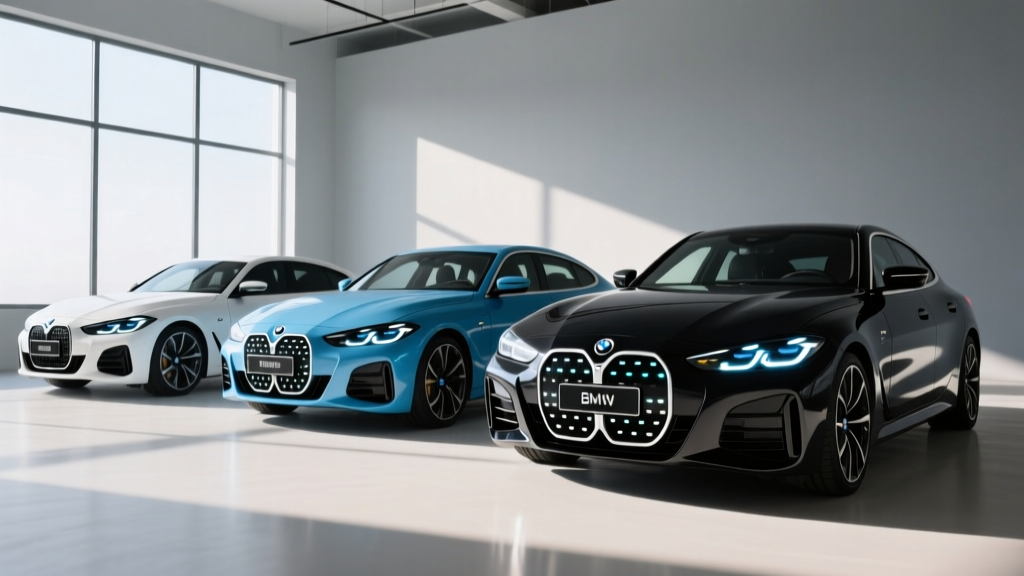
2026 BMW EV Lineup: Specs, Pricing, and Tax Credit Eligibility
BMW offers four core electric models in the US market for 2026. Here's how they stack up on the metrics that matter for your wallet:
| Model | Base MSRP | EPA Range | Battery (kWh) | Peak DC Charge | 10–80% Time | 0–60 mph | §30D Credit Eligible? |
|---|---|---|---|---|---|---|---|
| i4 eDrive40 | $57,900 | 307 mi | 81.5 kWh (NMC) | 205 kW | ~31 min | 5.5 sec | Yes (up to $7,500) |
| i4 M50 | $70,700 | 271 mi | 81.5 kWh (NMC) | 205 kW | ~31 min | 3.7 sec | Yes (up to $7,500) |
| i5 eDrive40 | $70,200 | 295 mi | 81.2 kWh (NMC) | 205 kW | ~30 min | 5.7 sec | Yes (up to $7,500) |
| i5 M60 | $87,100 | 256 mi | 81.2 kWh (NMC) | 205 kW | ~30 min | 3.7 sec | Yes (up to $7,500) |
| i7 eDrive50 | $106,700 | 318 mi | 101.7 kWh (NMC) | 195 kW | ~34 min | 4.5 sec | No (exceeds MSRP cap) |
| iX xDrive50 | $87,250 | 324 mi | 111.5 kWh (NMC) | 195 kW | ~35 min | 4.4 sec | Yes (up to $7,500) |
Federal Tax Credit: Which BMW EVs Qualify Under §30D?
The federal EV tax credit under IRS §30D can reduce your effective purchase price by up to $7,500 — but eligibility depends on a matrix of rules that eliminate several BMW models entirely.
- MSRP Cap: Sedans must be under $55,000; SUVs, vans, and trucks under $80,000
- Buyer Income Limits: Modified AGI must not exceed $150,000 (single), $225,000 (head of household), or $300,000 (joint filers)
- Battery Sourcing: Battery components must be manufactured or assembled in North America; critical minerals must be sourced from the US or free-trade-agreement partners (phased percentages increase annually)
- Point-of-Sale Transfer: You can transfer the credit to the dealer at purchase for an immediate price reduction, or claim it on your tax return
- One Credit Per Vehicle: The vehicle must be new, purchased for personal use, and primarily used in the US
- Credit Amount: Up to $3,750 for battery component sourcing + up to $3,750 for critical mineral sourcing = maximum $7,500
What this means for BMW buyers: The i7 eDrive50 at $106,700 exceeds the $55,000 sedan MSRP cap and is categorically ineligible. The i5 M60 at $87,100 also exceeds the sedan cap. However, BMW classifies the iX as an SUV, making it eligible under the $80,000 cap — but only in base xDrive50 trim at $87,250, which still exceeds $80,000. This means buyers must negotiate below $80,000 or select a lower-cost configuration to qualify. The i4 and i5 eDrive40 models fall within their respective MSRP caps.
Critical mineral and battery component sourcing rules have tightened through 2026. BMW sources battery cells primarily from CATL (China) and Samsung SDI (South Korea), which may limit the credit to the partial $3,750 on some model years. Always verify current eligibility with your dealer and consult fueleconomy.gov for the latest qualifying vehicle list before purchasing.
5-Year Total Cost of Ownership: BMW i4 vs. Gas Equivalent
To understand true bmw electric car cost, we need to compare a 5-year/75,000-mile ownership cycle against a comparable gas vehicle. The closest gas equivalent to the i4 eDrive40 is the BMW 430i Gran Coupe.
| Cost Category | BMW i4 eDrive40 | BMW 430i Gran Coupe | Difference |
|---|---|---|---|
| Purchase Price (MSRP) | $57,900 | $49,900 | +$8,000 (i4) |
| Federal Tax Credit | −$7,500 | $0 | −$7,500 (i4) |
| Effective Purchase Price | $50,400 | $49,900 | +$500 (i4) |
| Fuel/Energy (75k mi) | $4,875 | $10,125 | −$5,250 (i4 saves) |
| Maintenance | $2,100 | $4,500 | −$2,400 (i4 saves) |
| Insurance (5 years) | $12,750 | $10,000 | +$2,750 (i4 costs more) |
| Depreciation (est.) | $22,500 | $19,000 | +$3,500 (i4 loses more) |
| 5-Year Total | $92,625 | $84,525 | +$8,100 (i4 costs more) |
Assumptions: Home charging at $0.16/kWh national average; gas at $3.75/gallon.
BMW i4 eDrive40: 3.5 kWh/mile efficiency × $0.16/kWh = $0.065/mile
BMW 430i Gran Coupe: 29 MPG combined × $3.75/gallon = $0.135/mile
The i4 costs roughly half per mile to "fuel." Over 75,000 miles, that's $5,250 in energy savings.
The i4 eDrive40 breaks nearly even on purchase price after the tax credit, saves substantially on fuel and maintenance, but gives back those gains through higher insurance premiums and steeper depreciation. The net result: the i4 costs roughly $8,100 more over 5 years in this scenario. However, this equation shifts dramatically based on your electricity rate, annual mileage, state incentives, and whether you qualify for the full credit.
Charging Costs: Home, Public, and the Gas Comparison
Where and how you charge determines whether a BMW EV saves or costs you money on energy.
| Charging Method | Rate | Cost per Full Charge | Cost per Mile (307 mi range) |
|---|---|---|---|
| Home Level 2 (national avg) | $0.16/kWh | $13.04 | $0.042 |
| Home Level 2 (CA/MA peak) | $0.30/kWh | $24.45 | $0.080 |
| Home solar (amortized) | $0.06/kWh | $4.89 | $0.016 |
| Electrify America DCFC | $0.48/kWh | $39.12 | $0.127 |
| Tesla Supercharger (open network) | $0.35/kWh | $28.53 | $0.093 |
Home charging at average residential rates delivers the strongest savings — roughly one-third the per-mile cost of premium gasoline. But if you rely primarily on DC fast charging at $0.35–$0.50/kWh, the BMW i4's energy cost approaches or exceeds that of a fuel-efficient gas sedan. The i4 supports up to 205 kW peak DC charging, but sustained rates average 130–150 kW through the 10–80% window, meaning a typical fast-charge session takes about 31 minutes and costs $25–$39 depending on the network.
Pro tip: BMW includes one year of complimentary charging on Electrify America for new i4, i5, and iX purchases — typically 1,000–2,000 kWh of credit, which offsets early ownership charging costs substantially.
Maintenance Savings: Where BMW EVs Pull Ahead
Electric drivetrains eliminate dozens of maintenance items that gas-powered BMWs require regularly. Here's what you'll never pay for on an i4, i5, i7, or iX:
| Eliminated Service | Typical Gas BMW Cost | Frequency |
|---|---|---|
| Engine oil changes | $120–$180 | Every 10,000 mi |
| Oil filter replacement | Included above | Every 10,000 mi |
| Spark plugs | $300–$500 | Every 60,000 mi |
| Transmission fluid service | $250–$400 | Every 60,000 mi |
| Engine air filter | $50–$80 | Every 30,000 mi |
| Fuel filter | $150–$250 | Every 60,000 mi |
| Emissions system service | $200–$600 | As needed |
| Brake pad replacement (front) | $350–$550 | Every 30,000–50,000 mi |
Regenerative braking is the hidden maintenance hero. BMW's adaptive regen system recovers kinetic energy during deceleration, dramatically reducing friction brake wear. Many BMW EV owners report original brake pads lasting 80,000–100,000+ miles. In real-world ownership, brake fluid flushes every two years and cabin air filter replacements remain the primary scheduled maintenance items, along with tire rotation every 7,500 miles.
Budget approximately $400–$500 annually for BMW EV maintenance, compared to $800–$1,100 for a comparable gas BMW. Over five years, that's a $2,000–$3,000 maintenance savings.
Insurance Reality: The Cost Nobody Talks About
Insurance premiums for BMW electric vehicles run 15–30% higher than their gas counterparts. The i4 eDrive40 typically costs $2,400–$2,700/year to insure, while the 430i Gran Coupe averages $1,900–$2,100/year. The iX and i7 push premiums to $3,000–$3,800/year.
Why the premium?
- Higher repair costs: EV-specific components (battery packs, power electronics, electric motors) are expensive to replace after collision damage
- Specialized labor: High-voltage system repairs require certified BMW EV technicians, which limits shop options and increases labor rates
- Higher vehicle values: Comprehensive and collision coverage scales with replacement cost
- Claims data: Insurers have less historical loss data on EVs, leading to conservative pricing
Shop quotes from EV-friendly insurers (Geico, Progressive, and Liberty Mutual tend to be competitive for BMW EVs). Some insurers now offer specific EV discounts or green-vehicle policies that narrow the gap.
Depreciation and Resale Value: The Wildcard
EV depreciation has been volatile. Through 2024–2025, aggressive price cuts from Tesla and new federal incentives compressed used EV values across the market. BMW EVs were not immune — the i4 and iX saw steeper first-year depreciation than comparable gas BMWs, typically 25–35% versus 18–25%.
By year five, expect a BMW i4 eDrive40 to retain approximately 38–45% of its original MSRP, compared to 45–52% for a 430i Gran Coupe. The iX holds value slightly better due to SUV demand, retaining an estimated 40–47%.
Key depreciation factors for BMW EVs:
- Battery health perception: BMW's 8-year/100,000-mile battery warranty (covering capacity below 70% of original) provides buyer confidence, but out-of-warranty battery replacement costs ($15,000–$25,000) create resale uncertainty for high-mileage examples
- Tech obsolescence: Charging speed and infotainment advances in newer models can make 3–5-year-old EVs feel dated faster than gas cars
- Incentive distortion: When new buyers receive $7,500 in credits, used EV prices must adjust downward to remain competitive
Leasing a BMW EV can sidestep depreciation risk entirely. BMW Financial Services frequently offers aggressive lease deals on i4 and i5 models, and the lessor absorbs the resale value risk.
State, Local, and Utility Incentives
Beyond the federal credit, many BMW EV buyers stack additional incentives:
- California (CVRP): Up to $2,000 rebate for income-qualified buyers on vehicles under $60,000 MSRP
- Colorado: Up to $5,000 state tax credit for new EVs purchased in 2026
- New York (Drive Clean Rebate): Up to $2,000 point-of-sale rebate
- Utility rebates: Many utilities offer $500–$1,500 for Level 2 home charger installation (e.g., PG&E, ConEdison, Xcel Energy)
- HOV lane access: Several states grant solo carpool lane access to EVs regardless of occupancy, a significant commute-time benefit
- Reduced registration fees: Some states waive or reduce annual EV registration surcharges for the first year
A California buyer purchasing an i4 eDrive40 could potentially stack the $7,500 federal credit, $2,000 CVRP rebate, and $1,000 utility charger rebate — reducing effective cost by $10,500 before considering fuel savings.
BMW EV Battery Warranty and Long-Term Costs
BMW covers all EV battery packs with an 8-year/100,000-mile warranty guaranteeing minimum 70% state of health (capacity retention). If your battery degrades below that threshold within the warranty period, BMW replaces or refurbishes it at no cost.
Real-world degradation data from BMW's NMC battery packs shows typical capacity loss of 8–12% over the first 100,000 miles when following recommended charging practices (avoiding sustained 100% SoC, limiting DC fast charging frequency, using preconditioning). Most BMW EV batteries are projected to retain 80–85% capacity at 150,000 miles.
Out-of-warranty battery replacement remains the largest financial risk: $15,000–$20,000 for the i4/i5, $20,000–$25,000 for the iX and i7. This cost should factor into any plan to own a BMW EV beyond 100,000 miles or 8 years.
Frequently Asked Questions
How much does it really cost to own a BMW EV over 5 years?
For the BMW i4 eDrive40 with the full $7,500 federal tax credit, expect approximately $85,000–$95,000 over 5 years/75,000 miles including purchase, energy, insurance, maintenance, and depreciation. This is typically $5,000–$12,000 more than a comparable gas BMW 430i, primarily due to higher insurance and depreciation. The equation improves significantly with high annual mileage (15,000+ mi/yr), low home electricity rates, and stacked state incentives.
Do I qualify for the federal tax credit on a BMW electric car?
You qualify if: (1) the model MSRP is under $55,000 for sedans (i4, i5) or $80,000 for SUVs (iX), (2) your modified adjusted gross income is under $150K single/$300K joint, and (3) the vehicle meets battery sourcing requirements. The i7 is categorically ineligible due to its $106,700+ MSRP. Verify current battery-sourcing compliance on fueleconomy.gov before purchasing, as eligibility can change with supply chain shifts.
How much do I save on fuel and maintenance with a BMW EV?
Expect $4,000–$6,000 in fuel savings over 5 years/75,000 miles when charging primarily at home ($0.12–$0.18/kWh). Maintenance savings add another $2,000–$3,000 over the same period, primarily from eliminated oil changes, spark plugs, transmission service, and reduced brake wear from regenerative braking. Combined savings of $6,000–$9,000 are typical for home-charging BMW EV owners.
Are BMW electric cars more expensive to insure?
Yes — typically 15–30% more than equivalent gas BMWs. An i4 eDrive40 costs approximately $2,400–$2,700/year to insure versus $1,900–$2,100 for a 430i. Higher repair costs for EV-specific components, specialized labor requirements, and elevated vehicle values drive the premium. Shop multiple insurers and ask about EV-specific discounts.
How well do BMW EVs hold their value?
BMW EVs currently depreciate faster than their gas counterparts. Expect a 5-year-old i4 to retain 38–45% of original MSRP versus 45–52% for a gas 4 Series. The iX SUV holds slightly better at 40–47%. Battery health concerns, rapid technology advancement, and new-vehicle incentive pressure contribute to steeper EV depreciation. Leasing transfers this risk to BMW Financial Services.
Is home charging necessary to make a BMW EV cost-effective?
Home charging at residential electricity rates ($0.10–$0.20/kWh) is the primary driver of EV fuel cost savings. Exclusive reliance on DC fast charging ($0.35–$0.50/kWh) erases most or all energy cost advantages over gasoline. If you cannot install a Level 2 home charger, a BMW PHEV (plug-in hybrid) like the 330e or X5 xDrive50e may be a more financially rational choice.