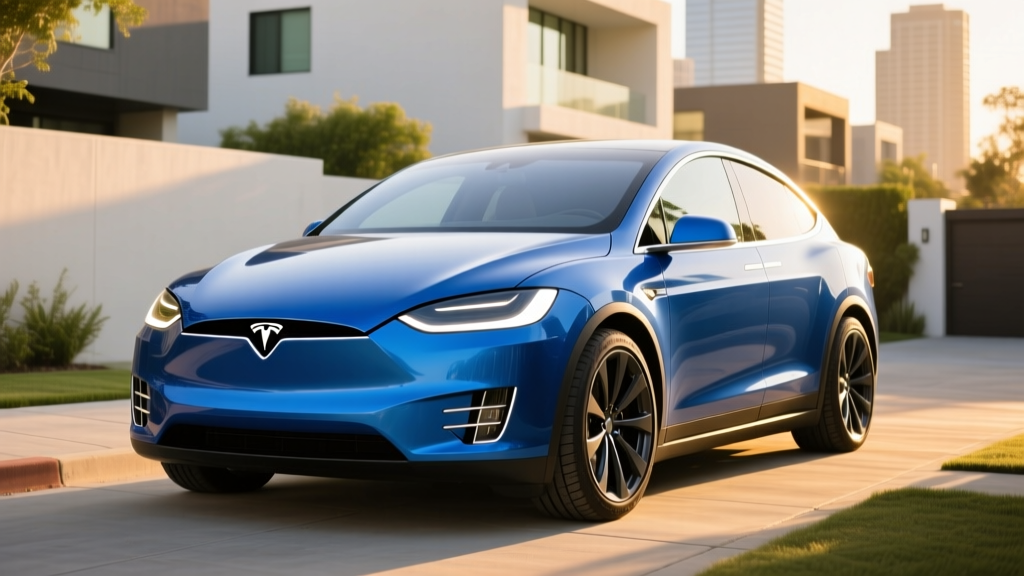
The Tesla Model X has occupied a unique position in the electric SUV segment since its debut, and the current-generation refresh continues that tradition. With its signature falcon-wing rear doors, available three-row seating, and access to the Supercharger network, it remains one of the most recognizable EVs on the road. This review examines the 2026 Tesla Model X — specifically the popular Deep Blue Metallic and Midnight Blue exterior options that buyers search for as the "blue Tesla X" — covering its real-world range, charging performance, pricing after federal tax credits, and whether it still justifies its premium asking price against a growing field of three-row electric SUVs.
2026 Tesla Model X at a Glance: Key Specifications
| Specification | Long Range (Dual Motor AWD) | Plaid (Tri-Motor AWD) |
|---|---|---|
| EPA Estimated Range | 348 miles | 335 miles |
| Battery Pack (usable) | ~100 kWh (NMC) | ~100 kWh (NMC) |
| Drivetrain | Dual Motor AWD | Tri-Motor AWD |
| Horsepower | 670 hp | 1,020 hp |
| 0–60 mph | 3.8 seconds | 2.5 seconds |
| Top Speed | 155 mph | 163 mph |
| Max DC Fast Charge | 250 kW | 250 kW |
| 10–80% DC Charge Time | ~30 minutes | ~30 minutes |
| Level 2 Charge Rate | 11.5 kW (~34 mi/hr) | 11.5 kW (~34 mi/hr) |
| MPGe (combined) | 102 MPGe | 98 MPGe |
| Efficiency | 33 kWh/100 mi | 34 kWh/100 mi |
| Seating | 5, 6, or 7 passengers | 5 or 6 passengers |
| Cargo (behind 3rd row) | ~15 cu ft | ~15 cu ft |
| Cargo (max, seats folded) | ~88 cu ft | ~88 cu ft |
| Towing Capacity | 5,000 lbs | 5,000 lbs |
| Base MSRP | $79,990 | $94,990 |
| Battery Warranty | 8 yr / 150,000 mi | 8 yr / 150,000 mi |
Sources: EPA fueleconomy.gov, Tesla Model X Design Studio. Specs reflect current 2026 model year; pricing excludes destination fee.
Real-World Range: What the EPA Sticker Doesn't Tell You
EPA sticker: 348 miles
Expected highway (70–75 mph, 65°F): ~280–300 miles
Cold weather (30°F, highway): ~220–250 miles
City/mixed driving (moderate climate): ~310–330 miles
The Model X Long Range carries an EPA-estimated 348 miles of range, which is competitive for a large, heavy three-row electric SUV. However, as with any EV, real-world results depend heavily on driving conditions. The Model X's boxy silhouette and roughly 5,000-pound curb weight work against it at highway speeds, where aerodynamic drag dominates energy consumption. In our experience and consistent owner reports, expect 280–300 miles on a flat interstate at 70–75 mph in mild temperatures.
Cold weather hits the Model X harder than some competitors. The large cabin volume requires significant energy to heat, and while the standard heat pump helps, battery chemistry (NMC) loses efficiency below freezing. Plan for 220–250 miles of usable range on a 30°F winter highway drive. Preconditioning the battery while plugged in — a feature Tesla's navigation system handles automatically when a Supercharger is set as your destination — mitigates some of this loss and is essential for maximizing fast-charge speeds in cold conditions.
The Plaid trim sacrifices about 13 miles of EPA range (335 miles) due to its tri-motor configuration and stickier performance tires. Real-world highway range for the Plaid drops proportionally to roughly 270–290 miles in mild weather.
Charging Performance: Supercharger Speeds and Home Setup
| Charging Level | Power / Rate | Miles Added per Hour | Notes |
|---|---|---|---|
| Level 1 (120V, 12A) | ~1.4 kW | ~4 mi/hr | Emergency/trickle only |
| Level 2 (240V, 48A) | 11.5 kW | ~34 mi/hr | Home Wall Connector; full charge in ~9 hrs |
| DC Fast Charge (V3 Supercharger) | Peak 250 kW | ~175 mi in 15 min | 10–80% in ~30 min; tapers above 80% |
| DC Fast Charge (V4 Supercharger) | Up to 250 kW (current Model X limit) | Same as V3 | V4 stalls capable of higher kW, but Model X architecture caps at 250 kW |
The Model X peaks at 250 kW on Tesla's V3 and V4 Superchargers using its native NACS connector. A 10–80% session takes approximately 30 minutes under ideal conditions — battery preconditioned, ambient temperature above 50°F, and a stall not shared with another vehicle. The charging curve tapers significantly above 60% state of charge, so the final 20% (80–100%) can add another 25–35 minutes. For road trips, the practical strategy is to charge to 80% and drive on.
At home, Tesla's Gen 2 Wall Connector delivers up to 11.5 kW (48 amps on a 60-amp circuit), adding roughly 34 miles of range per hour. A full 0–100% charge takes about 9 hours — overnight is sufficient for daily use. Installation typically requires a NEMA 14-60 outlet or hardwired connection; budget $500–$2,000 for electrician labor depending on your panel's proximity to the garage and whether a panel upgrade is needed (older 100-amp panels may require a $1,500–$3,000 upgrade to 200 amps to support continuous 48A draw safely).
With Tesla opening the Supercharger network to other EVs via NACS adoption, the competitive advantage of Tesla's proprietary charging has narrowed. However, Supercharger reliability and seamless plug-and-charge billing remain class-leading. The Model X can also use CCS adapters for non-Tesla DC fast chargers (Electrify America, EVgo), though at reduced peak rates.
Performance, Efficiency, and Daily Drivability
The dual-motor Long Range Model X produces 670 horsepower and rockets to 60 mph in 3.8 seconds — extraordinary for a vehicle that can carry seven passengers and their cargo. The tri-motor Plaid is almost absurdly quick at 1,020 hp and a 2.5-second 0–60 time, rivaling supercars while offering practical SUV utility.
Efficiency figures from the EPA show the Long Range at 102 MPGe combined (33 kWh/100 miles) and the Plaid at 98 MPGe (34 kWh/100 miles). For context, that translates to roughly $0.10–$0.14 per mile on the national average residential electricity rate of ~$0.16/kWh, compared to $0.18–$0.22 per mile for a similarly sized gas SUV at $3.50/gallon. Over 15,000 annual miles, the electricity savings versus premium gasoline can reach $1,200–$1,800 per year.
The adaptive air suspension is standard and provides up to 8.2 inches of ground clearance for rough roads or steep driveways, then lowers at highway speed for improved aerodynamics. Regenerative braking offers a strong one-pedal driving experience, though unlike some competitors, Tesla does not offer adjustable regen levels — it is a fixed, aggressive setting that most owners adapt to quickly.
Interior, Cargo, and Technology
The Model X interior centers on a 17-inch landscape touchscreen that handles nearly all vehicle functions, from climate control to glovebox release. A second 8-inch screen serves rear passengers. The minimalist design is polarizing — there are virtually no physical buttons — but the interface is responsive and the navigation with real-time Supercharger routing is best-in-class.
Cargo capacity measures approximately 15 cubic feet behind the third row (when equipped), expanding to about 42 cubic feet with the third row folded, and up to 88 cubic feet with both rear rows down. The front trunk (frunk) adds another 6.6 cubic feet. The falcon-wing rear doors open vertically, making third-row access easier than in conventional SUVs in tight parking spaces, though they require overhead clearance and their complex hinge mechanism has historically been a maintenance concern.
Notable tech features:
- Autopilot standard (SAE Level 2 driver assist — requires active driver supervision)
- Full Self-Driving (Supervised) available as a $8,000 add-on or $99/month subscription
- Over-the-air software updates that add features post-purchase
- Sentry Mode (360° camera-based security recording)
- Dog Mode and Camp Mode for climate control while parked
- HEPA air filtration with Bioweapon Defense Mode
Despite the "Full Self-Driving" name, Tesla's FSD (Supervised) requires the driver to remain fully attentive, with hands on or near the wheel and eyes on the road at all times. It is not autonomous driving. Only Level 4 services like Waymo operate without a human driver in defined areas. Do not treat any Tesla driver-assist system as a substitute for an engaged driver.
Pricing, Trims, and Federal Tax Credit Eligibility
| Trim | Base MSRP | Destination | As-Tested (typical config) | §30D Federal Credit | Est. Net Price |
|---|---|---|---|---|---|
| Long Range AWD | $79,990 | $1,990 | $84,000–$88,000 | See eligibility below | $76,500–$80,500 (if eligible) |
| Plaid AWD | $94,990 | $1,990 | $99,000–$106,000 | See eligibility below | $91,500–$98,500 (if eligible) |
The Model X Long Range starts at $79,990 before destination, while the Plaid begins at $94,990. Adding Deep Blue Metallic paint ($1,500–$2,000 depending on current options), 22-inch wheels, FSD, or premium interior colors can push a Long Range build past $90,000.
Federal tax credit (§30D) eligibility for the Model X is complex and changes based on IRS sourcing rules. Key requirements for 2026 include:
- MSRP cap: The Model X qualifies as an SUV under IRS definitions, so the cap is $80,000. The Long Range base MSRP of $79,990 clears this threshold, but adding options that push the sticker above $80,000 may disqualify it. The Plaid at $94,990 exceeds the cap and does NOT qualify for the new-vehicle credit.
- Buyer income limits: Modified adjusted gross income must not exceed $300,000 (joint), $225,000 (head of household), or $150,000 (individual).
- Battery sourcing requirements: The credit is split into two $3,750 halves — one for critical minerals sourcing and one for battery component manufacturing. Tesla's supply chain has progressively moved toward North American sourcing, but the exact credit amount ($3,750 or $7,500) depends on current-year compliance. Check the latest IRS guidance on fueleconomy.gov for the current status.
- Point-of-sale transfer: Eligible buyers can transfer the credit to the dealer at purchase, reducing the upfront cost rather than waiting for a tax refund.
Note: Tax credit rules are subject to legislative and regulatory changes. Consult a tax professional and verify current eligibility on fueleconomy.gov before purchasing.
Tesla Model X vs. Key Competitors: Is It Worth It?
| Attribute | Tesla Model X LR | Kia EV9 GT-Line AWD | Rivian R1S Dual Max |
|---|---|---|---|
| EPA Range | 348 mi | 270 mi | 352 mi |
| Base Price | $79,990 | $73,900 | $83,900 |
| 0–60 mph | 3.8 sec | 5.0 sec | 4.5 sec |
| DC Fast Charge Peak | 250 kW | 236 kW | 220 kW |
| Third Row | Yes (optional) | Yes (standard) | Yes (standard) |
| Towing | 5,000 lbs | 5,000 lbs | 7,700 lbs |
| Charging Network | Native NACS/Supercharger | NACS (2025+) | NACS adapter |
The Model X's strongest advantages remain its Supercharger-native charging experience, blistering acceleration, and over-the-air update ecosystem. Its weaknesses relative to newer competitors include an aging platform design (the basic architecture dates to 2015), higher pricing, and the falcon-wing doors' historical reliability questions. The Kia EV9 offers better value for families who don't need 670 hp, while the Rivian R1S surpasses the Model X in off-road capability and towing. For buyers who prioritize tech, performance, and charging infrastructure, the Model X still delivers.
- Class-leading Supercharger network access (native NACS)
- Extraordinary performance — 3.8s 0–60 (LR) / 2.5s (Plaid)
- Falcon-wing doors ease third-row access in tight spaces
- Over-the-air updates continuously add features
- Strong efficiency (102 MPGe) for its size and power
- HEPA air filtration system
- High base price; Plaid exceeds §30D MSRP cap
- Aging platform compared to newer EV SUVs
- Falcon-wing door complexity and repair costs
- Minimalist interior lacks physical controls some drivers prefer
- Real-world cold-weather range drops significantly
- FSD is expensive and still requires full driver attention
Who Should Buy the Blue Tesla Model X?
Choose the Model X Long Range if: You want a fast, tech-forward three-row EV with the most reliable DC fast-charging network, you primarily drive in moderate climates, and your configured MSRP stays at or below the $80,000 tax-credit cap.
Choose the Model X Plaid if: Performance is a priority, you accept the higher price and loss of the federal credit, and you want supercar acceleration in a practical family hauler.
Look elsewhere if: You need maximum towing capacity (consider Rivian R1S), you want the best value in a three-row EV (Kia EV9), you live in an extreme cold climate where range loss is a daily concern, or you prefer physical buttons and a more traditional interior layout.
The blue Tesla Model X — whether in Deep Blue Metallic or Midnight Blue — remains a statement vehicle that combines genuine utility with head-turning performance. Its 348-mile EPA range, 250 kW charging, and Supercharger ecosystem make it viable as a primary family vehicle and a road-trip companion, provided you plan for real-world range reductions in cold weather and at sustained highway speeds.
Frequently Asked Questions
What is the real-world range of the Tesla Model X?
The EPA rates the Model X Long Range at 348 miles and the Plaid at 335 miles. In real-world highway driving at 70–75 mph in mild weather, expect 280–300 miles. In cold weather (around 30°F), range drops to roughly 220–250 miles due to battery resistance and cabin heating demands.
How fast does the Model X charge at home and on the road?
On a Tesla Wall Connector (Level 2, 11.5 kW), the Model X gains about 34 miles of range per hour, with a full charge taking roughly 9 hours. On a V3 Supercharger (250 kW DC fast charge), a 10–80% session takes about 30 minutes with a preconditioned battery. Charging slows considerably above 80% SoC to protect battery longevity.
Does the Tesla Model X qualify for the $7,500 federal EV tax credit?
It depends on your configuration and income. The Long Range base MSRP of $79,990 falls under the $80,000 SUV cap, but adding options can push it over. The Plaid at $94,990 exceeds the cap entirely. You must also meet IRS income limits ($300K joint / $150K individual) and the vehicle must satisfy battery critical-mineral and component sourcing requirements. Verify current eligibility at fueleconomy.gov and consult a tax professional.
Is the Tesla Model X worth buying over the Rivian R1S or Kia EV9?
The Model X excels in acceleration, Supercharger convenience, and tech-forward features. The Rivian R1S offers superior off-road capability and towing (7,700 lbs). The Kia EV9 provides better value at a lower price point. Your choice depends on priorities: performance and charging network (Model X), adventure and towing (R1S), or value and space (EV9).
What is the battery warranty on the Tesla Model X?
Tesla covers the Model X battery and drive unit for 8 years or 150,000 miles, whichever comes first, with a minimum 70% capacity retention threshold. If the battery degrades below 70% of its original capacity within the warranty period, Tesla will repair or replace it at no cost.
How much does it cost to charge a Model X at home vs. Superchargers?
At the national average residential electricity rate of ~$0.16/kWh, a full 100 kWh charge costs roughly $16 at home. Supercharger pricing varies by location and time of day, typically $0.25–$0.40/kWh, making a full charge $25–$40. Most owners charge at home daily and use Superchargers primarily for road trips, keeping average fueling costs well below gasoline.