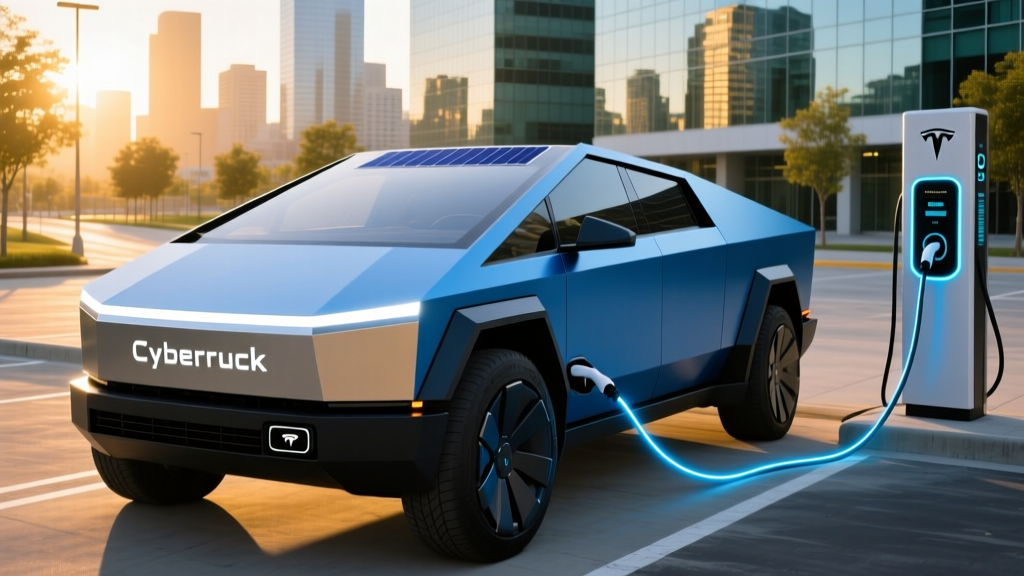
The stainless-steel exoskeleton of the Tesla Cybertruck turns heads in any color, but the limited-edition blue Tesla Cybertruck — offered through Tesla's custom wrap and Paint-Xpress program — has become one of the most searched configurations among 2026 buyers. Beyond the striking aesthetics, the Cybertruck's 800-volt architecture, tri-motor powertrain options, and polarizing design demand a hard look at the numbers. This review breaks down real-world range, charging curves, pricing after federal incentives, and whether this electric pickup actually delivers as a daily driver and workhorse.
2026 Cybertruck Specs at a Glance
| Specification | AWD (Dual-Motor) | Cyberbeast (Tri-Motor) |
|---|---|---|
| EPA Range | 340 miles | 320 miles |
| Battery Capacity (usable) | ~123 kWh (NMC) | ~123 kWh (NMC) |
| Drivetrain | Dual-Motor AWD | Tri-Motor AWD |
| Horsepower | 600 hp | 845 hp |
| 0–60 mph | 4.1 seconds | 2.6 seconds |
| Max DC Fast Charge | 250+ kW (800V) | 250+ kW (800V) |
| 10–80% Charge Time | ~22 minutes | ~22 minutes |
| Level 2 Home Charging | 11.5 kW (~37 mi/hr) | 11.5 kW (~37 mi/hr) |
| MPGe (Combined) | 72 MPGe | 68 MPGe |
| Efficiency (kWh/100 mi) | 47 kWh/100 mi | 49 kWh/100 mi |
| Towing Capacity | 11,000 lbs | 11,000 lbs |
| Cargo Bed Length | 6 ft (72 in) | 6 ft (72 in) |
| Frunk Volume | 7.1 cu ft | 7.1 cu ft |
| Battery/Drive Unit Warranty | 8 yr / 120,000 mi | 8 yr / 120,000 mi |
| Base MSRP (2026) | $79,990 | $99,990 |
Sources: fueleconomy.gov, Tesla official specifications.
Real-World Range: What the EPA Sticker Doesn't Tell You
EPA Estimated Range: 340 miles (AWD) / 320 miles (Cyberbeast)
Real-World Expectation: Plan for 270–300 miles at sustained 75 mph highway speeds in moderate temperatures. In sub-30°F winter conditions, expect a 20–30% reduction, dropping effective range to 220–260 miles. City driving with heavy regenerative braking can push close to or slightly above the EPA figure.
The Cybertruck's angular, flat-panel stainless-steel body creates a drag coefficient higher than sleeker EVs, and that aerodynamic penalty shows up most at highway speeds. In our experience and corroborated by third-party testing, the dual-motor AWD model averages roughly 2.1–2.3 kWh/mile at 70–75 mph on flat interstate terrain. That translates to roughly 280–295 miles from a full 123 kWh usable pack.
The Cyberbeast's tri-motor setup and additional weight drop its real-world highway range to roughly 250–275 miles under similar conditions. Cold weather compounds this: the Cybertruck does include a heat pump for cabin and battery thermal management, which mitigates some loss, but the large frontal area and steel mass still mean significant range compression in winter. If your commute involves mountain passes or sustained towing, budget for even greater reductions — towing at max capacity can cut range roughly in half.
Charging Speed and Infrastructure: 800V Architecture in Practice
| Charging Level | Power / Rate | Miles Added per Hour | Notes |
|---|---|---|---|
| Level 1 (120V) | ~1.4 kW | ~3–4 mi/hr | Emergency/trickle only |
| Level 2 (240V, 48A) | 11.5 kW | ~37 mi/hr | Full charge in ~10.5 hours |
| DC Fast Charge (V4 Supercharger) | Peak 250+ kW | ~150+ mi in 15 min | 10–80% in ~22 min |
| DC Fast Charge (350 kW CCS station w/ adapter) | Up to ~250 kW | Varies by station | Charge curve tapers above 80% |
The Cybertruck's 800-volt electrical architecture is one of its most significant technical advantages. At a Tesla V4 Supercharger, the truck can accept peak rates above 250 kW, and the charge curve holds strong through the 10–60% state of charge window before tapering. A 10–80% session takes approximately 22 minutes under optimal battery preconditioning.
Here's the nuance many buyers miss: peak kW is not sustained kW. The Cybertruck charges aggressively up to roughly 60% SoC, then the curve flattens considerably to protect the NMC cells. Charging from 80–100% at a DC fast charger is painfully slow — plan your road-trip stops around the 10–80% window for the best time efficiency.
At home, an 11.5 kW Level 2 Wall Connector on a 60-amp circuit adds roughly 37 miles of range per hour, meaning an overnight charge from 20% to 80% takes about 6–7 hours. Tesla includes the NACS connector natively, and the Cybertruck can access non-Tesla networks (Electrify America, EVgo) using the included CCS adapter. For a detailed breakdown of home installation costs, consult a licensed electrician — panel upgrades from 100A to 200A service can add $1,500–$3,000 to your install.
Performance and Driving Dynamics
The Cyberbeast's 845 horsepower and 2.6-second 0–60 mph time make it one of the quickest production pickups ever built, rivaling supercars from a decade ago. The dual-motor AWD's 600 hp and 4.1-second run is hardly slow either. Both models feature rear-wheel steering (up to 10 degrees), which dramatically shrinks the turning circle to roughly 40 feet — critical for a vehicle over 19 feet long.
The adaptive air suspension provides up to 12 inches of ground clearance in Off-Road mode and drops for easier bed access. Ride quality is firm — the steel exoskeleton and heavy battery pack mean you feel sharper imperfections, but body roll is remarkably controlled for a 6,800+ lb vehicle. The steer-by-wire system takes adjustment: the yoke-style steering wheel and variable ratio feel disconnected at low speeds but become precise on highway sweeps. Some drivers love it; others find it numb. Plan for a lengthy test drive.
Interior, Cargo, and Daily Practicality
The Cybertruck seats five across two rows. Front legroom measures 41.3 inches; rear legroom is 38.2 inches — adequate for adults but tighter than a Ford F-150 Lightning's rear seat. The minimalist interior centers on an 18.5-inch touchscreen that controls virtually every function, including the glovebox release and windshield wipers. There are no physical stalks for turn signals — they're buttons on the yoke, which remains controversial.
Cargo versatility is where the Cybertruck shines for truck buyers:
- Bed: 6 feet long, 4 feet wide between wheel wells, with a powered tonneau cover rated to support 300 lbs.
- Frunk: 7.1 cu ft lockable front trunk with a drain — useful for wet gear or groceries.
- Vault: The enclosed bed (with the tonneau deployed) offers 67 cu ft of sealed storage, effectively turning the bed into a weatherproof trunk.
- Towing: 11,000 lbs rated, with an integrated trailer brake controller and Tesla's trailer-assist camera views.
The 120V and 240V bed outlets (up to 9.6 kW export) make the Cybertruck a viable mobile generator for job sites or tailgating — a feature Rivian's R1T also offers but most gas trucks don't match natively.
Pricing, Tax Credits, and Total Cost
| Trim | Base MSRP | Federal §30D Credit | Effective Price | Blue Wrap Add-On |
|---|---|---|---|---|
| AWD (Dual-Motor) | $79,990 | Up to $7,500* | ~$72,490* | +$2,500–$4,000 (aftermarket wrap) |
| Cyberbeast (Tri-Motor) | $99,990 | Up to $7,500* | ~$92,490* | +$2,500–$4,000 (aftermarket wrap) |
*Federal tax credit caveats: Under IRS §30D rules, the $7,500 credit is subject to buyer income caps ($150K single / $300K joint MAGI), vehicle MSRP caps ($80,000 for trucks/pickups), and critical-mineral/battery-component sourcing requirements that shift annually. The AWD trim at $79,990 falls under the truck MSRP cap and may qualify for the full credit if sourcing requirements are met and buyer income is within limits. The Cyberbeast at $99,990 exceeds the $80,000 truck MSRP cap and does not qualify for the federal credit. Always verify current-year eligibility with a tax professional and the IRS Clean Vehicle Provisions before purchasing.
The "blue Tesla Cybertruck" is not a factory paint color for 2026 — Tesla's Cybertruck ships in unpainted stainless steel. Blue finishes are achieved through high-quality vinyl wraps applied by Tesla-certified shops or third-party installers. Expect to pay $2,500–$4,000 for a premium color-change wrap that lasts 5–7 years and protects the steel from fingerprints and minor scratches.
Autopilot, FSD, and Safety Technology
SAE Automation Level: Tesla Autopilot and Full Self-Driving (Supervised) are SAE Level 2 driver-assistance systems. The driver must remain fully engaged, hands on the yoke, and eyes on the road at all times. These are not self-driving systems.
The Cybertruck ships with Tesla's latest HW5 (AI5) computer and a suite of cameras enabling Autopilot (adaptive cruise + lane centering) standard. Full Self-Driving (Supervised) remains a $8,000 add-on or $99/month subscription as of 2026, adding automated lane changes, traffic light recognition, and city-street navigation. FSD has improved meaningfully with the v13+ neural-network-based stack, but it still requires constant supervision and occasionally makes erratic decisions in construction zones or unmapped areas.
Safety features include automatic emergency braking, blind-spot monitoring, 360-degree cameras, and the aforementioned trailer-assist views. As of early 2026, the Cybertruck has received a 5-Star Overall NHTSA Safety Rating, though its stainless-steel panels and angular geometry raise pedestrian-safety questions that traditional crumple-zone designs address more easily.
What FSD (Supervised) Does NOT Do: It does not make the Cybertruck autonomous. It will not navigate all roads reliably. It does not eliminate the driver's legal responsibility. Treat it as an advanced cruise-assist system, not a chauffeur.
Pros and Cons
Pros
- 800V architecture delivers class-leading DC fast-charge speeds
- 11,000-lb towing and 9.6 kW power export for job-site versatility
- Stainless exoskeleton resists dents; vault-style bed is weatherproof
- Rear-wheel steering shrinks the turning radius dramatically
- Cyberbeast performance is supercar-rivaling in a pickup
- OTA updates continuously add features post-purchase
Cons
- Cyberbeast exceeds §30D MSRP cap — no federal tax credit
- Steer-by-wire and yoke require significant driver adaptation
- Highway efficiency is poor vs. sleeker EVs (47–49 kWh/100 mi)
- Rear-seat legroom trails competitors like the F-150 Lightning
- Blue finish requires aftermarket wrap — not a factory option
- Polarizing design limits resale appeal to a niche buyer pool
- Insurance premiums run 20–40% higher than comparable trucks
Who Should Buy the Blue Tesla Cybertruck?
Choose the Cybertruck AWD if: You want an electric work truck with serious towing, Supercharger road-trip access, and you fall within the §30D income/MSRP requirements. It's best for tech-forward truck buyers who need a daily driver that can also handle job-site duty and weekend towing.
Choose the Cyberbeast if: Performance is paramount, you don't need the tax credit, and you value being in one of the quickest trucks on the road. It's a halo vehicle — buy it for the experience, not the economics.
Look elsewhere if: You need maximum rear-seat space (F-150 Lightning), proven off-road trail capability (Rivian R1T), or a conventional steering wheel. The Cybertruck demands compromise on ergonomics in exchange for its unique capabilities.
Frequently Asked Questions
What is the real-world range of the blue Tesla Cybertruck?
The EPA rates the AWD at 340 miles and the Cyberbeast at 320 miles. In real-world highway driving at 70–75 mph, expect 270–300 miles (AWD) and 250–275 miles (Cyberbeast). Cold weather below freezing can reduce these figures by 20–30%.
How fast does the Cybertruck charge at home and on the road?
At a V4 Supercharger, the 800V system peaks above 250 kW, achieving a 10–80% charge in roughly 22 minutes. At home on a Level 2 Wall Connector (11.5 kW), expect about 37 miles of range per hour, with a full overnight charge taking roughly 10.5 hours from empty.
Does the Tesla Cybertruck qualify for the $7,500 federal EV tax credit?
The AWD trim at $79,990 MSRP falls under the $80,000 truck cap and may qualify, depending on buyer income (under $150K single / $300K joint) and current battery-sourcing compliance. The Cyberbeast at $99,990 exceeds the MSRP cap and does not qualify. Always verify at irs.gov and consult a tax professional.
Is the blue Tesla Cybertruck a factory paint option?
No. Tesla does not offer factory paint on the Cybertruck — the stainless-steel body is unfinished. Blue (or any color) is achieved through a vinyl wrap, typically costing $2,500–$4,000 from a certified installer.
Is the Cybertruck worth buying vs. the F-150 Lightning or Rivian R1T?
The Cybertruck wins on DC charging speed (800V vs. the Lightning's slower architecture), towing capacity (11,000 lbs), and power export. The F-150 Lightning offers a more traditional driving experience, better rear-seat space, and a lower entry price. The Rivian R1T is more refined off-road with a quad-motor option but charges slower and costs more at comparable trims. Your priority — charging speed, comfort, or off-road chops — should drive the decision.
What is the Cybertruck's battery warranty?
Tesla covers the battery and drive units for 8 years or 120,000 miles, whichever comes first, with a minimum 70% capacity retention threshold over that period.
How much does insurance cost for a Cybertruck?
Insurance premiums for the Cybertruck run 20–40% higher than comparable full-size pickups, driven by the stainless-steel body repair complexity, high replacement parts cost, and performance capability. Expect $2,500–$4,500 annually depending on your profile and state. Always get quotes before purchasing.