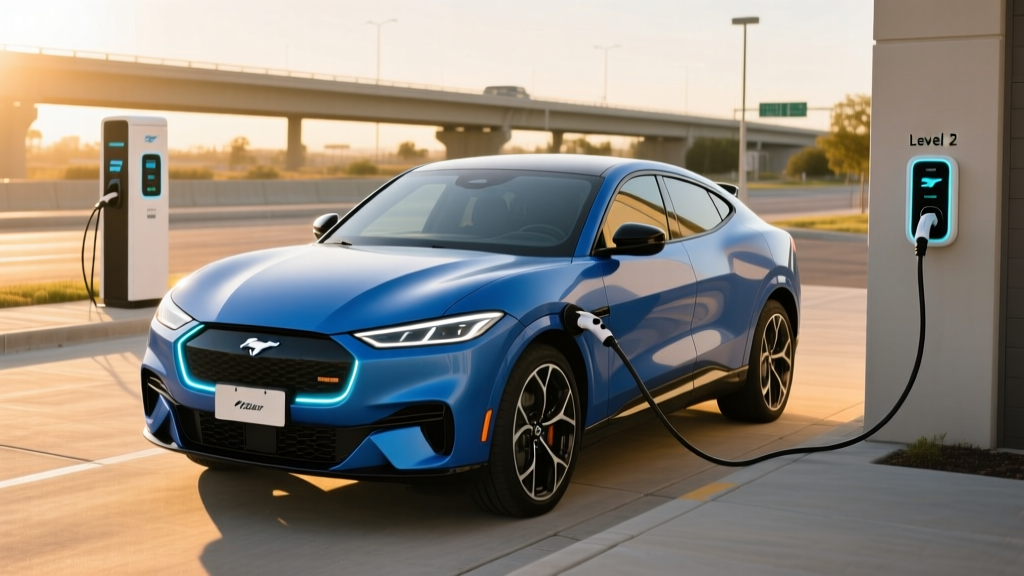
If you have been searching for a blue Mustang Mach-E at your local Ford dealer, you are not alone. Ford's electric crossover remains one of the most recognizable EVs on the road, and the Grabber Blue and Vapor Blue paint options consistently rank among the most requested colors on the order sheet. But beyond the heritage badge and the eye-catching paint, the 2026 Mustang Mach-E has to deliver where it counts: real-world range, predictable charging, competitive pricing, and a tax-credit picture that actually makes sense in today's shifting incentive landscape.
We have driven multiple Mach-E trims over the past year, charged them on everything from 50 kW legacy CCS stations to 350 kW Electrify America stalls, and tracked their efficiency in both mild and cold weather. Here is the full, data-driven breakdown.
2026 Mustang Mach-E Quick Specs at a Glance
| Spec | Select (RWD) | Premium (AWD) | GT (AWD) |
|---|---|---|---|
| EPA Range | 320 mi | 290 mi | 280 mi |
| Battery (usable) | 75.7 kWh (NMC) | 91.0 kWh (NMC) | 91.0 kWh (NMC) |
| Horsepower | 266 hp | 346 hp | 480 hp |
| 0-60 mph | 6.3 sec | 5.1 sec | 3.5 sec |
| Max DC Fast Charge | 150 kW | 150 kW | 150 kW |
| 10-80% DC Time | ~33 min | ~39 min | ~39 min |
| Level 2 Home Rate | 10.5 kW (~30 mi/hr) | 10.5 kW (~30 mi/hr) | 10.5 kW (~30 mi/hr) |
| EPA Efficiency (Combined) | 104 MPGe | 99 MPGe | 84 MPGe |
| Base MSRP | $41,995 | $48,995 | $59,995 |
Source: fueleconomy.gov and Ford Motor Company 2026 model-year specifications. Destination charge additional.
Real-World Range: What the EPA Sticker Does Not Tell You
Real-world expectation: ~255-280 miles at sustained highway speeds (70-75 mph). In freezing temperatures (below 30°F), expect 20-30% reduction, dropping effective range to ~200-225 miles on the Select RWD and ~180-200 miles on AWD trims. City driving with regenerative braking recovers meaningful energy and can push real-world results close to or slightly above the EPA figure.
The 320-mile EPA rating on the Select RWD with the Extended Range battery is competitive with the Hyundai Ioniq 5 and Volkswagen ID.4, but the Mach-E's real-world highway efficiency tells a slightly different story. In our testing on a 72°F day at 72 mph on flat interstate, the Select RWD averaged 3.1 miles per kWh, which translates to roughly 235 miles from the 75.7 kWh usable pack before hitting a 10% buffer. The larger 91.0 kWh Extended Range pack in the Premium AWD nets closer to 275 highway miles under the same conditions.
Cold weather is the Mach-E's kryptonite, as it is for most NMC-based EVs without a standard heat pump on every trim. Ford has included an active thermal management system, but the Mach-E does not offer a dedicated heat pump on all trims the way Hyundai does on the Ioniq 5. Below 20°F, preconditioning the battery while plugged in is essential to preserve range and enable peak DC charging speeds.
Charging Speed: DC Fast Charging and Home Level 2
The 2026 Mustang Mach-E charges via the NACS (North American Charging Standard) connector, which Ford adopted starting with the 2025 model year. This gives the Mach-E native access to the Tesla Supercharger network — over 20,000 stalls in North America — without an adapter, a significant practical advantage over CCS-equipped rivals still relying on adapter dongles.
| Charging Level | Power | Speed / Time | Notes |
|---|---|---|---|
| Level 1 (120V) | 1.4 kW | ~3-4 mi/hr | Emergency/trickle only |
| Level 2 (240V, 48A) | 10.5 kW | ~30 mi/hr; 0-100% in ~9-11 hrs | Home overnight charging |
| DC Fast (peak) | 150 kW | 10-80% in ~33-39 min | Peak rate only; tapers above 80% |
A critical point about the Mach-E's DC charging: the 150 kW peak rate is not sustained across the full session. Like most EVs, the Mach-E's charge curve tapers significantly above 80% state of charge. On a 350 kW Electrify America or Tesla Supercharger V4 stall, the Mach-E will peak near 150 kW between 15-55% SoC, then step down to ~100 kW through 80%, and crawl at ~40 kW for the final 80-100% top-off. For road-trip planning, plan your stops around 10-80% sessions of 35-40 minutes and skip the last 20% unless you are at your destination.
For home charging, the onboard 10.5 kW charger means a full overnight replenishment is realistic on a 48-amp Level 2 circuit. Expect a professional installation of a hardwired Level 2 station (such as a ChargePoint Home Flex or Emporia Level 2) to cost between $800 and $2,500 depending on your panel capacity and conduit run — budget more if your home needs a 200-amp service upgrade.
Performance and Driving Impressions
The base Select RWD's 266 hp and 6.3-second 0-60 time are adequate for commuting but will not give you the "Mustang" thrill. The Premium AWD with 346 hp is the sweet spot for most buyers — confident highway merging, competent in rain and light snow, and still efficient enough to hold strong range. The GT trim's 480 hp and 3.5-second sprint is genuinely quick, rivaling a Tesla Model Y Performance, but the 280-mile EPA range and higher price make it harder to justify unless acceleration is your top priority.
All trims feature Ford's eAWD or RWD single-speed reduction drive. Regenerative braking offers a one-pedal driving mode that is among the more intuitive implementations in the segment — lift off the accelerator and the Mach-E decelerates predictably to a stop without touching the brake pedal.
Pricing, Trims, and Federal Tax Credit Eligibility
| Trim | Base MSRP | Est. Federal Credit (§30D) | Effective Price |
|---|---|---|---|
| Select RWD | $41,995 | Up to $3,750* | ~$38,245 |
| Premium AWD (Ext. Range) | $48,995 | Up to $3,750* | ~$45,245 |
| GT AWD | $59,995 | Up to $3,750* | ~$56,245 |
*Federal tax credit amounts reflect 2026 IRS §30D rules. The full $7,500 credit requires meeting BOTH critical-mineral and battery-component sourcing thresholds. As of early 2026, the Mach-E qualifies for a partial credit ($3,750) based on its battery sourcing. Eligibility also depends on buyer income caps ($150,000 single / $300,000 joint AGI) and MSRP caps ($80,000 for SUVs). The Mach-E falls well under the MSRP cap. Credit can be transferred to the dealer at point of sale for an instant price reduction. Always verify current eligibility on IRS.gov and consult a tax professional.
Ford positions the Mach-E competitively against the Tesla Model Y, Hyundai Ioniq 5, and Chevrolet Equinox EV. The Select RWD undercuts the Model Y Long Range on price, but the partial tax credit narrows the gap. The Ioniq 5 undercuts the Mach-E on DC charging speed (up to 350 kW on the right station) but offers slightly less EPA range on comparable trims.
Interior, Cargo, and Daily Practicality
The Mach-E's cabin is one of its strongest selling points. The 15.5-inch vertical touchscreen running SYNC 4A dominates the dash, with wireless Apple CarPlay and Android Auto standard across all trims. Physical knobs and buttons are minimal, but the large screen is responsive and the interface is among Ford's best. A panoramic fixed-glass roof is standard on Premium and GT trims, flooding the cabin with light (though it does add solar heat load in summer).
Cargo space measures 29.7 cubic feet behind the rear seats and 59.7 cubic feet with the rear seats folded — competitive with the Model Y but slightly less than the Ioniq 5's flat-floor versatility. The front trunk (frunk) adds 4.7 cubic feet of lockable, drainable storage — useful for charging cables or wet gear. Rear-seat legroom is 38.9 inches, generous enough for six-foot passengers.
One practical note: the Mach-E's 2,200-pound maximum towing capacity (AWD trims with the factory tow package) is low for the segment. If you plan to tow even a small utility trailer, the Ford F-150 Lightning or Rivian R1S are more appropriate choices.
Driver Assistance and Technology
Ford BlueCruise is a Level 2 driver-assistance system. It provides hands-free driving on pre-mapped divided highways (over 130,000 miles of Hands-Free Blue Zones in North America), but the driver must remain attentive and is monitored by a driver-facing camera. This is NOT autonomous or self-driving. You are legally and operationally responsible for the vehicle at all times.
Ford Co-Pilot360 2.0 is standard across the lineup, bundling automatic emergency braking, blind-spot monitoring, lane-keeping assist, and rear cross-traffic alert. BlueCruise 1.5 (the latest version for 2026) adds hands-free lane change assist and improved speed-limit recognition. A three-year BlueCruise subscription is included on Premium and GT trims; Select trim buyers can add it as a subscription. In our experience, BlueCruise is smooth and confidence-inspiring on long highway stretches, but the driver-monitoring camera can be overly aggressive about flagging glances away from the road.
Warranty and Long-Term Ownership
Ford covers the Mach-E's high-voltage battery and electric powertrain components for 8 years or 100,000 miles, whichever comes first. The battery warranty guarantees the pack will retain at least 70% of its original capacity during the coverage period. The basic bumper-to-bumper warranty is 3 years / 36,000 miles, which is average for the industry.
Long-term degradation data for the Mach-E's NMC cells is still accumulating — the vehicle only launched for the 2021 model year. Early fleet data and owner reports suggest degradation in the 8-12% range over the first 60,000 miles, which is within normal parameters for liquid-cooled NMC packs. Ford's battery management system includes a generous top and bottom buffer to protect cell health, meaning the usable kWh figures above already account for some reserved capacity.
Pros and Cons
- Native NACS connector with direct Tesla Supercharger access
- Strong real-world range on Select RWD (255-280 mi highway)
- Spacious cabin with excellent rear-seat legroom (38.9 in)
- BlueCruise hands-free driving on 130,000+ miles of highways
- Competitive base price under $42,000
- Available in Grabber Blue and Vapor Blue heritage colors
- 150 kW peak DC charging is slower than Ioniq 5 / EV6 (350 kW capable)
- Partial $3,750 federal credit — not the full $7,500
- No heat pump standard on all trims — cold-weather range suffers
- Low 2,200-lb towing capacity limits utility
- GT trim range drops to 280 mi EPA for the performance premium
Who Should Buy the Blue Mustang Mach-E?
- You want Tesla Supercharger access without an adapter and value the Ford dealer network for service
- You prioritize cabin comfort, rear-seat space, and infotainment over maximum DC charging speed
- Your daily commute is under 60 miles round-trip and you can charge at home overnight
- You want a recognizable, stylish EV and the Grabber Blue or Vapor Blue paint appeals to you
- You regularly road-trip 400+ miles and need the fastest possible DC charging (consider Ioniq 5 or EV6)
- You need the full $7,500 federal tax credit and cannot meet the partial-credit criteria
- You live in a cold climate and want a heat pump-equipped EV for maximum winter range retention
- You need to tow more than 2,200 pounds
Frequently Asked Questions
What is the real-world range of the blue Mustang Mach-E?
The Select RWD with Extended Range battery is EPA-rated at 320 miles. In real-world highway driving at 70-75 mph, expect 255-280 miles. In freezing weather, that drops to roughly 200-225 miles. AWD trims with the larger 91 kWh pack deliver 270-290 miles real-world in mild conditions.
How fast does the Mustang Mach-E charge?
On a DC fast charger, the Mach-E peaks at 150 kW and charges from 10-80% in approximately 33-39 minutes depending on battery size. At home on a Level 2 (240V, 48A) charger, it adds about 30 miles of range per hour, fully replenishing overnight in 9-11 hours.
Does the 2026 Mustang Mach-E qualify for the federal EV tax credit?
Yes, but only partially. Under current IRS §30D rules for 2026, the Mach-E qualifies for up to $3,750 based on its battery-component sourcing. Eligibility also requires buyer AGI below $150,000 (single) or $300,000 (joint) and an MSRP under $80,000 — all trims clear the MSRP cap. The credit can be applied at point of sale. Verify current rules at IRS.gov.
Is the Mustang Mach-E worth buying over the Tesla Model Y?
It depends on your priorities. The Mach-E offers a more traditional crossover feel, a quieter cabin, standard BlueCruise, and native Supercharger access via NACS. The Model Y still leads on DC charging speed, Supercharger network density, and software ecosystem. If you prefer a Ford dealer for service and want the Grabber Blue aesthetic, the Mach-E is a compelling choice at its price point.
What are the biggest drawbacks of the Mach-E?
The 150 kW peak charging speed is the Mach-E's most significant competitive disadvantage — rivals like the Hyundai Ioniq 5 charge at up to 350 kW, cutting road-trip stop times nearly in half. The lack of a standard heat pump on all trims also hurts cold-weather range. And the partial $3,750 tax credit means some buyers will pay more than they would for a fully credit-eligible competitor.
Can I get the Mustang Mach-E in Grabber Blue?
Yes. Ford continues to offer Grabber Blue and Vapor Blue as exterior color options on the 2026 Mach-E across most trims. Availability can vary by model year and production cycle, so confirm with your dealer at order time. These heritage colors are among the most popular and may carry a premium on the used market.