Quick Verdict: Is the Blue Cybertruck Worth the Wait?
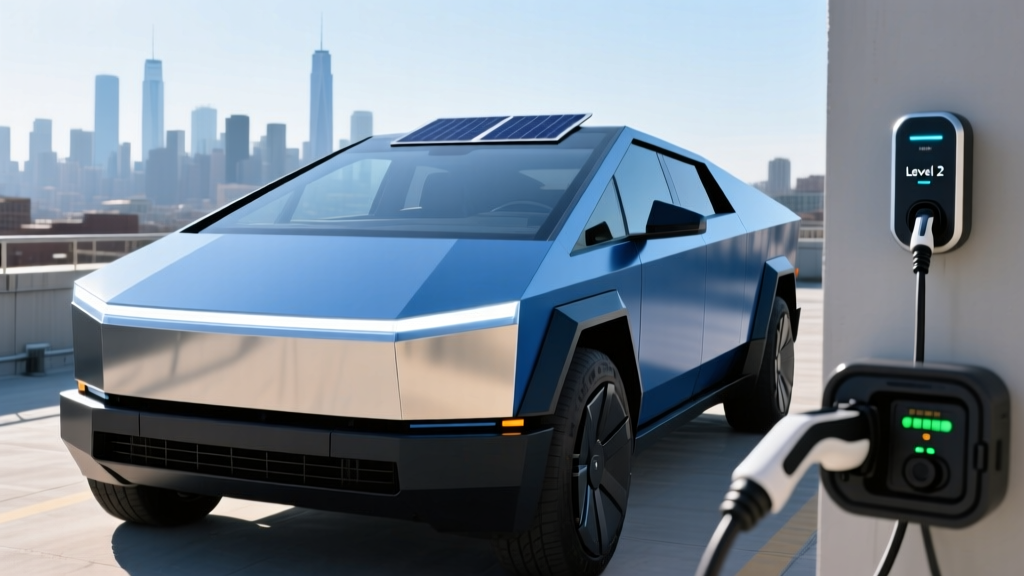
The Tesla Cybertruck in blue — officially a color-matched vinyl wrap or aftermarket PPF option as of the 2026 model year — remains one of the most polarizing EVs on the road. Beneath the angular stainless-steel exoskeleton and that head-turning blue finish lies a serious electric pickup: up to 340 miles of EPA-estimated range (AWD trim), 250 kW peak DC fast charging, and a 4.1-second 0-60 mph time in the dual-motor configuration. But the Cybertruck's real-world usability tells a more nuanced story than the spec sheet suggests, and buyers eyeing that blue paint job need to understand the full ownership picture before signing.
This review covers every number that matters — from battery chemistry and charge-curve taper to IRS §30D tax credit eligibility — so you can decide if a blue Cybertruck fits your driveway and your budget.
Range, Efficiency, and Real-World Expectations
Real-World Expectation: Plan for 270–300 miles on highway road trips at 70–75 mph. In cold weather (below 32°F), expect a 20–30% reduction, dropping effective range to roughly 220–250 miles. City driving with regen braking recovers more energy and can approach or slightly exceed the EPA sticker.
The Cybertruck AWD's 340-mile EPA figure places it competitively against the Ford F-150 Lightning Extended Range (320 miles EPA) and the Rivian R1T Dual-Motor Max Pack (352 miles EPA). However, the Cybertruck's heavy stainless-steel body and poor aerodynamic profile (despite Tesla's claims) mean highway efficiency suffers. According to fueleconomy.gov, the AWD Cybertruck achieves approximately 67 MPGe combined, translating to roughly 48 kWh per 100 miles — not class-leading.
For context, that efficiency figure means you'll consume about 1.5 kWh per mile at highway speeds. On a 300-mile road trip, you'll use roughly 144 kWh total, requiring at least one DC fast-charge stop. Cold-weather impacts are real: lithium-ion cells lose capacity and increase internal resistance below freezing, and cabin heating draws significant power. Tesla's heat pump helps mitigate this, but physics wins in sub-20°F conditions.
| Specification | RWD | AWD Dual Motor | Cyberbeast (Tri-Motor) |
|---|---|---|---|
| EPA Range | 320 mi | 340 mi | 320 mi |
| Battery (usable) | ~123 kWh (NMC) | ~123 kWh (NMC) | ~123 kWh (NMC) |
| 0-60 mph | 6.5 sec | 4.1 sec | 2.6 sec |
| Horsepower | ~315 hp | ~600 hp | ~845 hp |
| Drivetrain | Rear-Wheel Drive | Dual-Motor AWD | Tri-Motor AWD |
| Towing Capacity | 7,500 lbs | 11,000 lbs | 11,000 lbs |
| MPGe (combined) | 70 MPGe | 67 MPGe | 62 MPGe |
| Base MSRP | $60,990 | $79,990 | $99,990 |
Charging Speed: DC Fast, Level 2, and the Charge Curve Reality
Charging speed is where Cybertruck owners spend the most time — and where expectations often clash with reality. Here's the complete picture:
| Charging Level | Power (kW) | Speed (mi/hr added) | Notes |
|---|---|---|---|
| Level 1 (120V household) | ~1.4 kW | ~3 mi/hr | Emergency/trickle only — full charge takes days |
| Level 2 (240V home, 48A) | 11.5 kW | ~29 mi/hr | Full charge overnight (~10-11 hours from 10%) |
| Level 2 (240V, 80A Wall Connector) | 19.2 kW | ~48 mi/hr | Requires 100A circuit; full charge ~6-7 hours |
| DC Fast (Tesla Supercharger V4) | Peak 250 kW | ~200+ mi/hr (peak) | 10-80% in ~28-32 minutes |
| DC Fast (CCS adapter, EA/others) | Peak 250 kW | ~200+ mi/hr (peak) | Same speed with Tesla CCS adapter |
The 250 kW peak figure sounds impressive, but peak is not sustained. The Cybertruck's ~123 kWh NMC battery follows a typical charge curve: it holds near-peak speed from roughly 10-40% State of Charge, then progressively tapers. From 80-100%, charging slows dramatically to protect cell longevity — expect the final 20% to take nearly as long as the first 60%. This is normal for NMC chemistry and is managed by Tesla's thermal management system, which preconditions the battery when you navigate to a Supercharger.
For home charging, the Tesla Wall Connector at 80 amps (requiring a dedicated 100-amp circuit) is the gold standard. Most Cybertruck owners install a 48-amp Level 2 charger on a 60-amp circuit, which adds roughly 29 miles of range per hour — enough to fully replenish overnight for most daily driving. Budget $800–$2,500 for professional Level 2 installation depending on your panel capacity and run length; a panel upgrade to 200A service can add $1,500–$3,000 if needed.
Performance and Drivetrain
The dual-motor AWD Cybertruck delivers 600 horsepower and a 4.1-second 0-60 mph time — genuinely quick for a 6,800-pound vehicle. The tri-motor Cyberbeast drops that to 2.6 seconds, rivaling supercars, though at a $20,000 premium and with reduced range (320 miles EPA).
The AWD system uses independent front and rear motors with torque vectoring, providing confident traction in rain and light snow. However, the Cybertruck's sheer weight and stainless-steel body mean it's no lightweight trail rig. Ground clearance is respectable at approximately 16 inches (with adaptive air suspension in its highest setting), and the approach/departure angles are reasonable for fire roads but not hardcore rock crawling.
Towing capacity maxes out at 11,000 pounds for AWD and Cyberbeast trims. Be aware: towing at or near max capacity will cut your range roughly in half — expect 150-170 miles before needing to charge. This is consistent with all electric pickups and is a physics limitation, not a Cybertruck-specific flaw.
Pricing, Trims, and Federal Tax Credit Eligibility
Here's where the numbers get complicated for buyers eyeing a blue Cybertruck. The base RWD trim starts at $60,990, the AWD at $79,990, and the Cyberbeast at $99,990 (all 2026 MSRP figures before destination fees).
| Trim | Base MSRP | §30D Credit Eligible? | Effective Price (if eligible) |
|---|---|---|---|
| RWD | $60,990 | Yes — under $80K MSRP cap for trucks | ~$53,490 |
| AWD Dual Motor | $79,990 | Yes — at the $80K truck cap limit | ~$72,490 |
| Cyberbeast | $99,990 | No — exceeds $80K MSRP cap | $99,990 |
The federal EV tax credit under IRS §30D offers up to $7,500, but eligibility depends on three factors that change frequently:
- MSRP Cap: Vans, SUVs, and trucks must be under $80,000 MSRP. The Cybertruck qualifies as a truck, so the AWD at $79,990 barely clears the bar. The Cyberbeast does not qualify.
- Buyer Income Cap: Modified adjusted gross income must not exceed $300,000 (joint filers), $225,000 (head of household), or $150,000 (single filers).
- Battery Sourcing: The credit splits into two $3,750 halves — one for critical minerals sourcing and one for battery component manufacturing. Tesla's supply chain has progressively met these requirements, but the exact credit amount (full $7,500 vs. partial $3,750) can shift as sourcing rules tighten annually. Always verify current eligibility on the IRS website or with a tax professional before purchasing.
The point-of-sale transfer option, available since 2024, lets dealers apply the credit as an instant discount rather than waiting for a tax refund. This effectively lowers your out-of-pocket cost at delivery — but only if you meet all eligibility requirements at the time of purchase.
Interior, Cargo, and Technology
The Cybertruck's interior is minimalist even by Tesla standards. A single 18.5-inch touchscreen dominates the dashboard, handling infotainment, climate, vehicle settings, and the camera-based "rearview mirror" (a physical mirror is not standard). The yoke-style steering wheel remains controversial — some drivers adapt quickly, others find it impractical for low-speed maneuvering and parking.
Passenger space is adequate but not generous for a full-size truck. Front legroom measures approximately 41.5 inches, while rear legroom is around 38.2 inches — tighter than an F-150 Lightning or Rivian R1T. The rear bench fits three adults for short trips but feels cramped on long drives.
The 6.5-foot bed (Tesla calls it the "vault") offers 67 cubic feet of cargo volume with the tonneau cover closed. The motorized cover is a standout feature — it retracts electrically and supports up to 300 pounds of distributed weight. There's also a front trunk (frunk) with roughly 7 cubic feet of lockable storage, useful for charging cables and groceries.
On the tech side, the Cybertruck ships with Tesla's latest hardware (HW4/AI5 computer) and includes Basic Autopilot standard. Full Self-Driving (Supervised) remains a $8,000 add-on — and it's critical to understand that this is an SAE Level 2 driver-assistance system. You must keep your hands on the yoke and eyes on the road at all times. FSD does not make the Cybertruck autonomous.
Battery, Warranty, and Long-Term Ownership
The Cybertruck uses a ~123 kWh (usable) NMC (nickel manganese cobalt) battery pack. NMC offers higher energy density than LFP (lithium iron phosphate), which is why Tesla chose it for this heavy, range-demanding vehicle. The trade-off: NMC cells degrade slightly faster than LFP over thousands of cycles, and Tesla recommends keeping daily charge limits at 80-90% to maximize longevity — only charging to 100% before long trips.
Tesla's battery and drive unit warranty covers 8 years or 120,000 miles (whichever comes first), with a guaranteed minimum 70% capacity retention over that period. This is competitive with the industry standard. The vehicle limited warranty covers 4 years or 50,000 miles.
Battery replacement cost out of warranty is a legitimate concern: industry estimates place a Cybertruck-sized pack replacement at $18,000–$25,000+ depending on labor. However, real-world degradation data from Tesla's fleet suggests most packs retain 85-90% capacity at 100,000 miles — well above the warranty threshold. Catastrophic failure is rare; gradual capacity loss is the norm.
Pros, Cons, and Who the Blue Cybertruck Suits Best
- 340-mile EPA range (AWD) is competitive in the EV truck segment
- 250 kW DC fast charging with access to Tesla's Supercharger network (17,000+ stalls in North America)
- 11,000-lb towing capacity and 2,500-lb payload
- Stainless-steel body is dent-resistant — no paint to chip (blue wrap is replaceable)
- Over-the-air updates continuously add features
- Strong resale value relative to competitors
- Real-world highway range drops significantly (270-300 mi) — worse in cold weather
- Heavy weight (6,800+ lbs) hurts efficiency — 48 kWh/100mi is not efficient
- Yoke steering is divisive and impractical for some drivers
- Rear seat space is tighter than F-150 Lightning or Rivian R1T
- Cyberbeast trim ($99,990) is ineligible for the federal tax credit
- Blue finish requires aftermarket wrap — adds $3,000-$5,000 and needs replacement every 5-7 years
- Insurance premiums run 15-25% higher than comparable gas trucks
- Choose the Cybertruck AWD if: You want a head-turning electric truck with strong range, Tesla's Supercharger network access, and you can charge at home. The blue wrap makes a bold statement that raw stainless steel can't.
- Choose the Ford F-150 Lightning instead if: You need maximum rear-seat space, prefer a conventional steering wheel, want a proven dealer service network, or need to tow frequently (the Lightning's range while towing is similarly limited, but its interior is more practical).
- Choose the Rivian R1T instead if: You prioritize off-road capability, want a more refined interior, prefer a gear tunnel for creative storage, or need a quad-motor option for extreme terrain.
- Skip the Cybertruck entirely if: You can't install a Level 2 home charger, live in an apartment without charging access, or regularly drive more than 250 miles in cold weather without time to stop and charge.
Frequently Asked Questions
What is the real-world range of the blue Cybertruck?
The AWD Cybertruck carries a 340-mile EPA estimate, but expect 270-300 miles on highway road trips at sustained speeds, and 220-250 miles in freezing temperatures. City driving with frequent regenerative braking can approach the EPA figure. Towing at max capacity cuts range to roughly 150-170 miles.
How fast does the Cybertruck charge at home and on the road?
On a Tesla Supercharger V4, the Cybertruck peaks at 250 kW and charges from 10-80% in approximately 28-32 minutes, though the curve tapers significantly above 80%. At home on a 48-amp Level 2 charger (240V), it adds roughly 29 miles of range per hour, fully charging overnight in 10-11 hours. An 80-amp Wall Connector cuts that to 6-7 hours but requires a 100-amp dedicated circuit.
Does the Cybertruck qualify for the $7,500 federal EV tax credit?
The RWD ($60,990) and AWD ($79,990) trims qualify under the §30D truck MSRP cap of $80,000, provided the buyer meets income limits ($300K joint / $150K single) and the battery meets current critical-mineral and component sourcing requirements. The Cyberbeast ($99,990) exceeds the cap and does not qualify. Always verify current rules at irs.gov before purchasing, as sourcing requirements tighten annually.
Is the blue Cybertruck color from the factory?
As of the 2026 model year, Tesla does not offer a factory blue paint option for the Cybertruck. The raw stainless-steel exoskeleton is unpainted by design. A blue finish requires either a professional vinyl wrap ($3,000-$5,000) or paint protection film (PPF) with a blue tint. Wraps typically last 5-7 years before needing replacement.
Is the Cybertruck worth buying over the F-150 Lightning or Rivian R1T?
It depends on your priorities. The Cybertruck wins on Supercharger network access, stainless-steel durability, and tech-forward design. The F-150 Lightning wins on interior space, conventional controls, and dealer service availability. The Rivian R1T wins on off-road capability and interior quality. All three are capable electric trucks — the "best" choice is the one that matches your daily use case and charging situation.
What is the Cybertruck's battery warranty?
Tesla covers the battery and drive unit for 8 years or 120,000 miles, whichever comes first, guaranteeing a minimum of 70% capacity retention. The vehicle limited warranty covers 4 years or 50,000 miles. Out-of-warranty battery replacement is estimated at $18,000-$25,000+, though fleet data suggests most packs retain 85-90% capacity at 100,000 miles.