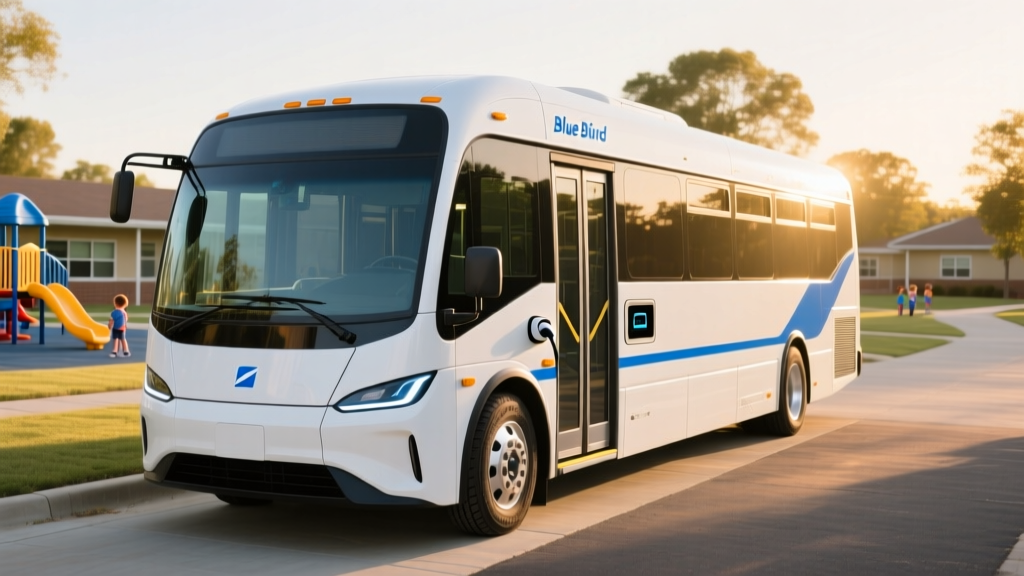
School bus fleet electrification has moved from pilot-project curiosity to a line-item reality for hundreds of U.S. school districts. With the EPA's Clean School Bus Program distributing billions in rebate funding and state-level mandates tightening diesel idling rules, transportation directors now need hard numbers — not brochure promises — to decide whether battery-electric buses can survive real routes in real weather. The 2026 Blue Bird Vision Electric remains the market-share leader in the Type C (conventional) electric school bus segment, and this profile breaks down exactly what districts get for roughly $350,000 before incentives: range under load, charging infrastructure demands, LFP battery longevity, and the ownership math versus diesel and propane alternatives.
Quick Verdict: Who Should Consider the Vision Electric in 2026?
The Blue Bird Vision Electric is best suited for districts running urban or suburban routes under 120 miles per day with access to depot-level Level 2 or DC fast charging. Its 196 kWh LFP battery delivers predictable, linear degradation and a 15-year warranty that outlasts the typical 12-year bus replacement cycle. However, rural districts with 150+ mile routes, extreme cold climates, or no utility capacity for depot charging should proceed cautiously — or evaluate the Lion Electric LionD or a plug-in hybrid alternative until infrastructure catches up. For fleet planners who can charge overnight and stay within the EPA-rated envelope, the Vision Electric offers the lowest per-mile energy cost in the Type C segment.
Range, Efficiency & the Real-World Route Test
| Spec | Value |
|---|---|
| EPA Estimated Range | 150 miles |
| Battery Capacity (Usable) | 196 kWh, LFP (Lithium Iron Phosphate) |
| Motor Output | 200 kW (268 hp) / 760 lb-ft torque |
| Drivetrain | Rear-wheel drive, single-speed direct |
| 0-30 mph (loaded) | ~8.5 seconds |
| GVWR | 33,000 lbs |
| Passenger Capacity | Up to 83 (72 standard) |
| Cargo / Luggage Space | 120 cu ft under-floor compartment |
| Efficiency (combined) | ~2.1 kWh/mile (MPGe not typically published for Class 5-7) |
| Max DC Fast Charge | 150 kW (CCS1) |
| 10-80% DC Charge Time | ~75 minutes |
| Level 2 AC Charge Rate | 19.2 kW (SAE J1772 / CCS Combo) |
| Level 2 Full Charge Time | ~10 hours (0-100%) |
| Base MSRP (before incentives) | ~$350,000 |
| Warranty — Battery | 15 years / unlimited miles (70% capacity retention) |
| Warranty — Powertrain | 5 years / 100,000 miles |
Real-World Range Reality Check
EPA Sticker: 150 miles
Typical loaded route (72 passengers, mixed suburban): ~120-130 miles usable before 10% reserve
Cold-weather penalty (below 20°F, cabin heat on): expect 25-35% range loss — plan for ~90-100 miles
Highway-speed field trips (sustained 55-65 mph): aerodynamic drag drops range to ~105-115 miles
Bottom line: a district's "120-mile route" on paper may consume 140+ miles of battery in winter. Blue Bird recommends sizing routes to no more than 75% of rated range in cold climates — roughly 110 miles max in northern states.
Efficiency in the school bus segment is best measured in kWh per mile rather than MPGe, since Class 5-7 vehicles fall outside standard EPA consumer fuel-economy labeling. The Vision Electric averages roughly 2.1 kWh/mile in moderate weather on a stop-and-go suburban route. At a national average commercial electricity rate of $0.12/kWh (varies widely by utility and time-of-use tariff), that translates to approximately $0.25/mile in energy cost — versus $0.55-$0.70/mile for a comparable 2026 diesel at $3.80/gallon and 6 mpg.
Charging Infrastructure: What Districts Must Build
| Level | Power | Connector | Miles Added / Hour | Use Case |
|---|---|---|---|---|
| Level 2 (AC) | 19.2 kW | SAE J1772 / CCS Combo | ~9 miles/hr | Overnight depot charging |
| DC Fast | 150 kW peak | CCS1 | ~55 miles/15 min (peak) | Mid-day top-up, opportunity charging |
School bus fleet electrification lives or dies at the depot. Most districts charge overnight using Level 2 chargers (typically ChargePoint or BTC Power units rated 19.2 kW), which replenish the 196 kWh pack in roughly 10 hours — perfect for a bus that returns at 4 PM and departs at 6 AM. DC fast charging at 150 kW is available for mid-day opportunity charging (split routes, activity runs), but sustained use above 80% State of Charge triggers taper; the final 20% can add 30+ minutes.
Infrastructure cost reality: A 10-bus depot with Level 2 chargers, switchgear upgrades, trenching, and utility transformer work typically runs $500,000-$1.2 million before utility make-ready incentives. Districts should engage their utility's transportation electrification program early — many offer 50-100% of make-ready costs. The EPA Clean School Bus Program rebates can cover up to $375,000 per bus and $13,000-$20,000 toward charging infrastructure for qualifying districts (prioritized for high-needs, rural, and Tribal schools).
Performance, Drivetrain & Daily Drivability
The Vision Electric uses a Cummins-supplied 200 kW (268 hp) electric motor driving the rear axle through a single-speed reduction gear. Torque is 760 lb-ft from zero RPM, which matters when merging onto highways with 83 students aboard. The 0-30 mph sprint takes roughly 8.5 seconds when loaded — adequate for school zones and arterial merges, though drivers accustomed to diesel's torque curve need a few weeks to adapt to the instant, linear electric pull.
Regenerative braking is aggressive and configurable through the dashboard, enabling near one-pedal driving on suburban routes. This extends brake-pad life dramatically: Blue Bird reports that many early-adopter fleets have not replaced friction brake components at 80,000+ miles. The air brake system (required above 26,000 lbs GVWR) is fully integrated with regen blending.
Driver-assist features remain SAE Level 1-2: standard collision mitigation (Mobileye-based), lane departure warning, and adaptive cruise control. There is no "self-driving" capability — the driver must remain fully engaged at all times. A fleet telematics suite (Blue Bird's SmartBus platform) provides real-time State of Charge monitoring, route energy consumption analytics, and predictive maintenance alerts to the transportation office.
Battery Chemistry, Degradation & the 15-Year Warranty
Blue Bird equips the Vision Electric with a 196 kWh LFP (lithium iron phosphate) battery pack — a deliberate choice over the NMC (nickel manganese cobalt) chemistry common in passenger EVs. LFP offers three fleet-relevant advantages:
- Cycle life: LFP cells typically tolerate 3,000-5,000 full cycles before reaching 80% capacity, versus 1,000-2,000 for NMC. At one cycle per school day (~180 days/year), the pack should outlast the bus's 15-year service life.
- Thermal stability: LFP is inherently more resistant to thermal runaway, reducing fire risk in a vehicle carrying 83 children.
- No cobalt: Eliminates supply-chain and ethical sourcing concerns — relevant for districts with sustainability mandates.
The trade-off: LFP is heavier and less energy-dense than NMC, contributing to the Vision Electric's ~33,000 lb GVWR. Cold-weather performance is also slightly worse; LFP cells accept charge more slowly below freezing, making battery preconditioning essential before DC fast charging in winter.
Blue Bird's battery warranty guarantees 70% capacity retention for 15 years with no mileage cap — a critical data point for fleet financial modeling. If the pack drops below 70% usable capacity within that window, Blue Bird replaces or remediates it at no cost. Independent fleet data from early adopters (2020-2023 model years) shows approximately 3-5% degradation per year in moderate climates, suggesting the warranty is conservative.
Pricing, Incentives & the Total Cost of Ownership
| Line Item | Amount |
|---|---|
| Base MSRP (bus only) | ~$350,000 |
| EPA Clean School Bus Rebate (high-needs district max) | -$375,000 |
| State incentive (e.g., California HVIP, New York Truck Voucher) | -$120,000 to -$265,000 (varies) |
| IRS §45W Commercial Clean Vehicle Credit (if applicable) | Up to -$40,000 |
| Net cost to district (best case, stacked incentives) | As low as $0-$80,000 |
Tax credit note: School districts, as tax-exempt entities, generally cannot claim the IRS §30D consumer credit. However, the §45W Commercial Clean Vehicle Credit (up to $40,000 for vehicles over 14,000 lbs) is available to taxable fleet operators, and the "direct pay" (elective payment) provision under the Inflation Reduction Act allows tax-exempt entities, including public school districts, to receive certain credits as direct payments beginning in 2023. Eligibility rules are complex and vary by district structure — consult a municipal finance advisor and reference current IRS guidance before modeling.
The real financial story is total cost of ownership (TCO) over a 12-15 year lifecycle. A 2025 study by the World Resources Institute's Electric School Bus Initiative found that electric buses, when fully incentivized, achieve TCO parity with diesel by year 5-7 and save $40,000-$100,000+ over their lifetime in fuel and maintenance savings. Key savings drivers: electricity at $0.25/mile vs diesel at $0.60+/mile, elimination of oil/filter/DEF changes, and 80%+ reduction in brake wear from regenerative braking.
Competitor Comparison: Vision Electric vs. LionD vs. IC Bus CE Series Electric
The Type C electric school bus market in 2026 has three primary contenders:
- Blue Bird Vision Electric: 150-mile range, 196 kWh LFP, 15-year battery warranty, ~$350K base. Market leader with the largest dealer/service network.
- Lion Electric LionD: ~135-mile range, 169 kWh NMC pack, 10-year battery warranty, ~$330K base. Stronger in cold-climate testing; Canadian manufacturing may appeal to Buy-American-exempt districts.
- IC Bus CE Series Electric (Navistar): ~130-mile range, 210 kWh NMC, 10-year warranty, ~$360K base. Backed by Navistar/TRATON service infrastructure; newer to market.
Pros — Blue Bird Vision Electric
- LFP battery with 15-year warranty — best in segment
- 150-mile EPA range covers ~85% of U.S. school routes
- Largest dealer and parts network among electric school bus OEMs
- Regenerative braking extends brake life to 100K+ miles
- Lowest per-mile energy cost vs. diesel ($0.25 vs. $0.60+)
- Strong EPA Clean School Bus rebate compatibility
Cons — Blue Bird Vision Electric
- 25-35% range loss in sub-20°F weather limits winter routes
- Depot charging infrastructure can exceed $100K per bus installed
- 10+ hour Level 2 charge time rules out quick mid-day turnaround without DCFC
- $350K sticker is 3x a diesel bus before incentives
- No V2G (vehicle-to-grid) capability as of 2026 — limits revenue potential
- LFP cold-charge limitations require preconditioning discipline
Who This EV Suits Best — and Who Should Wait
Fleet Decision Framework
Choose the Blue Bird Vision Electric if: Your district runs urban/suburban routes under 120 miles daily, has depot space for overnight Level 2 charging, qualifies for EPA Clean School Bus rebates or state incentives, and operates in moderate or southern climates. The 15-year LFP warranty makes it a lifecycle-cost winner for districts that plan to hold buses 12-15 years.
Consider alternatives or wait if: Your routes regularly exceed 130 miles, you operate in sustained sub-zero climates (northern Minnesota, Alaska, mountain routes), your utility cannot deliver depot-level power without a multi-year infrastructure project, or your district cannot absorb the upfront capital even with rebate timing delays. In these cases, evaluate the LionD's cold-weather tuning, a CNG/propane bridge, or wait for 2027-2028 models with expected 200+ mile range and V2G capability.
Frequently Asked Questions
What is the real-world range of the Blue Bird Vision Electric?
The EPA rates it at 150 miles, but real-world loaded routes typically consume 120-130 miles of usable range before the 10% reserve buffer. In cold weather (below 20°F), plan for 90-100 miles. Districts should size routes to 75% of rated range in winter.
How fast does the Vision Electric charge?
On Level 2 AC at 19.2 kW, a full 0-100% charge takes approximately 10 hours — ideal for overnight depot use. On a 150 kW DC fast charger (CCS1), 10-80% takes roughly 75 minutes, though the charge curve tapers significantly above 80%.
How much does the Vision Electric cost after incentives?
Base MSRP is approximately $350,000. With the EPA Clean School Bus rebate (up to $375,000 for high-needs districts), state incentives, and potentially the §45W commercial credit via direct pay, net cost can drop to $0-$80,000. Incentive stacking varies by district and state — verify current-year program availability.
Does it qualify for the federal EV tax credit?
The consumer §30D credit does not apply to school buses (GVWR exceeds 14,000 lbs and districts are typically tax-exempt). However, the §45W Commercial Clean Vehicle Credit (up to $40,000) may be available, and the IRA's elective pay provision allows tax-exempt entities to receive certain credits as direct payments. Consult a municipal finance professional and review current IRS rules.
Is the Vision Electric worth it vs. diesel?
On total cost of ownership, yes — typically by year 5-7 when incentives are applied. Fuel savings alone ($0.25/mile electric vs. $0.60+/mile diesel) add up to $50,000-$80,000 over 12 years at 12,000 miles/year. Add brake and maintenance savings, and TCO advantage can exceed $100,000. The breakeven timeline depends heavily on local electricity rates, route mileage, and incentive timing.
How long will the LFP battery last?
Blue Bird warrants the 196 kWh LFP pack for 15 years with 70% capacity retention guaranteed. Independent fleet data shows 3-5% annual degradation in moderate climates. LFP chemistry is rated for 3,000-5,000 cycles — at 180 school days per year, the pack should outlast the bus's operational life.