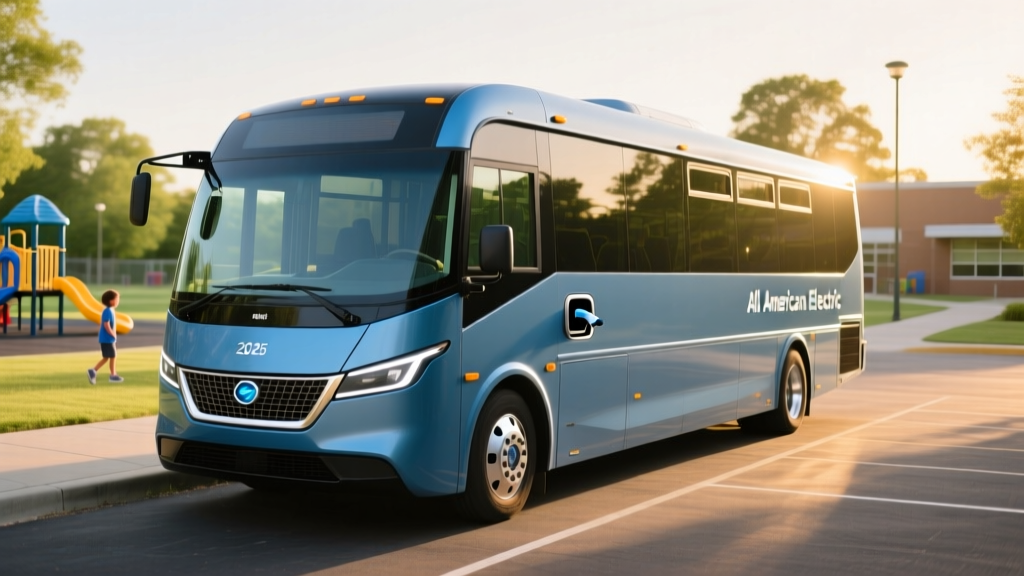
The Blue Bird All American Electric (also known as the D3RE2) is a full-size, Type D battery-electric school bus built on Blue Bird's longest-running platform. For 2026, it carries a 150 kWh lithium-ion (NMC) battery pack delivering an EPA-estimated range of up to 150 miles, a peak DC fast-charge rate of 60 kW, and a base price that typically lands between $350,000 and $390,000 before federal or state incentives. It seats up to 84 passengers and is designed for depot-based overnight charging with optional DC fast-charging for midday top-ups.
Quick Verdict for Fleet Buyers
Who it's for: School districts and private fleet operators running fixed routes under 120 miles per day with access to depot-based Level 2 or DC charging infrastructure.
Who should wait: Districts running rural routes exceeding 150 miles daily, those in extreme cold climates without heated depot storage, or operators without access to utility demand-charge management or grant funding for charging infrastructure.
Range, Battery, and Efficiency: The Numbers That Matter
The All American Electric uses a 150 kWh usable-capacity NMC (nickel manganese cobalt) battery pack mounted beneath the floor. Blue Bird rates the bus at up to 150 miles of range under typical stop-and-go school bus duty cycles. However, real-world range varies considerably based on route profile, climate, and accessory load.
| Specification | Value |
|---|---|
| Battery Capacity (Usable) | 150 kWh (NMC chemistry) |
| EPA-Estimated Range | Up to 150 miles |
| Real-World Range (moderate climate) | ~120–140 miles |
| Real-World Range (cold climate, <20°F) | ~90–110 miles |
| Electric Motor Output | 250 kW (~335 hp) |
| Peak Torque | ~860 lb-ft |
| Max DC Fast-Charge Rate | 60 kW (CCS1 connector) |
| DC Charge Time (10–80%) | ~3 hours at peak rate |
| Level 2 AC Charging (19.2 kW) | ~8 hours (0–100%) |
| Seating Capacity | Up to 84 passengers |
| GVWR | 36,000 lbs |
| Estimated Base Price | $350,000–$390,000 |
| Battery Warranty | 5 years / unlimited miles (standard) |
Key insight: School bus routes average 60–100 miles per day, meaning most districts will operate well within the All American Electric's real-world envelope. However, cold-weather routes in northern states can see 25–35% range reduction due to battery cabin heating demands and reduced regenerative braking efficiency. Districts in Minnesota, North Dakota, or upstate New York should plan for a 100-mile effective range in winter and spec accordingly.
Charging Infrastructure: What Your Depot Needs
Charging an 84-passenger electric school bus is fundamentally different from charging a consumer EV. You are not plugging into a household outlet — you are building or upgrading commercial depot infrastructure.
| Charging Level | Power (kW) | Time to Full Charge | Use Case |
|---|---|---|---|
| Level 2 AC (J1772/CCS AC) | 19.2 kW | ~8 hours | Overnight depot charging (standard) |
| DC Fast Charge (CCS1) | 60 kW peak | ~3 hours (10–80%) | Midday top-up or rapid turnaround |
Most school districts rely on overnight Level 2 depot charging at 19.2 kW per bus. A fleet of 10 buses charging simultaneously draws approximately 192 kW — equivalent to the load of a small commercial building. This almost always requires a utility service upgrade and dedicated transformer installation.
Depot charging infrastructure cost breakdown (per bus, estimated):
- Level 2 commercial charger (19.2 kW): $7,000–$15,000 per unit
- Electrical panel and conduit work: $5,000–$20,000 per stall (varies by distance to service panel)
- Utility transformer upgrade: $15,000–$80,000+ (shared across fleet, depends on existing capacity)
- Permitting and engineering: $3,000–$10,000
- Total per-bus infrastructure cost: $25,000–$50,000 for the first few stalls, declining as depot scales
DC fast-charging at 60 kW via CCS1 is available but adds $30,000–$60,000 per charger unit. For most school bus duty cycles, overnight Level 2 is sufficient — DC fast chargers are typically justified only for split-shift operations or midday activity runs.
Fleet operators should contact their local utility early in the planning process. Many utilities offer make-ready programs that cover the cost of wiring and infrastructure upgrades for commercial EV fleets. The EPA Clean School Bus Program also provides grants that can cover both bus acquisition and charging infrastructure.
Total Cost of Ownership: Electric vs. Diesel School Bus
The upfront cost of the All American Electric is roughly 3–4x that of a comparable diesel Type D bus. But total cost of ownership (TCO) tells a different story when you factor in fuel, maintenance, and incentive dollars.
| Cost Category | Electric (All American RE Electric) | Diesel (All American RE Diesel) |
|---|---|---|
| Purchase Price (before incentives) | $370,000 | $110,000 |
| Federal/State Incentives Applied | –$175,000 (est. EPA grant + state) | $0 |
| Net Acquisition Cost | $195,000 | $110,000 |
| Charging Infrastructure (amortized) | $35,000 | $0 |
| Fuel/Energy (12 yrs, 24,000 mi/yr) | $52,000 (est. $0.12/kWh avg) | $144,000 (est. $3.80/gal, 6 mpg) |
| Maintenance (12 yrs) | $28,000 | $72,000 |
| Estimated Total 12-Year Cost | $310,000 | $326,000 |
| Cost Per Mile (total) | $1.08 | $1.13 |
Key takeaway: With EPA Clean School Bus Program funding and state incentive stacking, the electric bus can reach TCO parity with diesel within 8–10 years. Without grant funding, payback extends to 12–15 years or may not be achieved before battery replacement. Incentive eligibility is critical — districts should confirm current-year program availability through the EPA's Clean School Bus Program page before committing.
Maintenance savings are significant and well-documented: electric school buses eliminate oil changes, diesel particulate filter (DPF) cleaning/replacement, exhaust system repairs, transmission fluid changes, and DEF fluid. Brake wear is reduced substantially due to regenerative braking — some fleets report 50–70% longer brake life.
Incentives and Funding: Stacking the Dollars
Electric school buses are among the most heavily subsidized vehicles in the United States. Multiple funding sources can be stacked to dramatically reduce net acquisition cost:
- EPA Clean School Bus Program: Up to $345,000 per electric bus + $20,000 for charging infrastructure (varies by district priority tier and funding year)
- State voucher programs: California's HVIP, New York's NYTVIP, and similar programs in Colorado, New Jersey, and other states can provide $50,000–$265,000 additional
- Utility make-ready programs: Many IOUs cover 50–100% of depot electrical infrastructure costs
- IRS §45W Commercial Clean Vehicle Credit: Up to $40,000 for qualified commercial electric vehicles over 14,000 lbs GVWR — note this is a commercial credit, not the consumer §30D credit, and is subject to domestic-content and critical-mineral sourcing rules per current IRS guidance
Important: incentive programs change annually. The EPA Clean School Bus Program funding is allocated in rounds, and state voucher programs may have waitlists or modified criteria year to year. Always confirm current-year availability and eligibility before finalizing a purchase order.
Real-World Ownership Considerations
Fleet operators evaluating the All American Electric should plan for these practical realities:
Route Planning and Range Buffer
Never spec a bus to operate at its maximum range. Plan for a 20–30% buffer. If your longest route is 110 miles, a 150-mile EPA-rated bus is adequate in moderate weather but risky in cold climates. Districts with routes over 120 miles should evaluate midday DC fast-charging capability or consider splitting routes.
Cold-Weather Performance
NMC batteries lose efficiency in cold temperatures. Expect 25–35% range reduction below 20°F due to cabin heating loads and reduced regenerative braking. Preconditioning the battery while still plugged in at the depot mitigates some of this loss. Districts in cold climates should consider heated depot storage where possible.
Driver Training
Electric school buses require driver training on regenerative braking behavior, one-pedal driving modes, and range-aware driving techniques (smooth acceleration, reduced idling with HVAC). Drivers accustomed to diesel may initially find the instant torque and quiet operation disorienting.
Utility Demand Charges
Commercial electricity billing often includes demand charges based on peak kW draw. A depot charging 10 buses simultaneously at 19.2 kW each could trigger significant demand charges. Smart charging software that staggers charge start times can reduce peak demand by 40–60%. Budget for this in your energy cost model.
Common Misconceptions About Electric School Buses
| Myth | Fact |
|---|---|
| "Electric buses can't handle cold weather" | They can, but with 25–35% range reduction. Proper route planning and battery preconditioning mitigate the impact. Fleets in Alaska and Canada operate electric buses successfully. |
| "The battery will need replacement in 5 years" | NMC packs in commercial applications are designed for 12–15 year service life with gradual degradation. Blue Bird warranties the battery for 5 years; real-world data from early adopter fleets shows ~80% capacity retention at year 8–10. |
| "Charging takes too long for school buses" | Overnight Level 2 charging (8 hours) fully replenishes the 150 kWh pack. Most buses are parked 12–16 hours between shifts — charging time is not a constraint for standard single-shift routes. |
| "There's no funding available" | The EPA Clean School Bus Program has allocated billions through 2026, and many states stack additional vouchers. Districts that apply early and work with their utility routinely achieve 60–80% cost offset. |
| "Electric buses are less safe than diesel" | Electric school buses meet or exceed all FMVSS safety standards. The low center of gravity (floor-mounted battery) improves rollover stability. Zero tailpipe emissions also improve air quality for students and drivers. |
Decision Framework: Is the All American Electric Right for Your Fleet?
Choose the Blue Bird All American Electric If:
- Your daily routes are under 120 miles (with buffer for cold weather)
- You have depot parking with access to utility power for Level 2 charging
- Your district qualifies for EPA Clean School Bus Program or state voucher funding
- You operate single-shift routes (no midday turnaround needed, or DC fast-charging is available)
- You plan to hold buses for 10+ years to realize TCO savings
- Your utility offers make-ready infrastructure support or favorable commercial EV rates
Stick with Diesel (or Wait) If:
- Your routes regularly exceed 140 miles per day
- You operate in extreme cold climates without heated storage and cannot accept 25–35% winter range loss
- No grant funding or utility infrastructure support is available in your area
- You run split-shift or midday activity routes without DC fast-charging access
- Your fleet turnover cycle is under 8 years (insufficient time to recoup higher upfront cost)
Frequently Asked Questions
What is the real-world range of the Blue Bird All American Electric?
Blue Bird rates it at up to 150 miles EPA-estimated. In real-world moderate-climate operation with stop-and-go school bus duty cycles, expect 120–140 miles. In cold weather below 20°F, plan for 90–110 miles due to heating loads and reduced regenerative braking.
How long does it take to charge the All American Electric?
On a 19.2 kW Level 2 depot charger, a full 0–100% charge takes approximately 8 hours — well suited for overnight parking. On a 60 kW DC fast charger (CCS1), reaching 80% from 10% takes roughly 3 hours. Note that DC charge speed tapers significantly above 80% state of charge.
How much does the Blue Bird All American Electric cost?
Base pricing typically falls between $350,000 and $390,000 depending on configuration and options. This is roughly 3–4x the cost of a comparable diesel Type D bus. However, EPA Clean School Bus Program grants, state vouchers, and utility incentives can reduce net acquisition cost by 50–80%.
What is the battery warranty and expected lifespan?
Blue Bird provides a standard 5-year battery warranty. The NMC battery pack is engineered for a 12–15 year service life with gradual capacity degradation. Early-adopter fleet data suggests approximately 80% capacity retention at 8–10 years of typical school bus use. Battery replacement cost, if needed outside warranty, is estimated at $50,000–$80,000.
Does the IRS §30D consumer tax credit apply to school buses?
No. The §30D credit applies to consumer light-duty vehicles. School buses qualify for the §45W Commercial Clean Vehicle Credit, which provides up to $40,000 for vehicles over 14,000 lbs GVWR. This credit has its own domestic-content and critical-mineral sourcing requirements. Consult a tax professional and review current IRS §45W guidance for eligibility.
Can the All American Electric handle hilly or mountainous routes?
Yes, the 250 kW motor provides 335 hp and ~860 lb-ft of torque — more than adequate for grade climbing. However, sustained climbing increases energy consumption significantly. Mountainous routes should be modeled conservatively, with range reduced by 15–25% compared to flat-terrain estimates. Regenerative braking on descents partially recovers this energy.
What charging connector does it use?
The All American Electric uses a CCS1 (Combined Charging System) connector for both AC Level 2 and DC fast charging. This is the standard commercial EV connector in North America and is compatible with all major commercial charging networks and depot charger manufacturers.