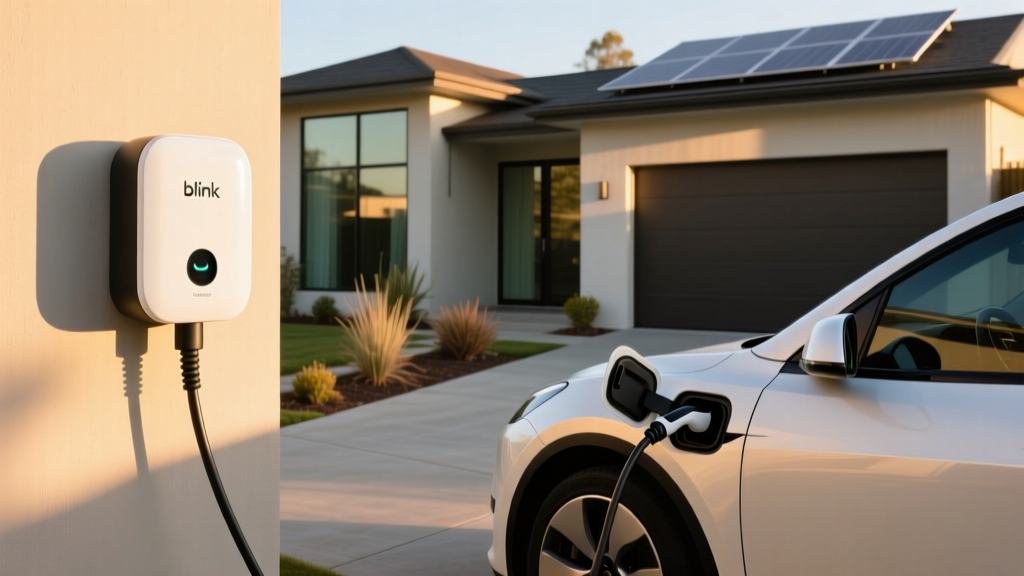
If you've just bought an electric vehicle or are about to, the Blink home charger lineup likely appeared in your search results. Blink is one of the most visible names in public charging networks, but their residential hardware — specifically the Blink HQ 200 — deserves its own evaluation separate from the company's commercial reputation. We've tested the unit, mapped out installation requirements, and calculated real-world charging economics so you can decide whether it belongs on your garage wall.
Quick Verdict: Who Should Consider a Blink Home Charger?
The Blink HQ 200 is a 40-amp, 9.6 kW Level 2 charger priced around $449. It sits in the mid-tier of the home charging market — not as feature-rich as a ChargePoint Home Flex or as rugged as a Grizzl-E, but competitively priced with Wi-Fi connectivity and a 25-foot cable. It works well for EV owners who want a straightforward, connected charger without paying premium prices. Where Blink stumbles is in its app experience and limited amperage adjustability compared to rivals.
Understanding Charging Levels: What Speed Does a Blink Home Charger Deliver?
Before evaluating any home charger, you need to understand the three charging tiers available to EV owners. The critical distinction in EV charging is between kW (kilowatts), which measures power — how fast energy flows into your battery — and kWh (kilowatt-hours), which measures energy capacity — how much total energy your battery stores. Think of kW as the width of a pipe and kWh as the size of the tank you're filling.
| Level | Voltage | Max Power (kW) | Miles of Range Added Per Hour | Typical Use Case |
|---|---|---|---|---|
| Level 1 | 120V AC | 1.4–1.9 kW | 3–5 miles/hr | Overnight top-ups, PHEVs, emergencies |
| Level 2 | 240V AC | 3.3–19.2 kW | 12–75 miles/hr | Home daily charging, workplace, public destinations |
| DC Fast Charge | 400–900V DC | 50–350+ kW | 150–1,000+ miles/hr (peak) | Road trips, highway corridors, commercial fleets |
The Blink HQ 200 operates at Level 2, delivering up to 9.6 kW (240V × 40A). For context, here's what that means in practice:
- Tesla Model 3 Standard Range (60 kWh battery): 0–100% in roughly 6.5 hours
- Hyundai Ioniq 5 (84 kWh usable, NMC): 10–80% in approximately 8–9 hours (overnight)
- Ford F-150 Lightning Extended Range (131 kWh): 10–80% in about 12–14 hours
- Toyota RAV4 Prime PHEV (18.1 kWh): Full charge in roughly 2.5 hours
Most EV owners with daily commutes under 60 miles will find 9.6 kW more than sufficient. You plug in at night, and by morning you have a full battery. The limitation appears with very large batteries (like the F-150 Lightning or Hummer EV) where a 10–80% charge takes longer than a typical night's sleep.
Installation Requirements: What Your Electrical Panel Needs
The Blink HQ 200 requires a 240-volt, 50-amp dedicated circuit. The charger itself draws 40 amps continuously, but the National Electrical Code (NEC) requires circuits to be rated at 125% of continuous load — hence the 50A breaker. This is a hardwired unit (no plug), meaning your electrician will run conduit and wire directly from your panel to the charger location.
Panel Capacity: The Hidden Cost Many Buyers Miss
Before purchasing any Level 2 charger, have a licensed electrician evaluate your home's electrical service. Most modern homes have 200-amp service panels, which can typically accommodate a 50A EV circuit. However, older homes — especially those built before 1990 — may have 100-amp or even 60-amp service. Adding a 50A circuit to a maxed-out 100A panel requires either a panel upgrade (replacing the entire panel with a 200A unit) or a service upgrade (bringing more amperage from the utility to your home).
Some newer solutions like the Span smart panel or load-management devices (such as the Emporia Load Management Controller) can allow EV charging without a full panel upgrade by dynamically shedding load when the house draws heavily elsewhere. These add $500–$1,500 to the project but can avoid a $3,000–$5,000 panel replacement.
| Component | Typical Cost Range | Notes |
|---|---|---|
| Blink HQ 200 charger unit | $449–$499 | Available direct or through Amazon |
| Electrician labor (standard install) | $400–$1,200 | Varies by run length, wall type, conduit |
| Electrical materials (wire, conduit, breaker) | $100–$350 | 6 AWG copper or 4 AWG aluminum typical |
| Permit and inspection | $50–$200 | Required in most jurisdictions |
| Total (no panel upgrade) | $1,000–$2,250 | Typical suburban garage install |
| Panel upgrade (if needed) | $2,500–$5,000+ | 100A → 200A service upgrade |
| Total (with panel upgrade) | $3,500–$7,250 | Older homes, high-load existing panels |
Always get at least two quotes from licensed electricians, and confirm they pull a permit. Unpermitted electrical work can void your homeowner's insurance and create a fire hazard. The National Electrical Contractors Association maintains a directory of qualified professionals.
Connector Compatibility: Will the Blink HQ 200 Fit Your EV?
The Blink HQ 200 ships with a J1772 connector — the standard Level 2 plug used by nearly every non-Tesla EV sold in North America through 2024. However, the connector landscape has shifted dramatically. Tesla opened its Supercharger network to non-Tesla vehicles using the NACS (North American Charging Standard) connector, and by 2025–2026, most major automakers — Ford, GM, Rivian, Volvo, Hyundai, Kia, and others — have transitioned to NACS ports on new vehicles.
| Connector | Brands Using It (2026 Models) | Blink HQ 200 Compatible? | Adapter Needed? |
|---|---|---|---|
| J1772 | Older EVs (pre-2025), some PHEVs, BMW i4/iX (current gen) | Yes — native | None |
| NACS (Tesla) | Tesla (all), Ford, GM, Rivian, Hyundai, Kia, Volvo (2025+) | With adapter | Tesla J1772-to-NACS adapter (~$100–$175) |
| CHAdeMO | Nissan Leaf (legacy, discontinued 2025), Mitsubishi Outlander PHEV | Not applicable | CHAdeMO is DC-only; irrelevant for L2 home charging |
| CCS1 | Being phased out in favor of NACS on new models | Yes — J1772 is the AC portion of CCS1 | None for home Level 2 |
Key takeaway: If you drive a 2025+ model with a NACS port, you'll need a J1772-to-NACS adapter to use the Blink HQ 200. Tesla sells an official adapter, and third-party options from Lectron and A2Z are widely available. If you'd rather avoid the adapter hassle, consider chargers that ship with a native NACS connector, such as the Tesla Wall Connector or the ChargePoint Home Flex (which offers a NACS variant).
Charging Cost: Home vs. Public vs. Gas — The Real Numbers
One of the strongest arguments for home Level 2 charging is cost. Let's break down what you'll actually pay to fuel an EV at home compared to public chargers and gasoline vehicles.
| Scenario | Rate | Cost Per Mile (3.5 mi/kWh EV) | Annual Cost (12,000 mi) |
|---|---|---|---|
| Home — off-peak utility rate | $0.08–$0.14/kWh | $0.023–$0.040 | $276–$480 |
| Home — standard rate (national avg) | $0.16–$0.18/kWh | $0.046–$0.051 | $552–$612 |
| Public Level 2 (ChargePoint, EVgo) | $0.25–$0.49/kWh | $0.071–$0.140 | $852–$1,680 |
| DC Fast Charging (Electrify America, EA) | $0.35–$0.58/kWh | $0.100–$0.166 | $1,200–$1,992 |
| Gasoline vehicle (28 MPG avg, $3.40/gal) | $3.40/gallon | $0.121 | $1,452 |
At off-peak residential rates, home charging costs roughly 3–4 cents per mile — about a quarter of what gasoline costs per mile. Even at standard rates, you're saving 50–75% on fuel compared to a gas car averaging 28 MPG. The Blink HQ 200's Wi-Fi connectivity allows you to schedule charging during off-peak hours through the Blink app, maximizing savings on time-of-use utility plans.
According to fueleconomy.gov, the average 2026 EV achieves 3.0–4.0 miles per kWh, with efficient sedans like the Tesla Model 3 and Hyundai Ioniq 6 reaching 4.0+ mi/kWh. Your actual cost per mile depends on your vehicle's efficiency and your local electricity rate.
Blink HQ 200 vs. the Competition: Equipment Comparison
The home Level 2 charger market is competitive. Here's how the Blink HQ 200 stacks up against the most popular alternatives in 2026:
Blink HQ 200
- Power: 9.6 kW (40A)
- Connector: J1772
- Cable length: 25 ft
- Smart features: Wi-Fi, app scheduling, energy tracking
- Amperage adjustable: No (fixed 40A)
- Outdoor rated: Yes (NEMA 4)
- Warranty: 1 year
- Price: ~$449
ChargePoint Home Flex
- Power: Up to 12 kW (50A)
- Connector: J1772 or NACS
- Cable length: 23 ft
- Smart features: Wi-Fi, app, Alexa, adjustable 16–50A
- Amperage adjustable: Yes (dip switch)
- Outdoor rated: Yes (NEMA 4)
- Warranty: 3 years
- Price: ~$549–$599
Tesla Wall Connector
- Power: Up to 11.5 kW (48A)
- Connector: NACS (native Tesla)
- Cable length: 24 ft
- Smart features: Wi-Fi, power sharing, OTA updates
- Amperage adjustable: Yes (via app)
- Outdoor rated: Yes (NEMA 3R)
- Warranty: 4 years
- Price: ~$475
Grizzl-E Smart
- Power: Up to 10 kW (40A)
- Connector: J1772 or NACS
- Cable length: 24 ft
- Smart features: Wi-Fi, OCPP, adjustable amperage
- Amperage adjustable: Yes (16–40A)
- Outdoor rated: Yes (NEMA 4X — extreme weather)
- Warranty: 3 years
- Price: ~$499
The Blink HQ 200's main advantage is price — at $449, it undercuts most competitors. Its disadvantages are the fixed 40A output (meaning you can't dial it down for a weaker panel), a shorter 1-year warranty, and an app that consistently receives mixed reviews from users. If you have a robust 200A panel and prioritize budget, the Blink is competitive. If you need adjustable amperage or a longer warranty, the ChargePoint Home Flex or Grizzl-E offer more flexibility for $50–$100 more.
Safety, Code Compliance, and Permits
Any Level 2 charger installation must comply with the National Electrical Code (NEC) Article 625, which governs electric vehicle charging systems. Key requirements include:
- Dedicated circuit: Your EV charger must have its own breaker — no sharing with other appliances or outlets.
- GFCI protection: The 2020 NEC revision requires GFCI protection for all receptacles used for EV charging. Hardwired installations (like the Blink HQ 200) may be exempt depending on local code interpretation, but many jurisdictions now require GFCI breakers regardless.
- Outdoor rating: If installing outside, the unit must be rated for wet locations. The Blink HQ 200 carries a NEMA 4 rating, meaning it's protected against splashing water and windblown dust — suitable for most outdoor installations.
- Permit required: Virtually all jurisdictions require an electrical permit for EV charger installation. The permit ensures an inspector will verify the work meets code. Typical permit fees range from $50–$200.
- Cable management: NEC requires that charging cables not create a trip hazard. Wall-mounted installations with proper cable routing satisfy this requirement.
Federal Tax Credit: Can You Offset the Cost?
The Alternative Fuel Vehicle Refueling Property Credit (IRS Form 8911) was renewed under the Inflation Reduction Act and covers 30% of the cost of home EV charging equipment and installation, up to a maximum of $1,000. However, there are important restrictions for 2026:
- The credit applies only to equipment installed at your primary residence.
- The installation must be in an eligible census tract (generally non-urban or low-income communities — check the IRS eligibility tool).
- The credit covers both the charger hardware and installation labor.
- It is non-refundable, meaning it can only reduce your tax liability to zero — you won't receive a refund for any excess.
On a $1,500 total Blink HQ 200 installation, a qualifying homeowner could claim $450 (30% × $1,500), reducing the net cost to $1,050. Consult a tax professional to confirm your eligibility based on your census tract and tax situation.
Frequently Asked Questions
How much does it cost to install a Blink home charger?
Total installed cost for the Blink HQ 200 typically ranges from $1,000 to $2,250 in a home with adequate panel capacity. This includes the $449 charger unit, $400–$1,200 in electrician labor, $100–$350 in materials, and $50–$200 in permit fees. If your home requires a panel upgrade from 100A to 200A service, add $2,500–$5,000 to the total.
How fast will the Blink HQ 200 charge my EV overnight?
At 9.6 kW, the Blink HQ 200 adds approximately 30–35 miles of range per hour of charging for an efficient EV (3.5 mi/kWh). Over an 8-hour overnight session, that's 240–280 miles of range — more than enough to fully replenish most daily driving. Larger-battery vehicles like the F-150 Lightning will add around 170–200 miles in 8 hours due to lower efficiency (roughly 2.0 mi/kWh).
Is the Blink home charger compatible with Tesla vehicles?
Yes, but you'll need a J1772-to-NACS adapter if your Tesla has a NACS port (all Teslas do). Tesla sells an official adapter for about $100. Alternatively, Tesla owners may prefer the Tesla Wall Connector, which includes a native NACS plug and supports up to 11.5 kW at a similar price point.
Can I install the Blink HQ 200 myself?
No. The Blink HQ 200 is a hardwired unit requiring a 240V, 50A dedicated circuit. This work must be performed by a licensed electrician to meet NEC requirements, pass inspection, and maintain your homeowner's insurance coverage. DIY 240V electrical work is dangerous and typically violates local building codes.
Does the Blink charger work with solar panels?
The Blink HQ 200 itself has no direct solar integration. However, if your home has solar panels feeding into your electrical panel, the electricity your charger draws may come partially or fully from solar generation depending on your system size and net metering arrangement. For dedicated solar-to-EV charging with smart scheduling, systems like the Emporia Vue with EV charger integration offer more granular control.
What happens if my area loses power — will the charger resume automatically?
Yes. The Blink HQ 200 supports auto-resume after a power outage. Once utility power is restored, the charger will resume the charging session that was in progress without requiring you to manually restart it. This is a valuable feature in areas with frequent grid interruptions.