Quick Verdict: The Blazer EV SS in 2026
The 2026 Chevrolet Blazer EV SS is the performance flagship of GM's Ultium-based midsize crossover lineup, packing 557 horsepower and a 0-60 mph time under 4.0 seconds into a practical two-row package. It trades outright range efficiency for straight-line punch and aggressive styling, positioning itself against the Ford Mustang Mach-E GT, Tesla Model Y Performance, and Hyundai Ioniq 5 N. After a rocky 2024 launch plagued by software complaints, the 2026 model year benefits from two years of over-the-air refinements to GM's infotainment stack and a more mature Super Cruise rollout.
But does the SS justify its $64,495 starting price, and how does real-world range hold up when you push 557 hp through 21-inch wheels? We break down every number that matters.
Range, Battery, and Real-World Efficiency
Real-World Expectation: ~240–260 miles in mixed highway driving at 70+ mph; expect ~200–220 miles in sub-30°F winter conditions with cabin heat active.
The Blazer EV SS uses GM's Ultium battery platform with a usable capacity of approximately 102 kWh in an NMC (nickel manganese cobalt) lithium-ion configuration. GM has not switched the SS to LFP chemistry — the energy density of NMC remains necessary to hit the SS's power and range targets in a single pack.
Efficiency is the trade-off for performance. The EPA rates the 2026 Blazer EV SS at roughly 87 MPGe combined, which translates to about 39 kWh per 100 miles. That's thirstier than a Tesla Model Y Performance (~30 kWh/100mi) and even the Hyundai Ioniq 5 N (~34 kWh/100mi). If you're a lead-foot driver who regularly exploits the SS's acceleration, expect efficiency to dip into the low 40s kWh/100mi, which compresses highway range toward the 220-mile mark on a full charge.
Cold-weather impact is real. The Ultium platform includes a heat pump for cabin and battery thermal management, but in our experience with GM's large-pack Ultium vehicles, sub-freezing temperatures still knock 15–25% off range depending on driving style and preconditioning habits. Always precondition the battery while plugged in before a cold-weather departure — it's the single easiest way to claw back range.
| Spec | Value |
|---|---|
| EPA Range | 285 miles |
| Real-World Range (highway, mild) | ~240–260 miles |
| Battery (usable) | ~102 kWh, NMC |
| Efficiency | 87 MPGe / 39 kWh/100mi |
| Drivetrain | Dual-motor AWD |
| Horsepower | 557 hp |
| Torque | 648 lb-ft |
| 0-60 mph | ~3.8 seconds |
| Max DC Fast Charge | 190 kW |
| 10-80% DC Charge Time | ~30 minutes |
| Level 2 Home Charging | 11.5 kW (~31 mi/hr) |
| Base MSRP | $64,495 |
| Battery Warranty | 8 yr / 100,000 mi |
Charging Speed: DC Fast, Level 2, and the Charge Curve
The 2026 Blazer EV SS peaks at 190 kW on a DC fast charger using its native CCS1 connector (NACS adapter available through GM's partnership with Tesla Supercharger access). On an ideal 350 kW station with a preconditioned battery, the 10-80% session takes approximately 30 minutes.
Here's the charging-curve reality that spec sheets omit: the SS does not sustain 190 kW for the entire session. Peak rate holds roughly from 10% to 35% State of Charge, then tapers through the mid-range, dropping to ~120 kW by 60% and below 80 kW past 75%. This is normal for a 102 kWh NMC pack — larger batteries can accept high absolute power, but the C-rate is moderate, which means the taper is gradual rather than cliff-like. Plan for 30 minutes to 80% and significantly longer if you need a full top-up.
| Charging Level | Power | Miles Added per Hour | Notes |
|---|---|---|---|
| Level 1 (120V) | ~1.4 kW | ~3–4 mi/hr | Emergency/trickle only |
| Level 2 (240V, 48A) | 11.5 kW | ~31 mi/hr | Full charge in ~10 hours |
| DC Fast (peak) | 190 kW | ~150+ mi in 10 min | 10-80% in ~30 min |
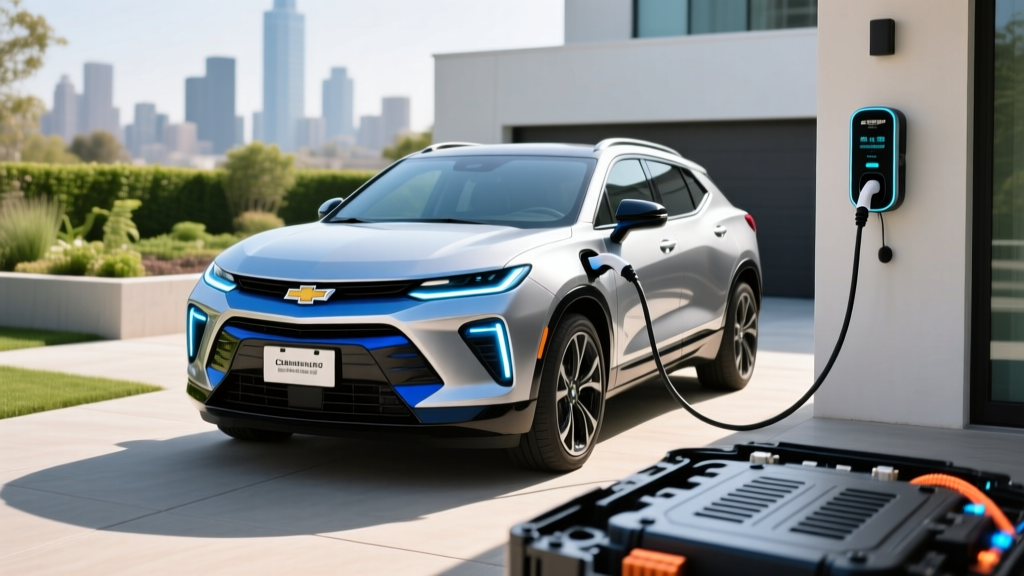
For home charging, the onboard charger accepts up to 11.5 kW on a 240V/48A Level 2 circuit. That means a depleted-to-full overnight session takes roughly 10 hours — fine for daily driving where you're replenishing 80–150 miles of use. You'll need a 60A dedicated circuit installed by a licensed electrician; expect $500–$2,000 for installation depending on panel proximity and local permitting, with more if your home needs a panel upgrade to 200A service.
GM now provides access to Tesla's Supercharger network via a GM-approved NACS adapter, expanding the practical fast-charging map considerably. Per Chevrolet's charging page, the Blazer EV is compatible with Electrify America, EVgo, and ChargePoint networks on CCS natively.
Performance: 557 Horsepower, Dual-Motor AWD
The SS badge isn't just cosmetic. The dual-motor all-wheel-drive powertrain delivers 557 horsepower and 648 lb-ft of torque, launching the Blazer EV SS from 0-60 mph in approximately 3.8 seconds with launch control engaged (Chevrolet calls this "Wide Open Watts" mode). That puts it in the same ballpark as the Mustang Mach-E GT (~3.5 sec) and comfortably ahead of most V6-powered ICE midsize crossovers.
The AWD system is fully electric — no mechanical linkage between axles. Torque distribution is managed electronically, and the SS includes a rear-biased calibration for more dynamic cornering feel. In practice, the instant torque delivery makes the SS feel quicker than its 0-60 time suggests in everyday rolling acceleration, such as highway merging.
Braking is handled by regenerative deceleration (with adjustable regen levels and a one-pedal driving mode) supplemented by mechanical disc brakes. The SS carries substantial mass — curb weight exceeds 5,600 lbs — which you'll notice in tight cornering and braking distances compared to lighter competitors like the Model Y Performance.
Interior, Cargo, and Technology
The Blazer EV SS cabin centers on a 17.7-inch diagonal infotainment touchscreen running GM's latest Ultifi-based software, paired with an 11-inch digital instrument cluster. The 2026 model year reflects significant software maturation since the widely reported 2024 launch issues — GM has issued multiple OTA updates addressing lag, Bluetooth stability, and navigation accuracy.
Wireless Apple CarPlay and Android Auto are standard. A NHTSA vehicle listing confirms standard safety tech including automatic emergency braking, lane-keep assist, blind-spot monitoring, and rear cross-traffic alert.
Super Cruise — GM's hands-free Level 2 driver-assistance system — is available on the SS. Note: this is SAE Level 2 automation, meaning you must remain attentive with eyes on the road. It is not self-driving. Super Cruise operates on over 750,000 miles of mapped divided highways in the US and Canada and remains one of the smoother hands-free systems available.
Cargo and passenger dimensions:
- Cargo volume (behind rear seats): ~30.3 cu ft
- Cargo volume (rear seats folded): ~64.1 cu ft
- Front legroom: ~41.5 inches
- Rear legroom: ~38.4 inches
- No front trunk (frunk): The Ultium platform in the Blazer does not include a frunk, which is a notable omission for the class.
The absence of a frunk is a genuine drawback for a vehicle in this price range, especially when competitors like the Ford Mustang Mach-E and Rivian R1S offer front storage. Cargo capacity behind the second row is competitive but not class-leading.
Pricing, Trims, and Federal Tax Credit Eligibility
The 2026 Blazer EV SS starts at $64,495 MSRP (including destination). Fully optioned with premium paint, Super Cruise, and upgraded audio, as-tested prices can approach $70,000.
The SS is the top trim. Lower trims in the Blazer EV lineup include the 2LT (~$47,495) and RS (~$54,195), which offer different range and powertrain configurations (RWD and AWD options). The SS is exclusively AWD with the full-output dual-motor setup.
| Item | Amount |
|---|---|
| Base MSRP (SS AWD) | $64,495 |
| As-Tested (w/ Super Cruise, premium paint) | ~$68,000–$70,000 |
| IRS §30D MSRP Cap (SUVs/trucks) | $80,000 |
| MSRP Cap Status | ✅ Under cap |
| Max Federal Credit (if eligible) | Up to $7,500 |
| Point-of-Sale Transfer | Available (dealer-registered) |
Does the Blazer EV SS qualify for the federal EV tax credit? The answer depends on your specific situation. Under current IRS §30D rules, eligibility hinges on three main criteria:
- MSRP cap: The SS at $64,495 falls under the $80,000 SUV cap. ✅
- Buyer income cap: Modified AGI must not exceed $300,000 (joint filers), $225,000 (head of household), or $150,000 (single). Exceed these thresholds and you're ineligible.
- Battery sourcing & critical minerals: The vehicle must meet progressively tightening requirements for North American battery component manufacturing and critical mineral sourcing. GM has worked to localize Ultium cell production (via Ultium Cells LLC plants in Ohio and Tennessee), but the exact credit amount ($3,750 vs $7,500) depends on whether both the battery component and critical mineral requirements are met for the specific VIN. This can change throughout the model year.
The credit can now be transferred to the dealer at the point of sale, reducing your purchase price upfront rather than waiting for a tax-time credit. Confirm eligibility with your dealer and a tax professional before signing — sourcing rules have shifted multiple times since 2023, and the IRS periodically updates qualifying vehicle lists.
Pros, Cons, and Who Should Buy
Pros
- 557 hp / 3.8-sec 0-60 makes it one of the quickest crossovers under $70K
- 102 kWh battery provides solid range buffer for road trips
- Super Cruise hands-free driving on 750K+ miles of highway
- 190 kW DC fast charging with Tesla Supercharger adapter access
- Spacious rear seat with nearly 38.5" of legroom
- Mature software platform after two years of OTA fixes
Cons
- 87 MPGe is inefficient vs Tesla/Hyundai competitors
- No frunk — unusual for an EV at this price point
- Heavy curb weight (~5,600 lbs) shows in cornering dynamics
- Real-world highway range closer to 240 mi than the 285 EPA sticker
- SS trim only starts at $64,495 — steep entry for the badge
- DC charge taper above 60% SoC extends longer road-trip stops
Who the Blazer EV SS is best for: Performance-oriented buyers who want a practical two-row crossover with serious straight-line speed, hands-free highway driving capability, and the flexibility of Tesla Supercharger access. It suits daily commuters with home Level 2 charging who take occasional road trips and value American-made EV credentials.
Who should look elsewhere: Efficiency-first buyers (the Model Y Performance delivers similar speed at ~30 kWh/100mi), those who need maximum cargo versatility (consider the Ioniq 5 or a three-row EV), and budget-conscious shoppers who don't need 557 hp and could save $15K+ on a Blazer EV 2LT or RS.
Competitor Comparison
At $64,495, the Blazer EV SS competes directly with:
- Tesla Model Y Performance (~$52,490): Quicker to 60 (~3.5 sec), far more efficient (~30 kWh/100mi), 303-mi EPA range, but smaller interior and no Apple CarPlay.
- Ford Mustang Mach-E GT (~$59,995): 480 hp, 280-mi EPA range, slightly lighter, strong handling, but lower peak DC charge rate.
- Hyundai Ioniq 5 N (~$67,500): 641 hp (with N Grin Boost), 221-mi EPA range, 800V architecture for faster peak charging (~233 kW), track-focused, but significantly less range.
The Blazer EV SS carves a middle path: more range than the Ioniq 5 N, more power than the Mach-E GT, and a more conventional (and for some, more comfortable) interior than the Model Y. It won't win any single spec-sheet category outright, but the combination is compelling if the styling and GM ecosystem resonate with you.
Battery Warranty and Long-Term Ownership
Chevrolet backs the Blazer EV SS battery and powertrain with an 8-year / 100,000-mile limited warranty, which is industry-standard and matches the federal mandate for emission-related components. The warranty covers battery capacity loss below a defined threshold (typically 60–70% of original capacity, though check your specific warranty booklet for the exact retention guarantee).
NMC batteries in GM's Ultium platform have shown reasonable degradation profiles in early data — expect approximately 8–12% capacity loss over the first 100,000 miles under normal use patterns. Avoid habitual DC fast charging to 100% and prolonged storage at very high or very low SoC to maximize longevity. GM's battery thermal management system actively conditions the pack, which helps mitigate calendar degradation.
For reference on long-term EV battery health, fueleconomy.gov's EV technology overview provides useful context on battery degradation expectations across chemistries.
Frequently Asked Questions
What is the real-world range of the Blazer EV SS?
The EPA rates it at 285 miles, but real-world highway driving at 70+ mph typically yields 240–260 miles. In cold weather (below 30°F), expect 200–220 miles. Driving style has a significant impact given the 557-hp powertrain's potential energy consumption.
How fast does the Blazer EV SS charge at home and on the road?
On DC fast charging, it peaks at 190 kW with a 10-80% time of roughly 30 minutes. At home on a 240V Level 2 charger (48A), it charges at 11.5 kW, adding about 31 miles of range per hour — a full charge takes approximately 10 hours.
Does the Blazer EV SS qualify for the $7,500 federal tax credit?
It meets the MSRP cap ($64,495 is under the $80,000 SUV limit), but full eligibility depends on your income (joint filers must earn under $300K MAGI) and whether the specific VIN meets current IRS battery-sourcing and critical-mineral requirements. Check the IRS qualifying vehicle list and confirm with your dealer before purchase. The credit can be transferred at point of sale.
Is the Blazer EV SS worth it over a Tesla Model Y Performance?
If you prioritize a traditional crossover interior layout, Apple CarPlay, Super Cruise hands-free driving, and GM's dealer network for service, the SS makes a strong case. If efficiency, range per dollar, and the lowest cost per mile are your priorities, the Model Y Performance remains hard to beat at ~$12K less and significantly better efficiency.
Does the Blazer EV SS have a frunk?
No. The Ultium platform as configured in the Blazer EV does not include a front trunk. All cargo capacity is in the rear cargo area (30.3 cu ft behind the second row, 64.1 cu ft with seats folded).
Can the Blazer EV SS use Tesla Superchargers?
Yes. GM provides a NACS adapter that enables Blazer EV owners to charge at Tesla Supercharger stations, significantly expanding the available DC fast-charging network. Confirm adapter availability and any associated cost with your dealer at purchase.