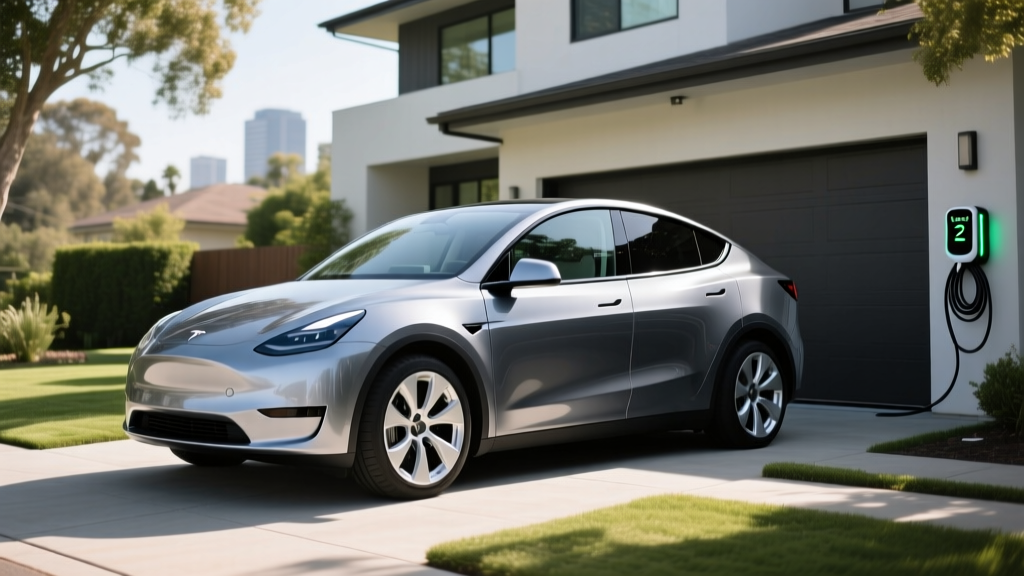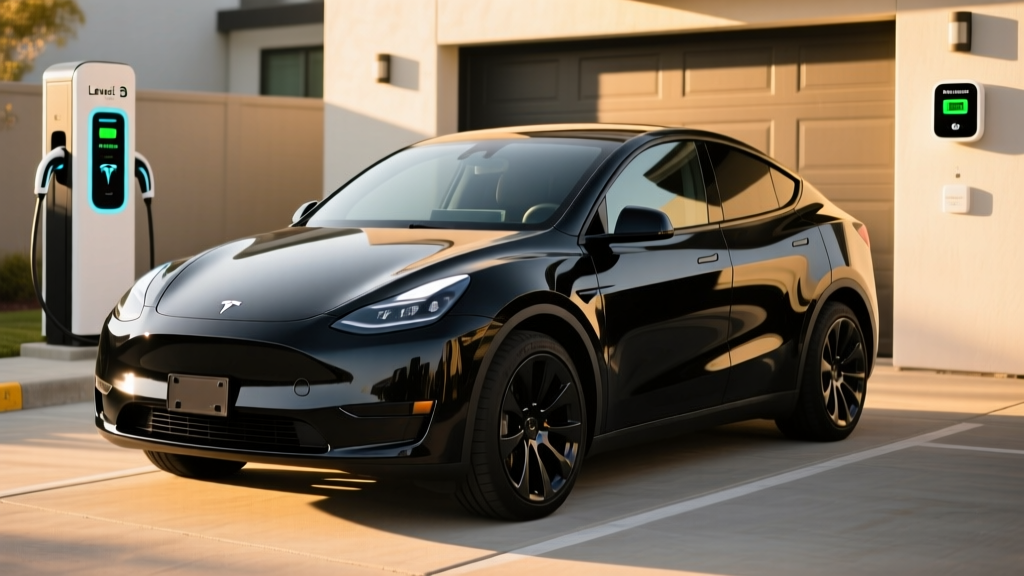
The Tesla Model Y remains the best-selling electric vehicle in the United States for good reason: it delivers crossover practicality, fast charging, and access to the most reliable DC fast-charging network available. But choosing the right configuration matters. The black Tesla Model Y — Tesla's Solid Black premium paint option — has become one of the most popular exterior choices for buyers who want a stealthy, professional look that hides road grime better than white or silver. This review covers the 2026 Model Y Long Range AWD and Performance trims with exact specs, real-world range expectations, charging performance, and current federal tax-credit eligibility so you can decide whether this EV fits your life.
2026 Tesla Model Y Specs at a Glance
| Specification | Long Range AWD | Performance |
|---|---|---|
| EPA Estimated Range | 320 miles | 293 miles |
| Battery Capacity (usable) | ~75 kWh (NMC) | ~75 kWh (NMC) |
| Drivetrain | Dual-Motor AWD | Dual-Motor AWD |
| Horsepower | ~384 hp | ~456 hp |
| 0-60 mph | 4.8 seconds | 3.5 seconds |
| Top Speed | 125 mph | 155 mph |
| Max DC Fast Charge | 250 kW | 250 kW |
| 10-80% DC Charge Time | ~22 minutes | ~22 minutes |
| Level 2 Home Charge Rate | 11.5 kW (~44 mi/hr) | 11.5 kW (~44 mi/hr) |
| MPGe (combined) | 117 MPGe | 106 MPGe |
| Efficiency | 28 kWh/100 mi | 31 kWh/100 mi |
| Cargo Volume (rear seats up) | 30.2 cu ft | 30.2 cu ft |
| Cargo Volume (rear seats folded) | 72.0 cu ft | 72.0 cu ft |
| Rear Legroom | 41.6 inches | 41.6 inches |
| Base MSRP | $44,990 | $49,990 |
| Battery Warranty | 8 years / 120,000 miles | 8 years / 120,000 miles |
Source: fueleconomy.gov and Tesla specifications. Figures reflect 2026 model year. MSRP excludes destination fee ($1,390).
Real-World Range: What the EPA Number Doesn't Tell You
Real-world expectations based on owner data and independent testing:
- City / mixed driving (65-75°F): 300-320 miles — the Model Y's regenerative braking recovers significant energy in stop-and-go traffic.
- Highway (70-75 mph, moderate temps): 260-285 miles — aerodynamic drag at sustained speed reduces efficiency roughly 12-18% below EPA.
- Cold weather (below 32°F, highway): 220-260 miles — battery resistance and cabin heating can cut range 20-30%. Preconditioning while plugged in recovers some of this loss.
- Hot weather (above 95°F, A/C running): 280-300 miles — thermal management is effective but cabin cooling still draws ~1-2 kW continuously.
The 75 kWh (usable) NMC battery pack in the Model Y Long Range provides a strong balance of energy density and charge speed. Tesla's battery thermal management system — which actively heats and cools the pack — is among the best in the industry, meaning range degradation in extreme temperatures is less severe than in many competitors. However, NMC chemistry is more sensitive to sustained 100% State of Charge (SoC) than LFP packs. Tesla recommends daily charging to 80-90% for routine use and reserving 100% for road trips.
For context, the EPA rates the Model Y Long Range AWD at 117 MPGe combined, which translates to roughly 28 kWh per 100 miles. At the U.S. average residential electricity rate of ~$0.16/kWh, that works out to approximately $0.045 per mile — roughly one-third the fuel cost of a comparable 25 MPG gas crossover at $3.50/gallon.
Charging Speed: DC Fast Charging and Home Setup
| Charging Level | Power | Speed (mi/hr added) | Notes |
|---|---|---|---|
| Level 1 (120V outlet) | ~1.4 kW | ~4-5 mi/hr | Emergency/trickle only; ~65+ hours for full charge |
| Level 2 (240V, 48A) | 11.5 kW | ~44 mi/hr | Full charge in ~7 hours; ideal home setup |
| Level 2 (240V, 32A) | 7.7 kW | ~30 mi/hr | Common with Mobile Connector + NEMA 14-50 |
| DC Fast (Tesla Supercharger V3) | 250 kW peak | ~1,000 mi/hr peak | 10-80% in ~22 min; tapers sharply above 80% |
| DC Fast (CCS adapter, non-Tesla) | ~150-200 kW | Varies | Depends on station; CCS adapter sold separately |
The Model Y's 250 kW peak DC fast-charge capability is impressive on paper, but real-world charging follows a curve, not a flat rate. Here's what you'll actually see at a V3 Supercharger (250 kW stall):
- 10-30% SoC: Sustains near 250 kW — this is where the peak rate delivers maximum benefit.
- 30-60% SoC: Gradually tapers from ~250 kW to ~150 kW.
- 60-80% SoC: Further taper to ~100-75 kW.
- 80-100% SoC: Drops below 50 kW — charging above 80% adds significant time. Tesla's navigation automatically routes through Superchargers and preconditions the battery for optimal charge speed on arrival.
The practical takeaway: plan road-trip stops around the 10-80% window. A 22-minute stop gets you from 10% to 80% (~256 miles of range in the Long Range AWD). Charging past 80% at a DC fast charger is rarely worth the wait unless you're at your final destination.
For home charging, a 48-amp Level 2 circuit (requiring a 60-amp breaker) delivers the full 11.5 kW the Model Y's onboard charger can accept. The Tesla Wall Connector costs approximately $475, and professional installation typically runs $500-$2,000 depending on panel proximity and local permitting. If your electrical panel is older or near capacity, a panel upgrade could add $1,500-$3,000. A licensed electrician should assess your setup before purchase.
Performance and Driving Dynamics
The Model Y Long Range AWD's dual-motor setup delivers 384 horsepower and a 4.8-second 0-60 mph time — genuinely quick for a family crossover. The Performance trim pushes that to 456 hp and 3.5 seconds, putting it in sports-car territory. Both trims feature Tesla's low center of gravity (battery pack mounted under the floor), which limits body roll and gives the Model Y planted handling unusual for its class.
Regenerative braking is aggressive and adjustable. In "Hold" mode, one-pedal driving is practical in most city and suburban conditions — lifting off the accelerator brings the car to a complete stop without touching the brake pedal. This reduces brake wear significantly; many Tesla owners report original brake pads lasting 80,000+ miles.
The 2026 Model Y uses Tesla's current-generation adaptive suspension tuning, which has improved ride compliance over earlier models. Road noise remains a common owner complaint at highway speeds, though recent acoustic glass updates have helped. The steering is precise but offers minimal feedback — a characteristic some drivers love and others find disconnected.
Pricing, Trims, and the Black Paint Premium
| Configuration | MSRP | Est. Federal Credit | Effective Price |
|---|---|---|---|
| Long Range AWD (Solid Black) | $46,490 | Up to $7,500* | ~$38,990* |
| Performance (Solid Black) | $51,490 | Up to $7,500* | ~$43,990* |
| Long Range AWD (Pearl White — no upcharge) | $44,990 | Up to $7,500* | ~$37,490* |
*Solid Black paint adds $1,500 to base MSRP. Pearl White Multi-Coat is the no-cost standard color. Destination fee ($1,390) not included. Federal tax credit subject to eligibility — see details below.
Solid Black is Tesla's premium non-metallic paint option. Unlike Pearl White (standard), Deep Blue Metallic, or Ultra Red, Solid Black has no metallic flake — it's a pure, deep black that photographs well and hides dirt effectively. The trade-off: black paint shows swirl marks and fine scratches more readily than lighter colors, so owners who care about paint perfection should budget for paint-protection film (PPF) or ceramic coating ($1,500-$3,000 installed).
Federal Tax Credit Eligibility (§30D Rules for 2026)
It can — but eligibility depends on several IRS requirements under §30D. Here's the 2026 checklist:
- MSRP Cap: The Model Y qualifies as an SUV under IRS rules (based on the window sticker vehicle classification), so the MSRP cap is $80,000. All current trims fall well under this limit.
- Buyer Income Cap: Modified Adjusted Gross Income (MAGI) must not exceed $150,000 (single), $225,000 (head of household), or $300,000 (married filing jointly).
- Battery Sourcing: The vehicle must meet critical-minerals and battery-component sourcing requirements that phase in annually. Tesla's Fremont and Austin-built Model Y batteries have progressively increased North American sourcing. Verify current-year compliance on fueleconomy.gov before purchasing.
- Point-of-Sale Transfer: As of 2024, the credit can be transferred to the dealer at point of sale, reducing your purchase price directly — you don't need to wait until tax filing. The dealer must be IRS-registered.
- Final Assembly: Must occur in North America. All U.S.-market Model Y vehicles are assembled in Fremont, CA, or Austin, TX — both qualify.
Important: Battery-sourcing requirements tighten each year. Always confirm the specific VIN's eligibility on IRS.gov or fueleconomy.gov before finalizing your purchase. Rules are subject to change. Consult a tax professional for your specific situation.
Interior, Cargo, and Technology
The Model Y's minimalist interior centers on a 15.4-inch touchscreen that handles nearly every vehicle function — climate, navigation, media, vehicle settings, and even the glovebox release. There is no traditional instrument cluster; speed and navigation info display on the left portion of the main screen. The 2026 refresh adds ventilated front seats, ambient lighting, and a rear-seat entertainment screen as standard.
Cargo space is a genuine strength: 30.2 cubic feet behind the second row and 72.0 cubic feet with the 60/40 rear seats folded. The rear trunk opening is wide and low, making it practical for strollers, groceries, and luggage. A front trunk (frunk) adds additional storage for charging cables or a small bag. Rear legroom at 41.6 inches is generous for adults, though the rear seat cushion is slightly low, which can leave taller passengers with a knees-up seating position on longer drives.
Tech highlights:
- Tesla's native navigation with real-time Supercharger routing and battery preconditioning
- Over-the-air (OTA) software updates that add features post-purchase
- Sentry Mode (360° camera recording when parked)
- Dog Mode and Camp Mode for climate control while unattended
- Tesla app with remote climate, location, and charge monitoring
Notable drawbacks:
- No Apple CarPlay or Android Auto — Tesla's proprietary system is the only option
- Turn-signal stalks removed in 2025 refresh; signals now on steering-wheel buttons (divisive among owners)
- Rear visibility is limited by the sloping roofline; the backup camera is essential
- No physical buttons for climate or volume — everything is touchscreen-mediated
Driver Assistance: Autopilot and FSD (Supervised)
Tesla Autopilot and Full Self-Driving (Supervised) are Level 2 driver-assistance systems under the SAE J3016 framework. This means the vehicle can manage steering, acceleration, and braking under certain conditions, but the driver must remain fully attentive, keep hands on the wheel, and be prepared to take over at any moment. This is not self-driving. Only Level 4 services like Waymo operate without a human driver.
Standard Autopilot includes Traffic-Aware Cruise Control and Autosteer (lane-centering on divided highways). The optional FSD (Supervised) package ($8,000 or $99/month subscription as of 2026) adds automatic lane changes, Navigate on Autopilot (highway on/off-ramp navigation), traffic-light and stop-sign recognition, and Autopark. FSD continues to improve through OTA updates but requires constant driver supervision. Tesla's camera-only vision system (no lidar or radar) performs well in clear conditions but can struggle in heavy rain, construction zones, and faded lane markings.
Warranty, Reliability, and Long-Term Ownership
Tesla's warranty coverage for the Model Y:
- Basic Vehicle: 4 years / 50,000 miles
- Battery & Drive Unit: 8 years / 120,000 miles (Long Range & Performance) — guarantees at least 70% battery capacity retention over the warranty period
The 70% capacity retention threshold is industry-standard but worth understanding: at 120,000 miles, a 320-mile Model Y with 70% State of Health (SoH) would still deliver ~224 miles of EPA-equivalent range. Real-world degradation data from Tesla fleet analytics suggests most Model Y packs retain 88-92% capacity at 100,000 miles under normal use (avoiding frequent 100% charges and DC fast-charging exclusively).
Insurance costs for the Model Y tend to run 15-25% higher than comparable gas crossovers due to repair costs and Tesla's aluminum-intensive structure. Average annual premiums range from $2,200-$3,200 depending on state, driving record, and coverage level. Always get an insurance quote before purchasing.
Who the Black Tesla Model Y Suits Best
- You commute 30-80 miles daily and can charge at home overnight
- You take regular road trips and want access to the Supercharger network (17,000+ stalls in North America)
- You need practical cargo space for a family of four with gear
- You value OTA updates and a tech-forward ownership experience
- Acceleration and handling are priorities (3.5-second 0-60 mph)
- You don't mind sacrificing 27 miles of EPA range for the speed upgrade
- You need Apple CarPlay/Android Auto integration
- You prefer physical buttons and a traditional instrument cluster
- You live in an area with limited home-charging options and sparse public infrastructure
- You tow frequently (the Model Y is rated for 3,500 lbs — adequate for a small trailer but not a boat or camper)
Pros and Cons
Pros
- 320-mile EPA range covers most daily driving and many road-trip segments without stopping
- Supercharger network remains the most reliable and widespread DC fast-charging option in the U.S.
- 250 kW peak DC charging with battery preconditioning minimizes road-trip downtime
- Class-leading cargo space (72 cu ft max) for an electric crossover
- Over-the-air updates continually add features and improve performance
- Strong resale value relative to most EV competitors
- Eligible for up to $7,500 federal tax credit (subject to sourcing and income rules)
Cons
- No Apple CarPlay or Android Auto — proprietary infotainment only
- Solid Black paint ($1,500 upcharge) shows swirl marks and requires more careful maintenance
- Turn signals on steering wheel buttons instead of a stalk — adjustment period required
- Rear-seat cushion height may be uncomfortable for taller adults on long trips
- Insurance premiums run 15-25% above comparable gas crossovers
- FSD (Supervised) remains a Level 2 system requiring full driver attention despite the "Full Self-Driving" name
- Panel gap and paint quality inconsistencies still reported by some owners
How It Compares: Model Y vs. Key Competitors
The Model Y competes in a growing segment. Here's how it stacks up against three key rivals in the electric crossover space:
- vs. Hyundai Ioniq 5 (Long Range AWD): The Ioniq 5 offers 800V architecture (faster peak charging at ~350 kW), a more comfortable ride, and CarPlay/Android Auto. But its 290-mile EPA range, smaller cargo area, and less mature charging-network access (though improving via NACS adapter) give the Model Y an edge for road-trip-heavy buyers.
- vs. Ford Mustang Mach-E (Extended Range AWD): The Mach-E offers a more traditional interior with physical controls and CarPlay. Its ~312-mile range is competitive, but DC charging tops out around 150 kW — significantly slower than the Model Y's 250 kW on long trips.
- vs. BMW iX xDrive50: The iX delivers a more premium interior and a 324-mile EPA range, but starts above $70,000 (exceeding the $80K MSRP cap for tax-credit purposes when options are added). It's a luxury alternative, not a direct price competitor.
The Model Y's combination of range, charging speed, cargo utility, and Supercharger access remains difficult to match as a total package — even as individual competitors surpass it in specific categories.
Frequently Asked Questions
What is the real-world range of the black Tesla Model Y?
The EPA estimates 320 miles for the Long Range AWD trim. In real-world conditions, expect approximately 300-320 miles in city/mixed driving at moderate temperatures, 260-285 miles at sustained highway speeds, and 220-260 miles in cold weather (below freezing) with cabin heating. The Performance trim's EPA estimate is 293 miles with correspondingly lower real-world figures.
How fast does the Tesla Model Y charge at home and on the road?
At a Tesla V3 Supercharger (250 kW peak), the Model Y charges from 10-80% in approximately 22 minutes. At home on a 48-amp Level 2 charger (11.5 kW), it adds roughly 44 miles of range per hour, or a full charge in about 7 hours. On a standard 120V outlet (Level 1), expect only 4-5 miles per hour — suitable only for emergencies or very low-mileage drivers.
How much does the black Tesla Model Y cost after tax credits?
The 2026 Model Y Long Range AWD in Solid Black starts at $46,490 (including the $1,500 black paint premium but excluding the $1,390 destination fee). If you qualify for the full $7,500 federal tax credit under §30D — and the specific VIN meets battery-sourcing requirements — the effective price drops to approximately $38,990. Eligibility depends on your income, the vehicle's MSRP classification, and current battery-component sourcing rules. Always verify on fueleconomy.gov.
Is the Tesla Model Y worth buying vs. competitors in 2026?
For buyers who prioritize Supercharger network access, strong range, fast DC charging, and cargo versatility, the Model Y remains the benchmark in its segment. If you prefer Apple CarPlay, physical controls, or a more traditional driving interface, the Hyundai Ioniq 5 or Ford Mach-E may suit you better. The Model Y's total package — especially for road-trip-capable daily driving — is still difficult to beat at its price point.
Does the Tesla Model Y qualify for the $7,500 federal EV tax credit?
The Model Y can qualify for up to $7,500 under IRS §30D, but eligibility is not automatic. You must meet income caps ($150K single / $300K married filing jointly), the vehicle must meet critical-minerals and battery-component sourcing requirements (which tighten annually), and final assembly must occur in North America (all U.S. Model Y vehicles qualify). The credit can be transferred at point of sale to reduce your purchase price directly. Verify your specific VIN's eligibility on IRS.gov before purchasing.
Does black paint affect the Model Y's range or efficiency?
No. Paint color has no measurable impact on range or efficiency. The $1,500 Solid Black premium is purely cosmetic. Some owners note that black exteriors absorb more solar heat when parked in direct sun, which can marginally increase A/C load in hot climates — but the effect on range is negligible (likely less than 1%).
What is the battery warranty on the Tesla Model Y?
Tesla covers the Model Y's battery and drive unit for 8 years or 120,000 miles (whichever comes first) on Long Range and Performance trims. The warranty guarantees at least 70% battery capacity retention over that period. If the battery degrades below 70% State of Health within the warranty window, Tesla will repair or replace it at no cost.